

Last Updated on 4 months ago by Grace Nyambura
How to Code Qualitative Data in MAXQDA [Step-by-Step Guide]
If you have collected interviews or focus group data and you are ready to start analysis, this tutorial walks you through exactly how to code qualitative data in MAXQDA — from importing your transcripts all the way to generating themes and exporting your code system.
I recorded a full video walkthrough of this process. The written guide below follows the same six steps and goes into additional detail.
- How to Code Qualitative Data in MAXQDA [Step-by-Step Guide]
- What Is MAXQDA? A Quick Overview for Researchers
- Step 1 — Set Up a New Project in MAXQDA
- Step 2 — Import Your Transcripts into MAXQDA
- Step 3 — Define Your Codes Before You Start
- Step 4 — Code Your Interview and Focus Group Transcripts in MAXQDA
- Step 5 — Generate Themes from Your Codes in MAXQDA
- Step 6 — Export Your Code System
- Frequently Asked Questions
- Key Takeaways
- Need Help With Your Qualitative Analysis?
What Is MAXQDA? A Quick Overview for Researchers
MAXQDA is one of the most widely used Computer-Assisted Qualitative Data Analysis Software (CAQDAS) tools available. It is designed to help researchers systematically organise, code, and analyse qualitative data from interviews, focus groups, surveys, and other text-based sources. For an overview of its full feature set, visit the MAXQDA official how-to resource centre.
In this tutorial, we are working with a focus group transcript involving pregnant women discussing sources of stress in urban low-income areas. The same process applies to individual interview transcripts.
Here is what we will cover in six steps:
- Set up a new project in MAXQDA
- Import your transcripts
- Define your codes
- Code your data
- Generate themes from your codes
- Export your code system
Step 1 — Set Up a New Project in MAXQDA
Open MAXQDA and create a new project. You can name it anything that reflects your study — for this tutorial, I named mine New Project 1.
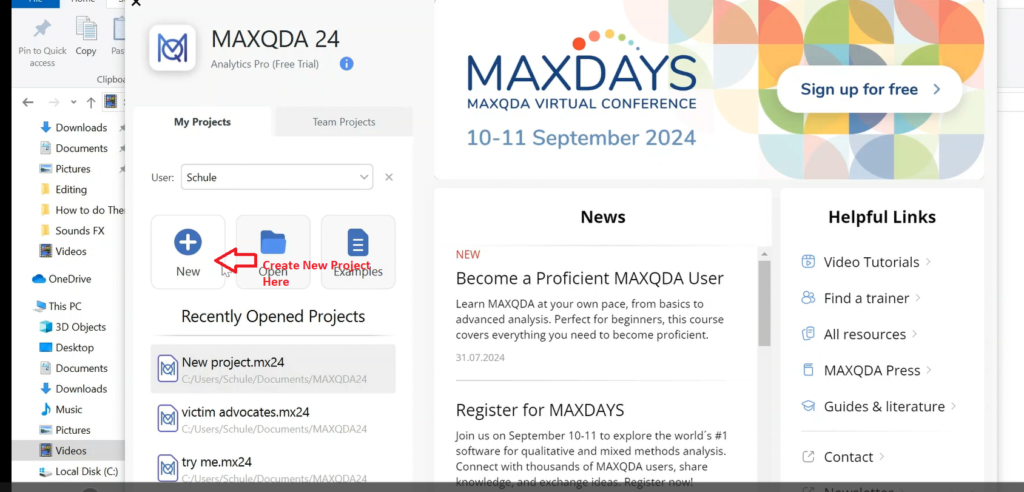
Creating a new project in MAXQDA for qualitative data analysis
Understanding the MAXQDA Interface
Once your project is open, you will see three key areas:
- The top menu bar, with tabs for Home, Import, Codes, Memos, Variables, Analysis, Mixed Methods, Visual Tools, Reports, MAXDictio, and Stats
- A second toolbar below it for importing and managing documents
- A left-hand panel showing your Document System and Code System
Getting familiar with this layout early saves a lot of time. The Document System is where your transcripts live; the Code System is where you build and manage your codes and themes.
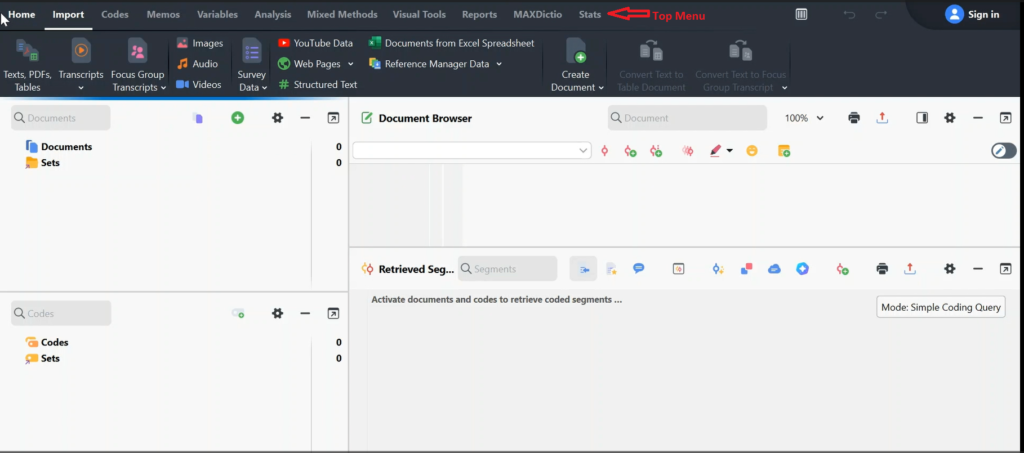
MAXQDA top menu with Home, Import, Codes, Analysis, and Visual Tools tabs
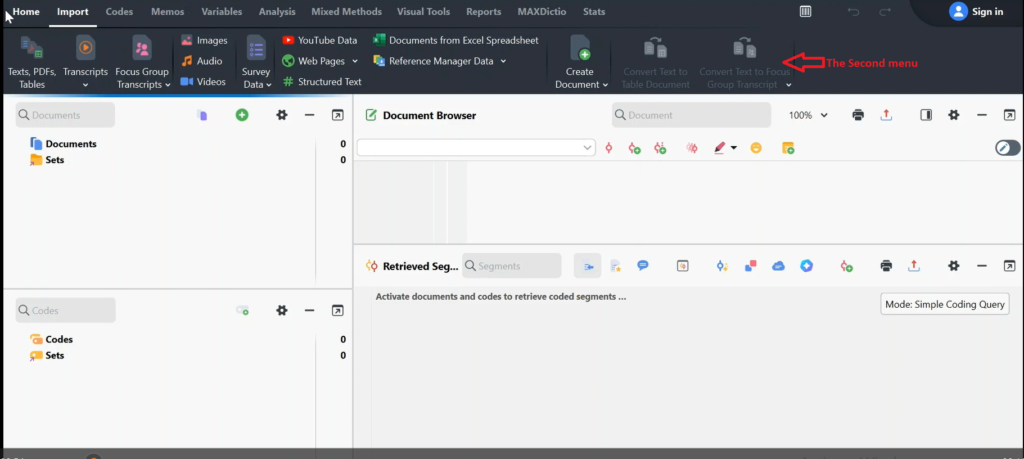
MAXQDA second toolbar showing transcript and document import options
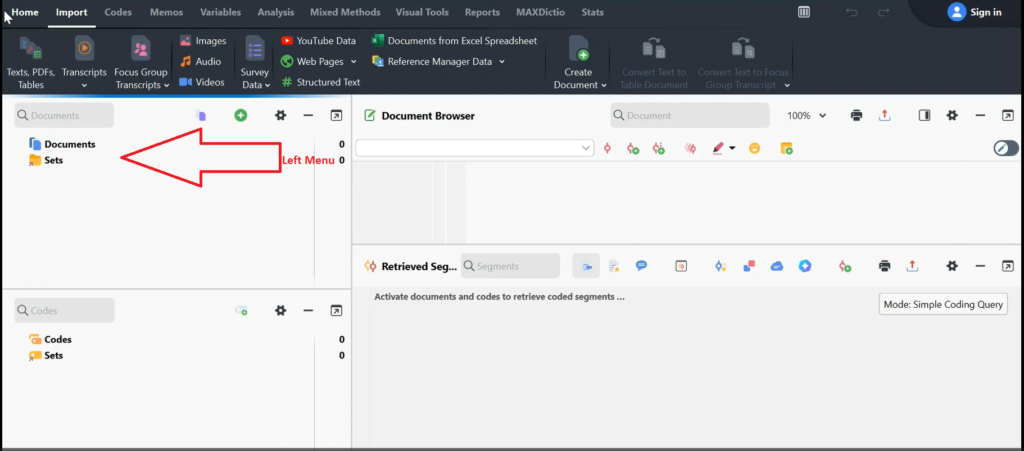
MAXQDA left panel with Document System and Code System sections
Step 2 — Import Your Transcripts into MAXQDA

Importing Documents
To import a document, go to the Import tab or simply drag and drop your transcript file directly into the Document System panel on the left. MAXQDA accepts Word documents, PDFs, plain text files, and more. If you have not yet conducted your interviews, our guide on how to create a qualitative research interview guide covers how to prepare your questions and protocols before collecting data.
Once your transcript is imported it appears in the Document System and is ready for coding.
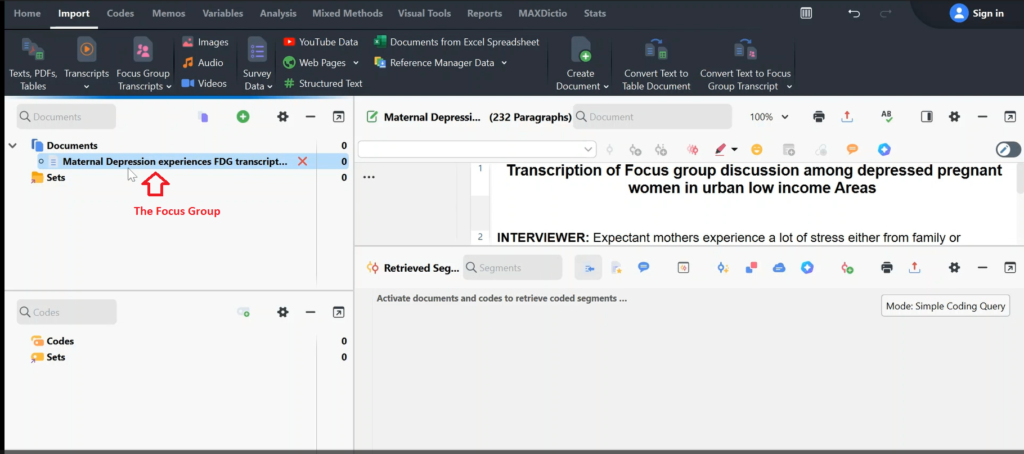
Focus group transcript loaded in MAXQDA ready for qualitative coding
Step 3 — Define Your Codes Before You Start
Before diving into coding, it is worth understanding what a code actually is.
| A code is a label or interpretive statement attached to a specific portion of your data that is relevant to your research question or objectives. |
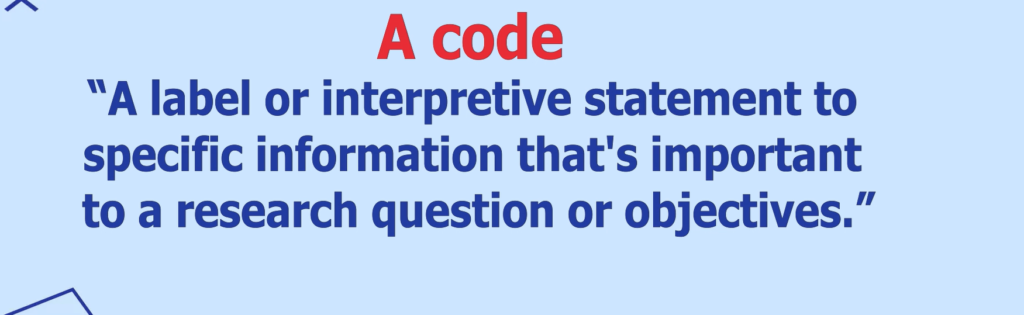
Definition of a qualitative code as a label attached to research-relevant data
Codes are not just keywords — they are meaning-making tools. If you are using an inductive approach, your codes emerge directly from what participants say. For a structured explanation of how qualitative coding works across different traditions, SAGE Research Methods provides an excellent overview.
Step 4 — Code Your Interview and Focus Group Transcripts in MAXQDA
This is the core of the process. You will read through your transcript, highlight meaningful segments, and assign codes to them.
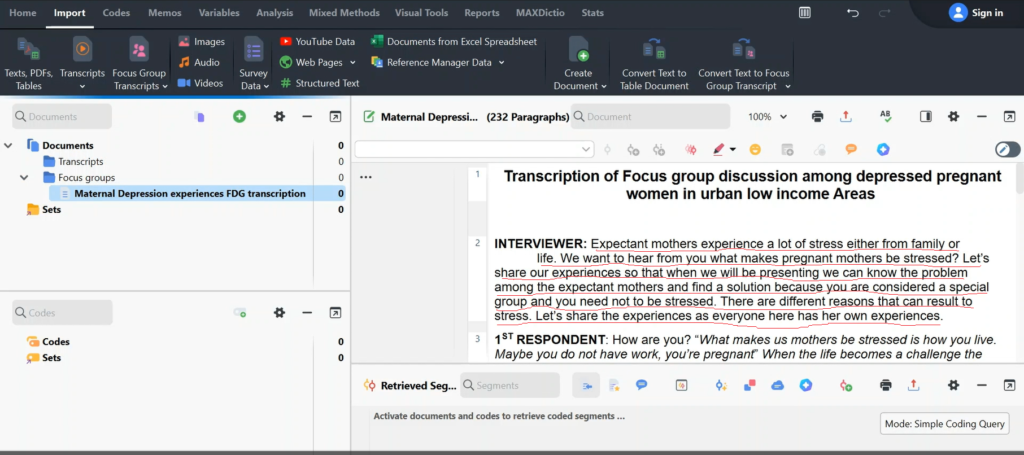
Creating a New Code in MAXQDA
- Read through the transcript and identify a segment relevant to your research question
- Highlight that segment with your cursor
- Right-click and select ‘Code with New Code’
- Give the code a name and assign it a colour
- Click OK
For example, the first respondent in our focus group says: “Maybe you don’t have work, you’re pregnant.” I highlighted that section, right-clicked, and created a new code called Unemployment in red.
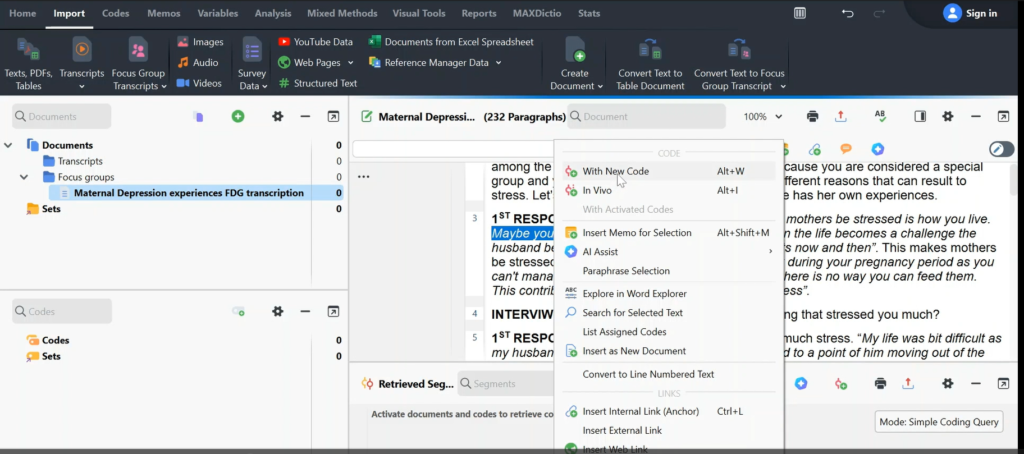
Creating the unemployment code in MAXQDA using right-click ‘Code with New Code’
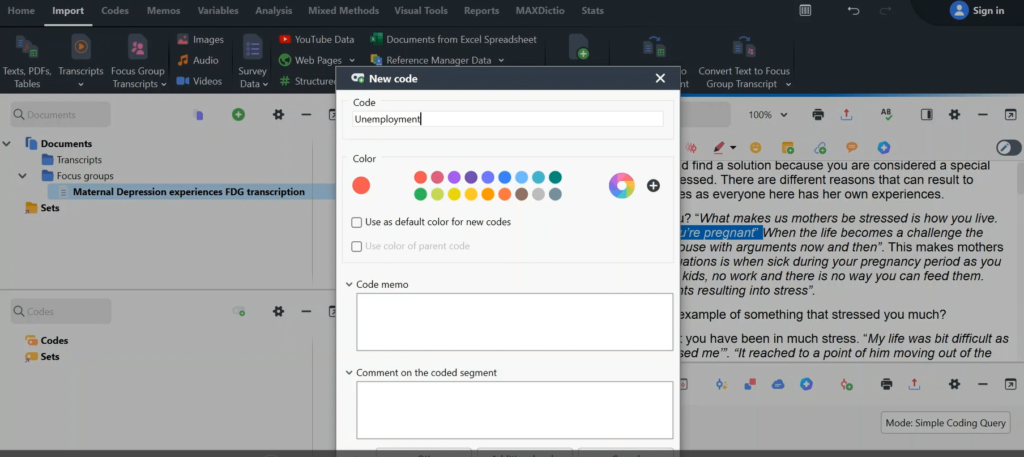
Unemployment code created in MAXQDA with red colour during qualitative coding
I continued through the transcript, creating new codes for each distinct idea:
- Spousal conflict — statements about arguments and relationship difficulties with partners
- Sickness during pregnancy — health-related stressors
- Inability to provide for family — financial strain linked to caregiving
- Lack of financial support from spouses — economic dependence stressors
- Job demands — work-related pressure during pregnancy
- Conflict with neighbours — interpersonal community stressors
- Illness — disease-related stress
- Lack of a stable source of income — income insecurity
- Disagreement with parents — family expectation conflicts
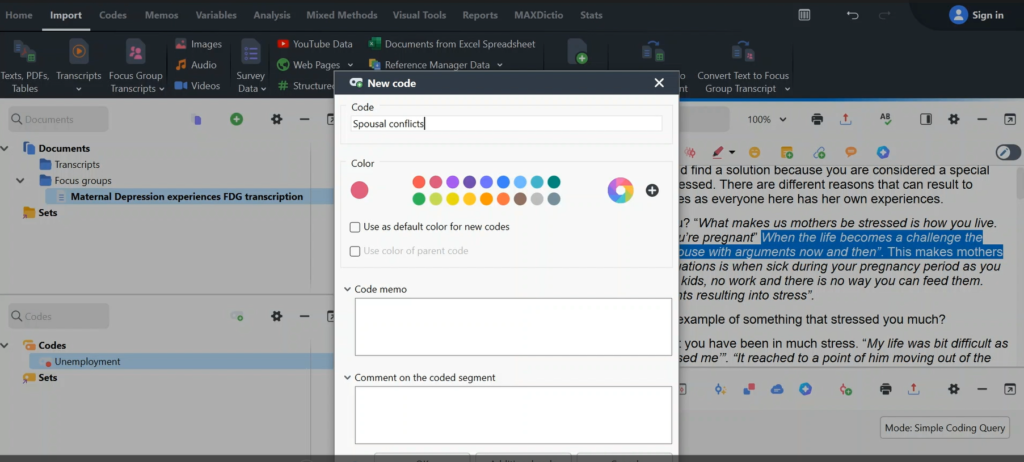
Spousal conflict code created in MAXQDA with maroon colour label
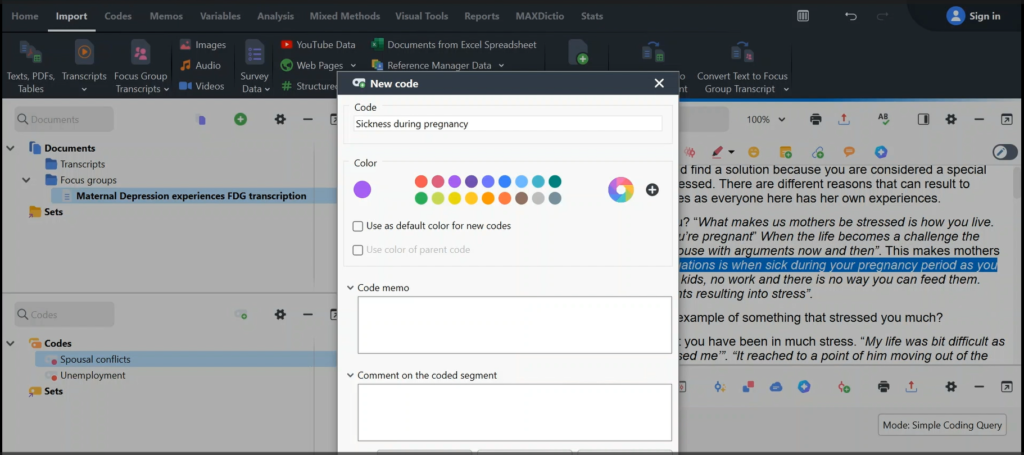
Sickness during pregnancy code created in MAXQDA during qualitative coding
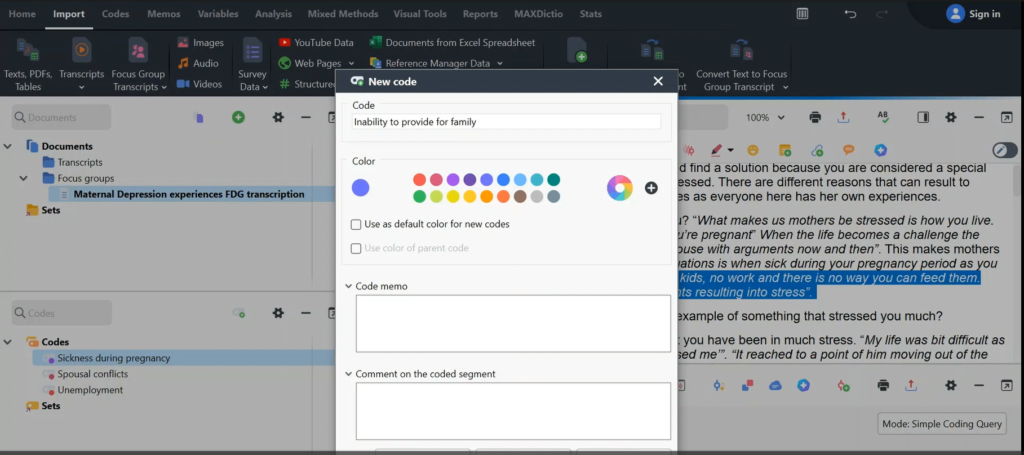
Inability to provide for family code created in MAXQDA
Assigning Statements to an Existing Code
You do not always need to create a new code. When a new segment fits an existing code, you can either right-click and select that code from the list, or drag and drop the highlighted text directly onto the code in the Code System panel.
For instance, when a participant said “my life was a bit difficult as my husband and his family strssed me,” I dragged that segment into the existing Sponsal conflicts code rather than creating a duplicate.
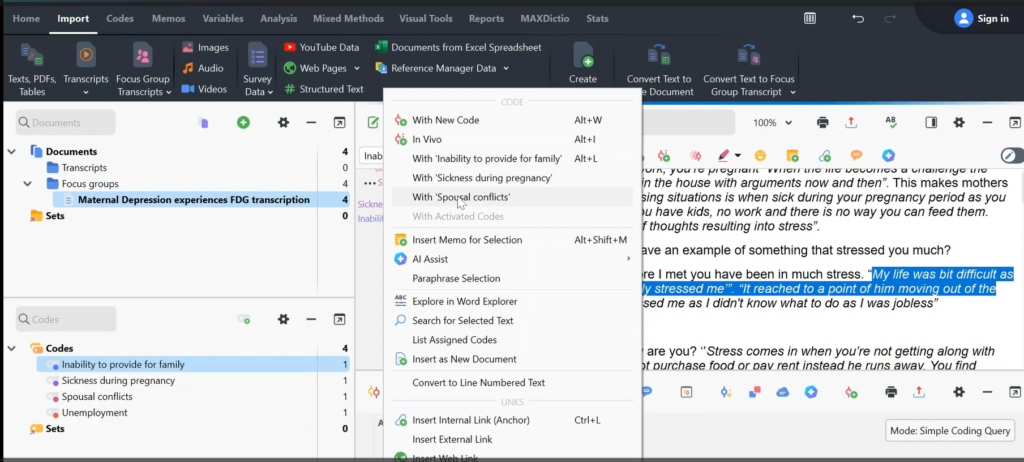
Keeping your code list clean is important — it prevents fragmentation and makes theme generation much easier in the next step.
For a comparison of how this coding process works in NVivo, see our guide on qualitative analysis of interviews with NVivo.
Step 5 — Generate Themes from Your Codes in MAXQDA
What Is a Theme in Qualitative Research?

Generating Themes
| A theme is a category of codes that share a common pattern of meaning. Multiple codes with related meanings are grouped together to form a theme. |
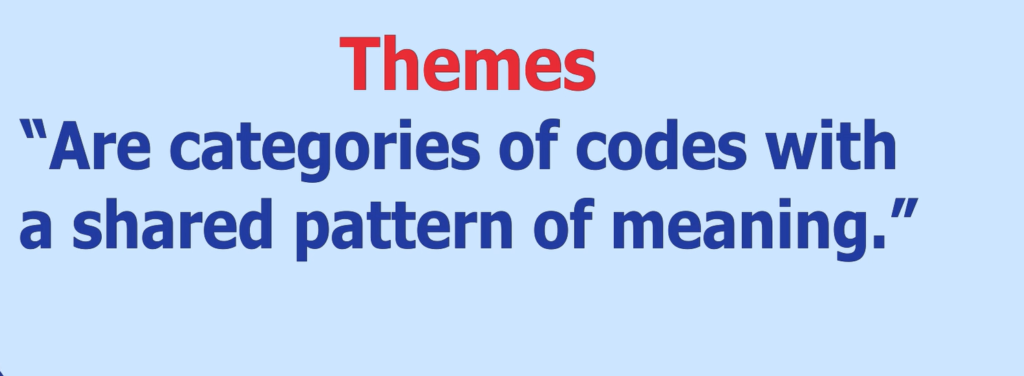
Themes defined as categories of codes with a shared pattern of meaning in MAXQDA
This distinction matters: codes are granular labels, themes are broader interpretive categories. If you want to go deeper on how themes are defined in qualitative methodology, Scribbr’s guide to thematic analysis breaks down the key concepts clearly.
How to Group Codes into Themes in MAXQDA
Once you have coded your full transcript, look across your Code System for patterns. Ask: which codes are pointing to the same underlying idea?
In our example, I identified three themes:
1. Financial Issues — grouping Unemployment, Lack of stable source of income, and Lack of financial support from spouses. I created this theme in the Code System, added a memo describing it as ‘all financial factors causing stress among pregnant women,’ then dragged each of those codes underneath it.
2. Conflict — grouping Spousal conflict and Conflict with neighbours. Description: ‘any kind of interpersonal conflict experienced by pregnant women.’
3. Illness — grouping Sickness during pregnancy and Illness. Description: ‘any form of illness affecting pregnant women.’
Each theme should have a written description — this is not optional. The description is what allows you to apply the theme consistently across all your transcripts.
Once your themes are set, continue coding the remaining transcripts using the same structure. For the next steps in writing up your findings, see our detailed guide on how to write a thematic analysis findings report using MAXQDA.
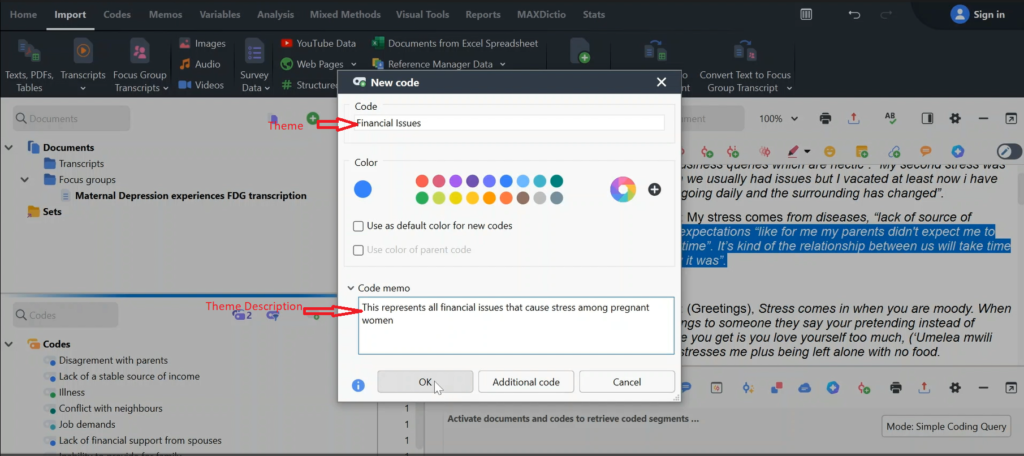
Financial issues theme with description memo in the MAXQDA code system
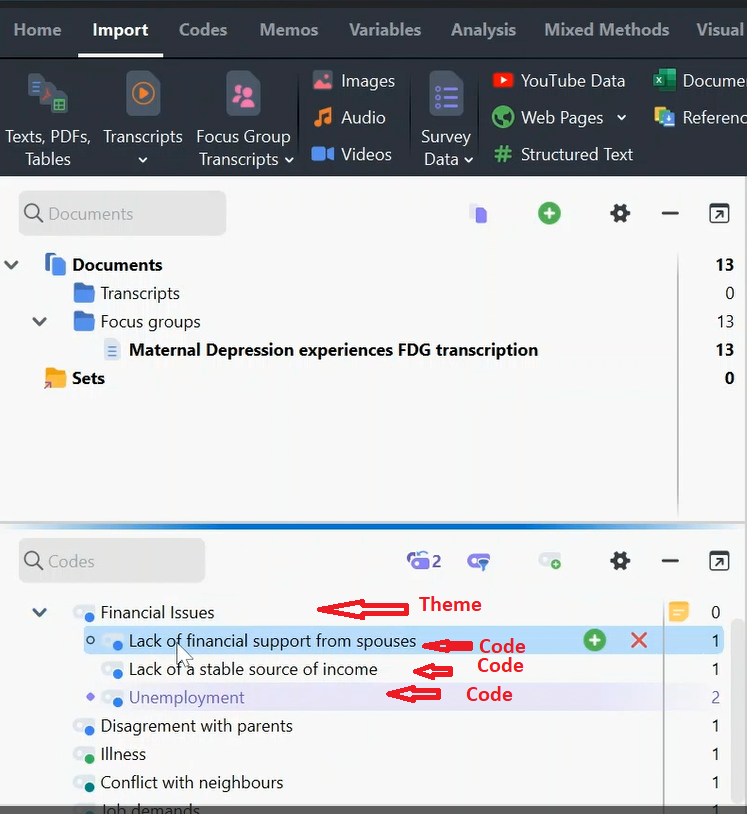
Financial issues theme in MAXQDA with unemployment and income-related codes nested underneath
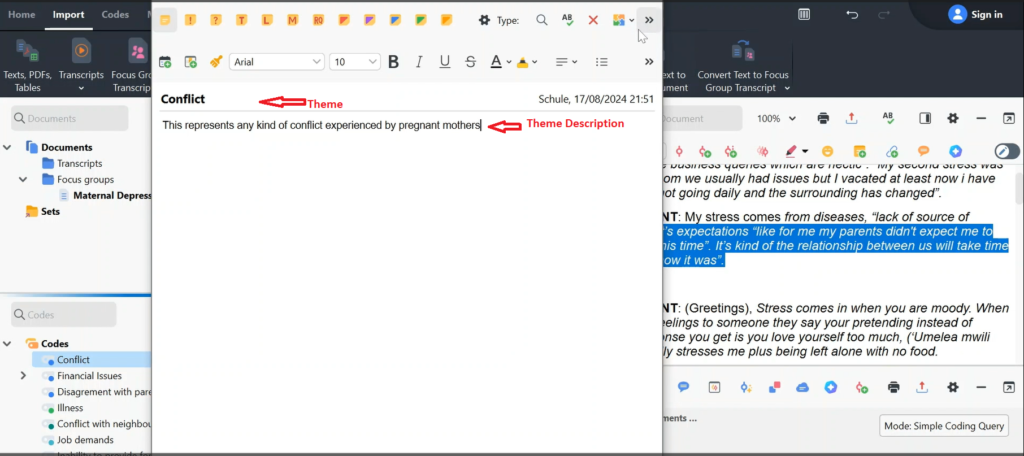
Conflict theme with description memo created in MAXQDA
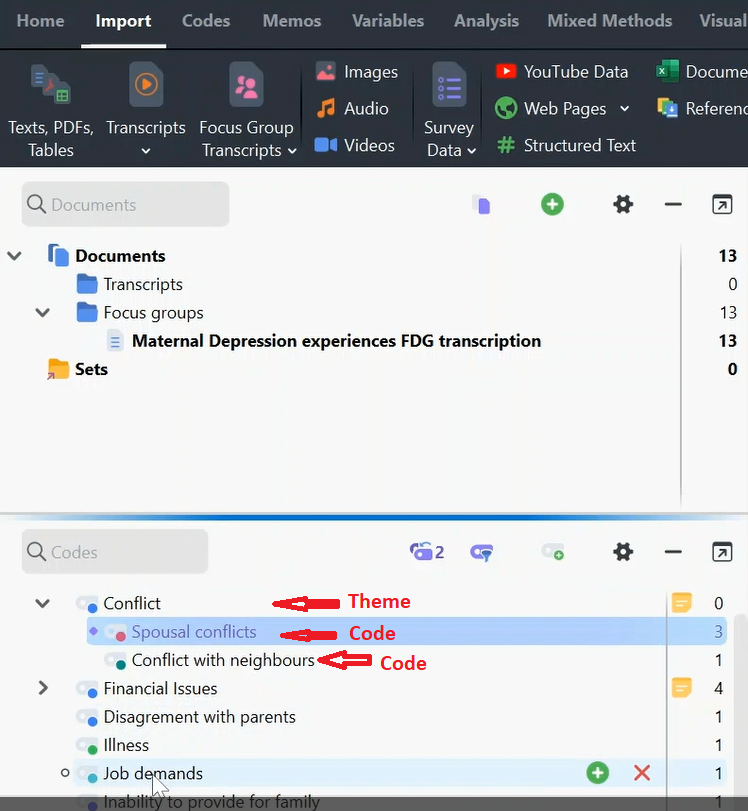
Conflict theme in MAXQDA with spousal conflict and conflict with neighbours codes
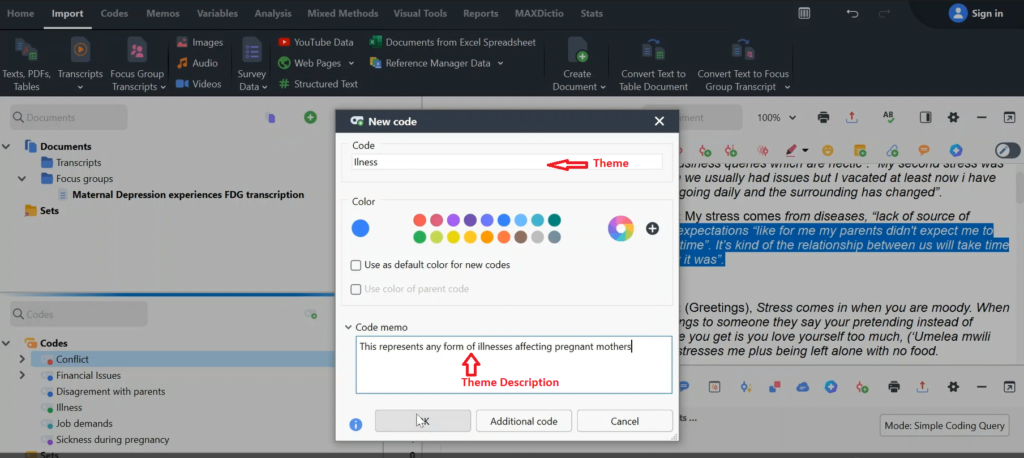
Illness theme with description memo created in MAXQDA code system
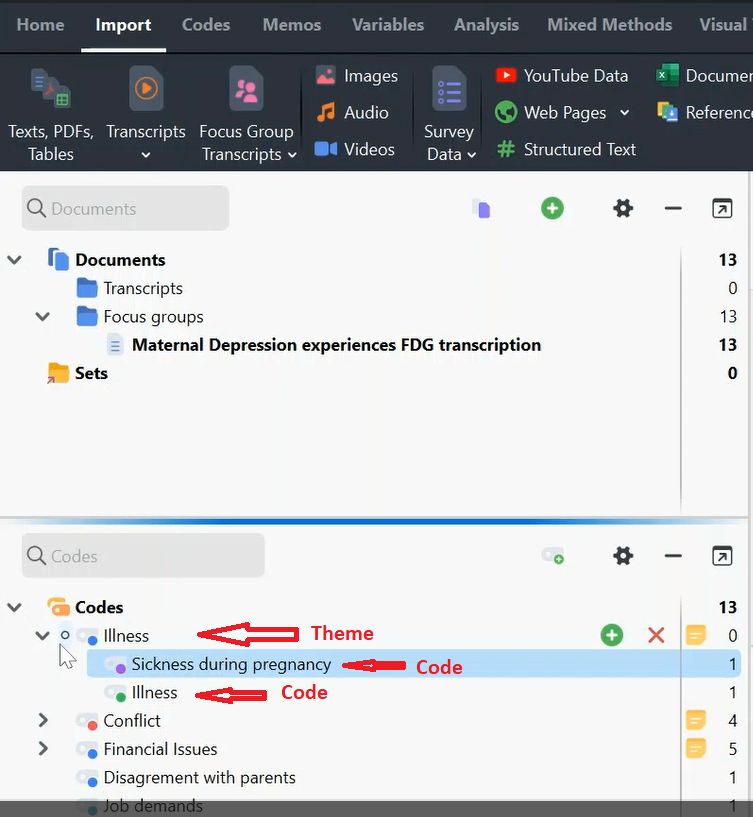
Illness theme in MAXQDA with sickness during pregnancy and illness codes nested underneath
Step 6 — Export Your Code System
Once your analysis is complete, MAXQDA lets you export a full summary of your code system. Go to Reports → Export → Code System. You can export it as a Word document, giving you a clean record of all your codes, themes, and descriptions — useful for your methodology chapter or for sharing with supervisors.
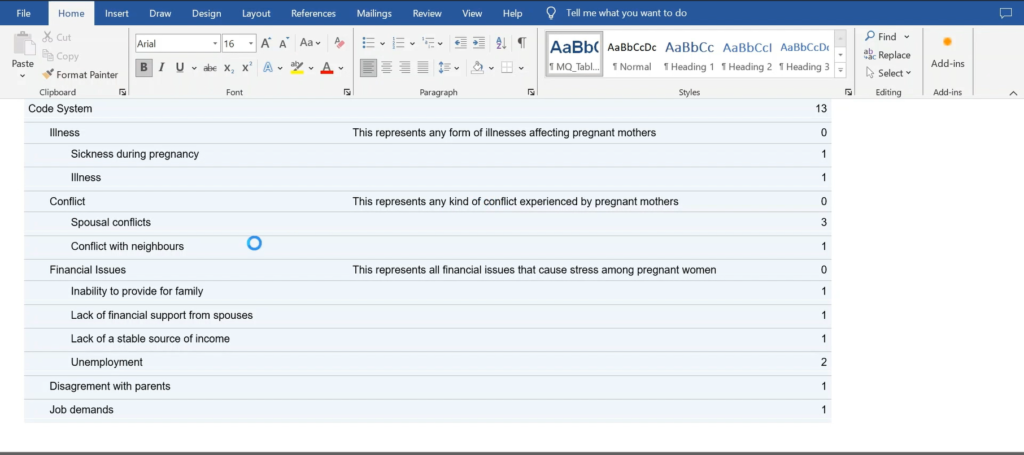
Complete MAXQDA code system exported after qualitative data analysis — all themes and codes
Frequently Asked Questions
Can MAXQDA analyse focus group data as well as individual interviews?
Yes. MAXQDA handles both formats. You import the transcript the same way regardless of whether it is a one-on-one interview or a group discussion.
What is the difference between a code and a theme in MAXQDA?
A code is a label attached to a specific segment of data. A theme is a higher-level grouping of codes that share a common pattern of meaning. In MAXQDA, themes are created as parent nodes in the Code System, with codes nested underneath them.
Do I need to code every transcript individually?
Yes — you apply your codes to each transcript manually. However, once your Code System is set up after the first transcript, subsequent transcripts go faster because you are assigning to existing codes rather than creating new ones.
What file formats can I import into MAXQDA?
MAXQDA accepts Word documents (.docx), PDFs, plain text files (.txt), Excel files, and audio/video files with transcripts.
Is MAXQDA suitable for inductive or deductive analysis?
Both. This tutorial uses an inductive approach — codes emerge from the data. If you are using a deductive approach with predetermined codes, see our guide on reflexive thematic analysis using MAXQDA.
Key Takeaways
- MAXQDA is a CAQDAS tool for systematically coding and analysing qualitative data from interviews and focus groups
- The six core steps are: set up project → import documents → define codes → code transcripts → generate themes → export code system
- Codes are granular labels; themes are broader categories that group codes with shared meaning
- Always write a description for each theme — this keeps your analysis consistent and justifiable
- You can drag and drop segments onto existing codes — keep your code list clean to avoid fragmentation
Need Help With Your Qualitative Analysis?
If you are working through your own data and need hands-on support, I offer two ways to work together. If you want the analysis done for you, visit the done-for-you qualitative analysis service. If you prefer to learn and work through it with guidance, book a one-on-one consulting session and we will go through your data together.
![Is AI Ethical for Qualitative Data Analysis? [Tested]](https://survivingresearch.com/wp-content/uploads/2025/04/Can-I-use-AI-to-do-qualitative-coding-ethically.jpg)
![Qualitative Analysis with MAXQDA [Complete Tutorial]](https://survivingresearch.com/wp-content/uploads/2025/04/Ultimate-Guide-To-Do-Qualitative-Analysis-Of-Interviews-With-Maxqda-In-2025-3.jpg)
Pingback: Qualitative Coding in Microsoft Word: Step-by-Step Guide -
Pingback: 9 Best Qualitative Data Analysis Software Tools [Compared] -
Pingback: MAXQDA Visualizations: 8 You Need for Your Research Report -