

Last Updated on 4 months ago by Grace Nyambura
Using AI to code qualitative interviews raises four serious ethical concerns: loss of human interpretation, algorithmic bias, lack of transparency, and participant data privacy. In this test, I coded the same interview manually and with MAXQDA AI, then compared results — AI produced good-sounding themes but couldn’t reliably show where those themes came from, and an AI detector flagged the output as machine-generated. My verdict: I don’t use AI for qualitative coding, and I explain exactly why below.
AI is changing research fast, but the real question for PhD students and academic researchers isn’t whether AI can do qualitative coding — it’s whether it can do it ethically. I’m Bernard Mugo, a qualitative research specialist, and in the past three years I’ve helped more than 200 PhD students analyze qualitative data and finish their thesis or dissertation. In this article, I put MAXQDA AI head-to-head against manual coding on a real interview transcript, then walk through the ethical issues that come with letting AI code your data.
- What Is Qualitative Coding?
- What Is Thematic Analysis?
- How I Tested Manual Coding vs. AI Coding in MAXQDA
- Comparing Manual Codes vs. AI Codes
- Testing the AI-Generated Codes for AI Detection
- 4 Ethical Issues With Using AI for Qualitative Coding
- My Personal Verdict: Should You Use AI for Qualitative Coding?
- Frequently Asked Questions
- Key Takeaways
- Need Hands-On Help With Your Qualitative Analysis?
What Is Qualitative Coding?
A code is a label or interpretive statement attached to a piece of information that matters to your research questions or objectives.

Here’s what a coded paragraph actually looks like in practice:

Qualitative coding is the process of applying these labels across a transcript, and it’s the foundation of thematic analysis.
What Is Thematic Analysis?
Thematic analysis is a qualitative research method that identifies patterns of meaning within data. This process, first systematically defined by Braun and Clarke (2006), remains the standard framework most PhD students use today.

Before you get to themes, you have to generate codes first, then group those codes based on shared meaning.
How I Tested Manual Coding vs. AI Coding in MAXQDA
To compare the two approaches fairly, I used two transcripts from the same study — Experiences of Patients with Heart Failure — and coded the same section of one transcript twice: once by hand, once using MAXQDA’s AI Assist feature.

Step 1: Manual Coding in MAXQDA
- Open MAXQDA and create a new project (I called mine “Manual Coding”).
- Import the transcript — either drag-and-drop or via the import menu.
- Read the full paragraph first to understand context, then go back and code.
- Highlight the relevant text and create a code.
Working through the transcript, I generated codes like “heart failure symptoms contributed to not being able to perform in the workplace,” which I color-coded purple since it described the impact of heart failure on the patient. When the patient mentioned taking medication, I coded that as “previously taken medication to try to manage heart failure symptoms.” When they described palpitations while climbing stairs, that became “experienced palpitations when walking or climbing stairs.”
Each code came from reading the participant’s actual words — for example, “I took medicines and since I was taking medicines, it was okay” directly supported the medication code.


Manual coding lets you read the statement, understand the context and nuance, and apply your own interpretation — and in qualitative analysis, researcher bias isn’t a disadvantage. It’s an advantage: your interpretive angle is what makes sense of the data.
Step 2: AI Coding in MAXQDA
For the second transcript, I created a new project and imported the same section, then selected the text, right-clicked, and chose AI Assist → Suggest new codes from selected text.


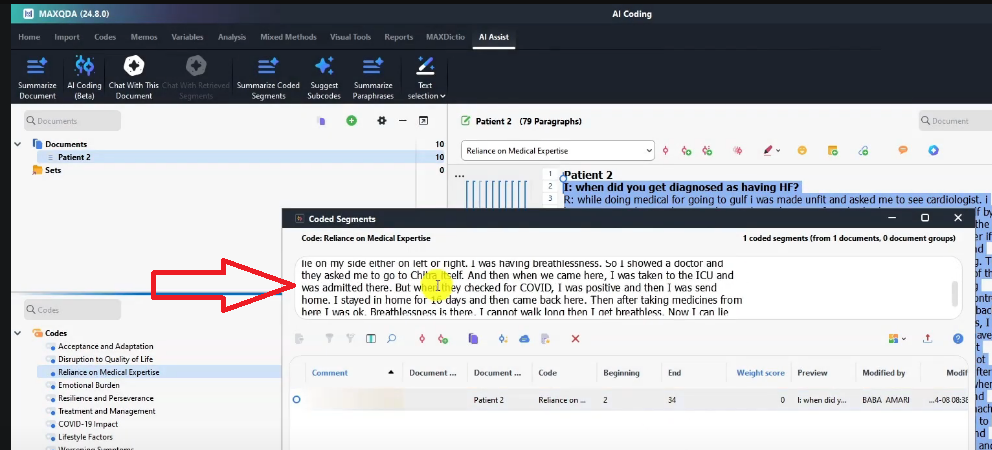
MAXQDA AI generated codes almost instantly — things like “diagnosis of heart failure,” “delayed diagnosis,” “occupational challenges,” and “adaptability,” along with more interpretive codes like “resilience,” “perseverance,” “emotional burden,” and “reliance on medical expertise.” Selecting all of them auto-populated the coding area.

The AI-generated memos were genuinely well-written. For one code — “disruption to quality of life” — the AI wrote: “the significant impact of the condition on individual daily activity, sleep, and overall wellbeing.” That’s a solid description. But it applied the code to a whole block of text rather than a specific sentence, meaning I still had to go back and find exactly which statement supported it.


Comparing Manual Codes vs. AI Codes
Placing the two code systems side by side, the difference in style was clear. My manual codes were longer, more interpretive, and tied to very specific statements — codes like “experiencing a lot of pain in the legs” and “experienced swelling in the legs and blisters as a result of heart failure.” The AI’s codes sounded more polished (“emotional burden,” “the psychological impact of living with a chronic and potentially life-threatening condition”) but were less precise about their source.


AI is genuinely useful for ideation — it’s good at suggesting themes you might not have considered. But for the actual coding work, it fell short: I could not confidently trace where the AI got a given theme from without manually re-reading the transcript anyway.
Testing the AI-Generated Codes for AI Detection
Out of curiosity, I exported both code systems — the manual one and the AI one — and ran the AI-generated version through GPT Zero, an AI content detector (Turnitin is the stricter standard most universities actually use, and I’d recommend testing there instead if you have access).

The result: the AI-generated code system was confidently flagged as AI-written. If you’re a PhD student, that matters — most universities run submitted work through Turnitin, GPT Zero, or similar tools, and content that reads as AI-generated puts your academic integrity at risk.


4 Ethical Issues With Using AI for Qualitative Coding
Beyond the detection risk, there are real ethical reasons to think twice before letting AI code your interviews.
1. The Loss of Human Interpretation

Even at its current, advanced stage, AI doesn’t understand context and meaning the way a human researcher does. Interviews are full of context and meaning — and AI’s inability to grasp that nuance can meaningfully affect the quality of your codes.
2. Bias in AI Algorithms

Most AI models are trained on data pulled from online sources, which can carry its own biases. When you use that AI to code your data, those same biases risk getting introduced into your research findings.
3. Transparency and Trust.

Research depends on being transparent about how you conducted it. Most researchers who use AI to analyze their data don’t disclose that fact — which breaks one of the most basic ethical principles in research: transparency.
4. Data Privacy Issues

Before you interview participants, you typically ask them to sign a consent form promising their information won’t be shared with third parties. If you then run that data through an AI tool like MAXQDA AI, there’s a real chance that data is being sent to an underlying AI model. That means participant information may be reaching a third party — directly breaking the confidentiality you promised, and violating your participants’ privacy.
My Personal Verdict: Should You Use AI for Qualitative Coding?
Given the ethical issues above, my answer is simple: I would never use AI for qualitative coding. Here’s why:
- Privacy and confidentiality — using AI risks exposing participants’ sensitive information to third-party models.
- AI doesn’t understand nuance and context — only a human researcher can genuinely interpret meaning.
- AI is supposed to make you faster, not slower — but in practice, verifying and correcting AI-suggested codes against the source text often takes longer than coding manually in the first place.
A tool is supposed to make research easier, and manual coding — where I bring my own background knowledge, context, and interpretation — consistently produces more accurate, defensible codes, faster. My recommendation: use MAXQDA to organize and track your project, but do the actual coding yourself.
If you’re weighing your options, it’s worth reading my related guides on coding transcripts in MAXQDA, turning codes into themes in MAXQDA, and writing up your thematic analysis findings in MAXQDA — together they walk through the full manual workflow this article recommends.
Frequently Asked Questions
Is it ethical to use AI for qualitative data analysis?
It’s ethically risky. The main concerns are loss of human interpretation, algorithmic bias, lack of research transparency, and participant data privacy — since tools like MAXQDA AI may send your interview data to third-party AI models, which can breach the confidentiality you promised participants.
Can AI detectors like Turnitin flag AI-assisted qualitative coding?
Yes. In this test, code systems generated with MAXQDA AI were confidently flagged as AI-written by GPT Zero, and Turnitin (the tool most universities use) is even stricter.
Is MAXQDA AI good for qualitative research?
It’s useful for ideation and generating theme ideas quickly, but it struggles to show precisely which text supports a given code — meaning you still need to manually verify its output, which can end up taking longer than manual coding from the start.
Should I disclose AI use in my dissertation methodology?
Yes. Transparency about your methods is a core research ethics principle. If you use AI anywhere in your analysis, disclosing it is both an ethical obligation and a way to protect your academic integrity.
Key Takeaways
- AI-generated codes can sound polished but often can’t show exactly which text they came from, so verification against manual coding remains necessary.
- AI-generated coding was confidently flagged by an AI detector (GPT Zero) — a real risk for PhD students whose universities use Turnitin.
- Four ethical concerns stand out: loss of human interpretation, algorithmic bias, lack of transparency, and participant data privacy.
- Manual coding lets you apply context, nuance, and interpretive judgment that AI still can’t reliably replicate.
Need Hands-On Help With Your Qualitative Analysis?
| Get Expert Help with Your Qualitative Analysis |
| If your findings chapter is holding up your PhD, you do not have to figure it out alone. My team at Surviving Research offers a done-for-you thematic analysis service — full MAXQDA analysis, themes, codebook, and write-up support, delivered to you. We have helped nearly 500 PhD students complete their dissertations and graduate. Book a consultation here. |
![How to Code Qualitative Data in MAXQDA [Step-by-Step Guide]](https://survivingresearch.com/wp-content/uploads/2024/08/Maxqda-Tutorial.webp)
![Qualitative Analysis with MAXQDA [Complete Tutorial]](https://survivingresearch.com/wp-content/uploads/2025/04/Ultimate-Guide-To-Do-Qualitative-Analysis-Of-Interviews-With-Maxqda-In-2025-3.jpg)