

Last Updated on 4 months ago by Bernard Mugo
What Is Research Philosophy in a Dissertation? A Guide
Research philosophy is the set of assumptions, conscious and unconscious, that a researcher makes about reality, knowledge, and values before and during a study. In a dissertation or thesis, these assumptions are captured in the methodology chapter so readers can interpret, understand, and judge your findings against the lens you used to produce them. This guide breaks down the four components of research philosophy, walks through the most common interpretive frameworks in qualitative research, and shows a full worked example.
- What Is Research Philosophy in a Dissertation? A Guide
- What Does Research Philosophy Mean?
- The Four Components of Research Philosophy
- Common Research Philosophies in Qualitative Research
- Comparing the Interpretive Frameworks
- Example: Writing About Research Philosophy in a Methodology Chapter
- Frequently Asked Questions
- Key Takeaways
- Get Help Writing Your Methodology Chapter
What Does Research Philosophy Mean?
When conducting a qualitative study, a researcher makes several decisions, many of them unconsciously. Those decisions and assumptions form the basis of their philosophy and approach to generating new knowledge. This matters because every study is, at its core, an attempt to generate new knowledge: it’s why we look for research gaps early on, gaps we then try to fill.
In the methodology chapter, you capture these conscious and unconscious assumptions as your research philosophy, explaining your ways of working so readers have a platform for interpreting, understanding, and judging your findings. The philosophical assumptions you bring to a study become the stance that determines its direction.
The Four Components of Research Philosophy
Research philosophy is made up of four components:
- Ontological assumptions
- Epistemological assumptions
- Axiological assumptions
- Methodological beliefs
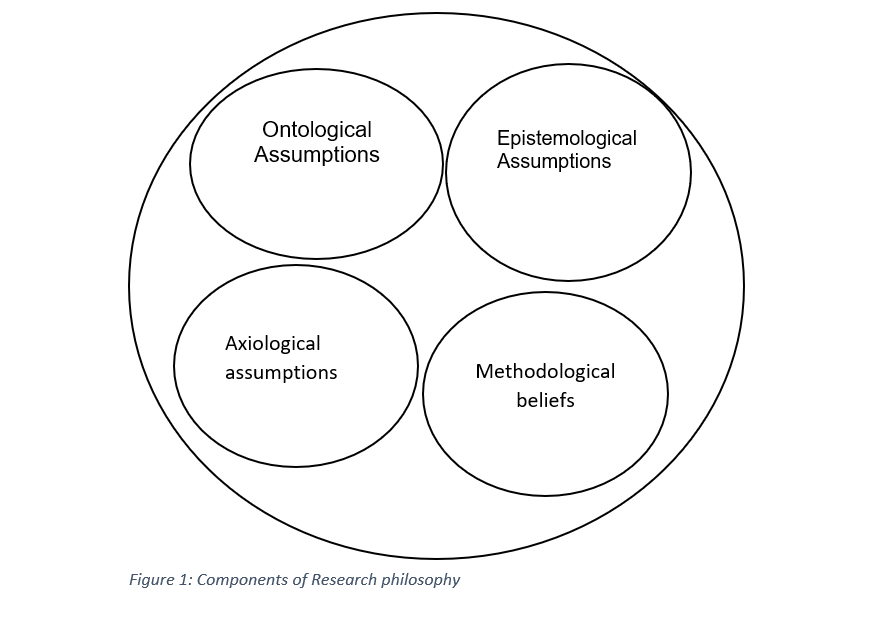
Components of Research Philosophy
Ontological Assumptions
Ontological assumptions relate to the researcher’s view of reality — whether it’s singular and objective, or multiple and subjectively experienced.
Epistemological Assumptions
Epistemological assumptions relate to how a researcher knows reality — what counts as acceptable, valid knowledge, and how closely the researcher interacts with what they’re studying to get it.
Axiological Assumptions
Axiological assumptions are the value stance taken by the researcher — how they handle their own biases, values, and role in shaping the research.
Methodological Beliefs
Methodological beliefs are the procedures a researcher uses in a study — inductive or deductive, the data collection methods favored, and how findings are ultimately reported.
Common Research Philosophies in Qualitative Research
In qualitative research, a researcher’s philosophy also includes the interpretive framework they adopt. That framework signals their ontological, epistemological, axiological, and methodological assumptions all at once. Here are four common interpretive frameworks in qualitative research:
Adapted from Creswell & Poth (2018).
| Framework | Researcher Goals | Key Influences | Example Study |
| Post-positivism | Focus on cause and effect, determining what contributes to an outcome’s probability | Prior training in quantitative research | The Impact of Social Media on Adolescent Mental Health: A Mixed-Methods Approach |
| Social constructivism / Interpretivism | Understanding the world in which participants work and live | Recognizing how past experience shapes interpretation | A study investigating how students support each other’s learning through structured peer interactions |
| Pragmatism | Finding specific solutions to real-world problems | Favors diverse, flexible data collection and analysis approaches | Interviews with healthcare providers and patients to improve telemedicine practices |
| Postmodern perspectives | Changing dominant ways of thinking that aren’t beneficial in contemporary times | Understanding the conditions of the contemporary world | Analyzing how national histories marginalize minority narratives |
Comparing the Interpretive Frameworks
Once you’ve picked a framework, its philosophical beliefs shape how you write your methodology chapter. Here’s how the four components play out under each interpretive framework:
| Framework | Ontology | Epistemology | Methodology |
| Post-positivism | A single absolute reality exists, understood through experiments and testing | Reality is approximated; researchers minimize interaction with subjects | Deductive: hypothesis testing, key variables, group comparisons |
| Social constructivism / Interpretivism | Multiple realities, constructed through interaction and lived experience | Reality is co-created by researcher and participants | Inductive: observation, interviewing, analyzing texts |
| Pragmatism | Reality is what is practical and useful | Known through both objective and subjective evidence | Mixed: both qualitative and quantitative approaches |
| Postmodern perspectives | A hybrid of subjective and objective experience | Multiple, co-created ways of knowing | Collaborative processes; political participation highlighted |
Example: Writing About Research Philosophy in a Methodology Chapter
Suppose you’re conducting a study on the causes of stress among pregnant mothers, a group typically considered vulnerable. For this kind of study, social constructivism / interpretivism is a natural fit. Here’s how each component might read in your methodology chapter.
Example study title: Causes of stress among pregnant mothers who are considered a vulnerable group.
Ontological Assumptions Example
The researcher adopted an ontological stance that reality is multiple and can be experienced in different ways. The experiences of different mothers on what might cause their stress during pregnancy were considered and reported individually.
Epistemological Assumptions Example
The researcher sought subjective evidence from participants and worked to establish a close connection with them in order to understand the causes of stress during pregnancy, recording participant responses during interviews and using direct quotes as evidence.
Axiological Assumptions Example
The researcher believed that bias is present in research because of the subjective experience of both participants and researcher. Having worked consistently with pregnant women, the researcher acknowledged that this experience could shape their interpretation of participant accounts.
Methodological Beliefs Example
The researcher favored an inductive approach to data collection and analysis, relying primarily on semi-structured interviews to gather rich, first-person accounts of stress during pregnancy. Analysis moved from initial codes to broader themes grounded in participants’ own words, consistent with a social constructivist methodology.
Frequently Asked Questions
Do I need a whole section on research philosophy in my dissertation?
Most qualitative dissertations include a research philosophy section, often near the start of the methodology chapter, even if brief. It signals to your examiners which assumptions shaped your design choices.
How do I know which interpretive framework fits my study?
Start from your research questions. If you’re testing cause-and-effect relationships, post-positivism may fit. If you’re exploring lived experience and multiple perspectives, social constructivism is more common in qualitative work. Pragmatism suits studies mixing methods to solve a practical problem.
What’s the difference between research philosophy and research methodology?
Research philosophy is the set of underlying assumptions (ontology, epistemology, axiology, methodology-as-belief). Research methodology is the practical application of those beliefs — your actual research design, sampling, data collection, and analysis procedures.
Key Takeaways
- Research philosophy has four components: ontological, epistemological, axiological, and methodological assumptions.
- Your interpretive framework (post-positivism, social constructivism, pragmatism, or postmodernism) signals all four at once.
- State your research philosophy explicitly in your methodology chapter so readers can judge your findings against your assumptions.
- Write a worked example for all four components, not just some of them, to keep your methodology chapter consistent.
Get Help Writing Your Methodology Chapter
Are you overwhelmed by your qualitative data? I offer two specialized services for PhD students who need support with N-Vivo analysis. The first is my done-for-you qualitative data analysis service, where I handle the full coding, theme development, data visualization, and a findings report — including a walk-through recording of the entire analysis. The second is one-on-one N-Vivo consulting, where we work together on a video call via Zoom or Microsoft Teams, and I guide you through your analysis step by step.
Once your philosophy is set, the next step is picking your approach: see how to choose the right qualitative research method for your study, then how to write the methodology chapter for a qualitative study for the full chapter structure.