

Last Updated on 4 months ago by Grace Nyambura
| What is qualitative analysis with MAXQDA? Qualitative analysis with MAXQDA is the process of using MAXQDA — a computer-assisted qualitative data analysis software (CAQDAS) — to code interview transcripts, organize codes into themes, and produce a structured findings report. This tutorial follows Braun and Clarke’s six-step reflexive thematic analysis framework throughout. |
- What Is MAXQDA and How Does It Work?
- The Braun and Clarke Framework Used in This Tutorial
- Step 1 — Familiarize Yourself with Your Data
- Step 2 — Generate Initial Codes in MAXQDA
- Step 3 — Develop Themes from Your Codes
- Step 4 — Review and Refine Your Themes
- Step 5 — Define and Name Your Final Themes
- Step 6 — Produce the Findings Report
- Frequently Asked Question
- Is MAXQDA free to use?
- What’s the difference between MAXQDA and NVivo?
- Do I have to use Braun and Clarke’s framework with MAXQDA?
- How many codes should I generate before looking for themes?
- What is the difference between a sub-theme and a code in MAXQDA?
- Can I use the question-as-containers method for deductive analysis?
- Key Takeaways
In this tutorial, I’m going to walk you through the complete process of qualitative analysis of interviews using MAXQDA — from importing your raw transcripts all the way to a finished findings report.
My name is Bernard Mugo. Over the past three years, I’ve helped more than 200 PhD students analyze qualitative data and complete their dissertations. This guide captures the exact process I use and teach.
The example study I’ll use throughout this tutorial is Experiences of Patients with Heart Failure — two interview transcripts exploring what patients say about living with the condition. I’ll follow Braun and Clarke’s six-step reflexive thematic analysis framework at each stage.
Here’s what this tutorial covers:
- Familiarizing yourself with your data
- Generating initial codes in MAXQDA
- Developing themes from your codes
- Reviewing and refining your themes
- Defining and naming your final themes
- Producing the findings report
What Is MAXQDA and How Does It Work?
MAXQDA is one of the leading computer-assisted qualitative data analysis (CAQDAS) tools used by PhD students and academic researchers worldwide. It allows you to import interview transcripts and other qualitative data, build a structured coding system, develop themes, and export your analysis for reporting — all within a single project file.
For this tutorial, I’m using MAXQDA 2024. When you open the software and create a new project, give it a descriptive name — I’m calling mine ‘Experiences with HF (Heart Failure) 2’.
If you’re still deciding between MAXQDA and other tools, see my comparison of the 9 best qualitative data analysis software tools — it covers MAXQDA alongside NVivo, ATLAS.ti, and others.
Navigating the MAXQDA Interface
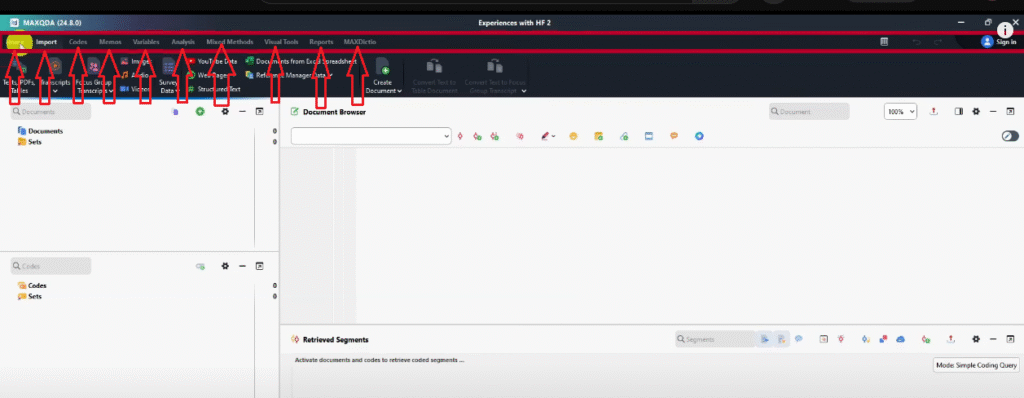
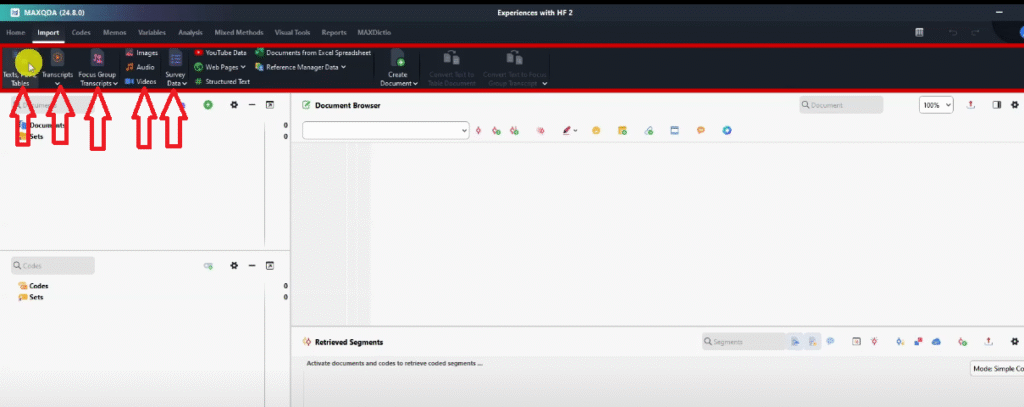
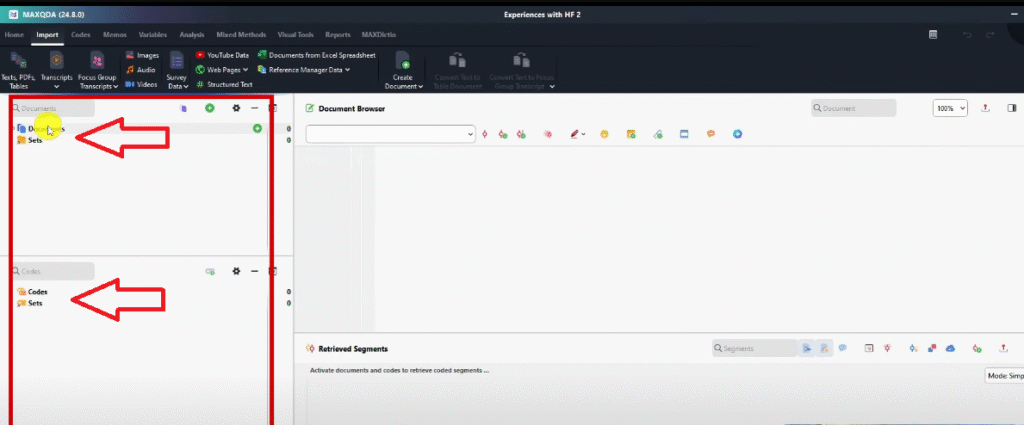
MAXQDA has three main navigation areas:
- Top menu bar: Home, Import, Codes, Memos, Variables, Analysis, Mixed Methods, Visual Tools, Reports, MAXDictio
- Second menu row: Options for the type of data you’re importing — Text, PDFs, Transcripts, Focus Group Transcripts, Images, Audio, Video, Survey Data, and more
- Left panel: Document Sets and Code Sets — the two primary areas where your transcripts and codes live
As a beginner, the two areas you’ll use most in this tutorial are the Document Sets section (where your transcripts are stored) and the Code System (where your codes and themes are built).
The Braun and Clarke Framework Used in This Tutorial
For this tutorial, I’m following the Braun and Clarke six-step reflexive thematic analysis framework, the most widely used approach to thematic analysis in qualitative research. The six steps are:
- Familiarizing with the data
- Generating initial codes
- Searching for and developing themes
- Reviewing potential themes
- Defining and naming themes
- Producing the findings report
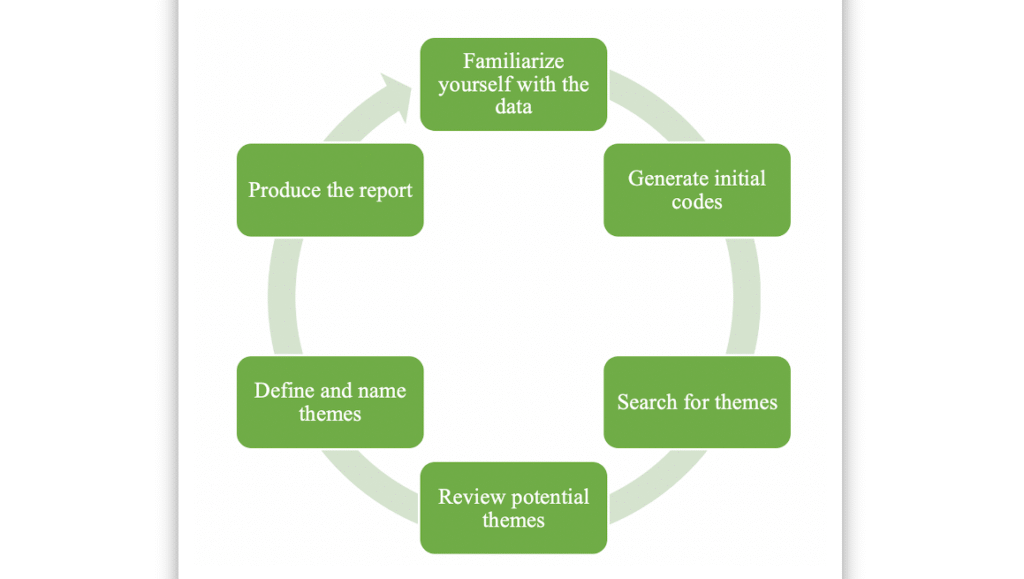
Each section of this tutorial maps directly to one of these steps. For a deeper understanding of the framework itself — including the difference between inductive and deductive approaches — see my guide on inductive and deductive thematic analysis with worked examples.
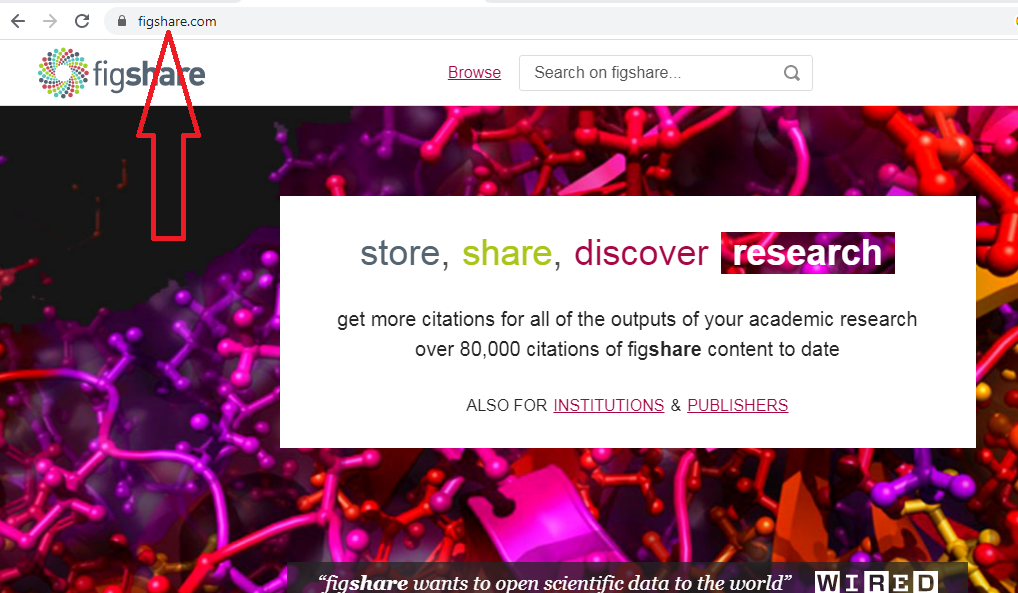
One practical note on transcripts: the example transcripts I use in this tutorial come from Figshare, an open-access research data repository where researchers share their datasets after publication. It’s an excellent place to find real transcripts to practice with before you begin your own analysis. I use Figshare specifically because I want to be transparent that I never use client transcripts in tutorials.
Step 1 — Familiarize Yourself with Your Data
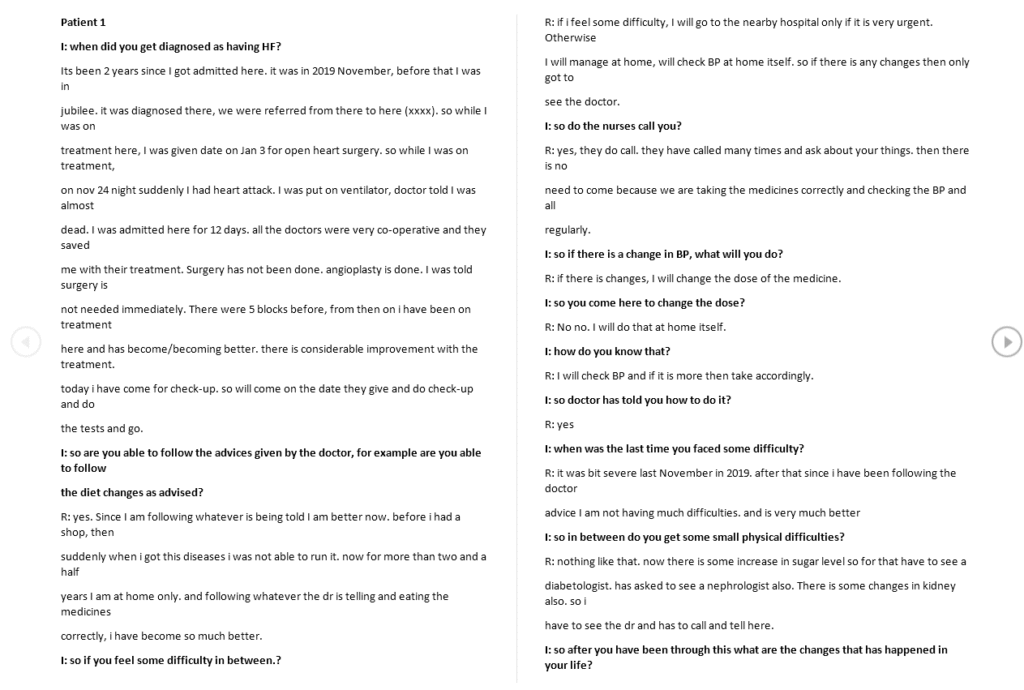
Before touching MAXQDA, read every transcript carefully — as you would read a book, not skim. Familiarization is about understanding the nuance of what your participants are saying and beginning to notice patterns before any formal coding begins.
For the heart failure study, I read through both patient transcripts in full. The interviewer asked participants about their diagnosis, their ability to follow medical advice, their experiences with the healthcare system, and their current health challenges. Knowing this landscape before coding makes the coding process significantly faster and more accurate.
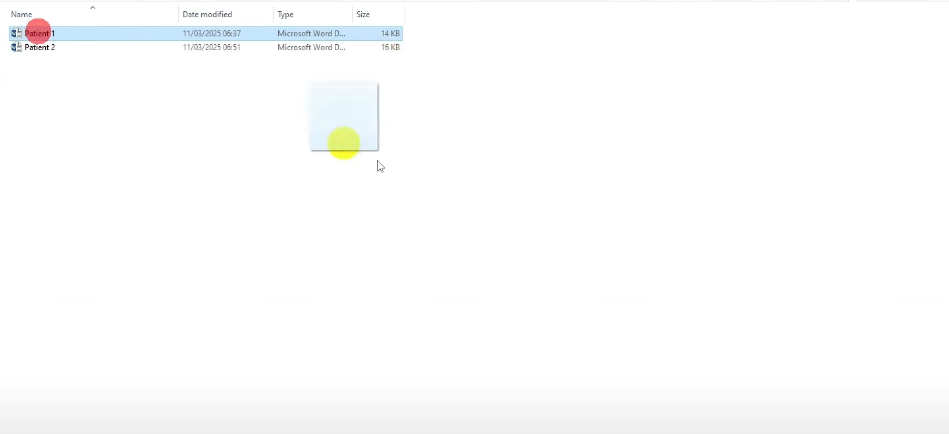
Once you’ve read your transcripts, import them into MAXQDA. There are two ways to do this. You can drag and drop your transcript file directly from your computer into the Document Sets section in the left panel. Alternatively, go to the Import menu → Transcripts → Transcripts without Timestamps, then browse to your file. Both methods produce the same result. I imported both patient transcripts using the second method.
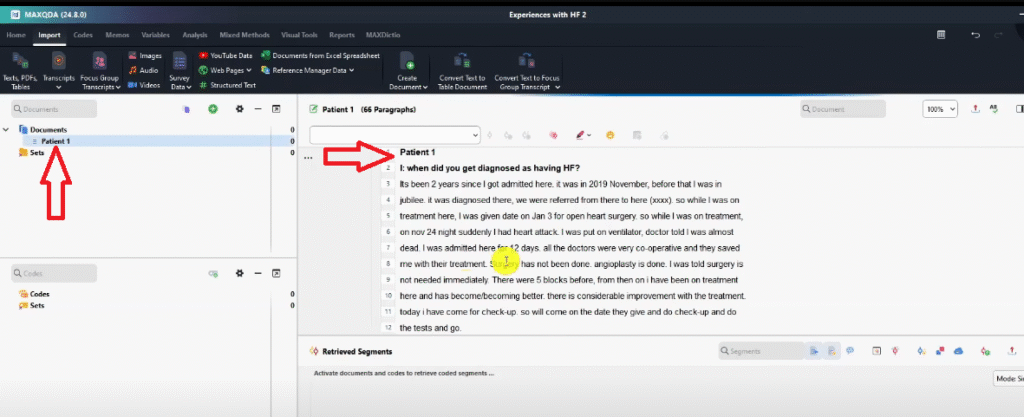
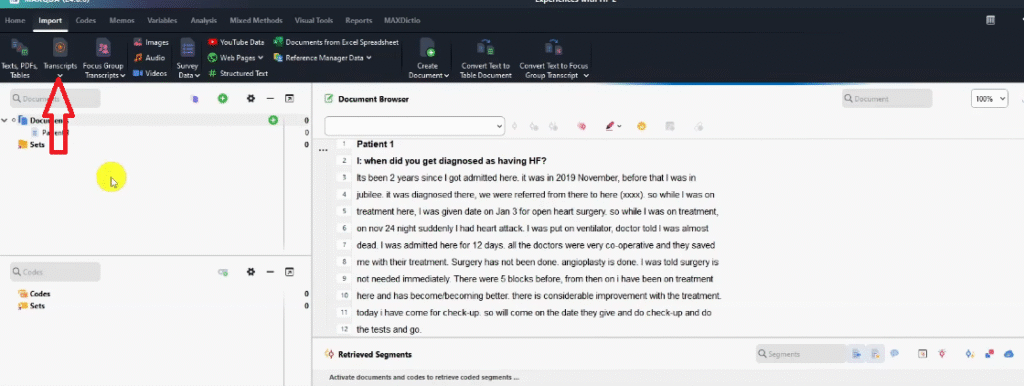
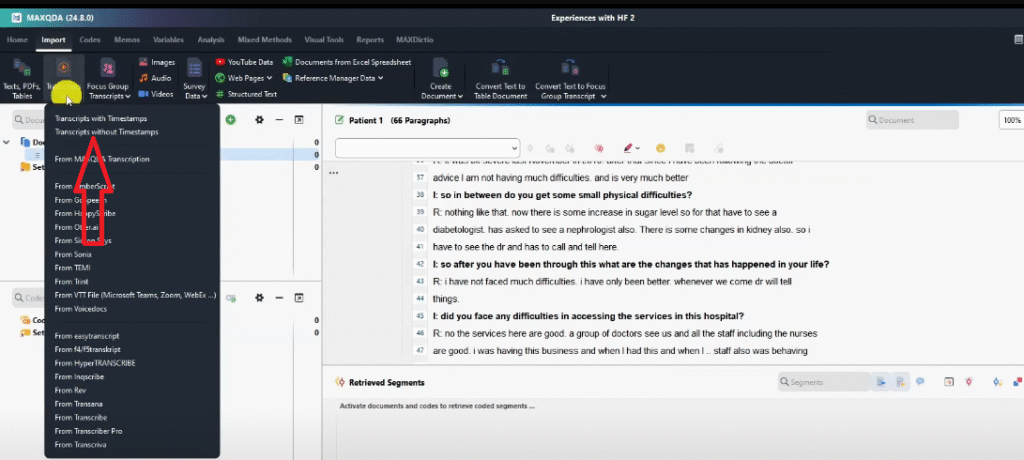
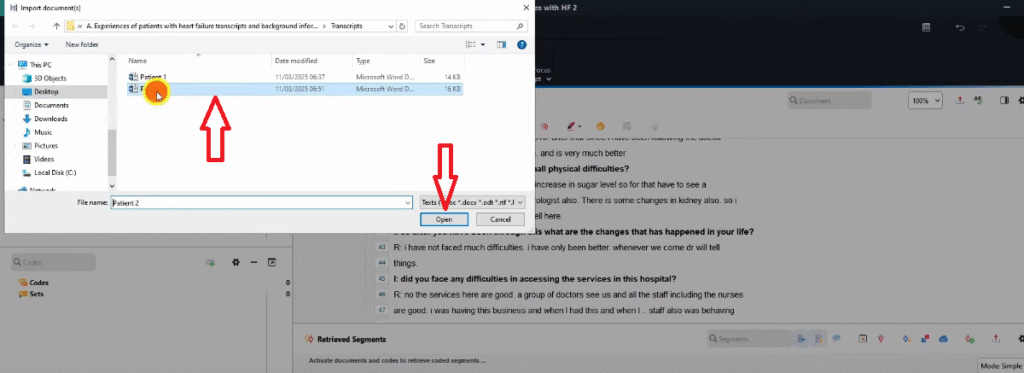
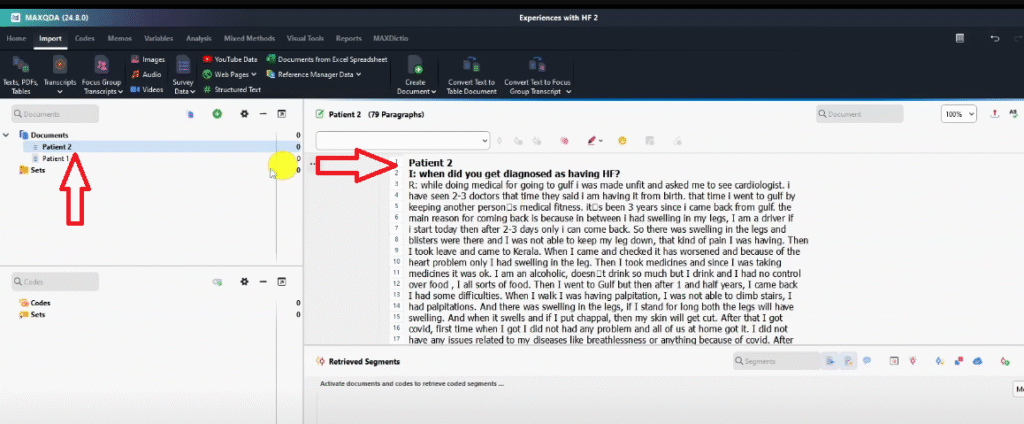
If your transcripts aren’t ready yet, see my guide to the best tools for transcribing interviews — it covers AI transcription services and manual options across different price points.
Step 2 — Generate Initial Codes in MAXQDA
What Is a Code in Qualitative Research?
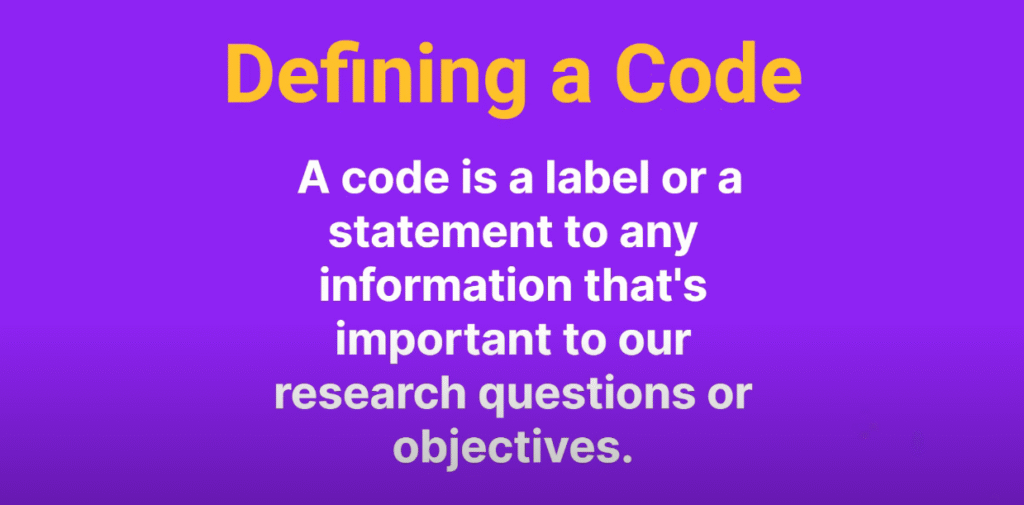
A code is a short, descriptive or interpretive label applied to a segment of your data — a word, sentence, or paragraph — that captures something meaningful in relation to your research question. Codes are precise: they are short, clear, and either describe what’s happening in the data or interpret a deeper meaning that isn’t immediately visible.
To illustrate the difference, consider this classroom observation excerpt:
| Ms. Jackson rises from her desk and announces, “Okay, you guys, let’s get lined up for lunch.” Row one — five children in the first row — rise and walk to the door. Some of the seated children talk to each other. Mrs. Jackson looks at them and says, “No talking — save it for the cafeteria.” |
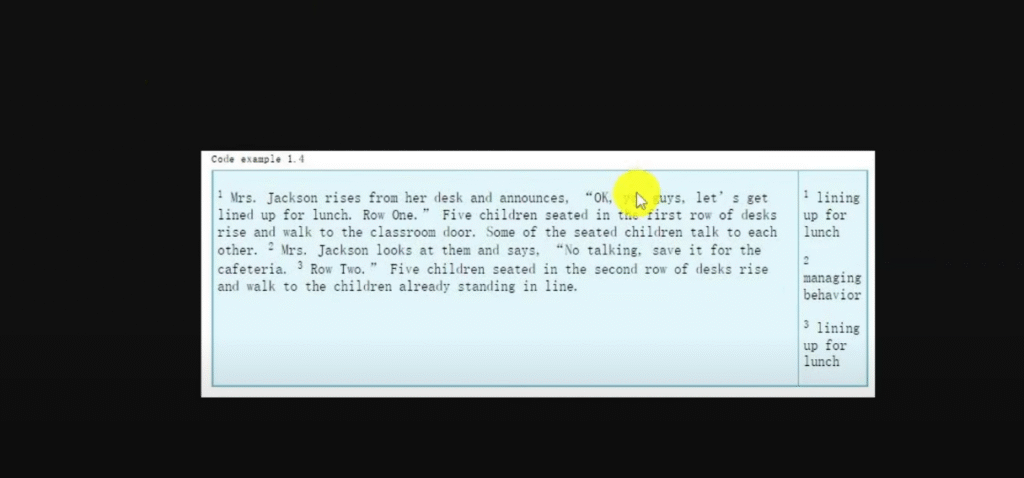
- Sentence 1 (children walking to the door): Code = lining up for lunch — a descriptive code capturing what’s happening
- Sentence 2 (teacher correcting behaviour): Code = managing behaviour — an interpretive code capturing the teacher’s intent
- Sentence 3 (second row walking to the door): Code = lining up for lunch again — a new data segment added to an existing code

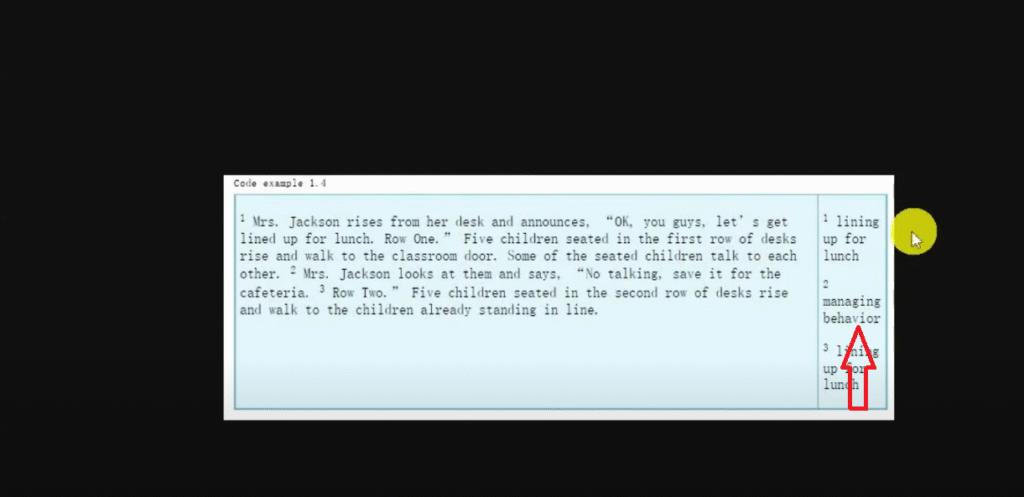
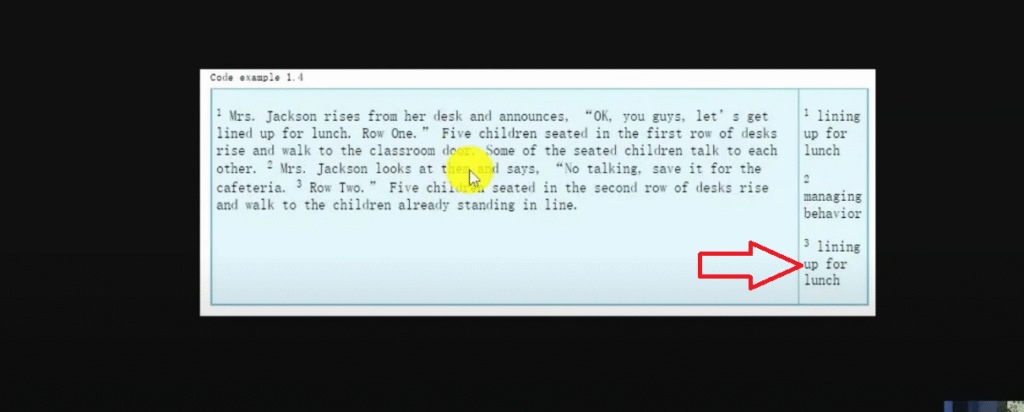
This example shows that a code can be descriptive (what’s happening) or interpretive (what it means), and that multiple data segments can support the same code.
Using Questions as Containers in MAXQDA
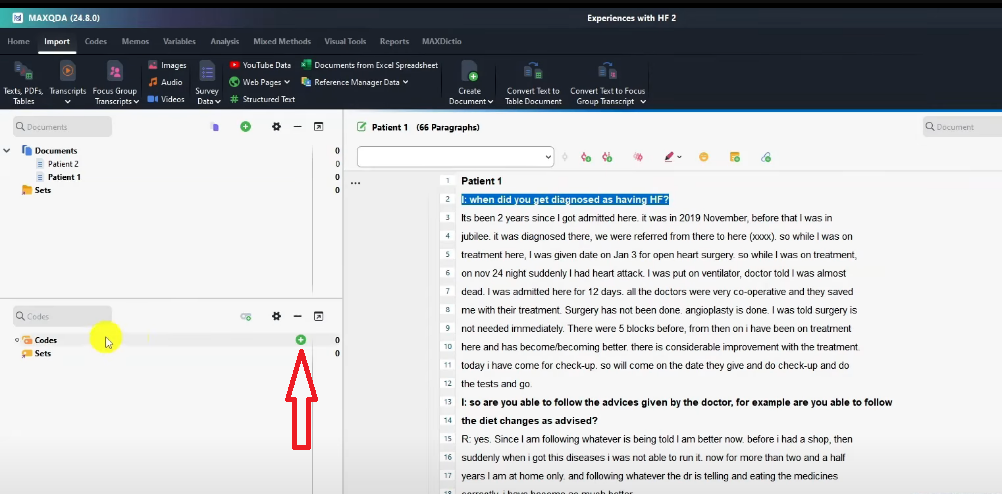
When coding interview data in MAXQDA, one powerful approach is to use the interviewer’s questions as containers — parent codes that act like labeled buckets, organizing the participant responses underneath each relevant question.
This is not a deductive approach. I’m still doing inductive thematic analysis — letting the meaning emerge from the data — but using the question structure to keep the coding organized. The questions become scaffolding, not a predetermined code framework.
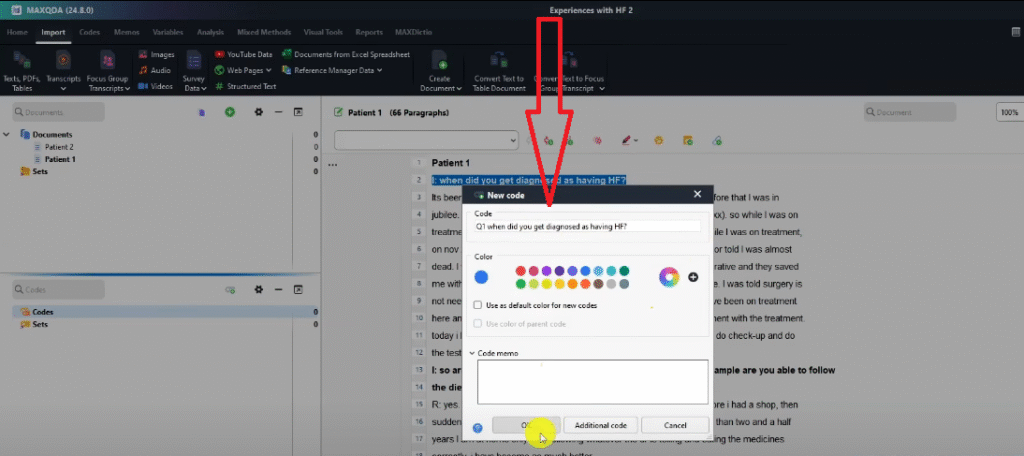
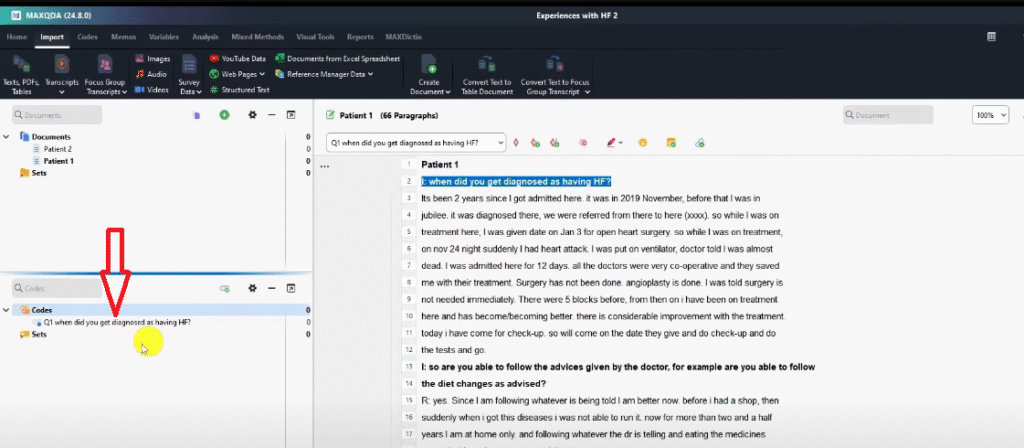
In MAXQDA, create a question container by clicking the Plus (+) button in the Code System, pasting the question text, and renaming it Q1 (for question 1), Q2 (for question 2), and so on. Assign a color to each container to make them visually distinct.
How to Create and Apply Codes in MAXQDA
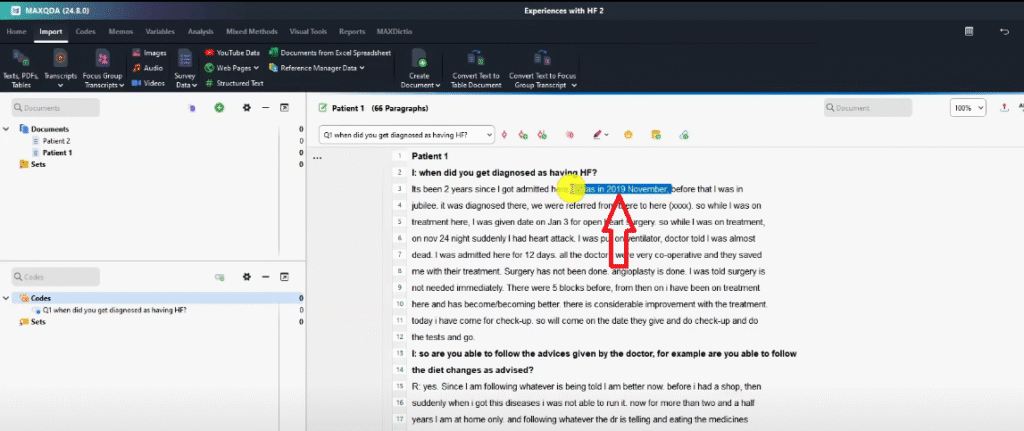
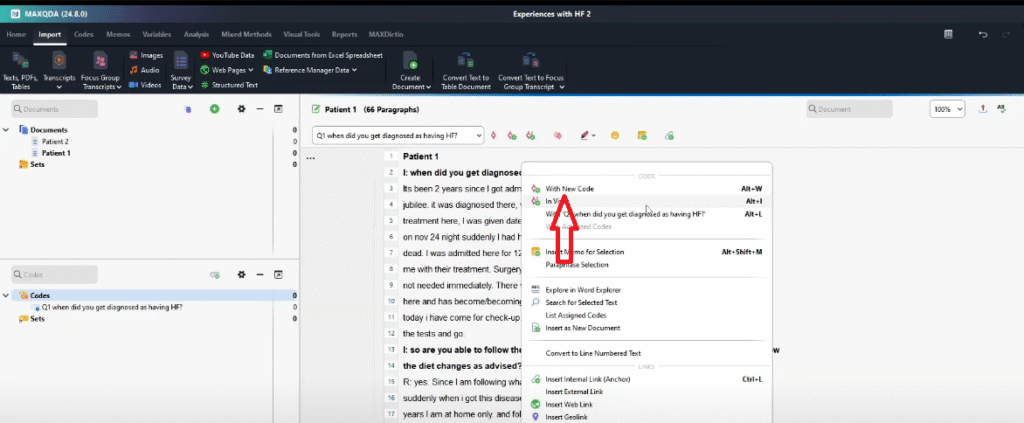
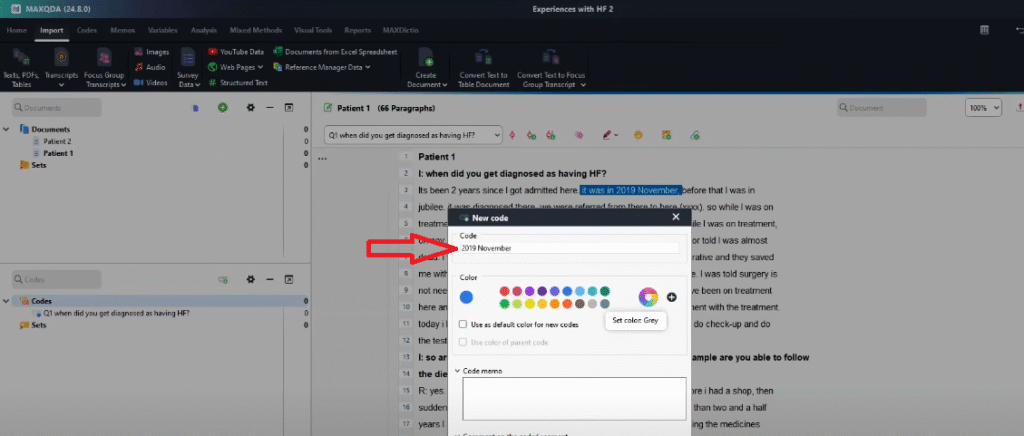
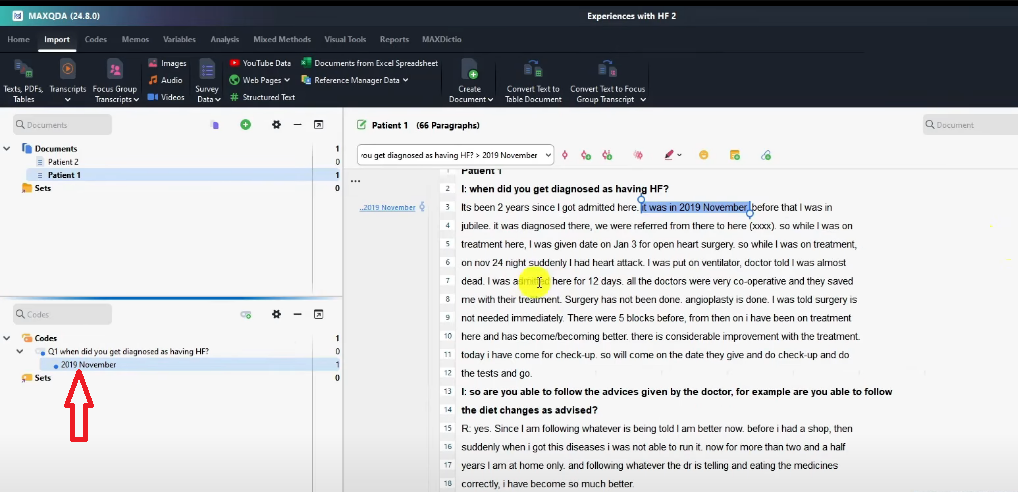
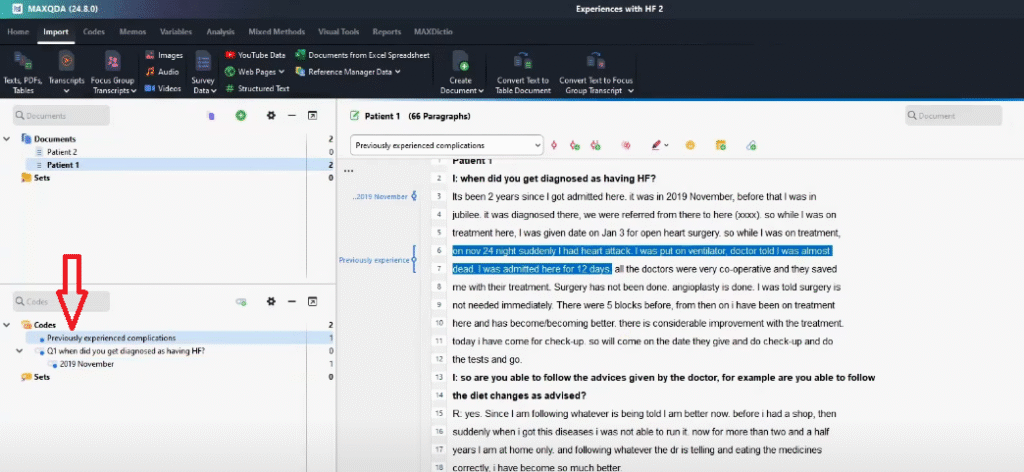
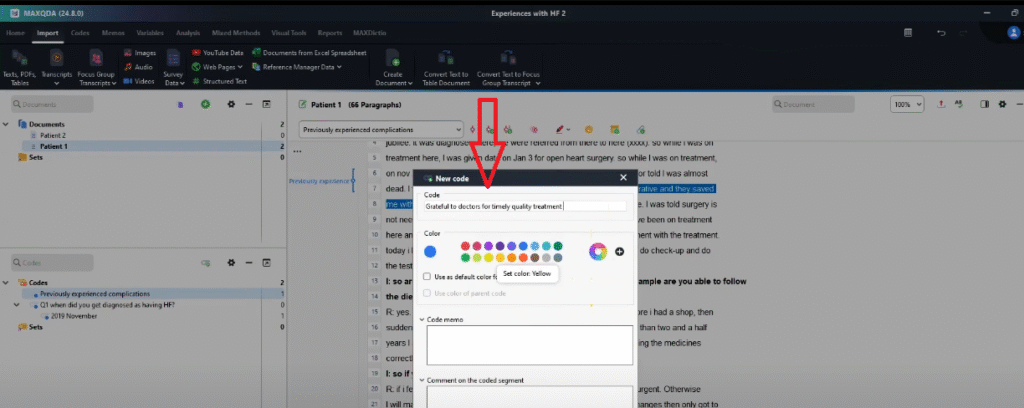
With your transcript open, highlight any text segment you want to code. Then right-click and select ‘Code with New Code’. Give the code a short, meaningful name, then drag it under the relevant question container.
Here are the codes I generated for Patient 1 in the heart failure study:
For Question 1 (When were you diagnosed with heart failure?):
- 2019, November — the date of diagnosis given by Patient 1
- Diagnosed during medical examination for immigration — Patient 2’s context
- Previously experienced complications — an emergent code not tied to the question
- Grateful to doctors for timely, quality treatment — a latent interpretive code
- Witnessed improvement based on current treatment
For Question 2 (Are you able to follow the advice given by the doctor?):
- Follows doctor’s dietary advice
- Witnessed significant improvement in health as a result of following doctor’s advice
- Monitors their blood pressure regularly
- Takes medication as instructed by the doctor
- Nurses call frequently
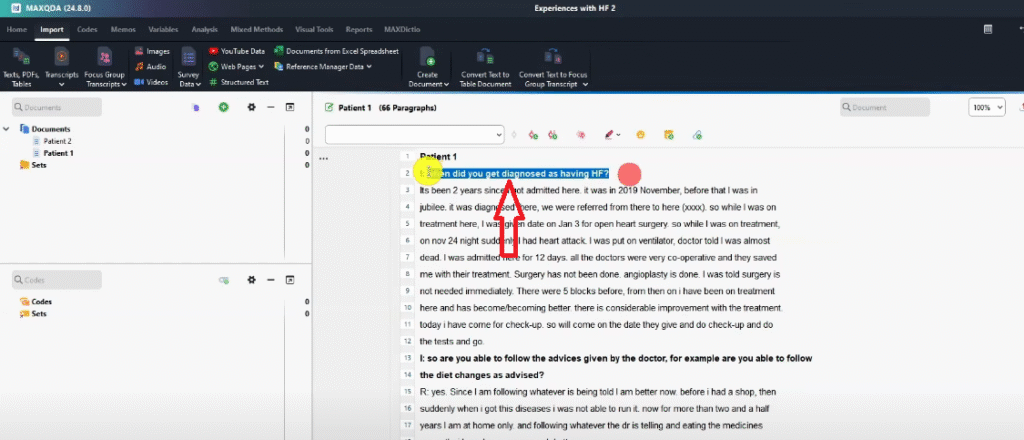
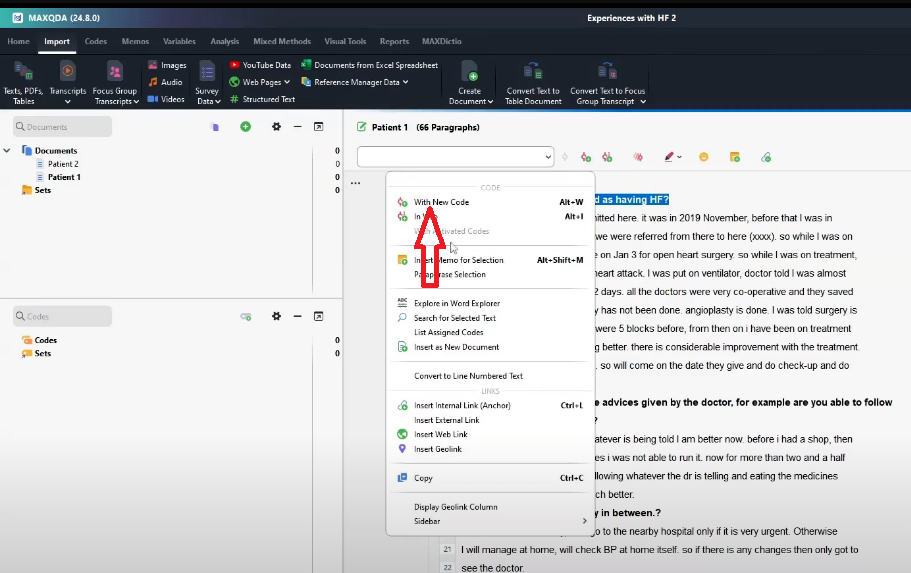
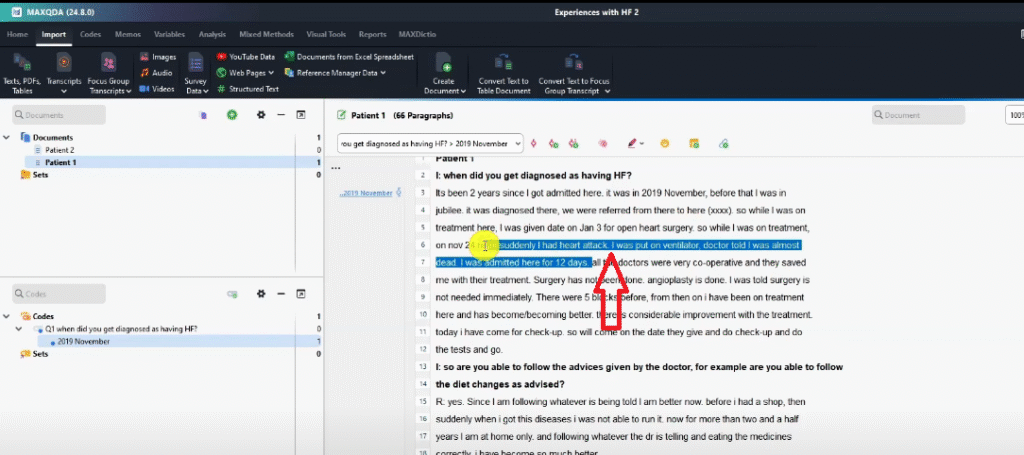
An important point: not every code has to belong to a container. If a data segment is meaningful but doesn’t relate to any specific question, code it anyway and leave it outside the containers. These ‘free’ codes often become important codes or sub-themes later in the analysis.
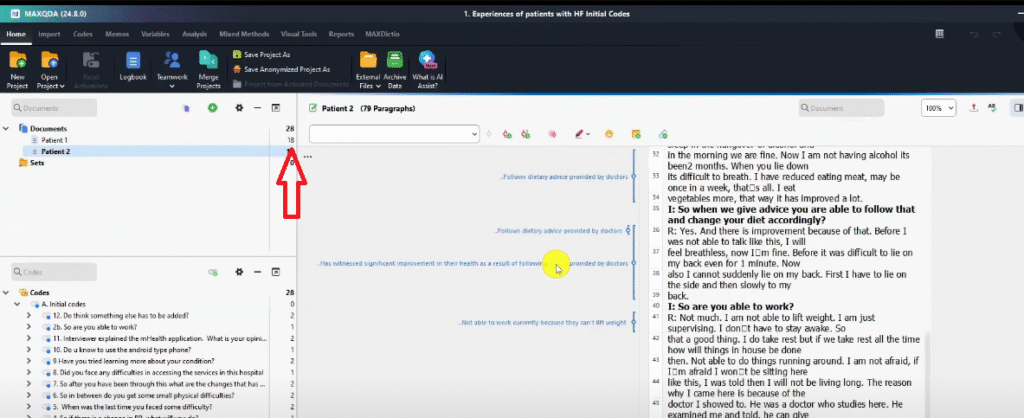
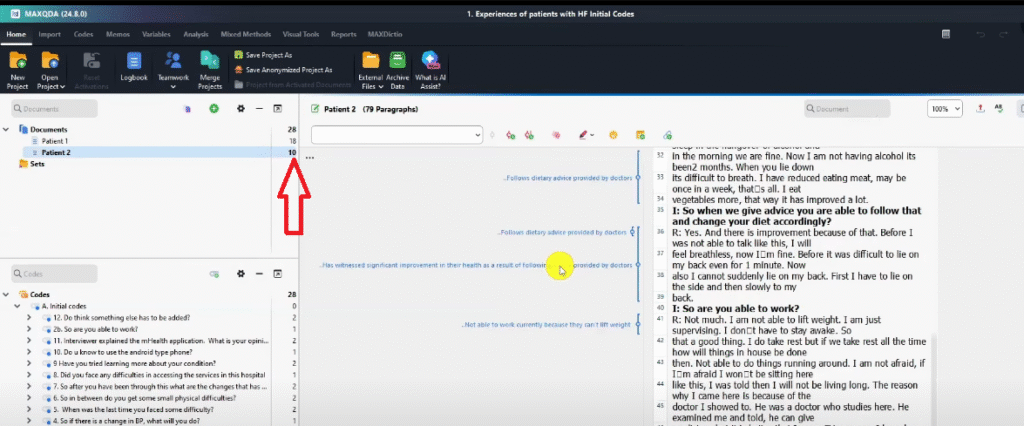
After coding Patient 1, I moved to Patient 2 and applied the same process. The final tally: 18 codes for Patient 1 and 10 codes for Patient 2.
Revising Your Initial Codes
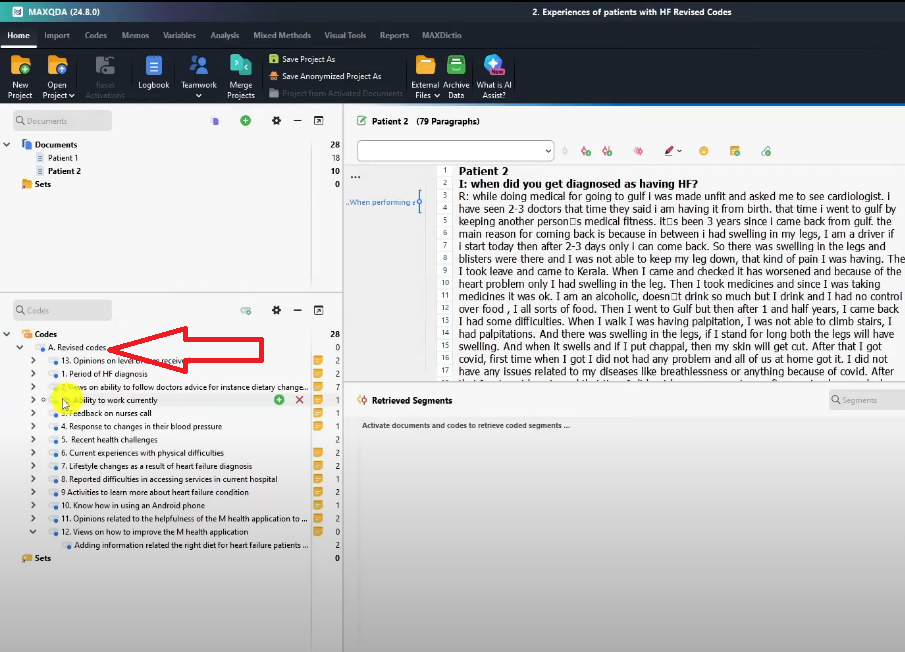
Before moving to theme development, take time to revise your initial codes. Create a copy of your MAXQDA project file (right-click the file → Copy, then paste and rename it ‘Revised Codes’). This preserves your original coding as an audit trail.
Go through each code and ask: Does this code make sense? Is the phrasing precise? Are there grammatical errors? Are any codes redundant or too similar to merge? After revision, your codes should be cleaner and more consistent — ready to group into themes.
Step 3 — Develop Themes from Your Codes
How to Create Preliminary Themes in MAXQDA
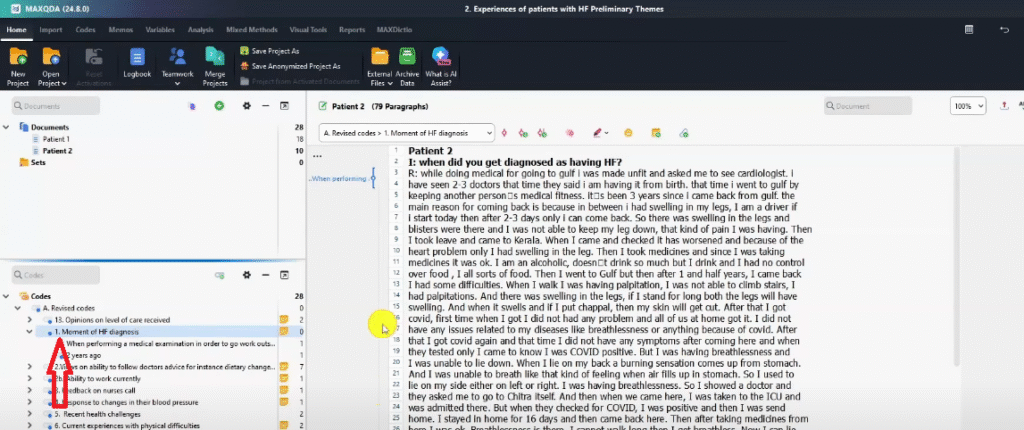
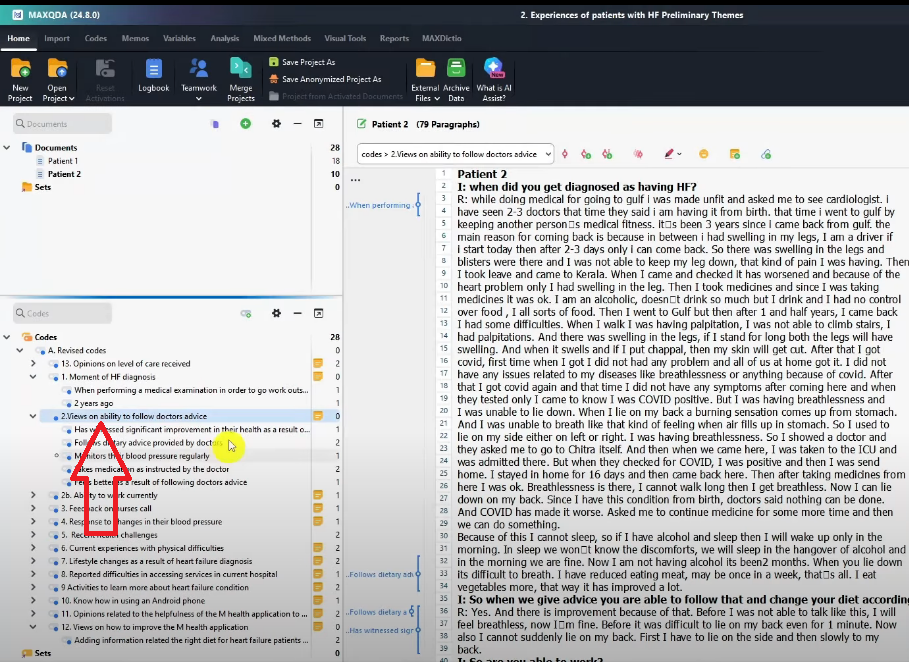
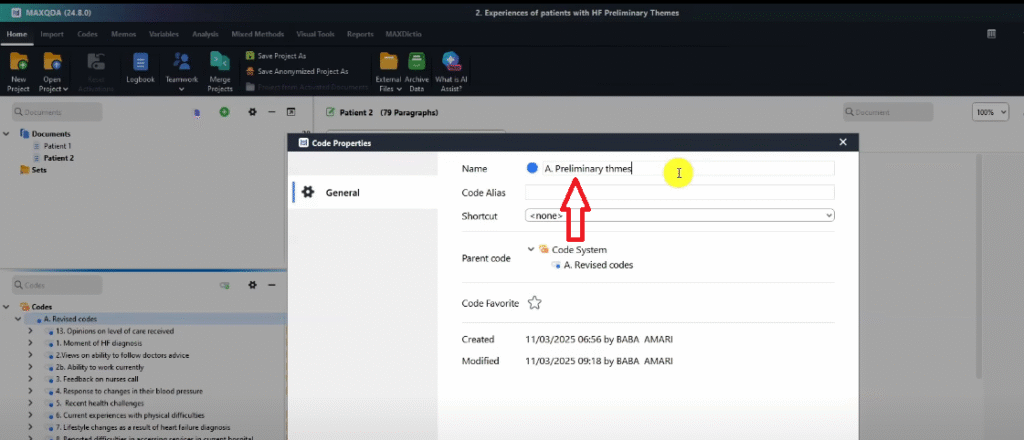
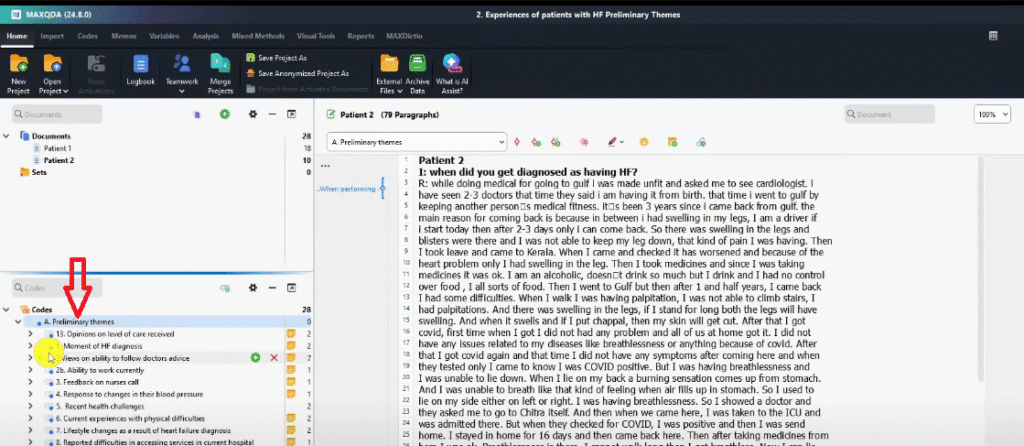
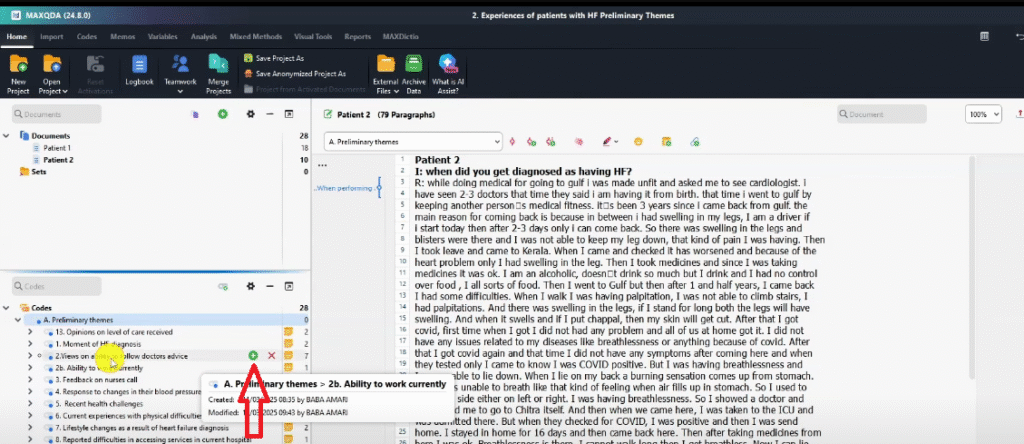
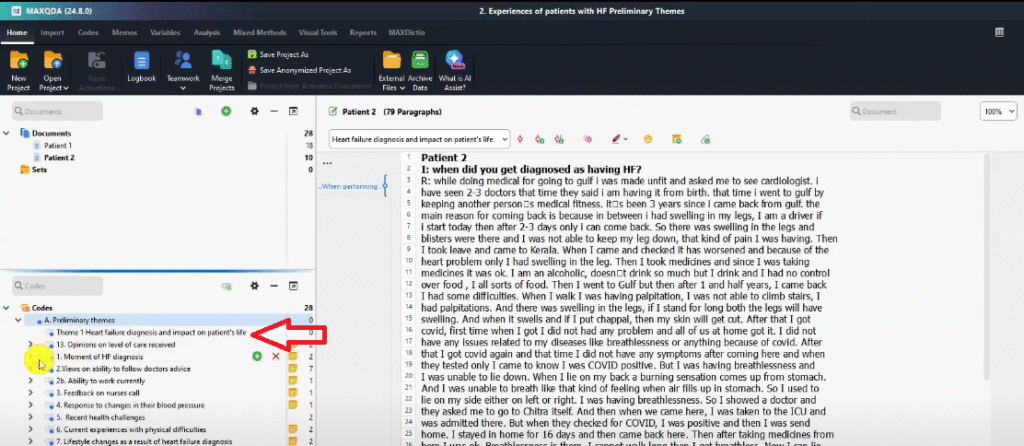
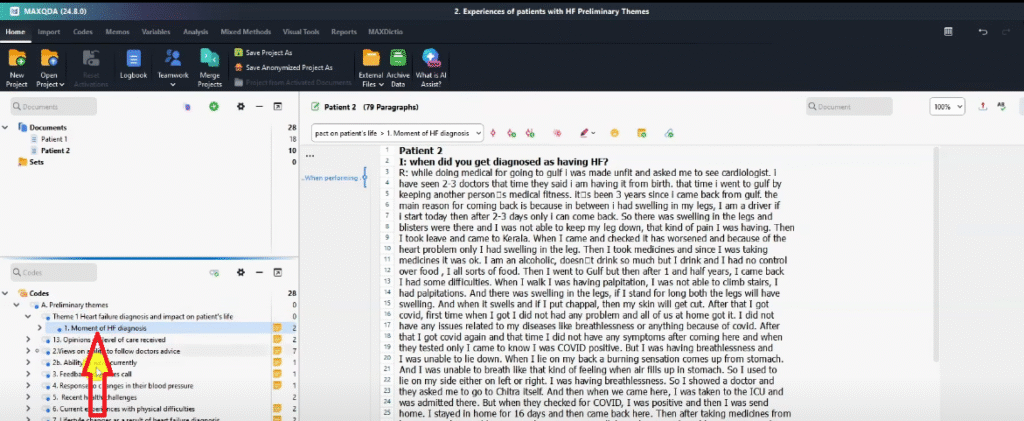
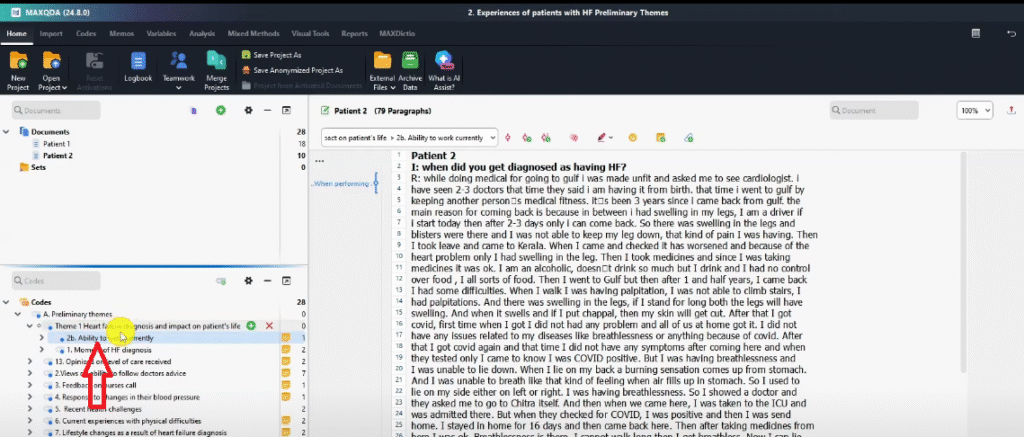
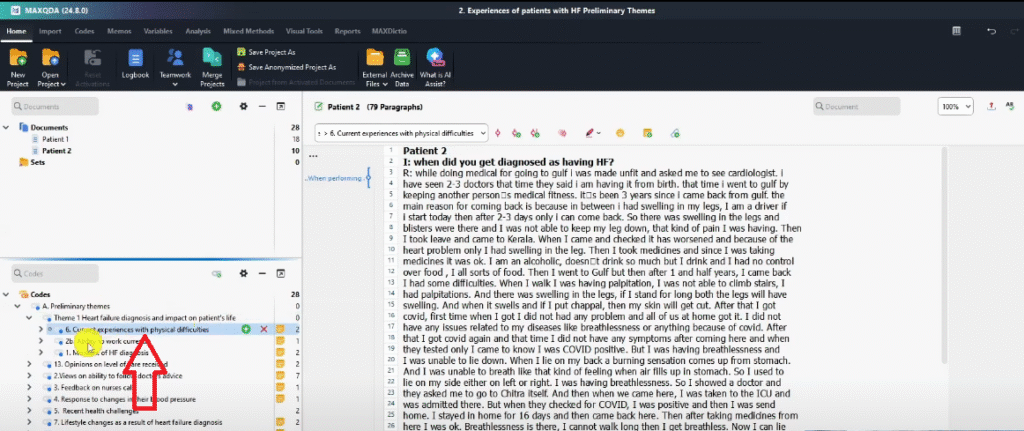
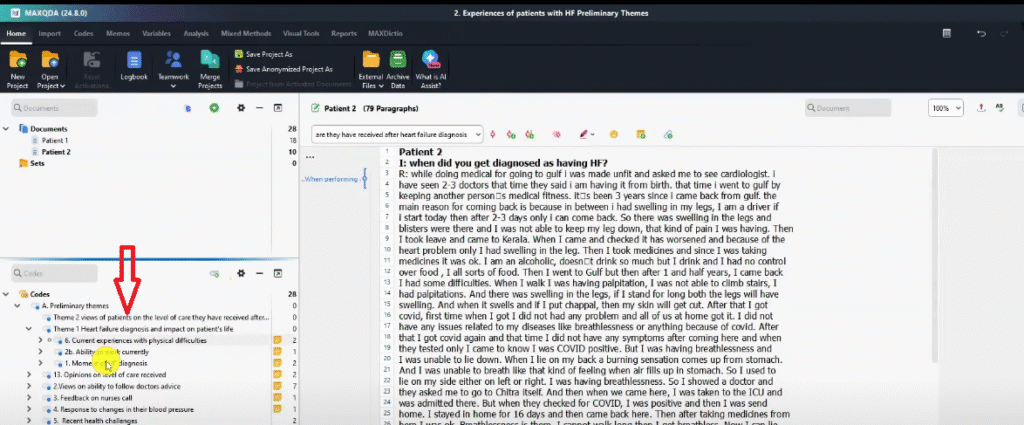
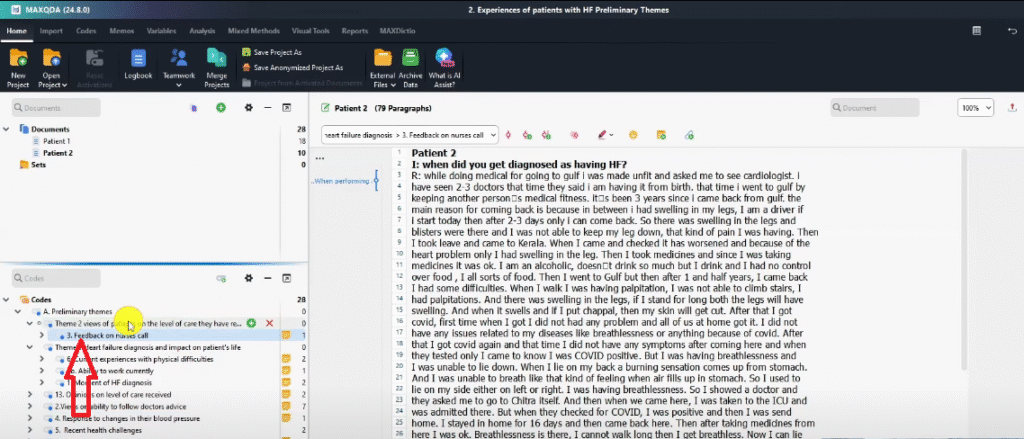
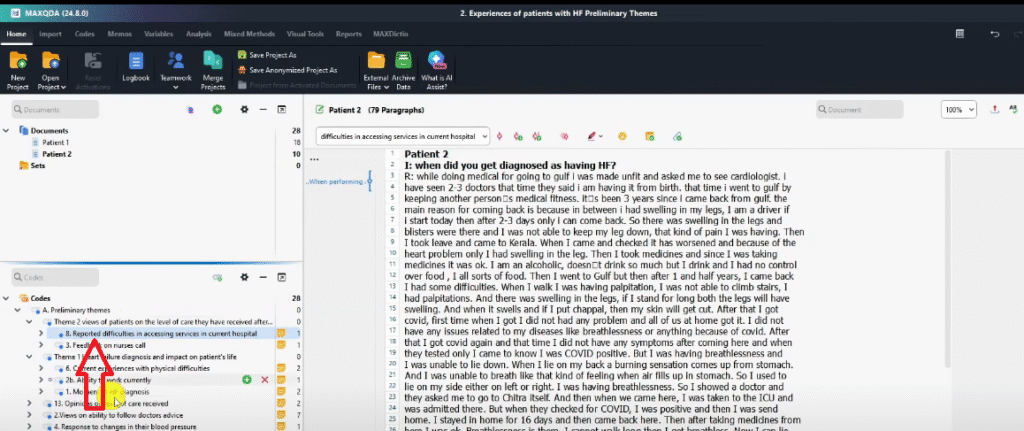
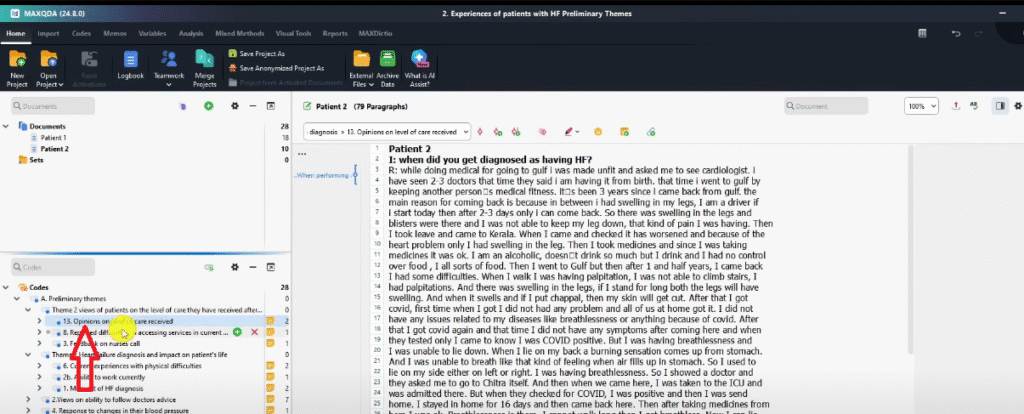
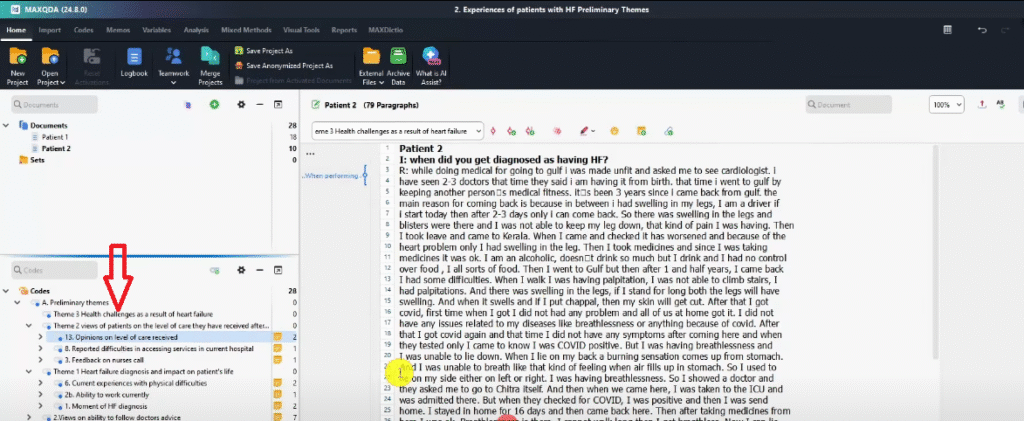
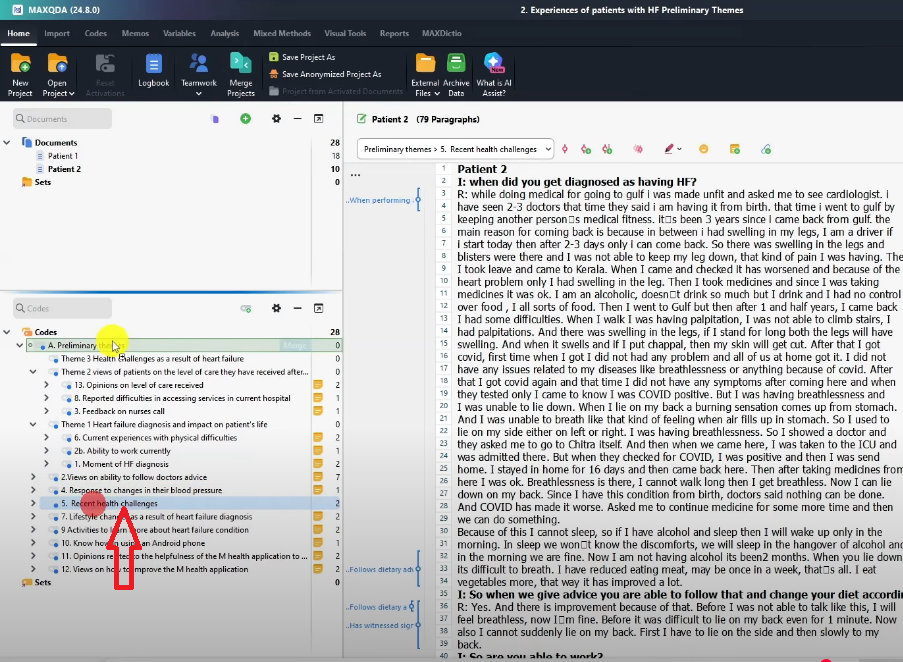
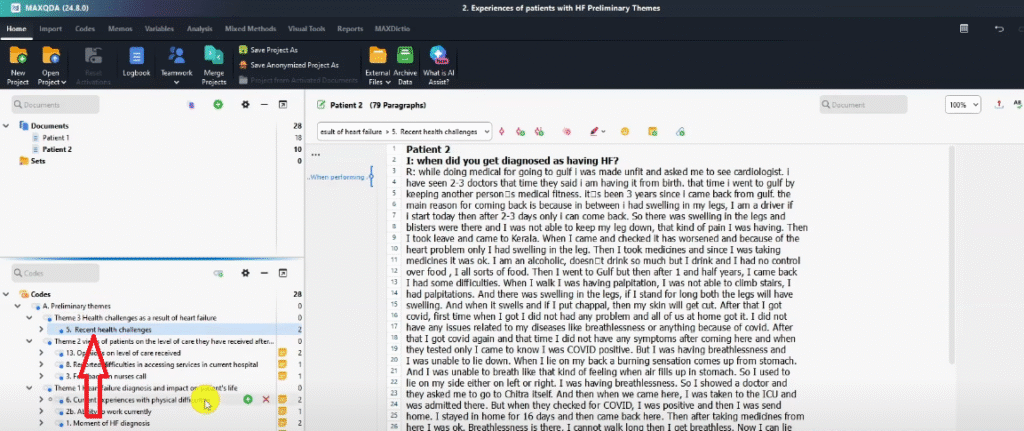
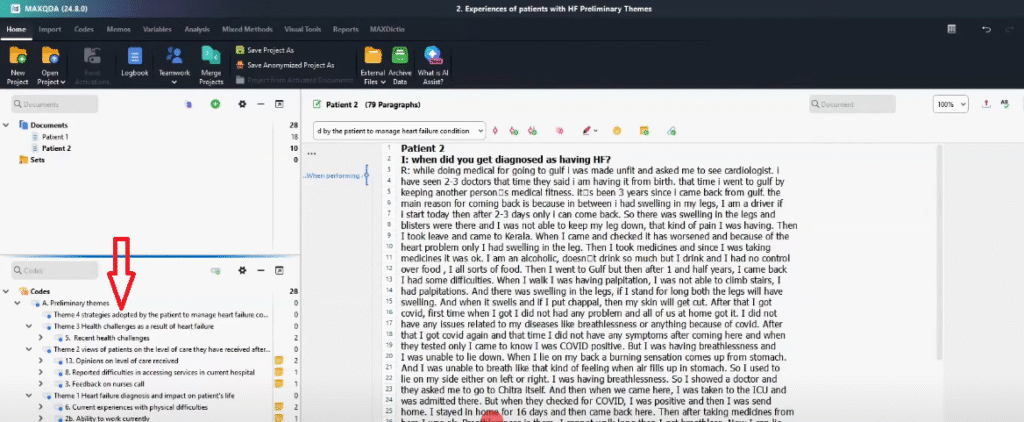
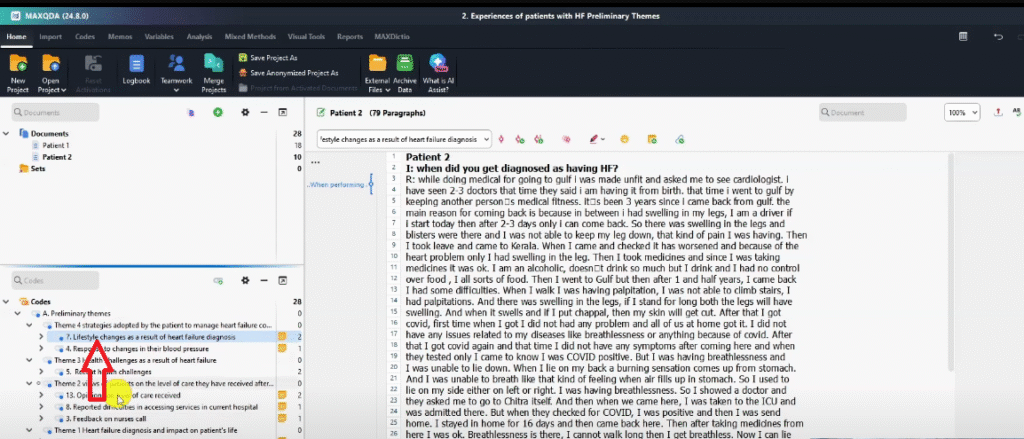
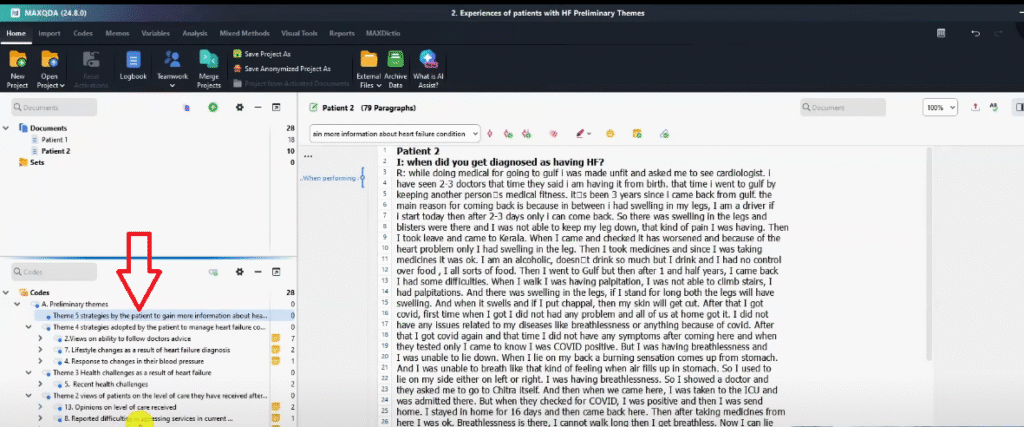
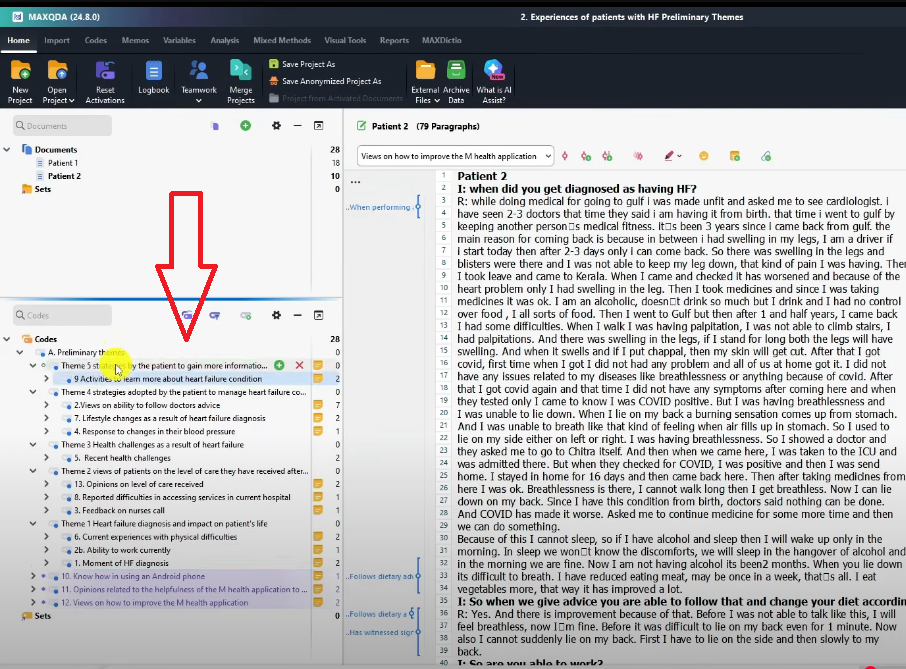
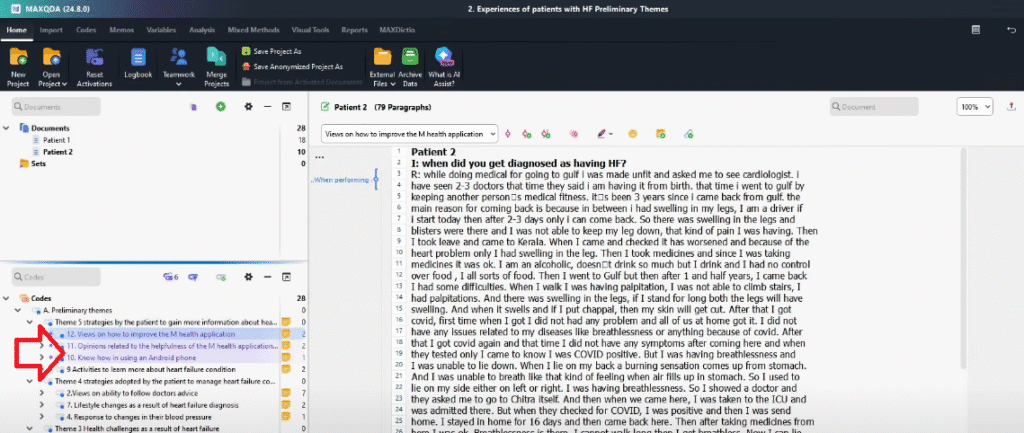
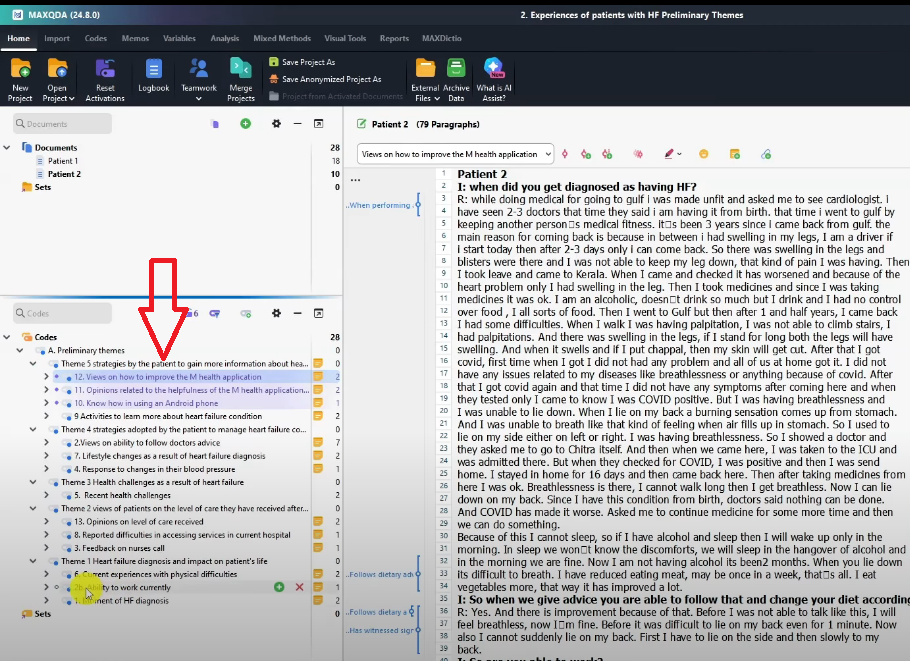
To build each theme in MAXQDA, click the Plus (+) button in the Code System, name the theme, and then drag and drop the relevant codes under it. This restructures your code system from a question-based organization to a meaning-based one.
With revised codes in hand, create another copy of your MAXQDA project and name it ‘Preliminary Themes’. This version is where you move from codes to themes.
The goal is to find codes that share a pattern of meaning — regardless of which question container they came from — and group them together under a new parent code called a theme. Ignore the question containers at this stage. Focus entirely on what the codes mean.
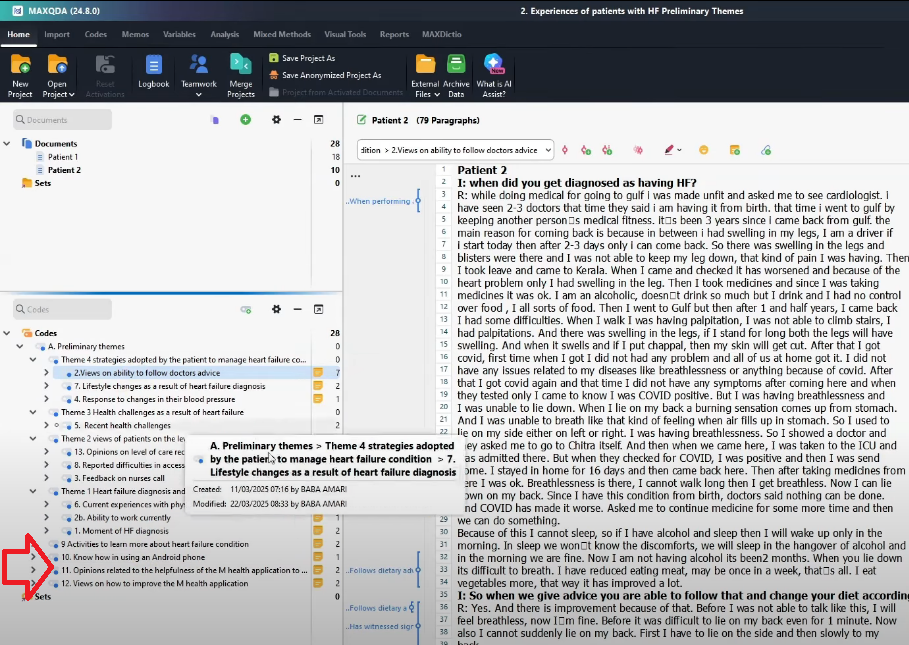
From my heart failure dataset, five preliminary themes emerged:
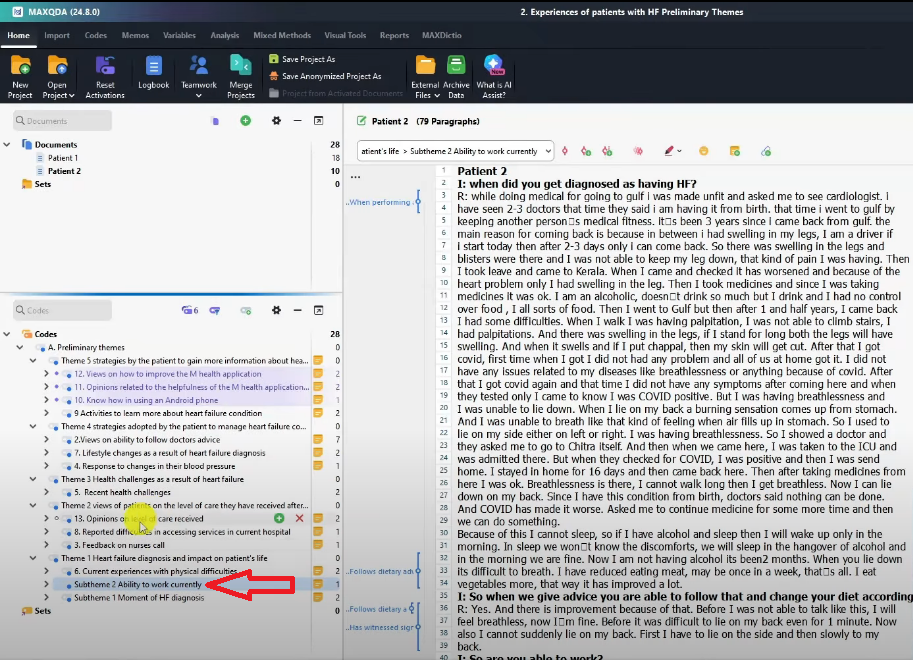
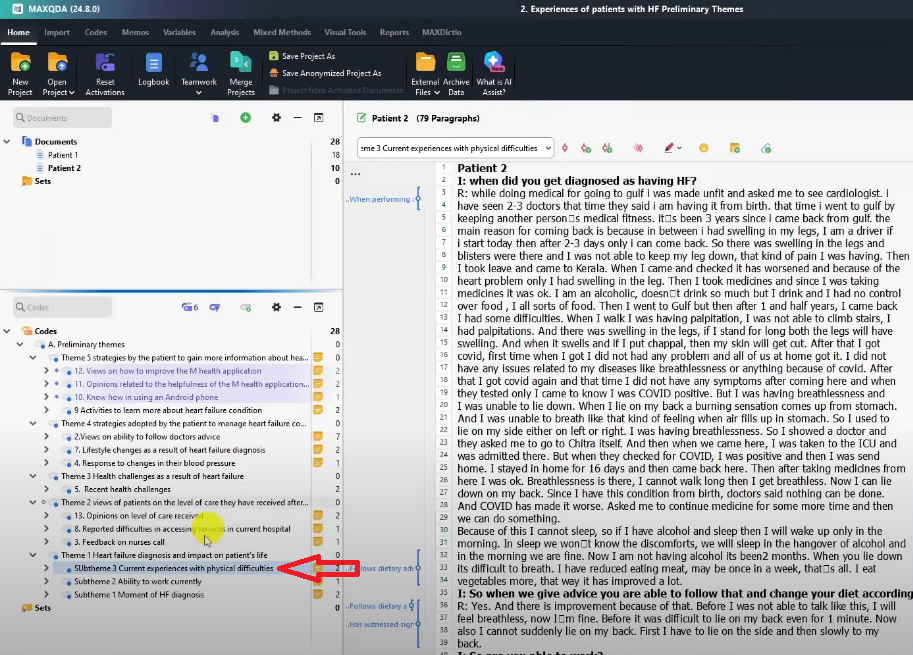
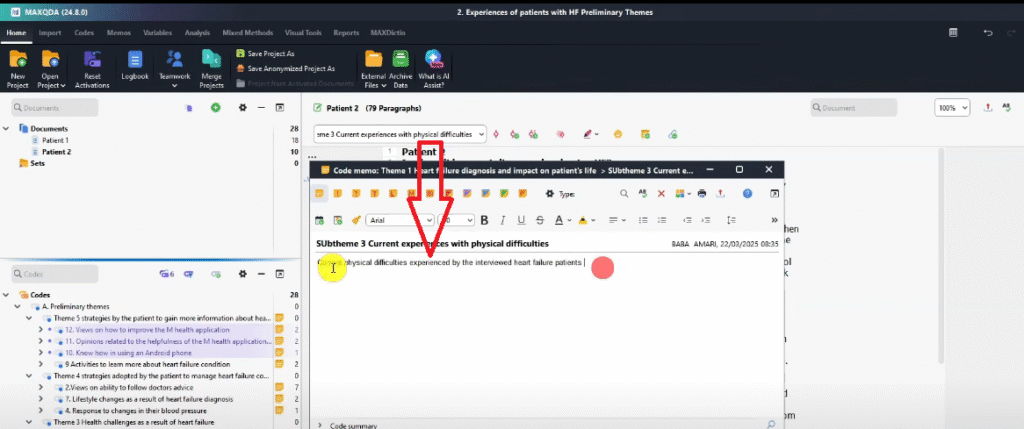
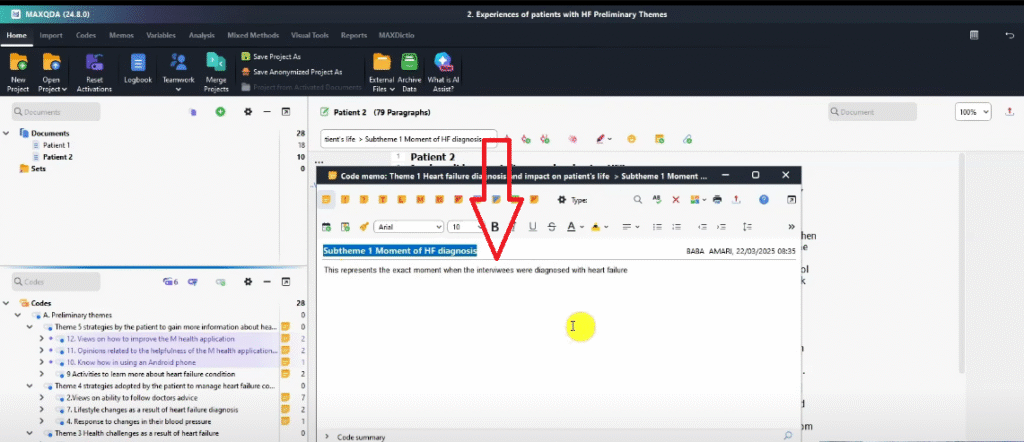
- Heart failure diagnosis and impact on patient’s life — Moment of HF diagnosis, ability to work currently, current experiences with physical difficulties
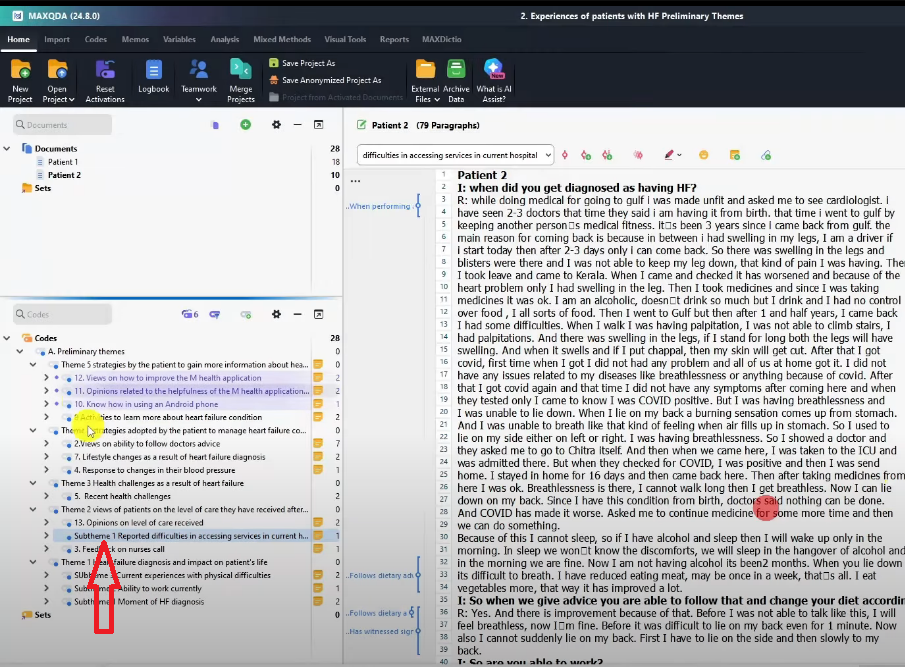
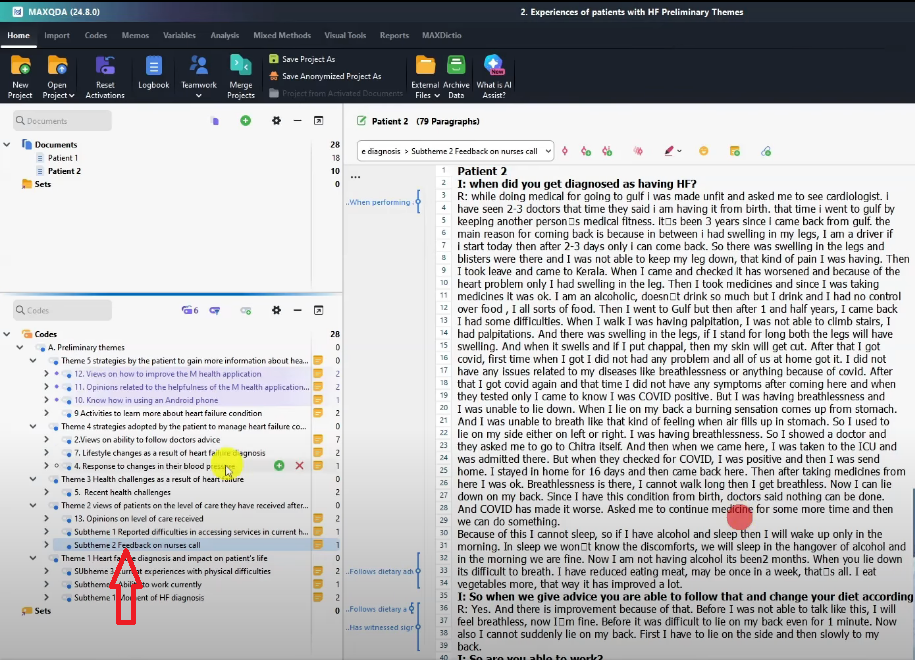
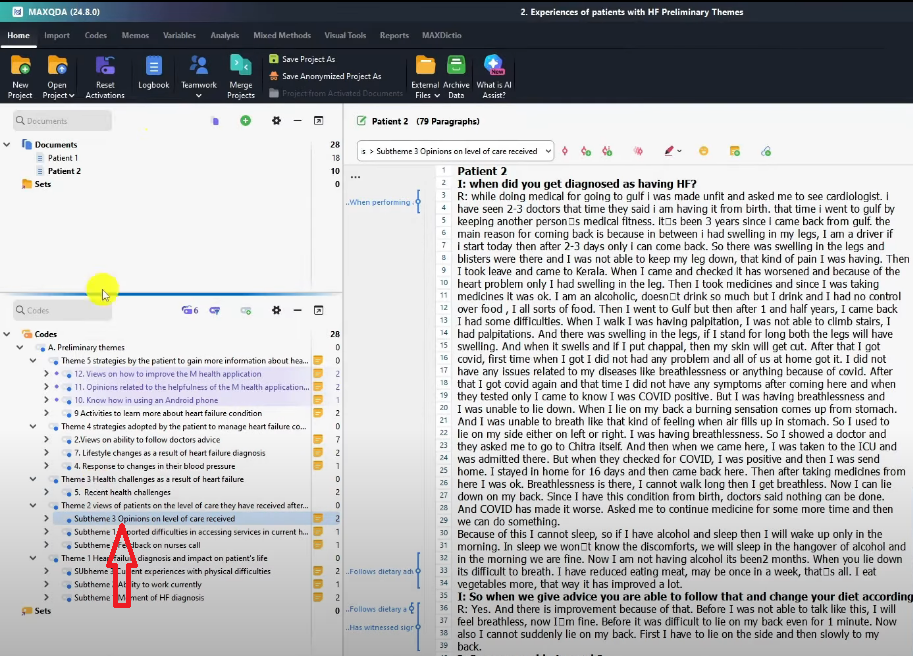
- Views of patients on the level of care received after diagnosis — Feedback on nurses’ calls, reported difficulties accessing services, opinions on level of care
- Health challenges as a result of heart failure — Recent health challenges
- Strategies adopted by the patient to manage heart failure — Response to changes in blood pressure, lifestyle changes, adherence to medication
- Strategies by the patient to gain more information about heart failure — Information-seeking behaviours, activities to learn more about the condition

Adding Theme Descriptions Using Memo
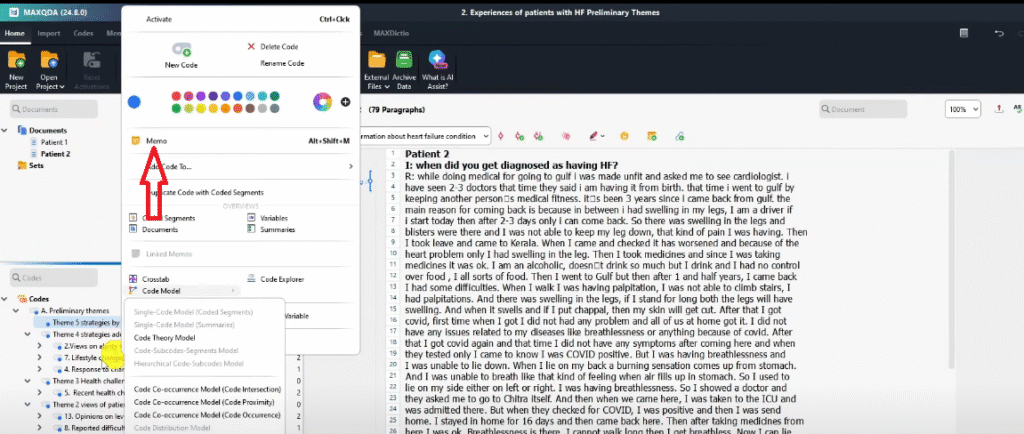
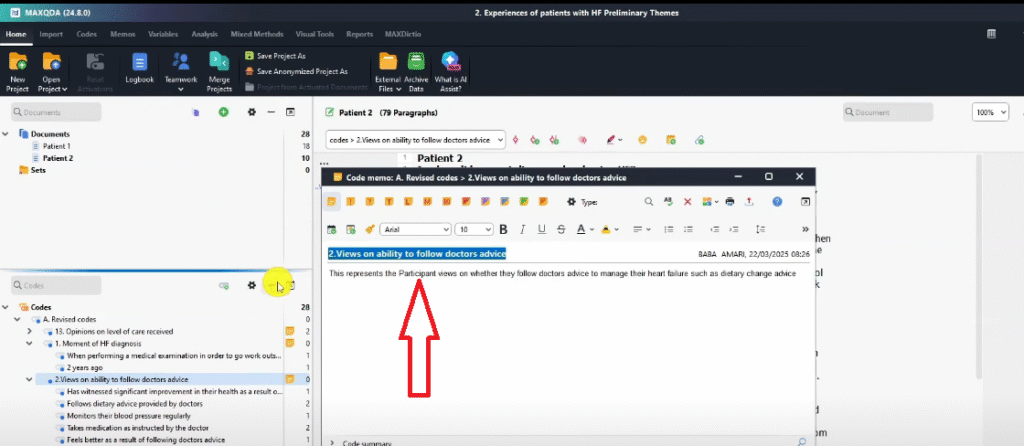
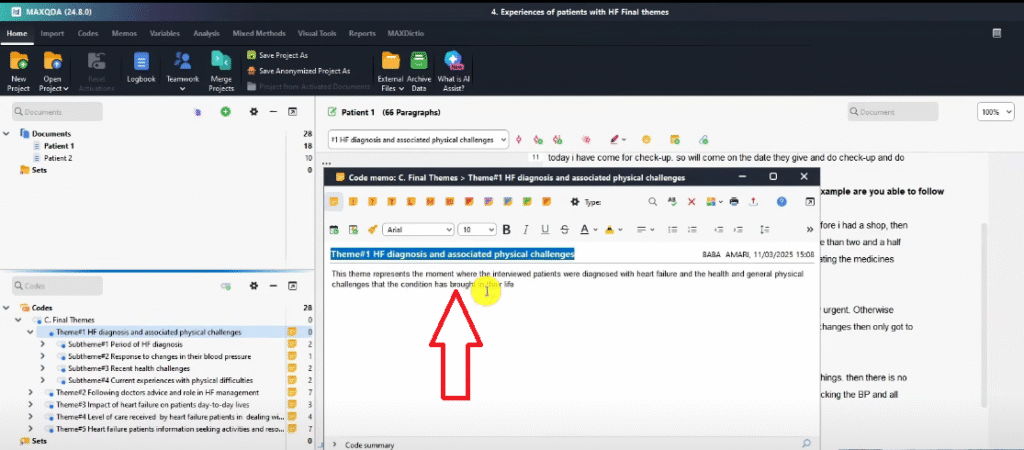
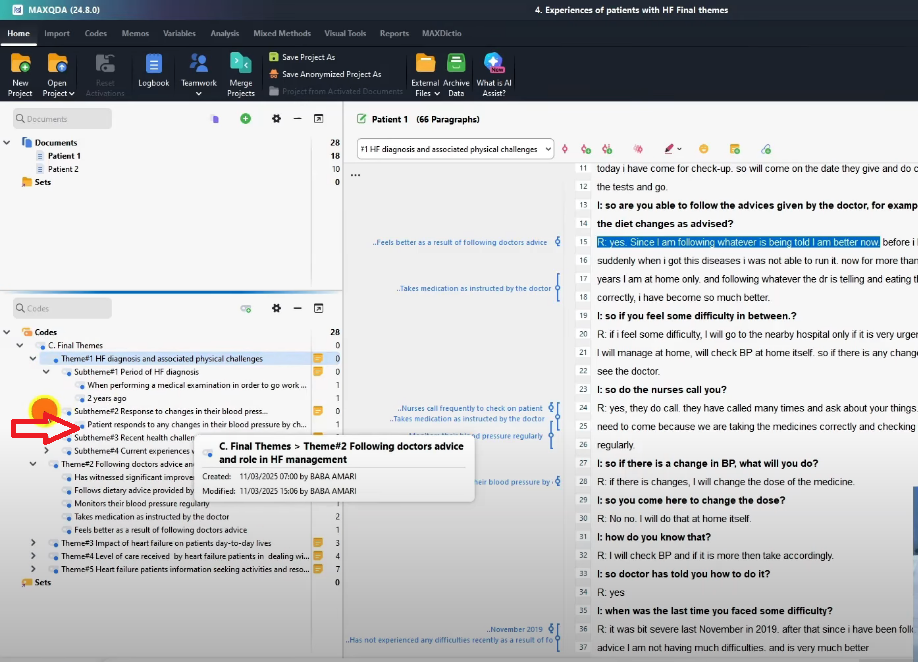
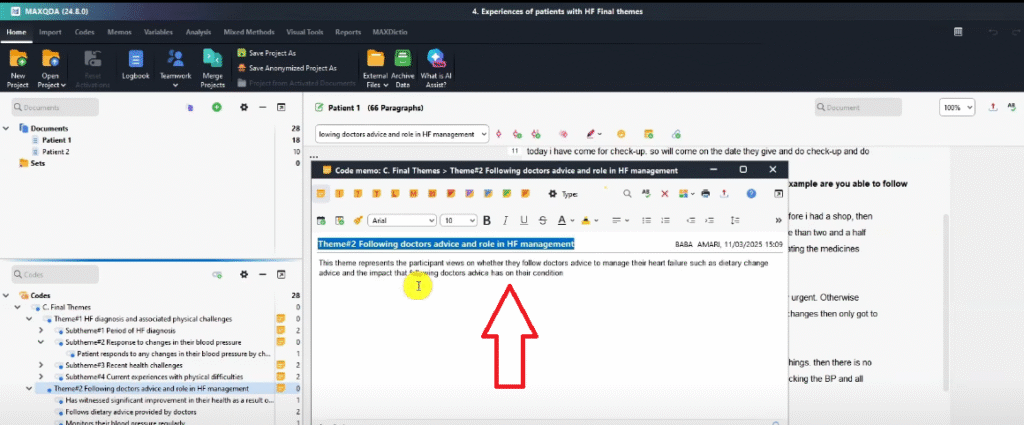
For each preliminary theme, add a memo — MAXQDA’s built-in description field. Right-click on the theme, select Memo, and write a clear one-to-two sentence description of what this theme represents.
This is a critical step that many beginners skip. The memo serves two purposes: it forces you to articulate the theme’s boundaries clearly, and it gives you ready-made text to use when writing up your findings chapter. The discipline of writing a good memo at this stage saves hours during write-up.
Step 4 — Review and Refine Your Themes
Create another copy of your project and rename it ‘Reviewed Themes’. This step is about critically evaluating whether your preliminary themes truly answer your research questions.
Go back to your research objectives. For the heart failure study, the central question was: what are the experiences of patients living with heart failure? Review each preliminary theme and ask:
- Does this theme directly address the research question?
- Is this theme meaningfully distinct from the others, or does it overlap significantly?
- Are the codes under this theme genuinely coherent, or have I grouped them loosely?
- Do I have enough data supporting each theme to write a substantive section in my report?
This recursive process of refining is what Braun and Clarke call reflexivity — you’re actively interrogating your own analytical decisions rather than treating coding as a mechanical exercise. It’s the step that separates strong qualitative analysis from superficial pattern-matching.
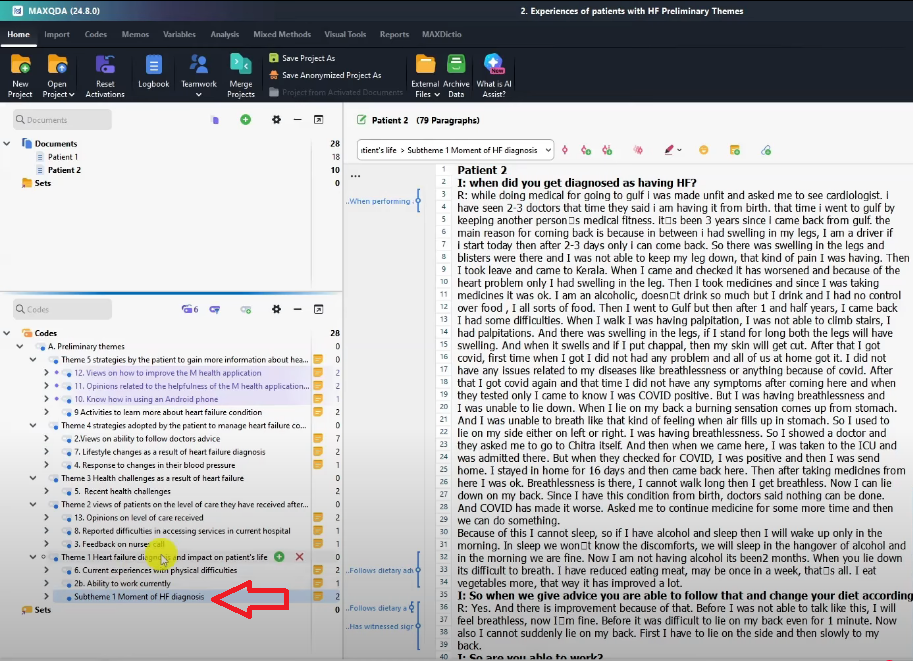
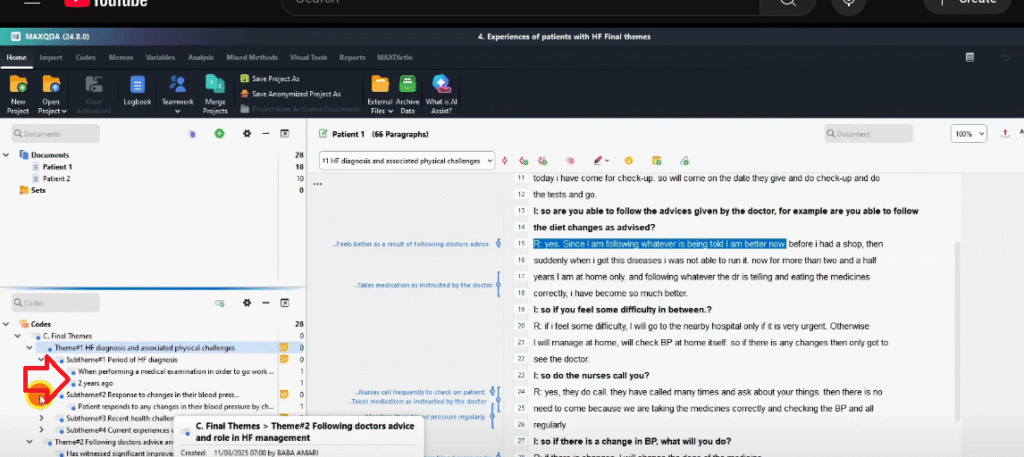
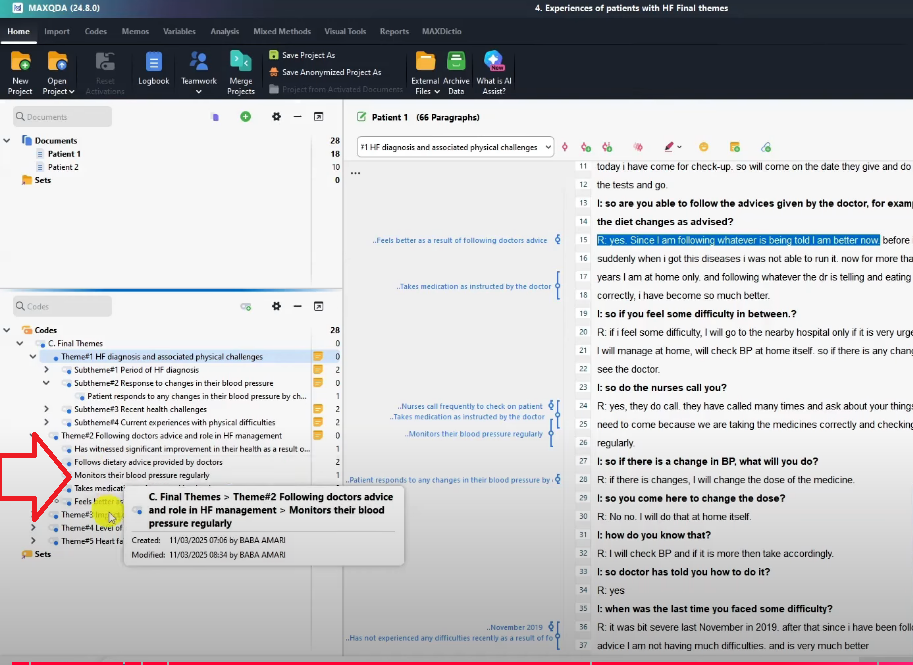
In MAXQDA, you can also begin converting your question containers into sub-themes at this stage. Right-click on a container, go to Properties, and rename it to reflect its role as a sub-theme rather than a question label. Sub-themes sit inside themes and add a layer of granularity to your analysis.
Step 5 — Define and Name Your Final Themes
Step 6 — Produce the Findings Report
Exporting the Code System from MAXQDA
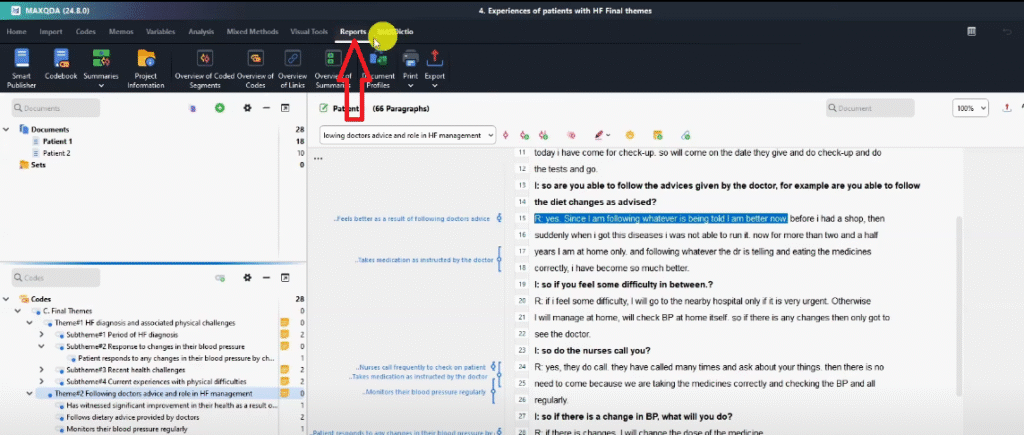
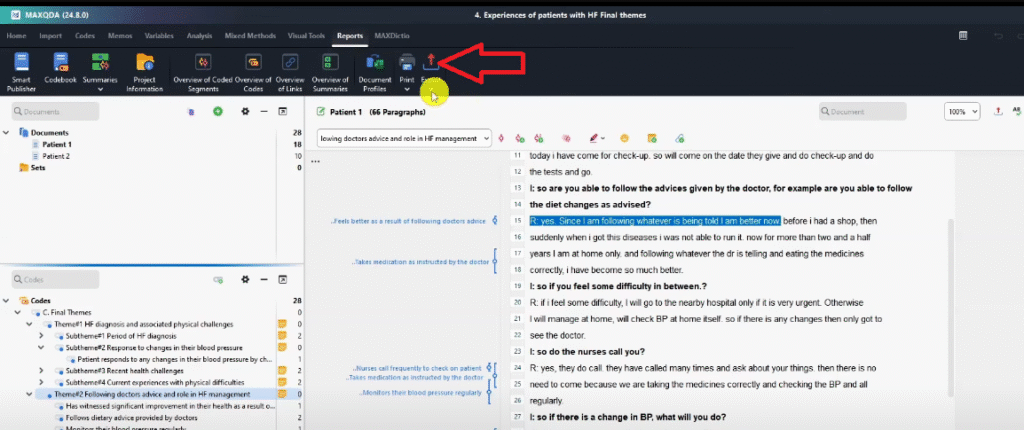
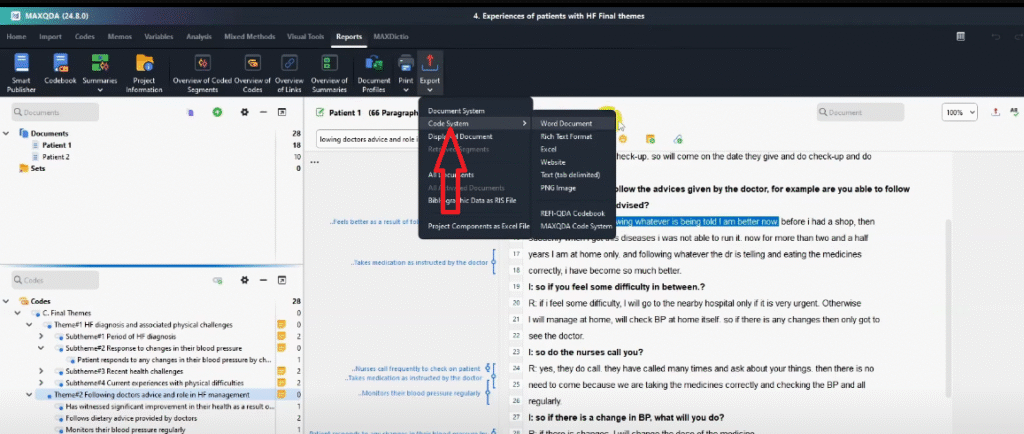
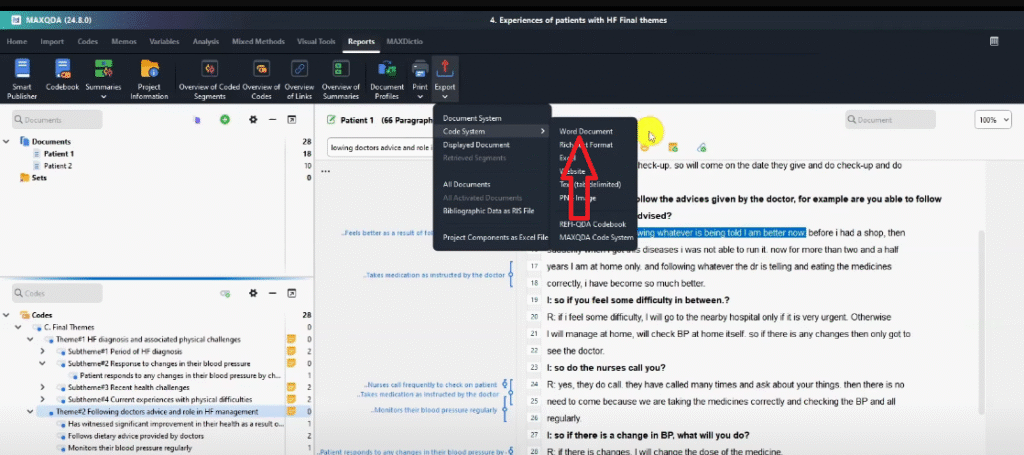
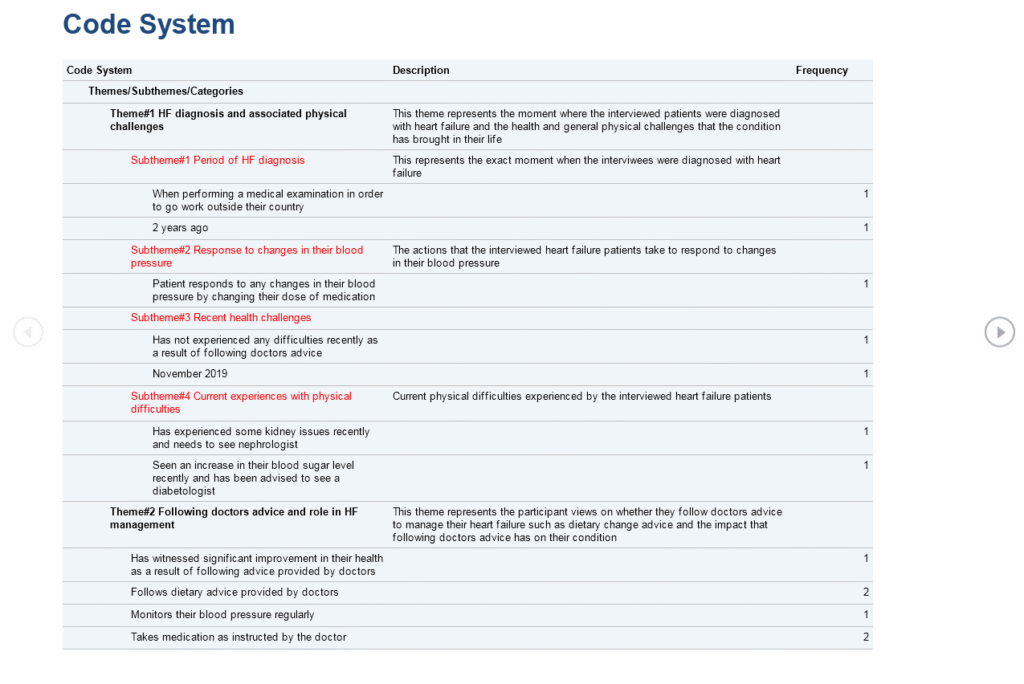
The code system — also called the codebook — is the first thing to export. Go to Reports → Export → Code System. Select Word document format. In the export options, make sure to include memos — these will become the theme descriptions in your report.
The exported code system shows your full analytical structure: themes, sub-themes, codes, and descriptions. This becomes the table in your findings chapter that shows examiners exactly how your analysis was conducted.
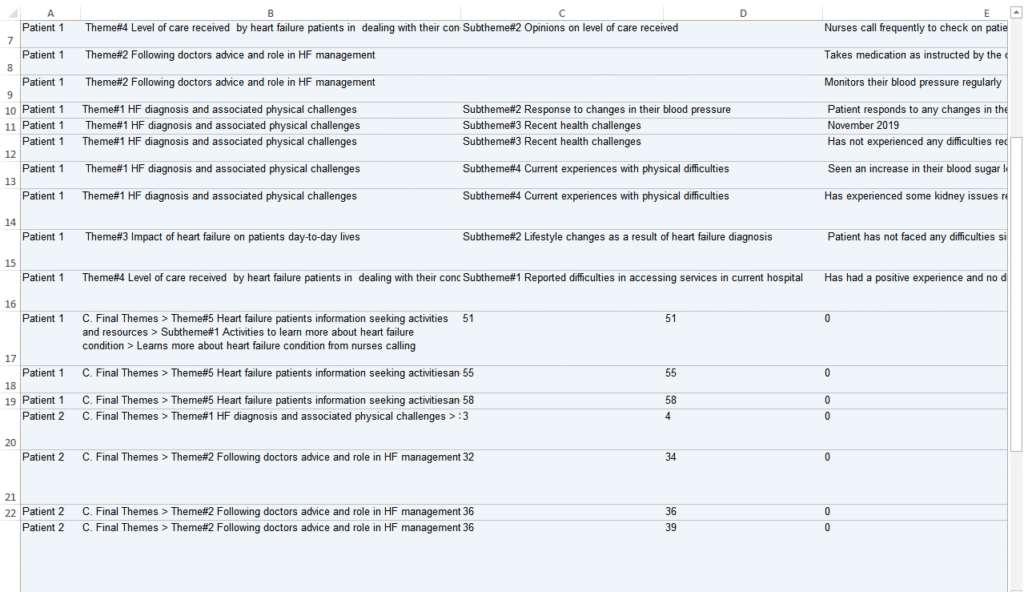
Exporting Coded Segments as an Excel File
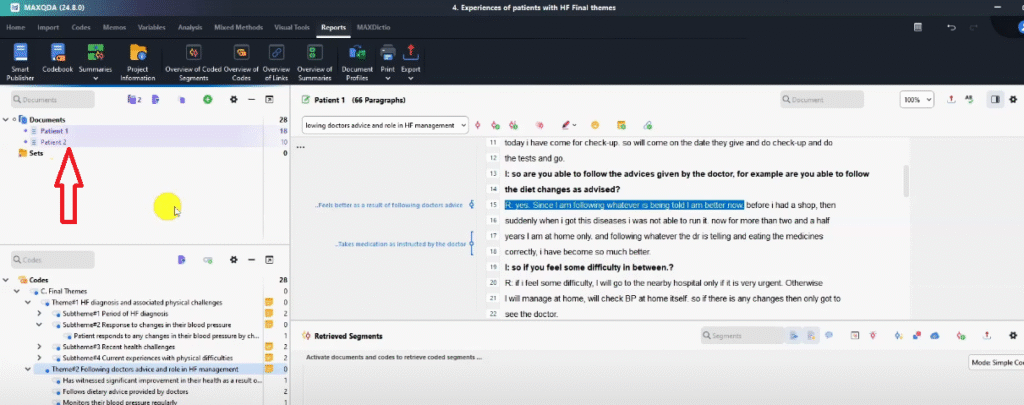
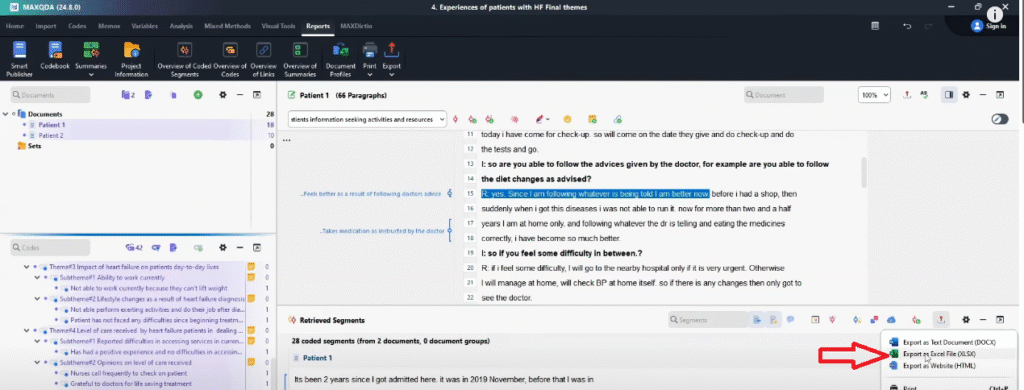
Next, export your coded segments — the actual participant quotes assigned to each code. To do this, first activate all your documents by holding Ctrl and clicking each one. Then activate all your themes and their sub-codes the same way.
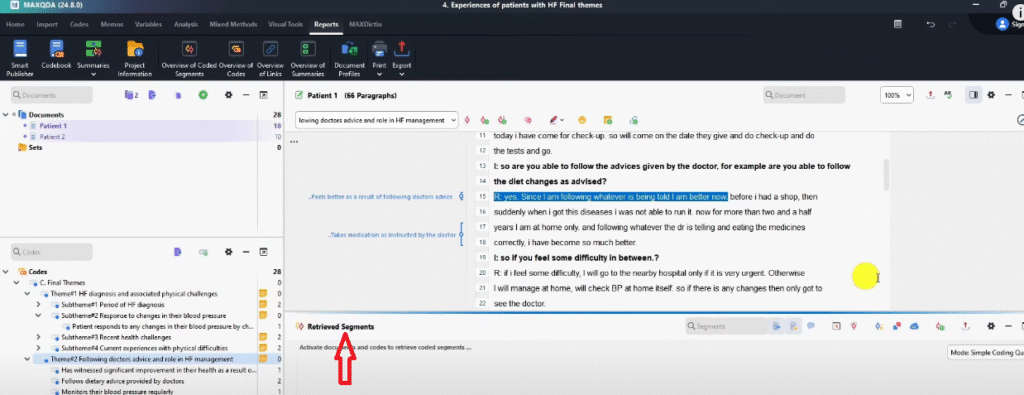
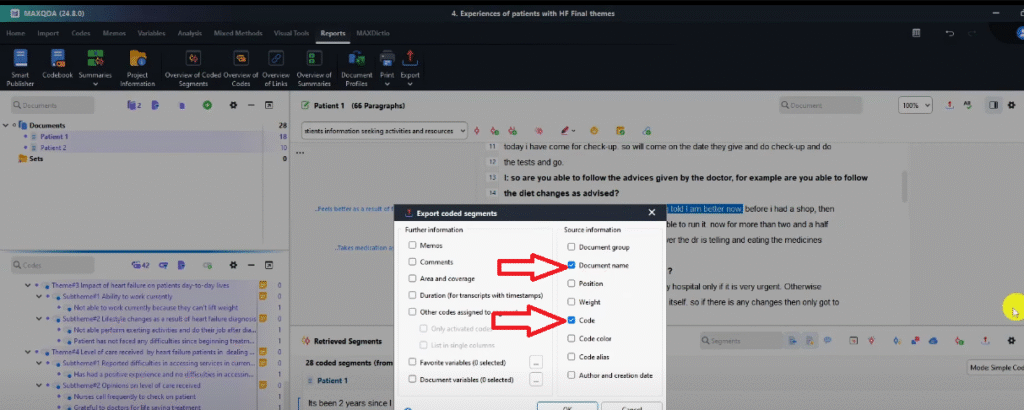
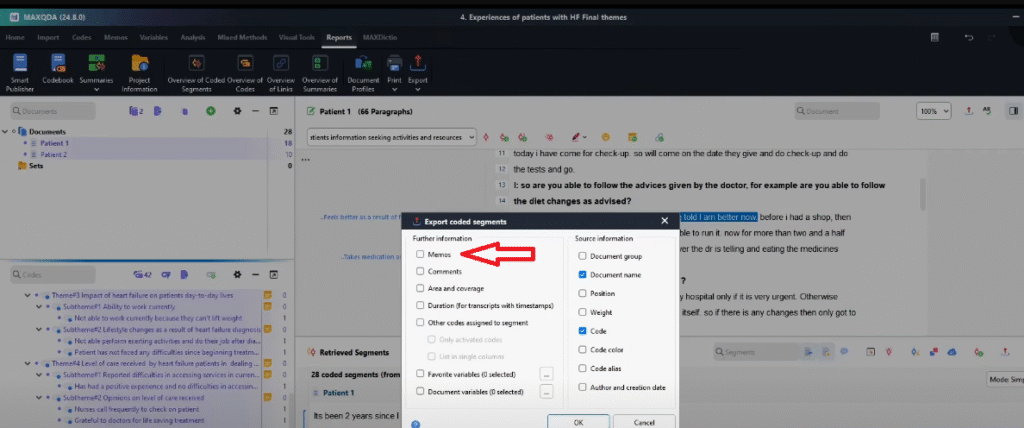
Once everything is activated, go to the Retrieved Segments panel → Export → Excel file. In the export options, select Document Name and Code, and deselect memos. Save the file.
The resulting Excel file shows: theme → sub-theme → code → participant quote. This is your evidence file — you’ll draw on it constantly when writing the narrative discussion of each theme. It saves hours of manually hunting through transcripts for supporting quotes.
Writing the Findings Narrative
With your code system and coded segments exported, you’re ready to write. Your findings chapter has two main sections:
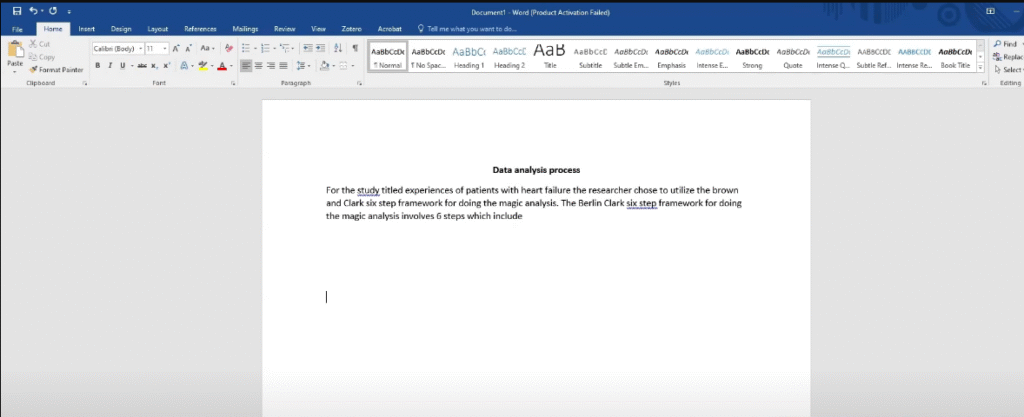
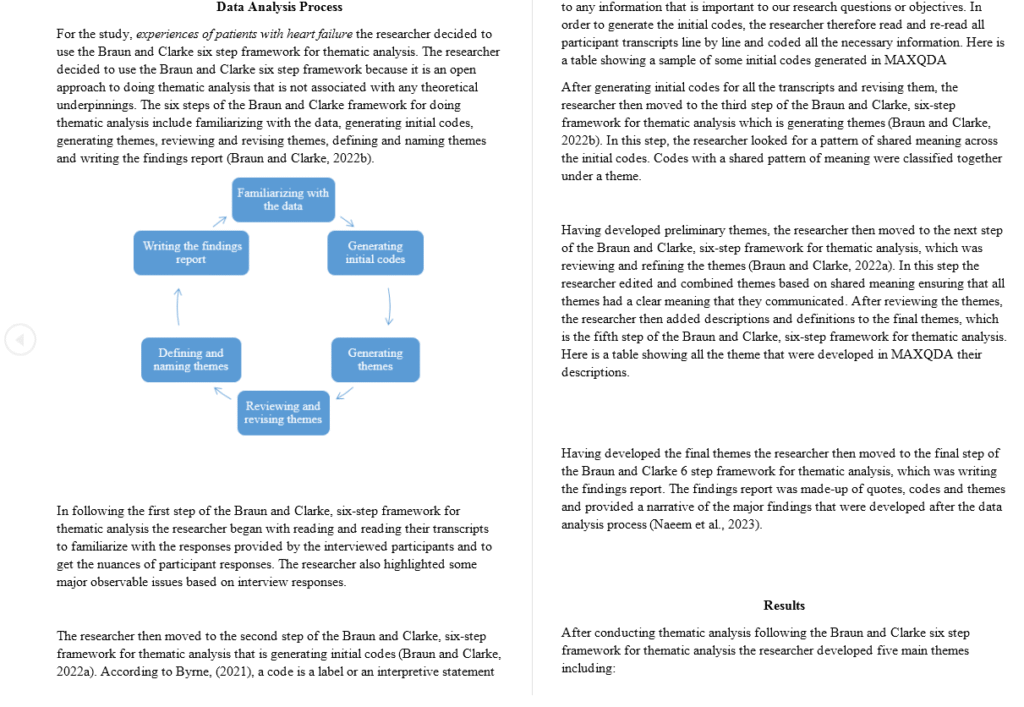
Data analysis process: Describe how you conducted the analysis. For example: “For the study titled Experiences of Patients with Heart Failure, the researcher conducted reflexive thematic analysis following the six-step framework developed by Braun and Clarke (2006). The analysis proceeded through familiarization, initial coding, theme development, theme review, theme definition, and the production of this findings report.” Write this in past tense.
Thematic findings: Introduce all five themes, then discuss each one in a dedicated section. Open each section with the theme’s memo description, then explain the sub-themes and codes, and support every claim with a direct participant quote drawn from your coded segments Excel file.
For a detailed example of how a complete findings report is structured, see my guide on how to analyze interview transcripts in qualitative research, which includes a sample findings chapter you can use as a reference.
Exporting Visualizations from MAXQDA
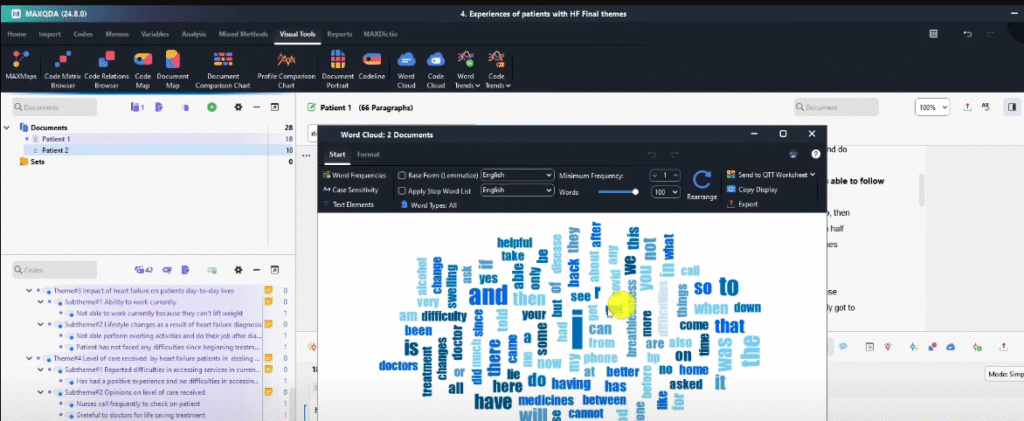
MAXQDA offers two built-in visualizations you may want to include in your report:
- Word cloud: Go to Visual Tools → Word Cloud, then drag your documents into the panel and click OK. This generates a frequency-based word cloud of your transcript data. I rarely include these in academic reports as they add limited analytical value, but some supervisors find them useful for overview sections.
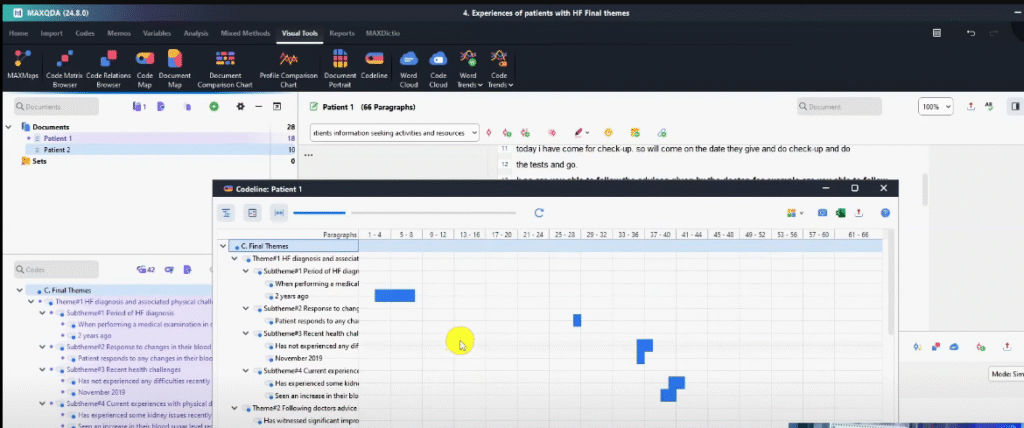
- Code line: Go to Visual Tools → Code Line. This produces a visual showing which codes appear at which line numbers across your transcripts. It’s useful for demonstrating coding density and distribution in your methodology section.
Personally, I prefer drawing custom charts in Word — they look cleaner and are easier to format to journal or thesis requirements. But both MAXQDA visualizations can be exported (Ctrl+Shift+E) and inserted into your document.
Frequently Asked Question
Is MAXQDA free to use?
MAXQDA is not free but offers a 14-day free trial with access to all features. Student and academic licences are available at reduced cost, and many universities provide institutional licences. Visit maxqda.com to check current pricing and trial options.
What’s the difference between MAXQDA and NVivo?
Both are CAQDAS tools with similar core functions — importing data, coding, theme development, and visualization. MAXQDA is widely considered more intuitive for beginners and has a cleaner interface. NVivo has a slightly steeper learning curve but offers some additional features for large datasets. For a full comparison, see my guide on the best qualitative data analysis software tools.
Do I have to use Braun and Clarke’s framework with MAXQDA?
No. MAXQDA is a tool, not a methodology — you can use it with any qualitative analysis approach, including grounded theory, content analysis, framework analysis, or IPA. Braun and Clarke’s reflexive thematic analysis is used in this tutorial because it’s the most widely adopted approach for PhD interview data, but the MAXQDA functions described here apply to any coding-based method.
How many codes should I generate before looking for themes?
There’s no fixed number. For a small dataset of two to four interviews, 20–40 codes is typical. For 10–15 interviews, you might generate 60–100 initial codes before revision. The key signal to start looking for themes is thematic saturation — when new transcripts stop producing meaningfully new codes.
What is the difference between a sub-theme and a code in MAXQDA?
In MAXQDA, the hierarchy is: Theme → Sub-theme → Code → Participant Quote. A theme is the highest-level pattern. A sub-theme is a distinct facet of that theme. A code is the specific label attached to an individual data segment. In practice, some themes will have sub-themes and some will connect directly to codes — both structures are valid depending on the data.
Can I use the question-as-containers method for deductive analysis?
Yes. Using questions as containers works well for both inductive and deductive approaches. For a deductive analysis, you would set up your theory-based codes as containers before reading the data, then assign data segments to those pre-defined codes. For a full walkthrough of the deductive approach, see my guide on deductive thematic analysis with examples.
Key Takeaways
- Qualitative analysis with MAXQDA follows the same core logic as any thematic analysis — the software organizes and speeds up the process, but the intellectual work of coding and meaning-making is always yours
- Save multiple copies of your MAXQDA project at each stage (Initial Codes, Revised Codes, Preliminary Themes, Final Themes) — these serve as an audit trail demonstrating your analytical rigor
If you’d prefer to have an expert handle the analysis, I offer a done-for-you thematic analysis service for PhD students and researchers. You can also find more free MAXQDA and NVivo tutorials on the Surviving Research YouTube channel.
![How to Code Qualitative Data in MAXQDA [Step-by-Step Guide]](https://survivingresearch.com/wp-content/uploads/2024/08/Maxqda-Tutorial.webp)
![Is AI Ethical for Qualitative Data Analysis? [Tested]](https://survivingresearch.com/wp-content/uploads/2025/04/Can-I-use-AI-to-do-qualitative-coding-ethically.jpg)
Pingback: MAXQDA Free Training for Beginners: Start Coding Your Data -
Pingback: MAXQDA Visualizations: 8 You Need for Your Research Report -