

Last Updated on 4 months ago by Grace Nyambura
Participant Observation in Qualitative Research: A Guide
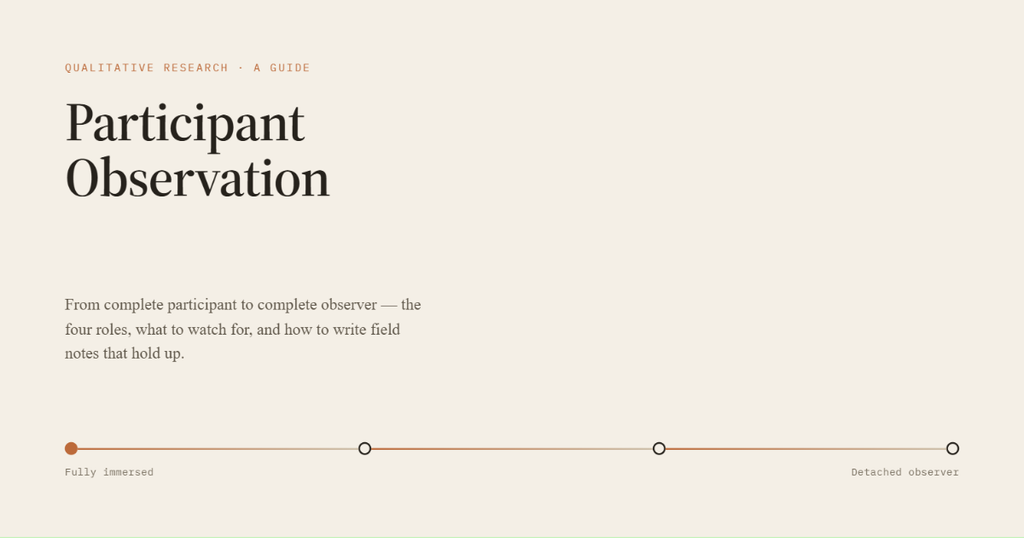
Participant observation is one of the most effective ways to collect data in qualitative research. It involves noting phenomena in field settings using the observer’s senses, sound, sight, smell, and touch, and recording those observations with a note-taking instrument for research purposes. This guide covers the four types of observational roles, what to watch for in the field, and step-by-step tips for conducting participant observation well.
- Participant Observation in Qualitative Research: A Guide
- What Is Participant Observation?
- The Four Types of Observational Roles
- What to Watch For During an Observation
- Step-by-Step Tips for Conducting Participant Observation
- Common Challenges in Participant Observation
- Common Mistakes to Avoid in Participant Observation
- Frequently Asked Questions
- Key Takeaways
- Get Help Analyzing Your Observation Data
What Is Participant Observation?
Participant observation is a qualitative data collection method where the researcher immerses themselves, to varying degrees, in the setting or group being studied (Creswell & Poth, 2018). The purpose of your study and your research questions determine what you observe: the participants, the physical setting, interactions, activities, conversations, and even your own behavior as the observer.
Since writing down everything is impossible, start with a broad focus and narrow in on what relates to your research questions or purpose as the observation continues.
The Four Types of Observational Roles
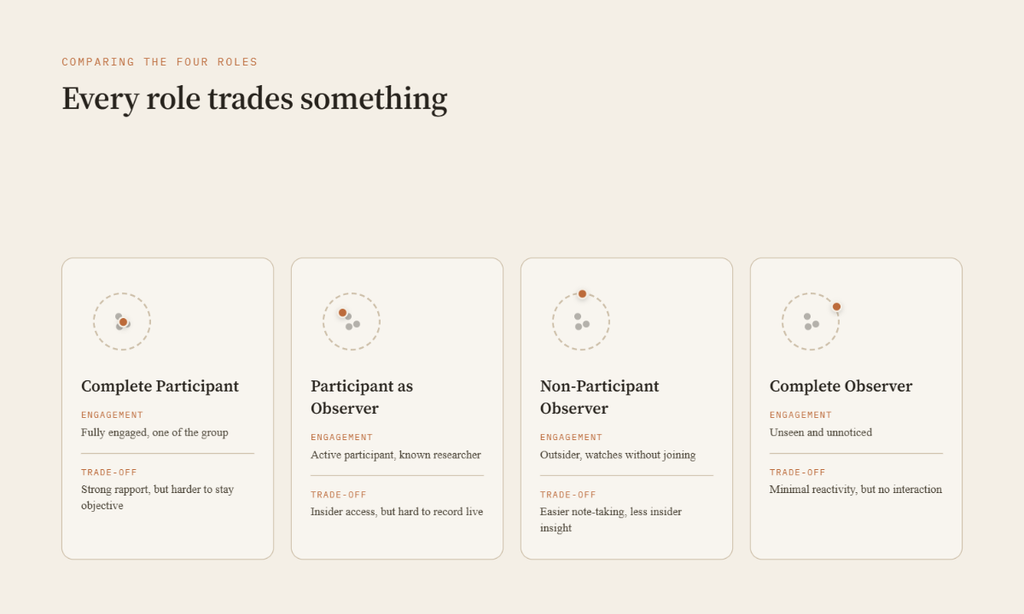
The extent to which an observer is engaged in what they’re observing determines their observation type. There are four main roles:
- Complete participant
- Participant as observer
- Non-participant observer
- Complete observer
Complete Participant
A complete participant is fully engaged with the people they’re observing. This full engagement can help the observer build stronger rapport with the group, though it also makes maintaining research distance harder.
Participant as Observer
Here, the participant role is more prominent than the researcher role. Being an active participant can give the researcher subjective data and insider views that an outsider wouldn’t access, but it can also make it difficult to record data in real time while engaged in the activity.
Non-Participant Observer
The researcher remains an outsider to the group being studied. They watch the group and take field notes without interfering in group activities.
Complete Observer
The researcher is neither noticed nor seen by the people they’re studying. In practice, a researcher’s role often shifts during a study, for example moving from non-participant to participating observer and back, existing on a continuum between complete outsider and complete insider.
| Role | Researcher’s Engagement | Main Trade-off |
| Complete participant | Fully engaged, indistinguishable from the group | Strong rapport, but harder to stay objective |
| Participant as observer | Active participant, known researcher role | Insider access, but harder to record data live |
| Non-participant observer | Outsider, watches without joining in | Easier note-taking, less insider insight |
| Complete observer | Unseen and unnoticed by the group | Minimal reactivity, but no direct interaction |
What to Watch For During an Observation
Beyond choosing a role, researchers conducting participant observation need to stay alert to a few recurring issues:
- Impression management — participants may behave differently because they know they’re being watched.
- Potential deception by the people being observed.
- Being marginalized as an outsider in an unfamiliar observation setting.
Step-by-Step Tips for Conducting Participant Observation
- Select the ideal sites for your observations and obtain all necessary permissions to access them.
- After gaining access, decide what to observe, who to observe, the time of day, and the length of each observation session. A gatekeeper can help you gain access to the observation group.
- Determine which type of observation you’ll use, from complete participant to complete observer, based on your research questions.
- Develop and use an observation protocol to record field notes, clearly marked with the date, place, and time of each observation.
- Take time to build initial rapport with the people you’re observing, or have someone known to the group introduce you. Consider starting with limited objectives, observing more and noting less, during your first few sessions.
- Keep detailed records: the physical setting, portraits of participants, specific activities and events, and your own reactions as the observer. Include clear descriptions, personal reflections, and initial interpretations.
- Follow good observation procedures: withdraw properly from the site, thank participants, and update them on how their data will be used and how they can access the results.
- After each observation, prepare rich, narrative field notes describing the people and events you observed in full.
Common Challenges in Participant Observation
Even with a solid protocol, participant observation carries a few consistent challenges: balancing genuine engagement against maintaining analytical distance, managing your own biases as they surface in real time, and the practical difficulty of writing detailed notes while staying present in the setting. Planning your role on the participant-observer continuum in advance, and reviewing it as the study progresses, helps manage all three.
It also helps to debrief with a supervisor or peer periodically during longer observation studies. Talking through what you’re seeing, and how you’re reacting to it, is one of the simplest ways to catch bias before it shapes your field notes too heavily.
Common Mistakes to Avoid in Participant Observation
A few habits consistently undermine otherwise well-designed observational studies:
- Trying to record everything: a broad, unfocused note-taking approach produces mountains of low-value data. Narrow to what actually relates to your research questions.
- Skipping the observation protocol: without a written protocol, note-taking style drifts between sessions, making later coding and comparison much harder.
- Ignoring your own reactions: your reactions and initial interpretations are data too. Leaving them out of your field notes loses valuable reflexive insight.
- Rushing rapport-building: jumping straight into detailed note-taking before participants are comfortable can change how people behave around you. Start with limited objectives.
- Delaying write-ups: waiting days to turn rough notes into full field notes loses detail and nuance. Write them up as soon as possible after each session.
Frequently Asked Questions
What is the difference between participant observation and other qualitative methods?
Participant observation involves the researcher immersing themselves directly in a setting, while methods like interviews or focus groups rely on a single structured interaction rather than sustained presence in the field. Scribbr’s explainer on participant observation breaks down this distinction with examples.
How long should a participant observation study last?
There’s no fixed duration. It depends on your research questions and when you reach data saturation, the point where new observations stop revealing new insights. Some studies run a few sessions; ethnographic studies can run for months.
Can I combine participant observation with interviews?
Yes. Many qualitative researchers pair observation with informal or semi-structured interviews with the people they’re observing, which helps cross-check what they see against what participants say. See our tips on conducting the best interviews in qualitative research for guidance on that side of data collection.
Do I need ethics approval for participant observation?
In most institutions, yes. Because participant observation involves observing and recording people’s behavior, often in naturalistic settings, ethics boards typically require a clear plan for informed consent, confidentiality, and how you’ll protect participants who may not always remember they’re being observed. Check your institution’s research ethics requirements before entering the field.
What should I include in my field notes?
Strong field notes describe the physical setting, the people present, the activities and conversations you observed, and your own reactions and initial interpretations as the researcher. Aim to write them up in full as soon as possible after each session, while the details are still fresh.
Key Takeaways
- Participant observation sits on a continuum from complete participant to complete observer, and your role can shift during a study.
- Match your observation role to your research questions, not the other way around.
- Use a written observation protocol so every session captures the date, place, time, and focus consistently.
- Watch for impression management and your own bias, both can distort what you record.
- Write up rich, narrative field notes as soon as possible after each session.
Get Help Analyzing Your Observation Data
Once your field notes are written up, the next step is coding them and identifying themes, the same process used for interview transcripts.