

Last Updated on 4 months ago by Grace Nyambura
Qualitative Research Questionnaire Example (2026 Guide)
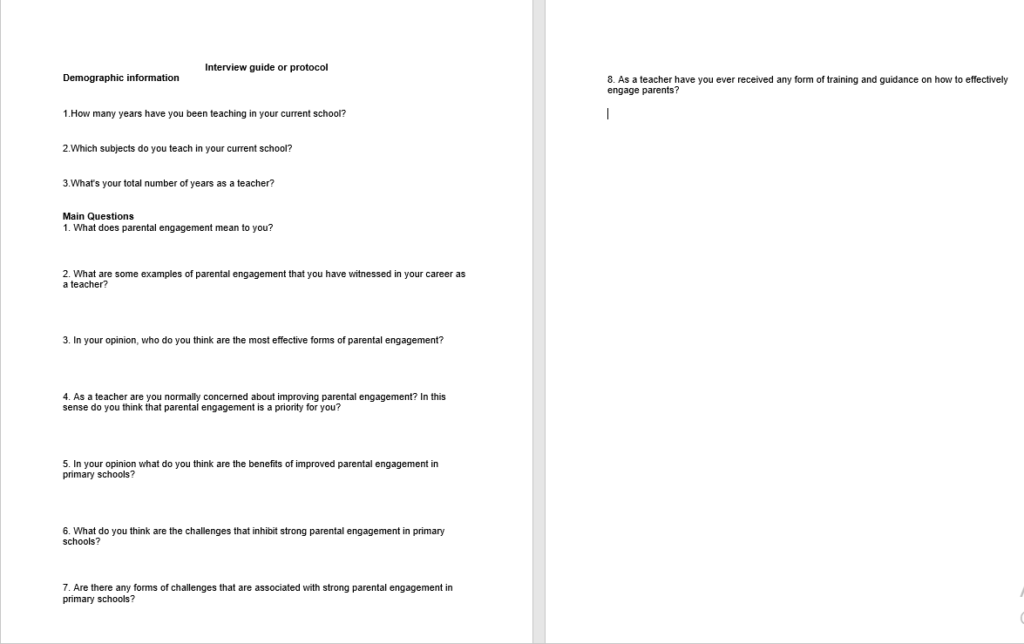
If you searched for a qualitative research questionnaire example, here’s the short version: in qualitative research we don’t actually call it a questionnaire — we call it an interview guide or interview protocol. This article shows you a full worked example, built from real research objectives, so you can copy the structure for your own study.
- Qualitative Research Questionnaire Example (2026 Guide)
- Questionnaire vs. Interview Guide: What's the Real Difference?
- Step 1: Start With Your Research Objectives
- Step 2: Draft Your Demographic Questions
- Step 3: Turn Each Objective Into an Interview Question
- Common Mistakes When Writing a Qualitative Interview Guide
- Frequently Asked Questions
- Key Takeaways
- Get Expert Help With Your Qualitative Data Analysis
Questionnaire vs. Interview Guide: What’s the Real Difference?
A questionnaire is a quantitative tool — structured, closed questions where participants pick from fixed options like yes/no or a Likert scale. An interview guide (also called an interview protocol) is the qualitative equivalent: a flexible list of open-ended questions used to conduct semi-structured interviews.
Semi-structured interviews differ from structured interviews because they let participants express themselves with fewer limitations. According to SAGE’s Encyclopedia of Qualitative Research Methods, the researcher develops a written interview guide in advance but retains flexibility in how closely they follow it during the actual conversation. That’s the tool this article walks you through building.
Step 1: Start With Your Research Objectives
Every question in your interview guide should trace back to a specific research objective — never write a question first and try to justify it afterward. Here’s the process:
- Write out your research objectives in full before drafting a single interview question.
- For each objective, ask yourself: what would a participant need to tell me for this objective to be addressed?
- Draft one or two questions per objective, using plain, open-ended language your participants will understand.
Step 2: Draft Your Demographic Questions
Before the main questions, open with demographic questions relevant to your participant group. In the worked example below, the study interviews teachers about parental engagement, so the demographic section collects information specific to teachers — years of experience, grade level taught, and school type — rather than generic demographic data that doesn’t serve the research objectives.
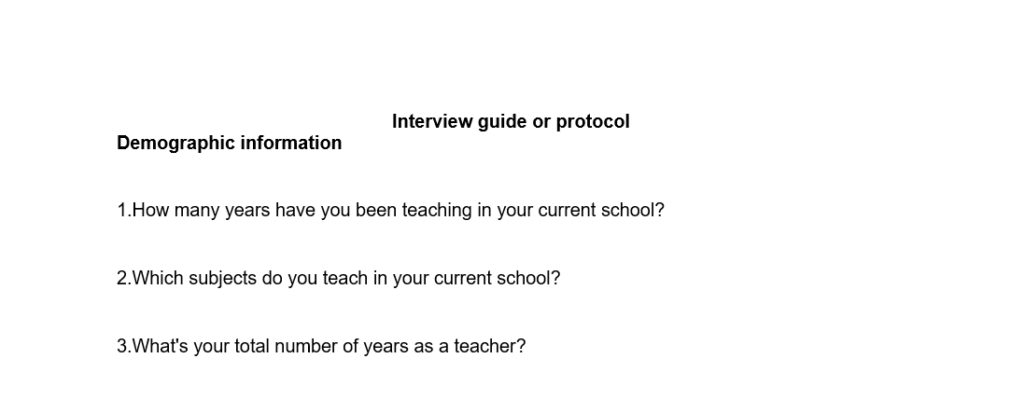
Demographic questions section of a qualitative interview guide for teachers in a primary school study
Step 3: Turn Each Objective Into an Interview Question
This is the core skill: converting an abstract research objective into a concrete, answerable question. Below is a full worked example so you can see the pattern in action.
Full Worked Example — Parental Engagement Study
The study objective is: evaluating the importance of parental engagement in a large English primary school. Participants are teachers. Here’s how each objective maps to a question:
- Objective: Determine what parental engagement means to teachers → Question: “What does parental engagement mean to you?”
- Objective: Highlight the most effective forms of parental engagement → Question: “What are some examples of parental engagement you have witnessed in your career as a teacher?” with a follow-up: “In your opinion, what do you think are the most effective forms of parental engagement?”
- Objective: Determine whether the teacher has prioritized parental engagement → Question: “As a teacher, are you normally concerned about improving parental engagement?” with a follow-up: “Do you think that parental engagement is a priority for you?”
- Objective: Evaluate the benefits of strong parental engagement in schools → Question: “In your opinion, what do you think are the benefits of improved parental engagement in primary schools?”
- Objective: Evaluate the challenges associated with strong parental engagement → Question: “What do you think are the challenges that inhibit strong parental engagement in primary schools?” with a follow-up: “Are there any other forms of challenges associated with strong parental engagement in primary schools?”
- Objective: Highlight examples of training and guidance teachers have received in relation to parental engagement → Question: “As a teacher, have you ever received any form of training and guidance on how to effectively engage parents?”

First study objective: determining what parental engagement means to teachers

Interview guide question 1: “What does parental engagement mean to you?”

Interview guide question 2 asking teachers for examples of parental engagement witnessed

Question 2 in the Interview Protocol

Interview guide question 3 asking teachers about the most effective forms of parental engagement

Third study objective: determining whether teachers prioritize parental engagement

Interview guide question 4 asking teachers if they are concerned about improving parental engagement

Fourth study objective: evaluating the benefits of strong parental engagement in schools

Interview guide question 5 asking teachers about the benefits of improved parental engagement
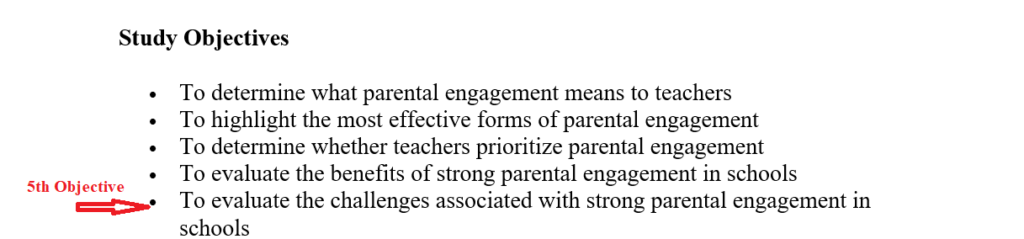
Fifth study objective: evaluating the challenges associated with strong parental engagement

Interview guide question 6 asking teachers about challenges inhibiting parental engagement
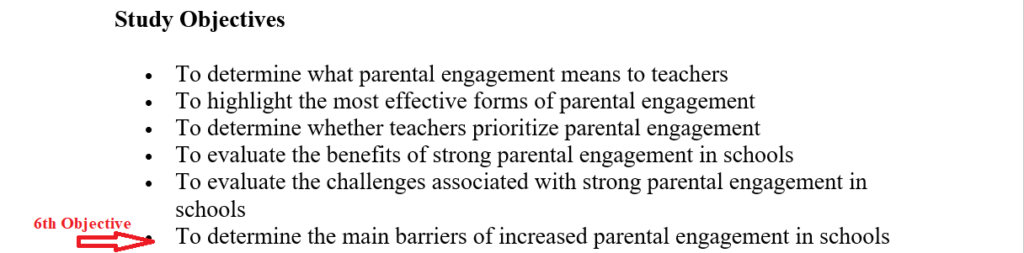
Sixth study objective: further evaluating challenges associated with parental engagement
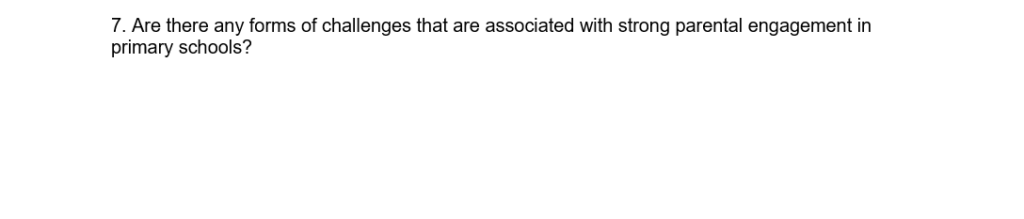
Interview guide question 7 asking teachers about additional challenges to parental engagement
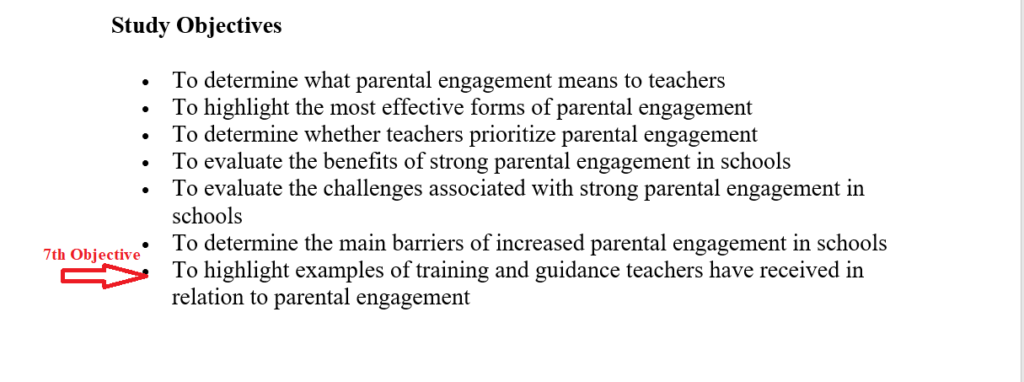
Seventh study objective: highlighting training and guidance teachers received on parental engagement
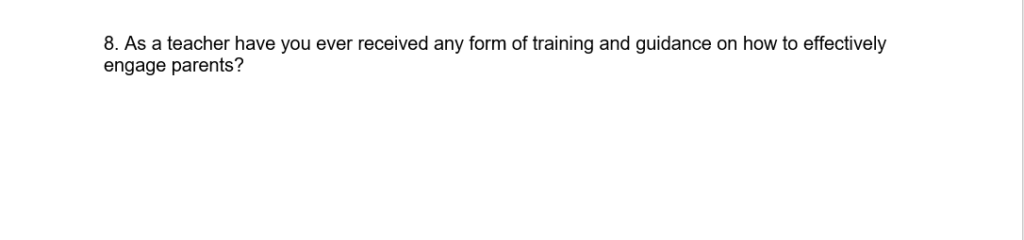
Interview guide question 8 asking teachers about training received on engaging parents
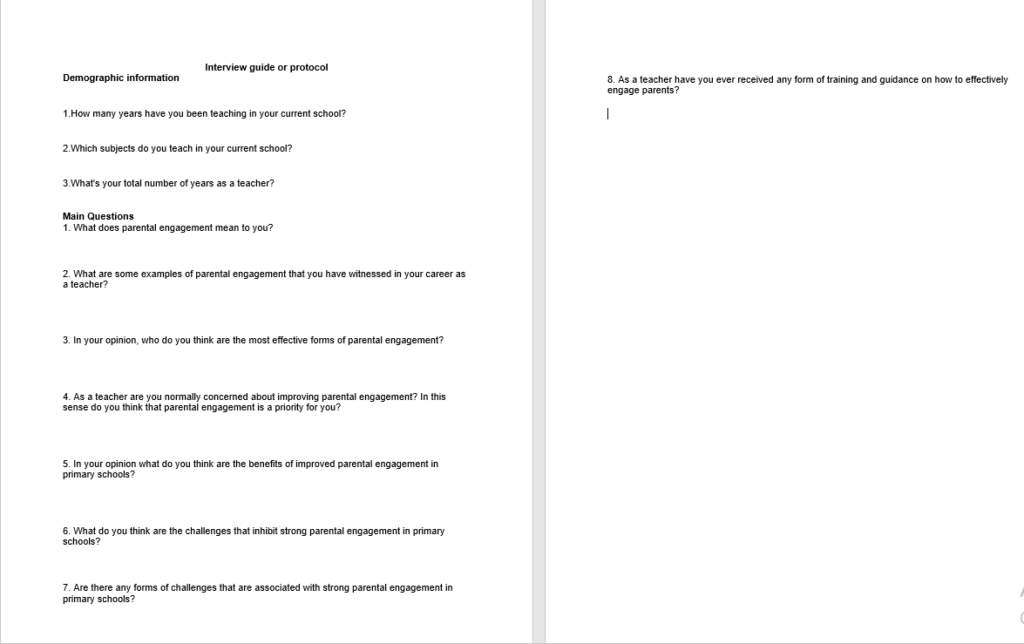
Completed qualitative research interview guide for the parental engagement study
Notice the pattern: each question is written in plain, open language — never a leading or yes/no question — and every question leaves room for a follow-up if the participant’s answer opens up something worth probing further. Once you’ve collected your responses, you’ll move into coding. If you want a full walkthrough of that next step, see Qualitative Coding of Interviews with NVivo.
Common Mistakes When Writing a Qualitative Interview Guide
- Calling it a “questionnaire” in your methodology chapter — examiners expect the correct term: interview guide or interview protocol.
- Writing closed, yes/no questions — these belong in quantitative questionnaires, not qualitative interview guides.
- Skipping the objective-to-question mapping step and writing questions that sound good but don’t actually address any research objective.
- Treating the guide as a rigid script instead of a flexible tool — semi-structured interviews are meant to allow follow-up questions based on what the participant says.
For more on structuring your questions around the “golden thread” of aims, objectives, and questions, Grad Coach’s guide to qualitative interviews walks through this in detail, and Scribbr’s guide to semi-structured interviews is a good refresher on how this interview type compares to structured and unstructured approaches.
Frequently Asked Questions
Is it wrong to call it a questionnaire in qualitative research?
Technically, yes. A questionnaire implies structured, closed questions typical of quantitative research. In qualitative research, the correct term is interview guide or interview protocol — even though many students search for “questionnaire” when looking for this exact template.
How many questions should a qualitative interview guide have?
Most semi-structured interview guides work well with one primary question per research objective, plus optional follow-up questions. In the worked example above, seven objectives produced eight core questions with several built-in follow-ups.
Can I use the same interview guide for every participant?
Yes, that’s the point of a semi-structured approach — the same guide keeps your interviews comparable, while the flexibility to ask follow-up questions lets each conversation go deeper where it matters.
Key Takeaways
- In qualitative research, it’s called an interview guide or interview protocol — not a questionnaire.
- Every question should map back to a specific research objective — write objectives first, questions second.
- Open with demographic questions relevant to your specific participant group.
- Use plain, open-ended language and build in follow-up questions rather than treating the guide as a fixed script.
Get Expert Help With Your Qualitative Data Analysis
If you’re building your interview guide and want feedback before you start collecting data — or you’ve already got transcripts and need help coding them — reach out and let’s get your data working for you.


Pingback: How to Code Qualitative Data in MAXQDA [Step-by-Step Guide] -