

Last Updated on 4 months ago by Bernard Mugo
How to Choose the Right Qualitative Research Method
Before you conduct qualitative research, you need to decide which qualitative research method, also called your research strategy, you’ll use. This guide presents the five most common qualitative research methods, compares them side by side, and walks through how to actually pick the right one for your study.
- How to Choose the Right Qualitative Research Method
What Is a Qualitative Research Method?
A qualitative research method is the overall strategy or design you use to investigate your research problem. It shapes how you define your research focus, what counts as data, how you collect it, and how you analyze it. Choosing the right one first makes every later decision, from your interview protocol to your analysis approach, more straightforward.
There are five common qualitative research methods, approaches, or designs:
- Narrative research
- Phenomenological research
- Grounded theory research
- Ethnographic research
- Case study research
The Five Common Qualitative Research Methods
Narrative Research
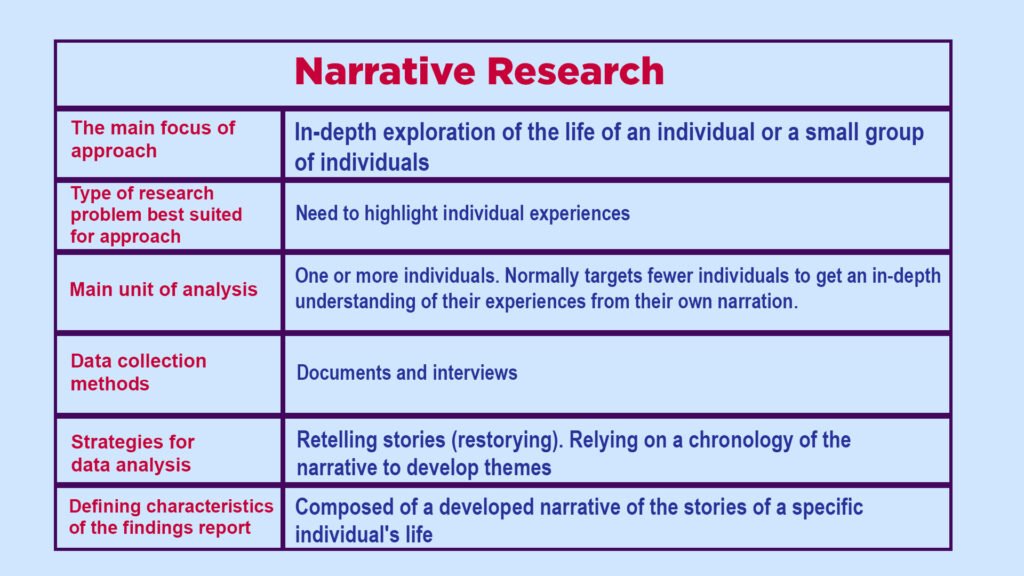
Narrative research highlights the experiences of individual study subjects as expressed in their told stories and lived experiences. A narrative involves written or spoken text providing a chronologically connected account of a series of events or a single event.
Researchers using this method typically study one or two individuals, gather data by collecting their stories, and report on individual experiences in chronological order of meaning.
Main features of narrative research:
- Collecting stories from individuals, including documents that capture told and lived experiences.
- A focus on individual experiences, including individual identity and self-perception.
- Attention to the specific situations or places where narrative stories occur, including emotional, physical, and social context.
- Data collected through interviews, documents, observation, and pictures, among other sources.
- Analysis strategies that categorize stories thematically or structurally.
- Stories interpreted and retold in chronological order, even if participants didn’t tell them that way.
- Attention to turning points, tensions, or interruptions that organize the story.
Phenomenological Research
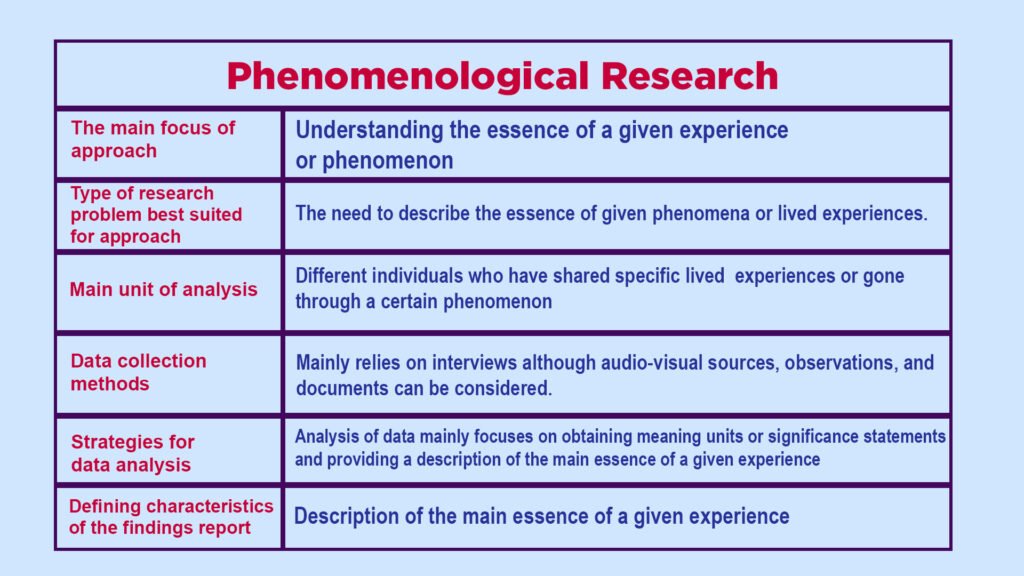
Phenomenological research describes the common meaning several individuals share based on their lived experience of a given phenomenon or concept. The researcher focuses on what all participants have in common as they experience that phenomenon, aiming to reduce their varied experiences to a description of the universal essence of the experience.
For example, a phenomenological study might examine grief, anger, insomnia, or undergoing surgery. The researcher collects data from people who’ve experienced the phenomenon and develops a combined description of what they experienced and how.
Defining features of phenomenological research:
- Significant emphasis on the phenomenon itself, phrased as a single concept such as “grief” or “professional growth.”
- A group of individuals (often 10–15) who have all experienced the phenomenon.
- Data collection mainly through interviews, sometimes supplemented by documents or observation.
- Analysis moving from narrow units (codes) to broader units (themes).
- A descriptive passage discussing the essence of the experience for participants.
Grounded Theory Research
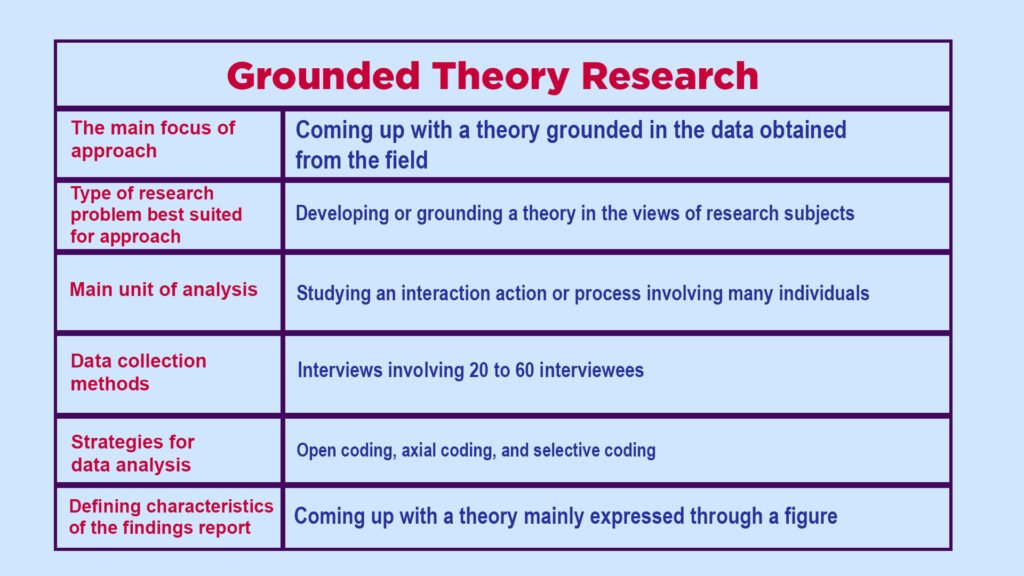
Where narrative research focuses on individual stories and phenomenology on shared experience, grounded theory research moves beyond description to generate or discover a theory, a unified explanation for why certain phenomena occur. Participants need to have experienced the given phenomenon, and the resulting theory explains it or frames further research.
The theory is grounded in the data participants provide. The researcher works to develop a general explanation of a process, interaction, or action shaped by the views of a large number of participants.
- Focuses on an action or process with distinct phases or steps occurring over time.
- Aims to develop a theory, a general explanation of a process or action.
- Involves memoing: writing down ideas as data is collected and analyzed.
- Data analysis happens iteratively and simultaneously, based on need.
- Primary data collection is interviewing, comparing new data against the emerging theory.
- Data collection moves back and forth between participants and the evolving theory.
- Analysis can include axial coding, selective coding, and presenting propositions.
Ethnographic Research
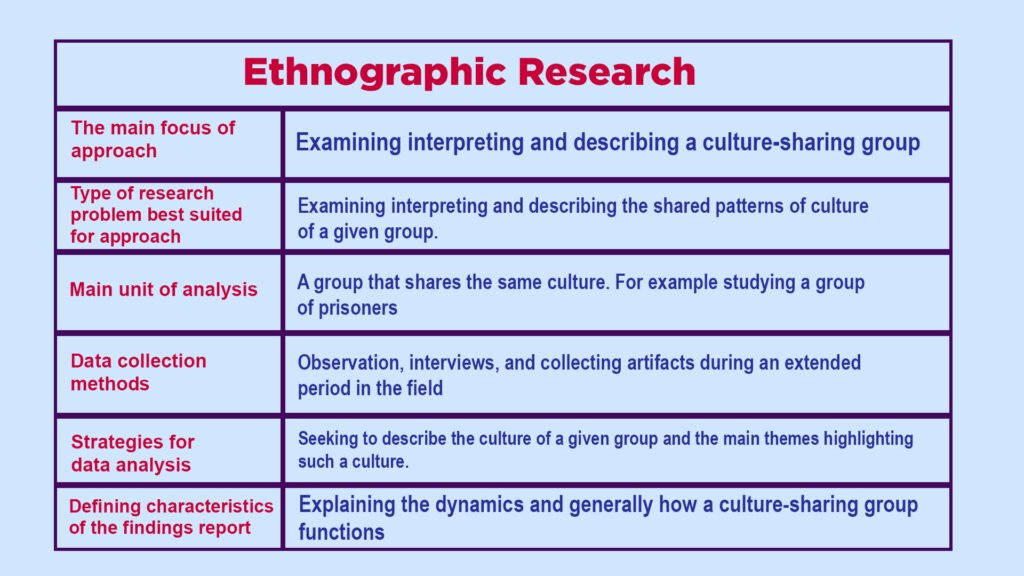
Ethnographic research studies individuals who share a culture, sometimes a small group like social workers, though ethnographic studies typically involve a larger group interacting over time. The researcher describes and interprets shared patterns of behavior, values, language, and beliefs within that culture-sharing group.
Ethnographic research involves extended observation, often true participant observation, where the researcher is immersed in participants’ day-to-day lives and interviews group members.
- Develops a complete, complex description of a group’s culture.
- Requires a culture-sharing group that has interacted long enough to develop studiable social behaviors.
- Looks for patterns in beliefs, ideas, language, and customary behaviors.
- May begin with a theoretical lens, such as acculturation, Marxism, or materialistic theory.
- Analysis relies on participants’ insider views, often including verbatim quotes.
- Results in an in-depth understanding of how the culture-sharing group functions.
Case Study Research
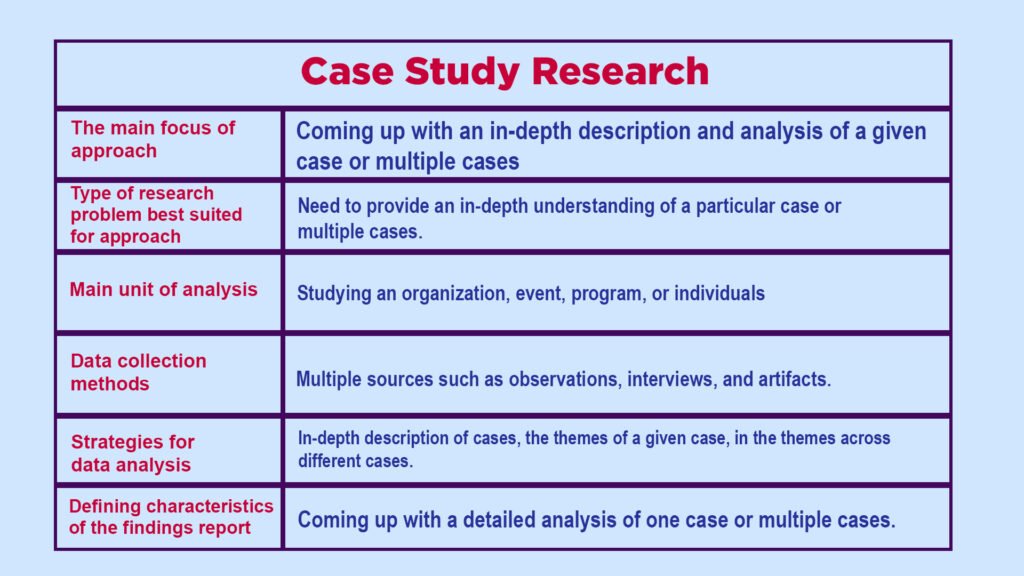
Case study research studies a single case, or multiple cases, within a real-life setting. A case can be an individual, entity, organization, small group, partnership, relationship, community, project, or decision process. The investigator explores a specific bounded system (or systems) over a given period.
Data collection draws on multiple sources: interviews, observations, documents, reports, and audio-visual material. The researcher describes the case(s) and presents dominant themes found during investigation.
- Starts by identifying the specific case to describe and analyze.
- A case is defined within certain parameters, such as location or time frame.
- Provides in-depth understanding of the particular case.
- Integrates multiple forms of qualitative data — a single source is rarely considered enough.
- Analysis focuses on describing the case through identified themes.
- Concludes with assumptions, explanations, patterns, or general lessons learned.
Comparing the Five Qualitative Research Methods
Having looked at each approach individually, here’s how they compare side by side:
| Method | Focus | Typical Sample | Primary Data Source | Example Question |
| Narrative research | One person’s storied experience over time | 1–2 individuals | Stories, documents, interviews | How did a nurse’s career shape her professional identity? |
| Phenomenological research | Shared essence of a lived experience | 10–15 individuals | In-depth interviews | What is the shared experience of parents coping with a child’s chronic illness? |
| Grounded theory | Generating a theory of a process or action | 20–30+ individuals | Interviews, constant comparison | How do first-generation students develop a sense of belonging on campus? |
| Ethnographic research | Shared culture, patterns, and behaviors of a group | A culture-sharing group | Observation, immersion, interviews | How does a hospital ward’s staff culture shape patient care routines? |
| Case study research | In-depth understanding of one or more bounded cases | 1 or more cases | Interviews, documents, observation, artifacts | How did one school implement a new literacy program? |
How to Choose the Right Method for Your Study
With the five methods laid out, here’s how to actually decide between them:
- Start with your research question, not the method. If your question asks “what is the shared experience of…,” you’re likely looking at phenomenology. If it asks “how does a theory explain…,” grounded theory fits better.
- Consider your unit of analysis. One or two individuals over time points to narrative research; a bounded system (an organization, program, or event) points to case study research.
- Think about whether culture is central. If your study is fundamentally about shared group behavior, beliefs, or values over time, ethnography is the natural fit.
- Check whether you’re trying to describe or to theorize. Narrative, phenomenology, ethnography, and case study all describe; grounded theory is the one method built specifically to generate a new theoretical explanation.
- Match your access and timeline. Ethnography and grounded theory typically require sustained access and more time; narrative and case study can sometimes be scoped more tightly.
Frequently Asked Questions
Can I combine two qualitative research methods in one study?
Yes, though it’s less common and should be justified methodologically. Some researchers combine case study research with elements of ethnography, for example, when a bounded case also involves sustained cultural immersion.
Which qualitative method is easiest for a first-time researcher?
Case study research and narrative research tend to be more approachable for first-time qualitative researchers, since both work with a clearly bounded unit of analysis. Grounded theory and ethnography typically demand more time and methodological experience.
Does my research philosophy affect which method I choose?
Yes. Your research philosophy (your ontological, epistemological, axiological, and methodological assumptions) should align with your chosen method. Social constructivist researchers, for instance, gravitate toward narrative, phenomenological, or grounded theory designs.
Key Takeaways
- Start from your research question, then work backward to the method, not the other way around.
- Narrative and phenomenology describe individual or shared experience; grounded theory generates a new theory.
- Ethnography centers on culture; case study centers on a bounded real-life system.
- Your method should be consistent with your broader research philosophy.
Get Help Choosing Your Research Method
Once your method is chosen, work backward to your research philosophy to make sure they align, then move on to writing the methodology chapter for a qualitative study.
Are you overwhelmed by your qualitative data? I offer two specialized services for PhD students who need support with N-Vivo analysis. The first is my done-for-you qualitative data analysis service, where I handle the full coding, theme development, data visualization, and a findings report — including a walk-through recording of the entire analysis. The second is one-on-one N-Vivo consulting, where we work together on a video call via Zoom or Microsoft Teams, and I guide you through your analysis step by step.


Pingback: Tips For Conducting Participant Observation In Qualitative Research -