
Introduction
There are many different approaches that we can use to conduct thematic analysis.
However, conducting inductive thematic analysis is one of the most popular approaches to analyzing qualitative data.

There are two common approaches of doing inductive thematic analysis, which include Braun and Clarke six-step framework.
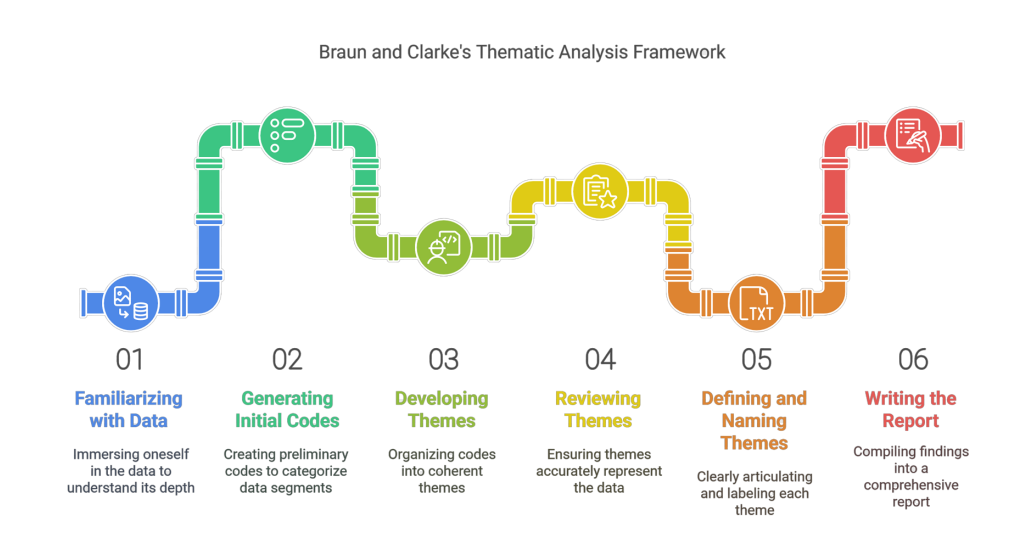
And the Saldana’s approach.
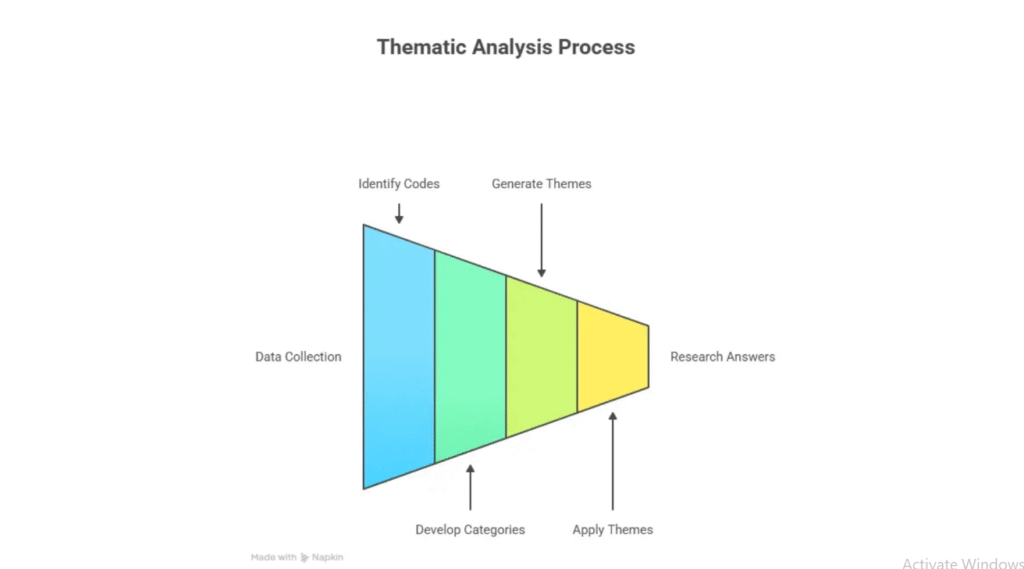
In this article, we are going to look at how to conduct thematic analysis according to Saldana.

My name is Bernard Mugo. I like to refer to myself simply as an academic.

In the past three years, I’ve helped more than 300 PhD students analyze qualitative data and finally complete their thesis or dissertations.
In the course of helping such a large number of students, I’ve gained invaluable experience in the best practices that you can use to perform qualitative analysis of your interviews and be able to retrieve quality findings.

Now let’s look at thematic analysis process, according to Saldana, and let’s see the steps that this scholar suggests.
Thematic Analysis process according to Johny Saldana
According to Joe Saldana, thematic analysis process has four main steps.
The first step is identifying and categorizing codes.
This involves going through the data to identify and label key ideas, which are called codes.
The second step is developing high level categories.
In this step, we group the initial codes into broader categories and develop themes into high level categories.
The third step is generating themes through analytic memoing.
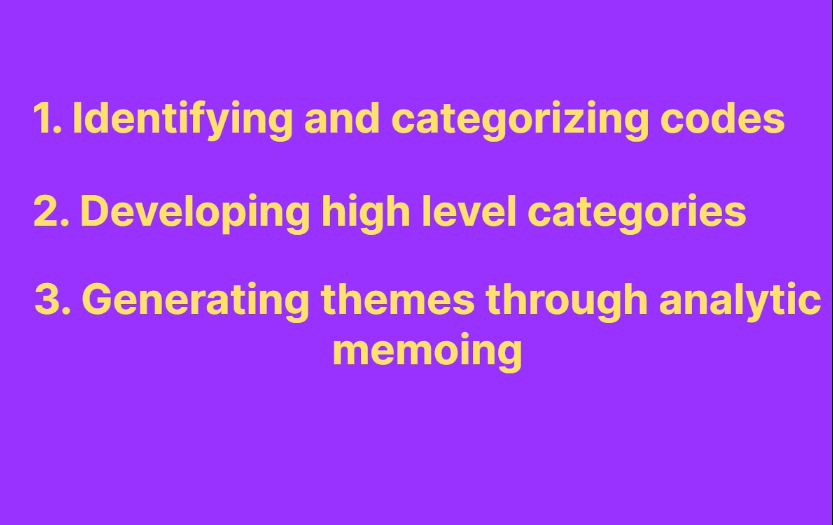
In this step, we synthesize categories to create themes by writing analytic memos to reflect on the data and refine the themes.
The fourth step is applying themes to research questions.
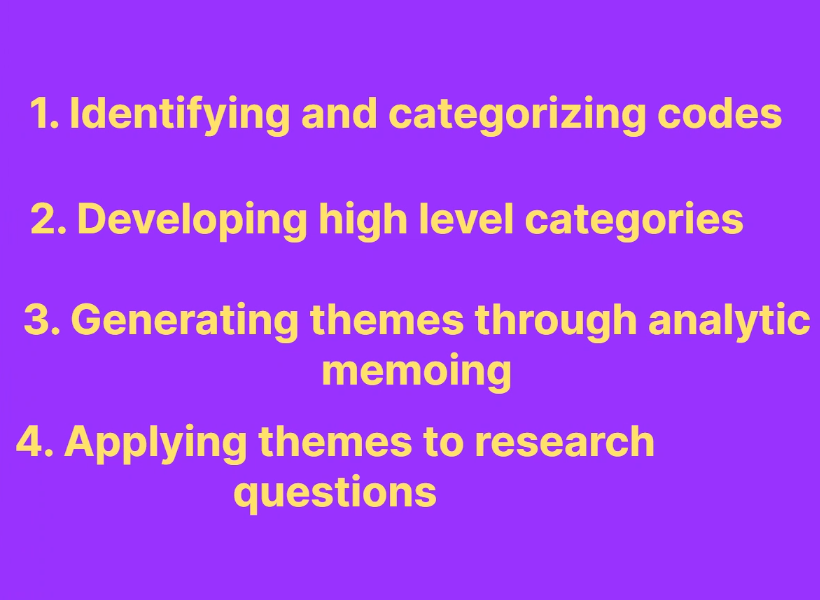
In this step, we use the developed themes to answer the original research questions.
Lets us now conduct the Saldana approach of inductive thematic analysis using MAXQDA.
Now we open MAXQDA, and as usual we are going to import the transcripts that we want to analyze, and then we go through the steps by Saldana.
So the first thing that I’m going to do is I can either import transcript directly using this import button.
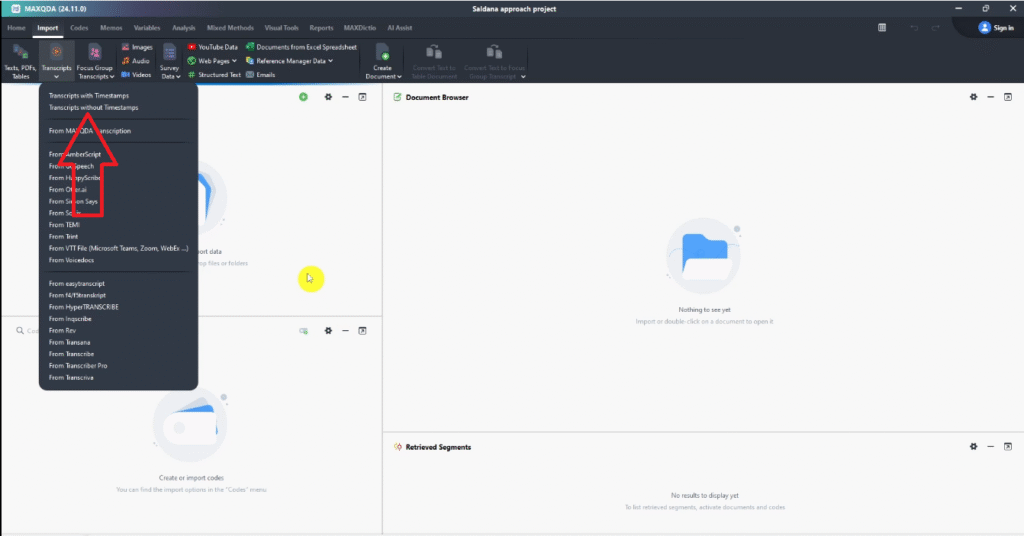
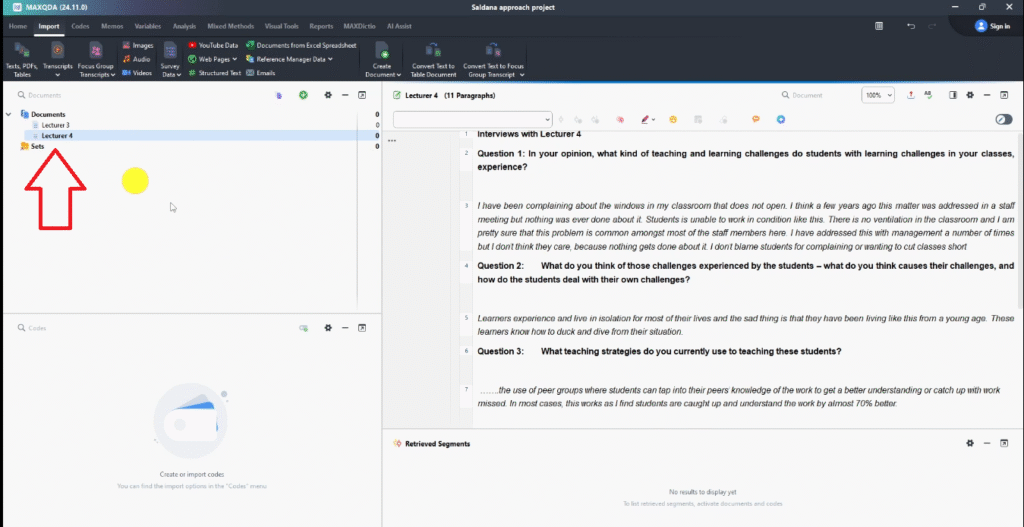
Or I can drag and drop them.
I prefer to drag and drop them for the purposes of this article.
Identifying and labeling codes
We can begin with the first steps proposed by Saldana in conducting inductive thematic analysis, which is identifying and labeling codes.
This means that we are going to do something we call coding.
Before we begin coding, I like to have a clear idea of a way to manage my codes before I go through the other three steps of the Saldana approach.
What do I mean by this?
Let me show you practically.
Let us open one of our transcript.

Remember, these are transcripts about issues related to challenges of teachers teaching in a given community college.

I want to mark the first question as red.

Second question as blue.

Third question as purple.

Fourth question as green.
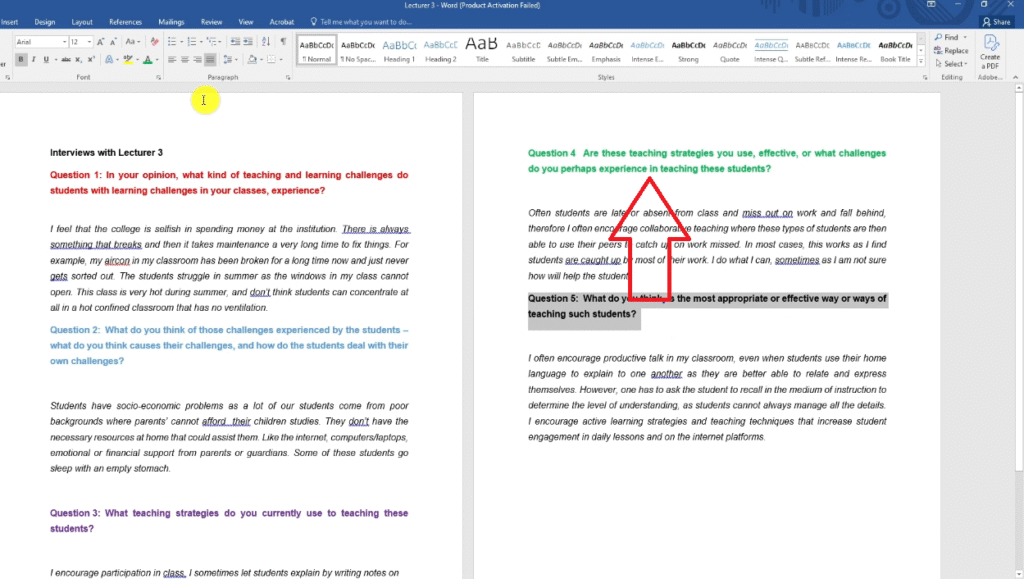
Fifth question as brownish.

Those are the colors I marked for the questions.
Now we are going to go back to MAXQDA, and we are going to start coding.
Let us read everything and let’s do coding for the two transcripts.
Let me begin with lecturer three.
In your opinion, what kind of teaching and learning challenges do students with learning challenges in your classes experience.
So what teaching challenges does this person see?
I feel that the college is selfish in spending money at the institution. There is always something that breaks and then it takes maintenance a very long time to fix things. For example, my aircon in my classroom has been broken for a long time now and just never gets sorted out. The students struggle in summer as the windows in my class cannot open. This class is very hot during summer, and don’t think students can concentrate at all in a hot confined classroom that has no ventilation.
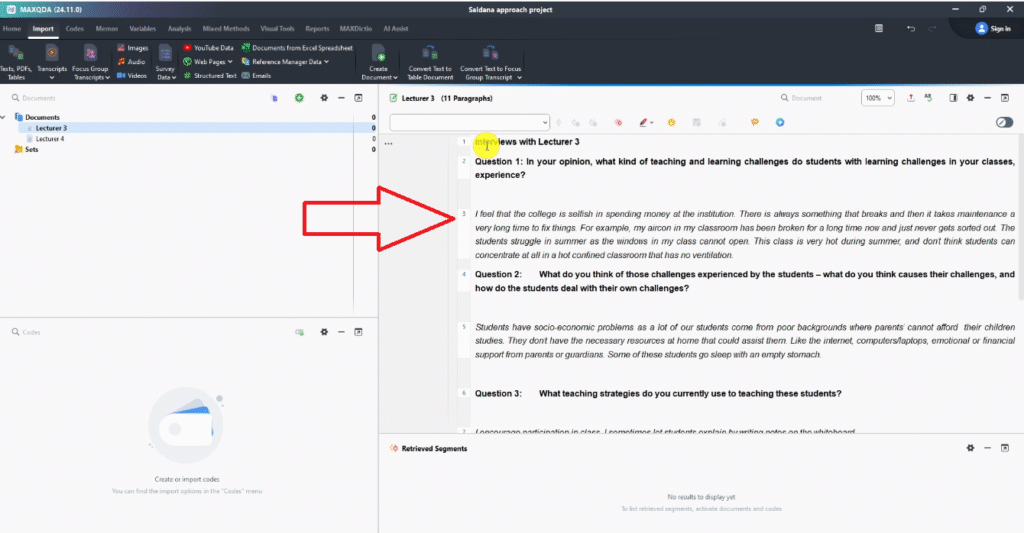
So one of the learning challenges is if you read the whole thing, is poor infrastructure.
We highlight the statement.
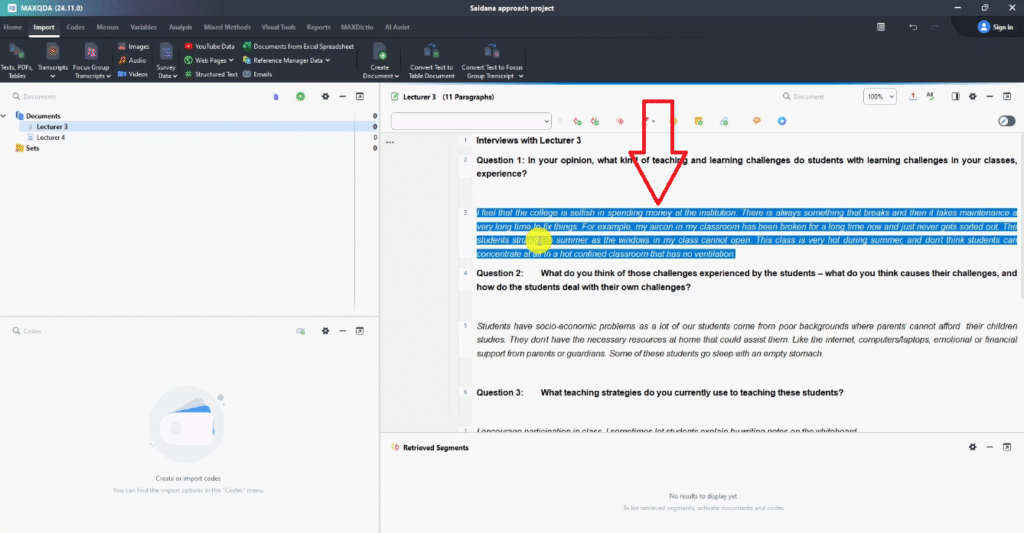
We go to With New code.
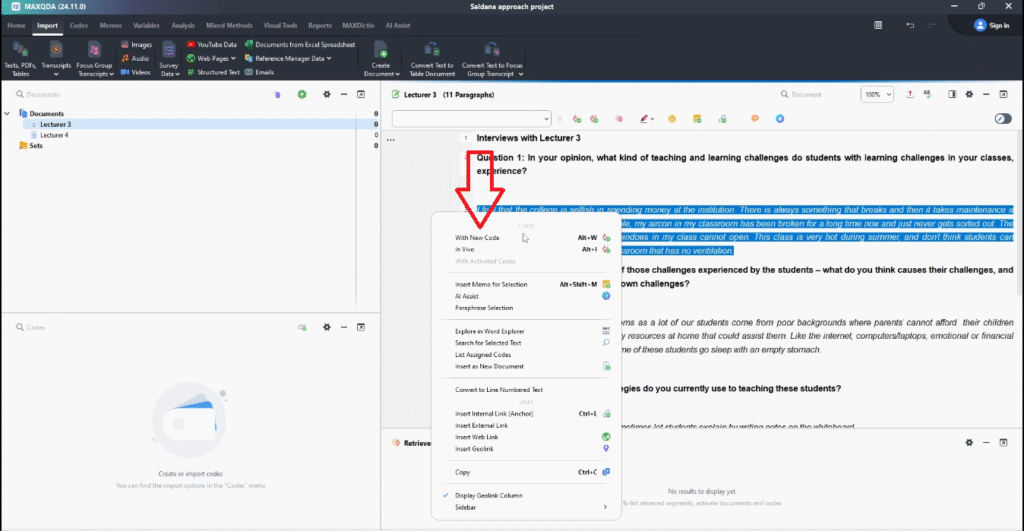
And code poor infrastructure.
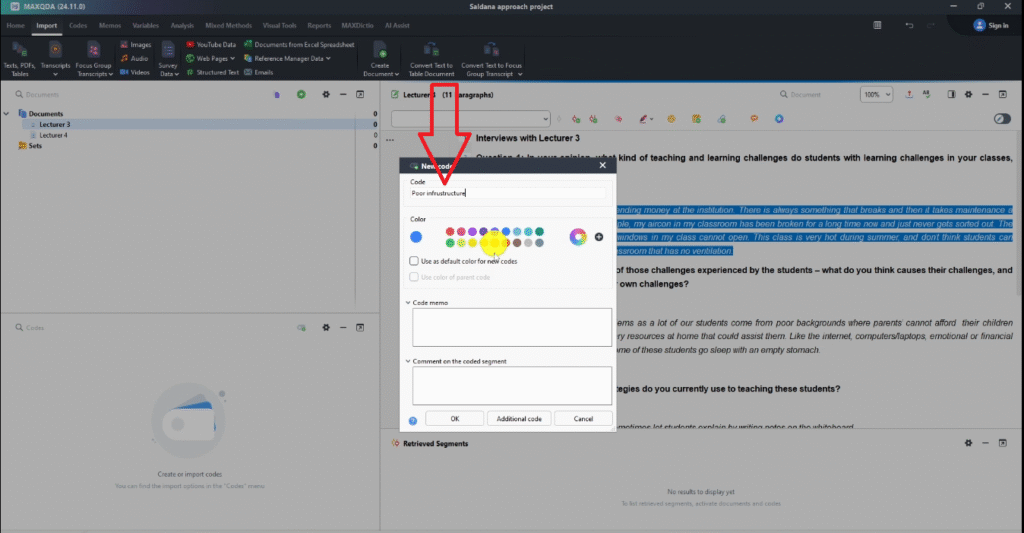
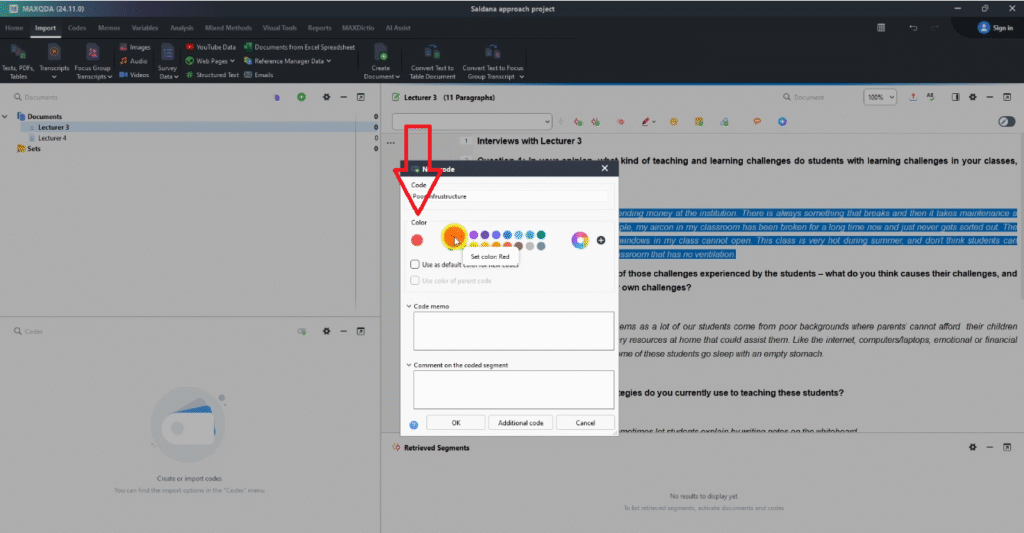
Then remember, we assigned that question with the red color, that means that we mark that code with red.
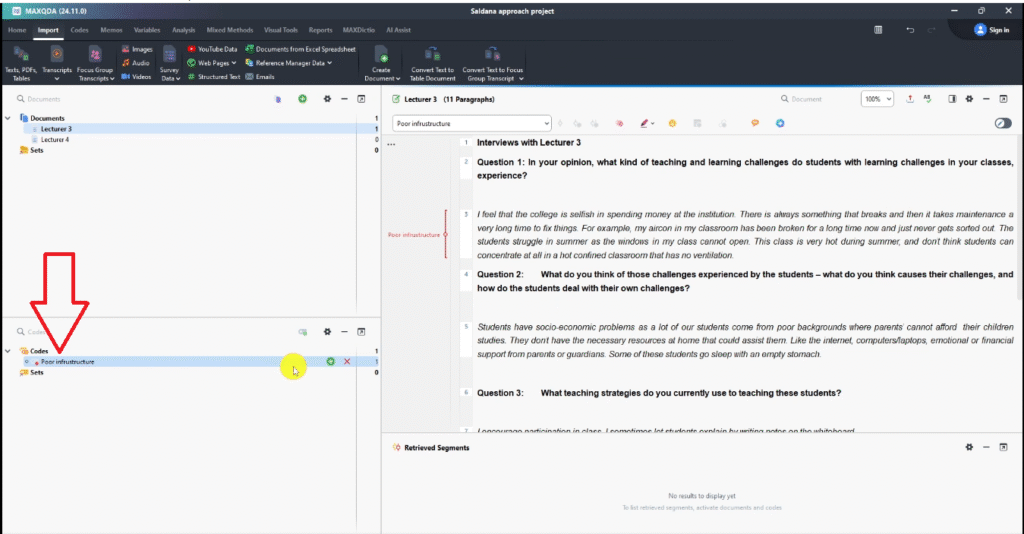
You can see we have the first code down here, poor infrastructure.
I am not trying to get many codes because it is just an article, what I am trying to show you is how we conduct the first step in inductive thematic analysis using the Saldana approach which is finding codes from transcripts.
So let us have the second question.
What do you think are those challenges experienced by students, what do you think causes their challenges and how the students deal with their own challenges?
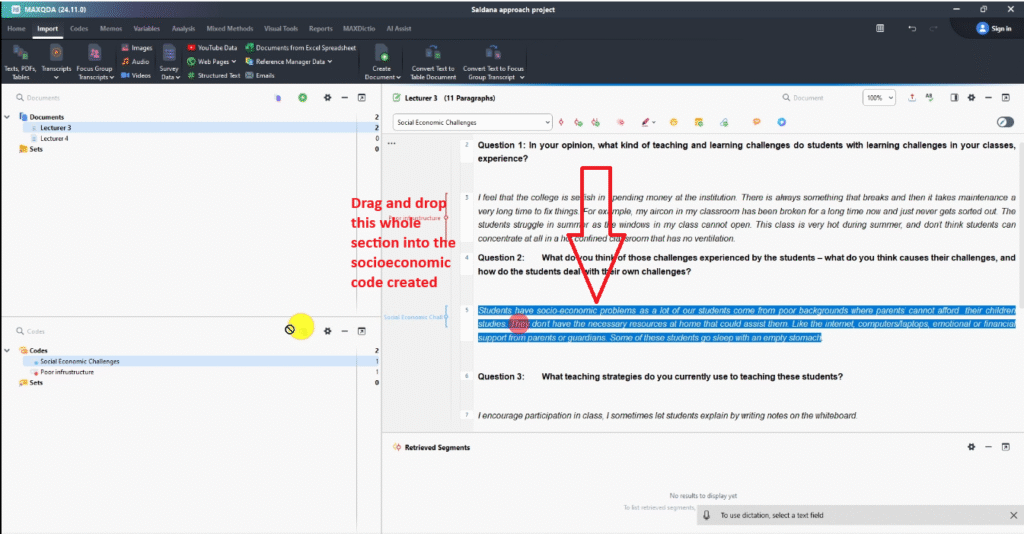
Students have socio-economic problems as a lot of our students come from poor backgrounds where parents’ cannot afford their children studies. They don’t have the necessary resources at home that could assist them. Like the internet, computers/laptops, emotional or financial support from parents or guardians. Some of these students go sleep with an empty stomach.
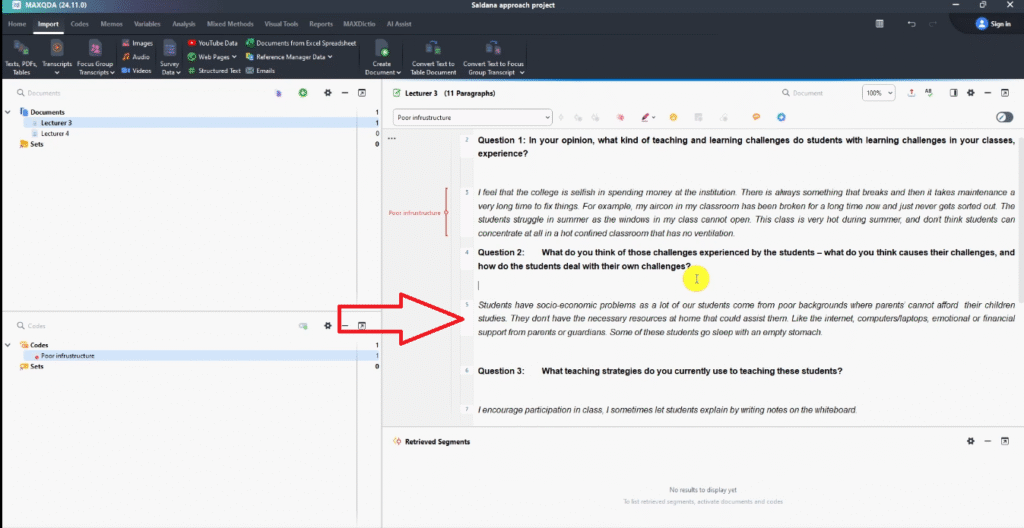
So one of the main challenges affecting the students is socioeconomic challenges ,let us highlight this.
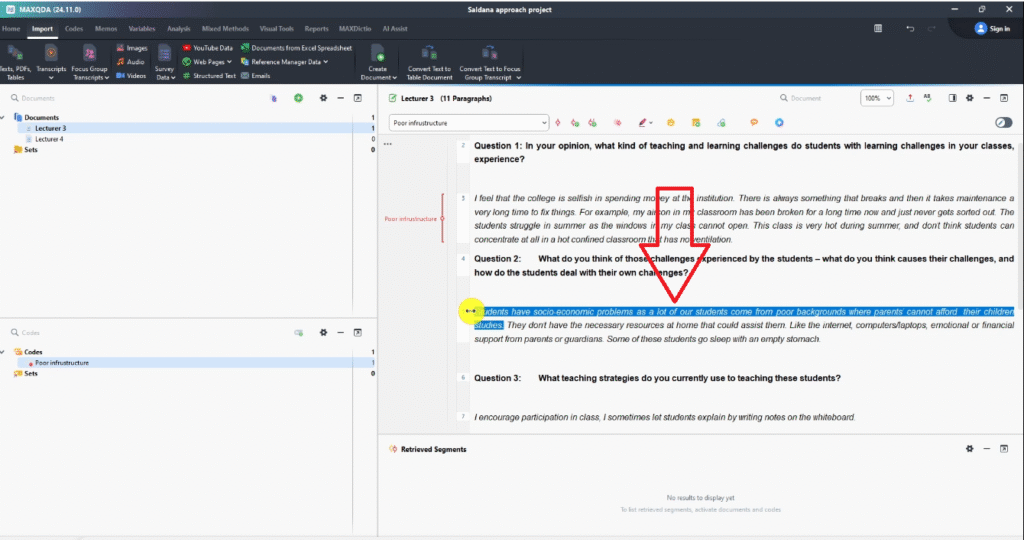
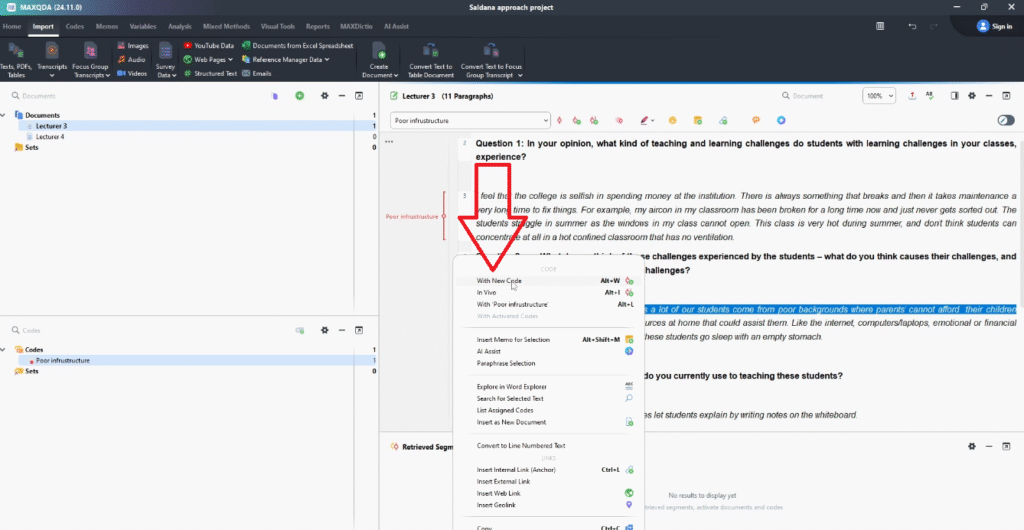
Go to with new code.
And I want to code this as socioeconomic challenges.
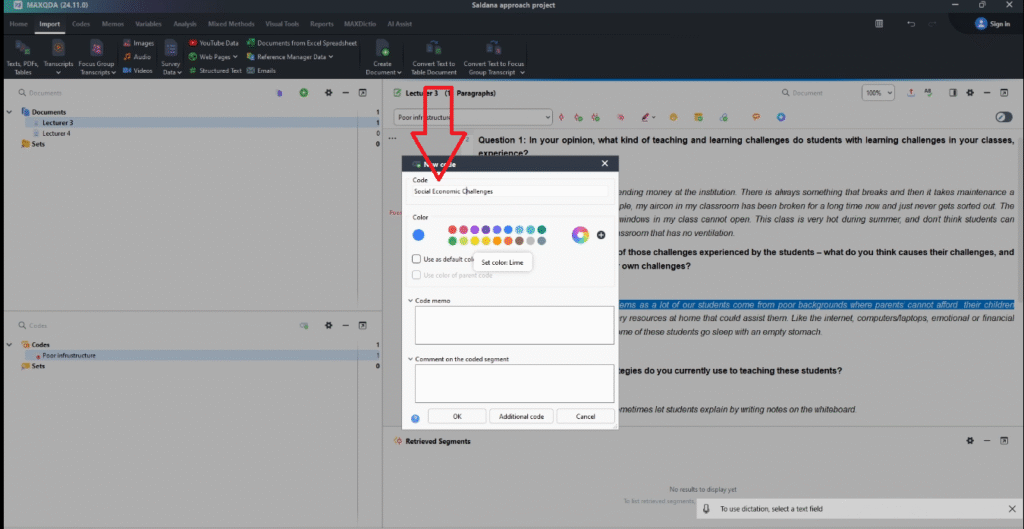
The color code is blue.
So socioeconomic challenges is another challenge experience by students.
Actually, we could extend that code to this whole paragraph.
Let us go to the third question.
What teaching strategies do you currently use to teaching these students?
I encourage participation in class, I sometimes let students explain by writing notes on the whiteboard.
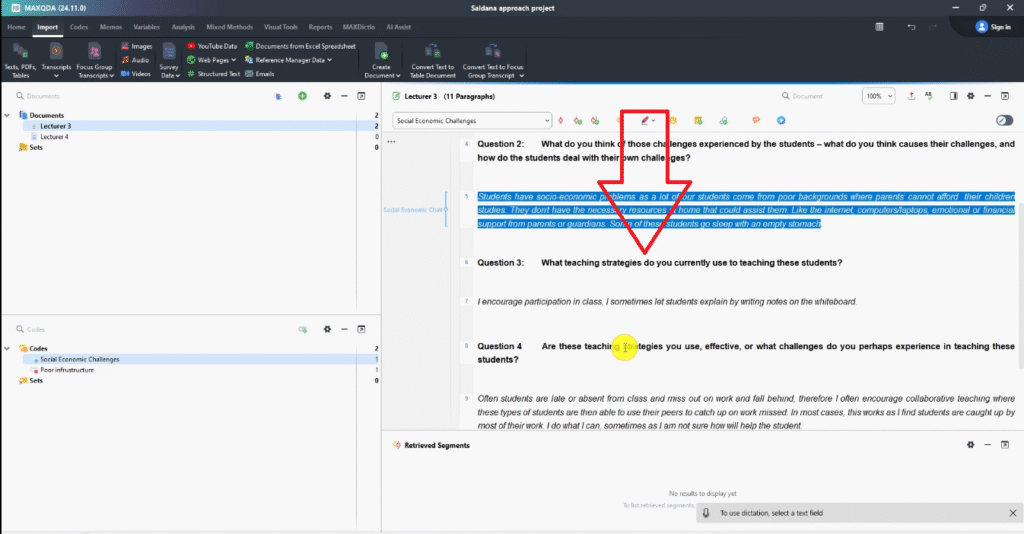
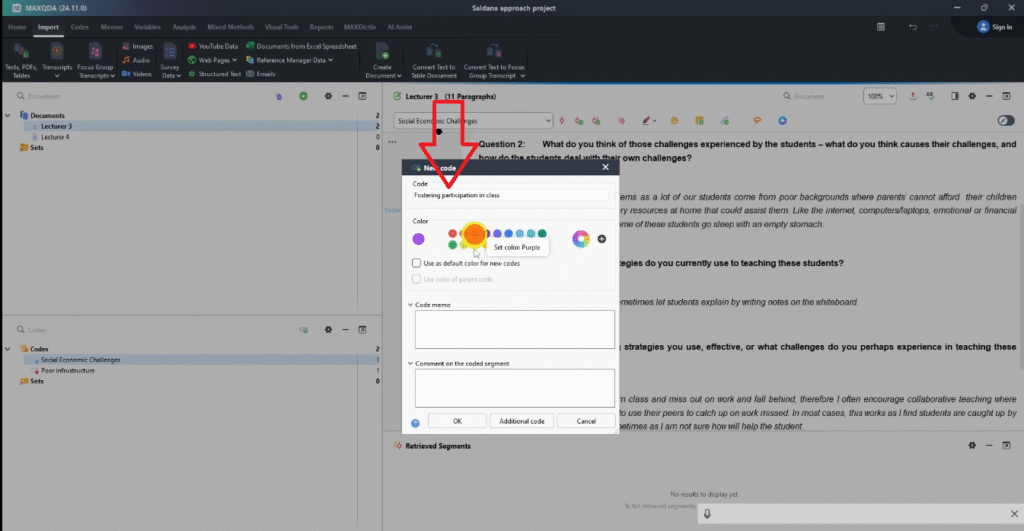
Highlight the whole section, with new code, and say fostering participation in class.
And that code has color purple.
Let’s read the fourth question.
Are these teaching strategies you use, effective, or what challenges do you perhaps experience in teaching these students?
Often students are late or absent from class and miss out on work and fall behind, therefore I often encourage collaborative teaching where these types of students are then able to use their peers to catch up on work missed. In most cases, this works as I find students are caught up by most of their work. I do what I can, sometimes as I am not sure how will help the student.
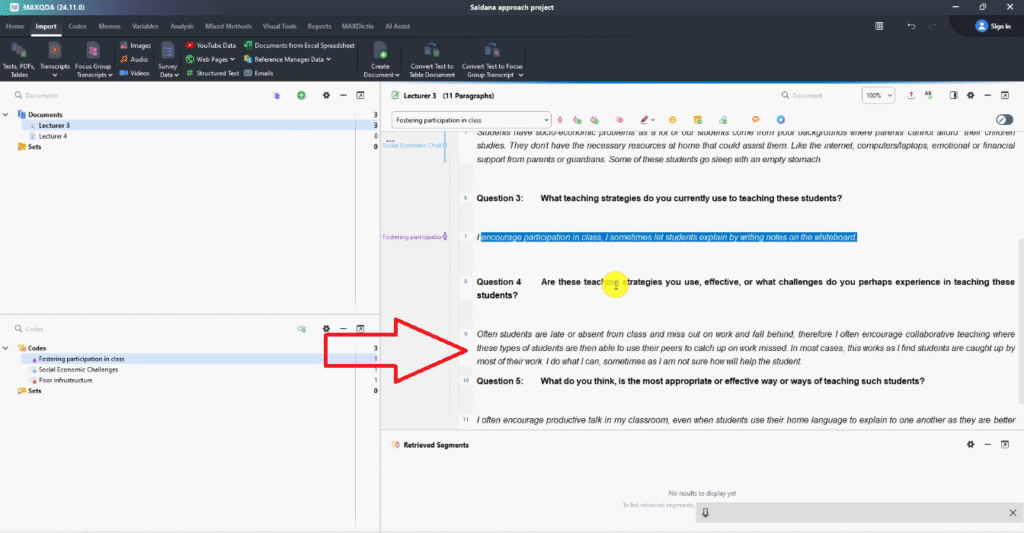
The question is asking about the teaching strategies these teachers use to navigate the challenges.
So I often encourage collaborative teaching where these types of students are then able to use their peers to catch up.
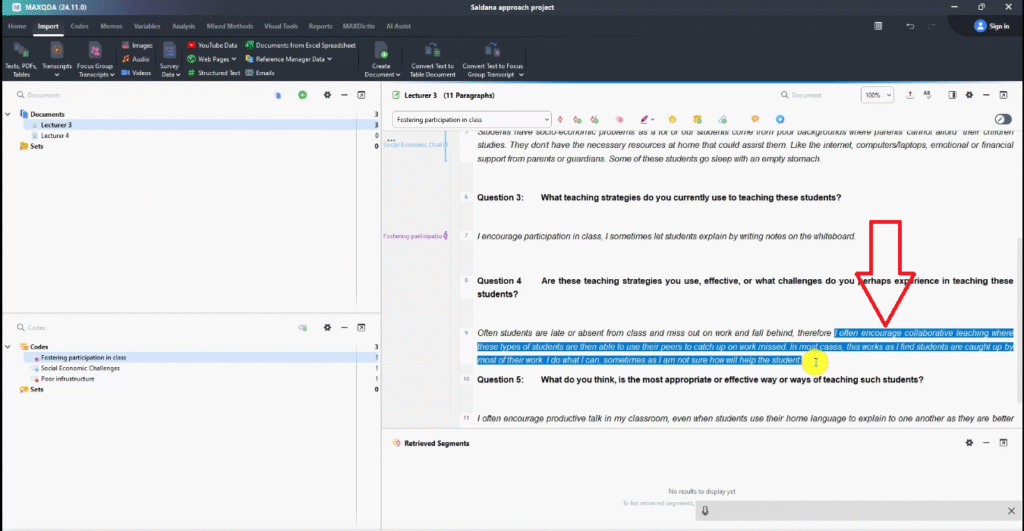
The strategy that this teacher uses is…, let us go to with new code, and say collaborative teaching.
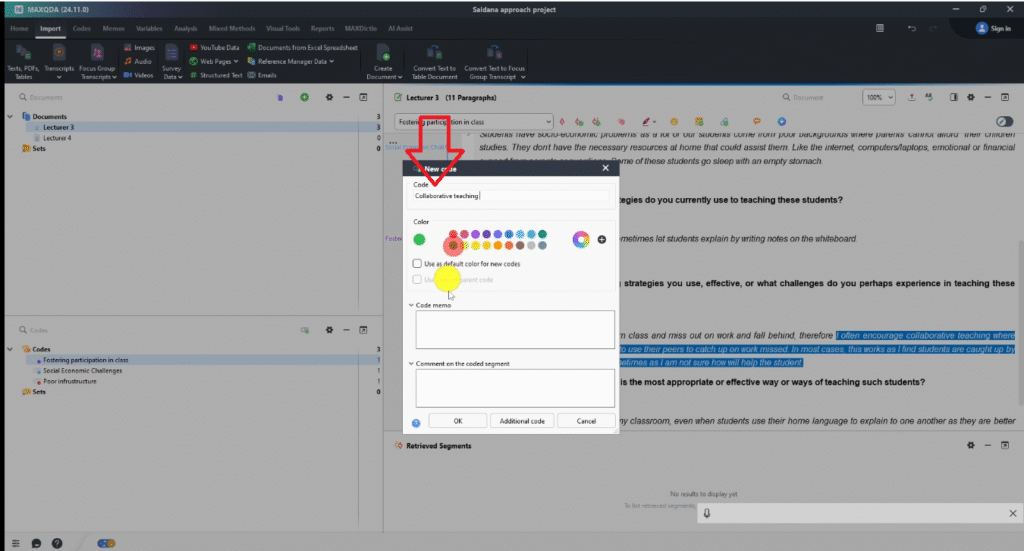
That question has a green color so we marked the code as green.
You can see how these codes have colors showing where they came from.
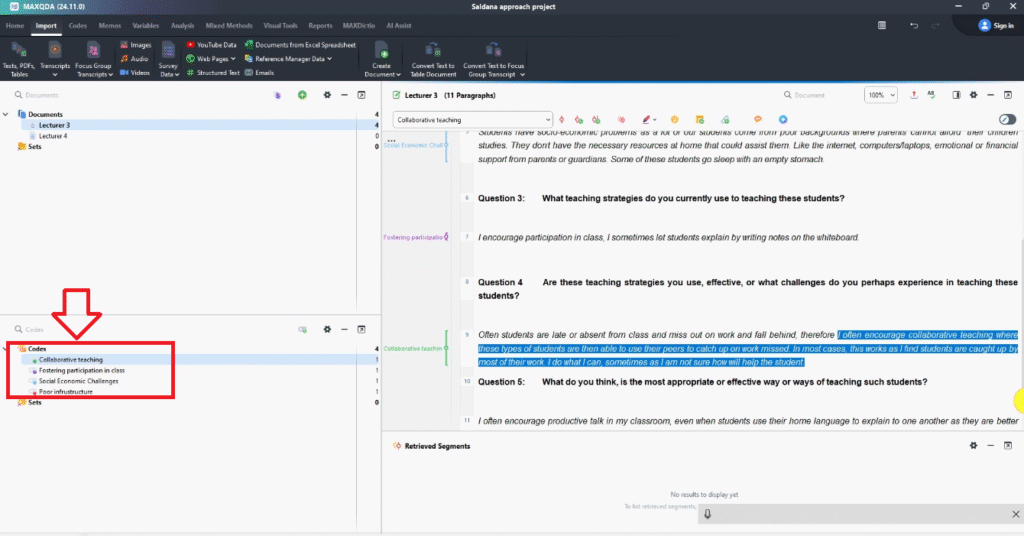
This is a very important step in the saldana’s approach of inductive thematic analysis because we are going to combine the codes to form some categories, and then we are going to move from categories to themes.
The final question for this participant, what do you think is the most appropriate or effective way or ways of teaching students?
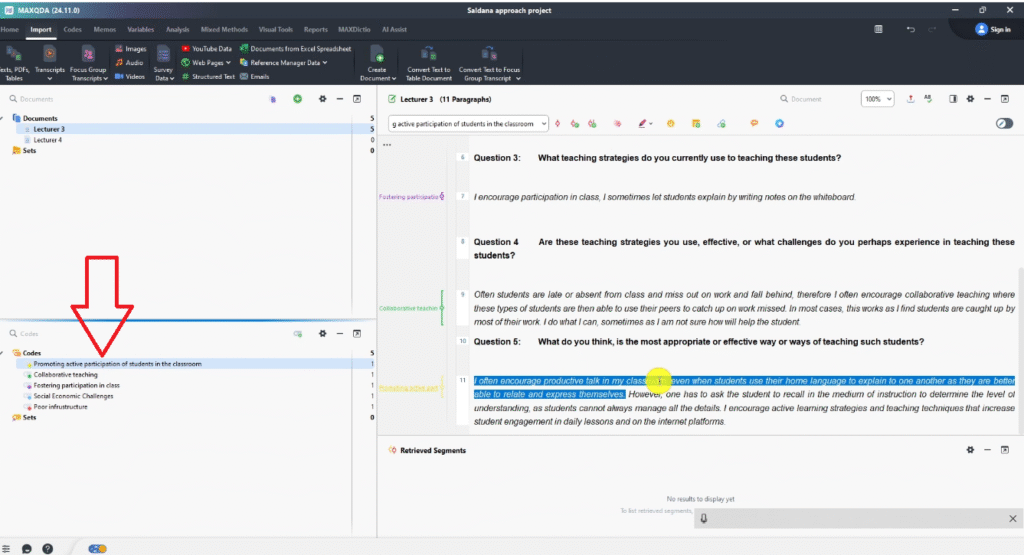
I often encourage productive talk in my classroom, even when students use their home language to explain to one another as they are better able to relate and express themselves. However, one has to ask the student to recall in the medium of instruction to determine the level of understanding, as students cannot always manage all the details. I encourage active learning strategies and teaching techniques that increase student engagement in daily lessons and on the internet platforms.
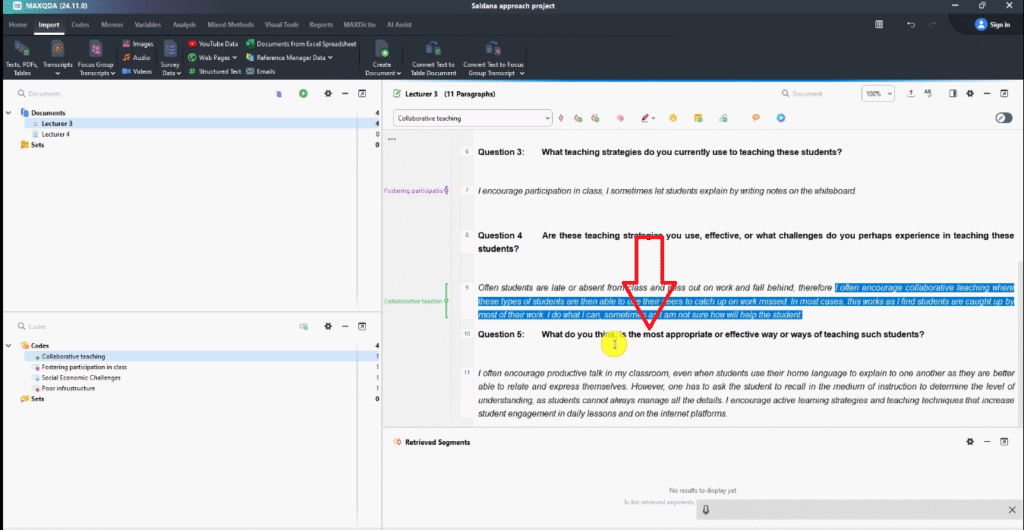
So effective ways of teaching this students.
I see a method like promoting active participation of students in the classroom.
The color for this one should be that brown.
Let us code another transcript.
Lecture four.
In your opinion, what kind of teaching and learning challenges do students with learning challenges in your class experience?
I have been complaining about the windows in my classroom that does not open. I think a few years ago this matter was addressed in a staff meeting but nothing was ever done about it. Students is unable to work in condition like this. There is no ventilation in the classroom and I am pretty sure that this problem is common amongst most of the staff members here. I have addressed this with management a number of times but I don’t think they care, because nothing gets done about it. I don’t blame students for complaining or wanting to cut classes short.
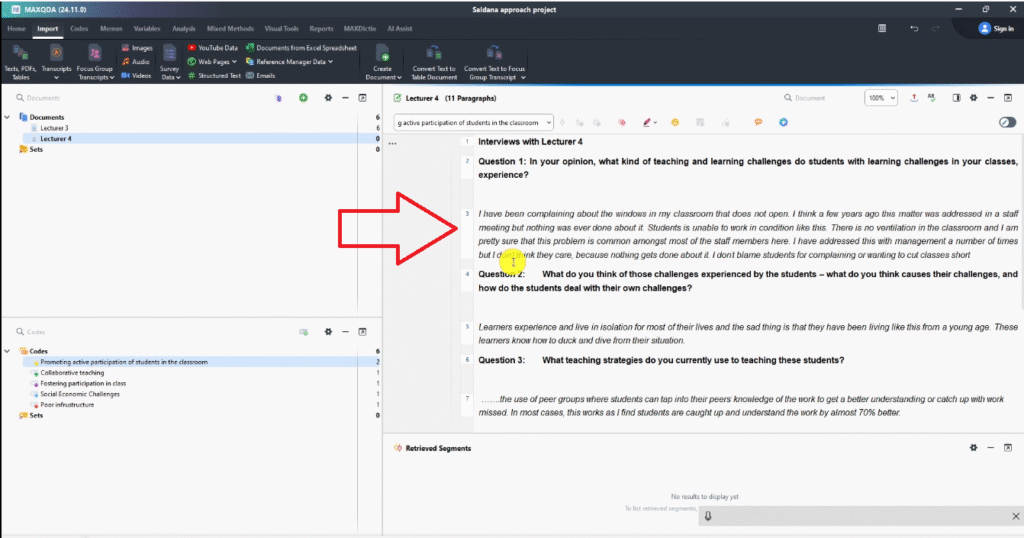
We can already see the issue of poor infrastructure.
Been complaining about the windows in my classroom that do not open.
Highlight that section, because we had a previous code that relates to it.
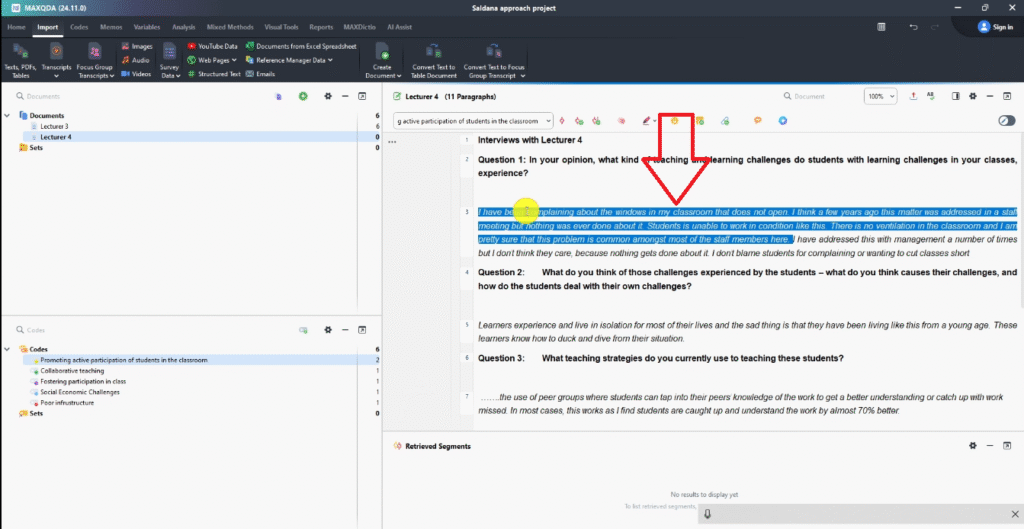
I drag and drop that quote into poor infrastructure.
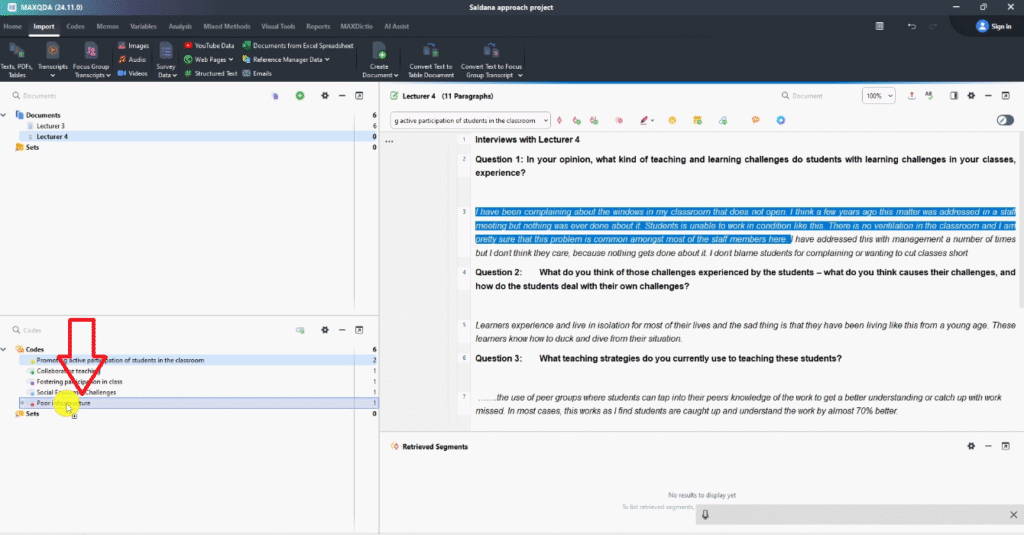
If you look at that code, you can see that we move from having only one quote to two quotes.
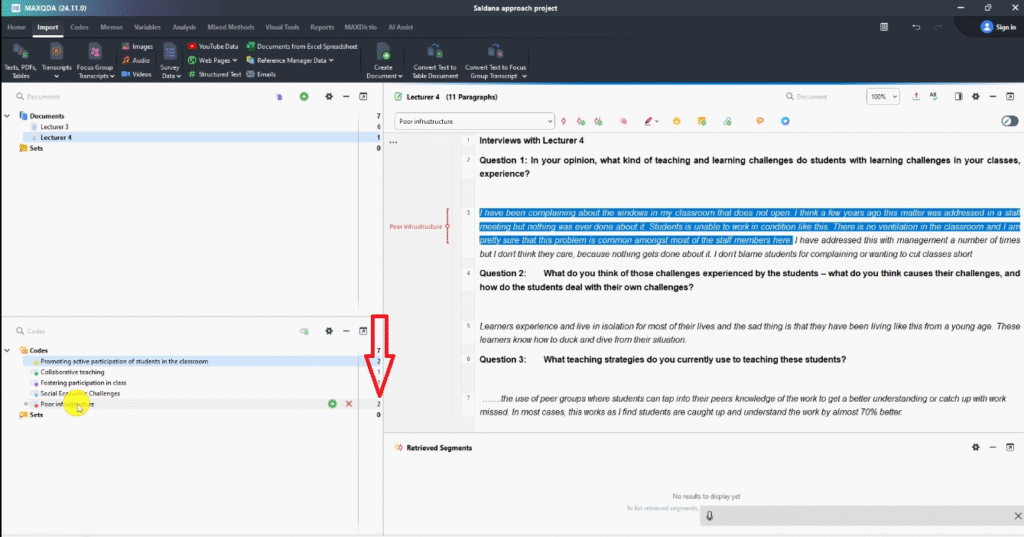
Let us proceed.
What do you think of those challenges experienced by students, what do you think causes their challenges and how do students deal with their own challenges?
This is the second question.
Learners experience and live in isolation for most of their lives and the sad thing is that they have been living like this from a young age. These learners know how to duck and dive from their situation.
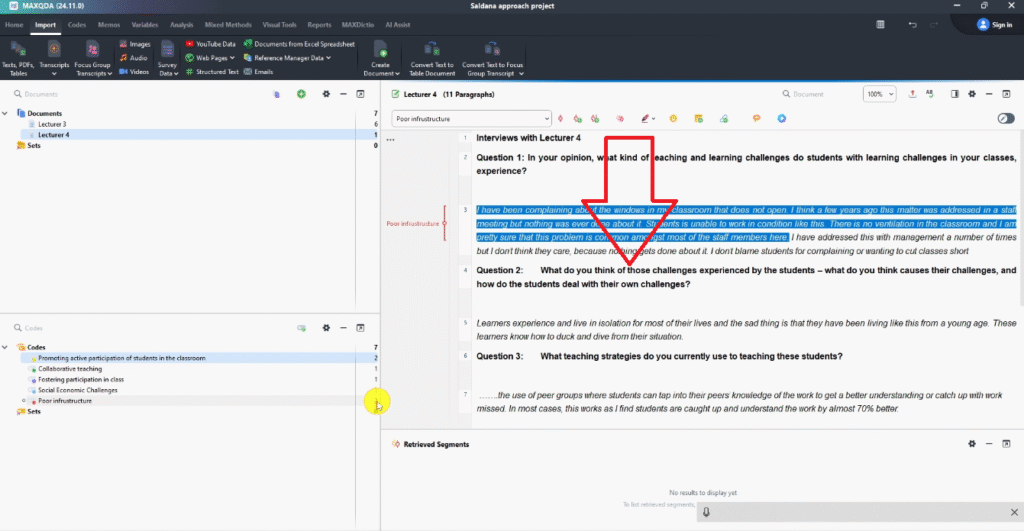
This participant believes that the biggest problem is learners living in isolation.
I can highlight this.
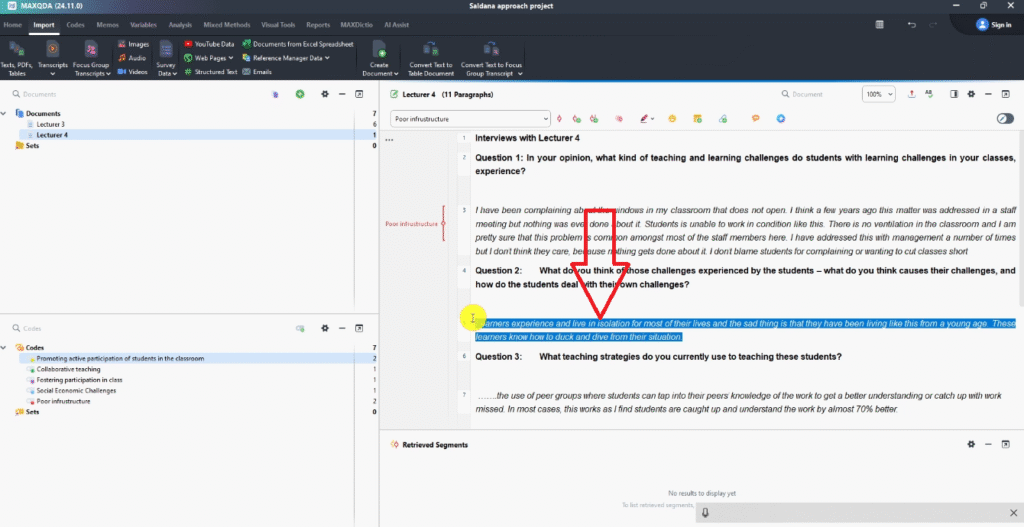
And code it as student living in a form of self isolation.
Then the color code for question two is blue.
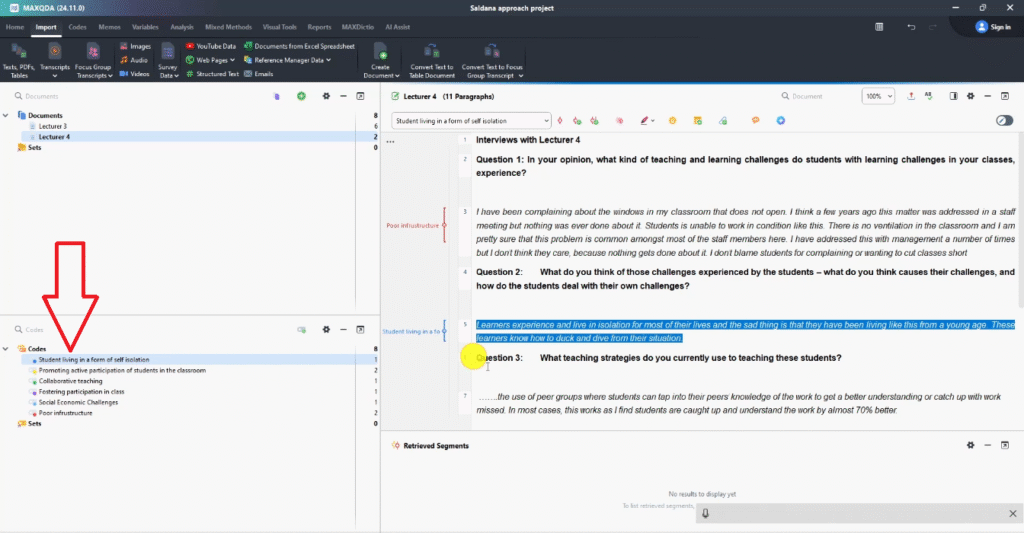
Go to question three.
What teaching strategies do you currently use to teach these students?
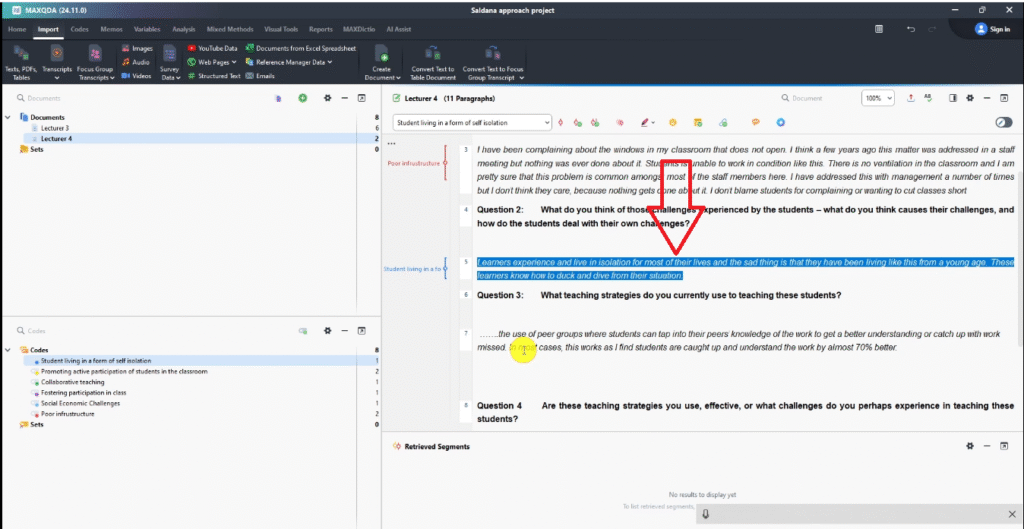
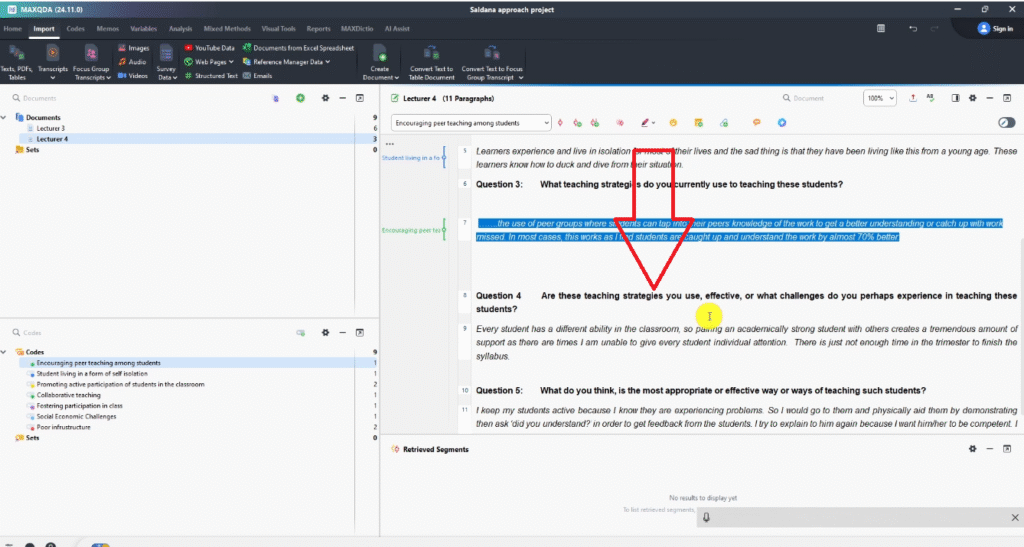
…….the use of peer groups where students can tap into their peers’ knowledge of the work to get a better understanding or catch up with work missed. In most cases, this works as I find students are caught up and understand the work by almost 70% better.
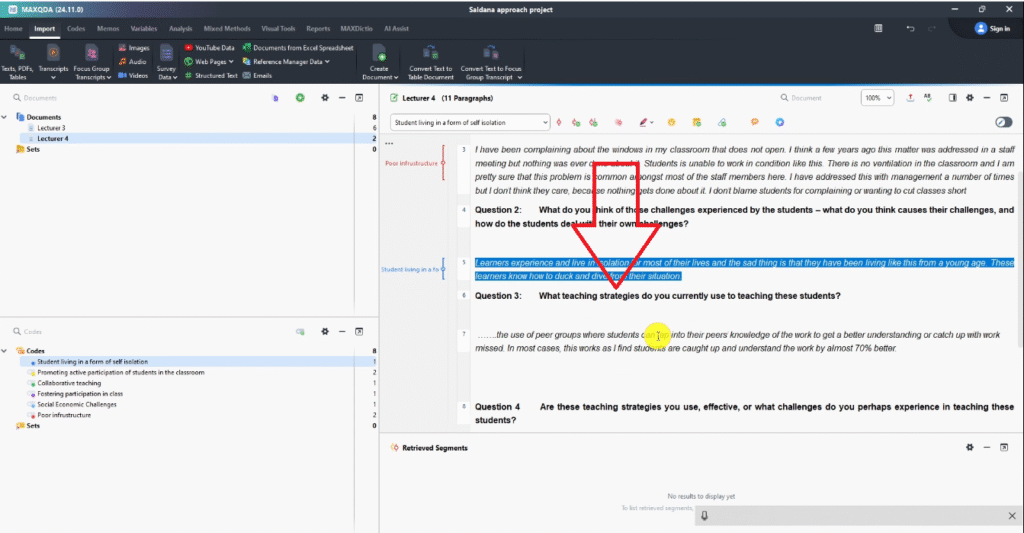
This teacher is saying they use peer groups, and I think that relates to collaborative teaching, but we’ll come to that later.
I want to highlight this.
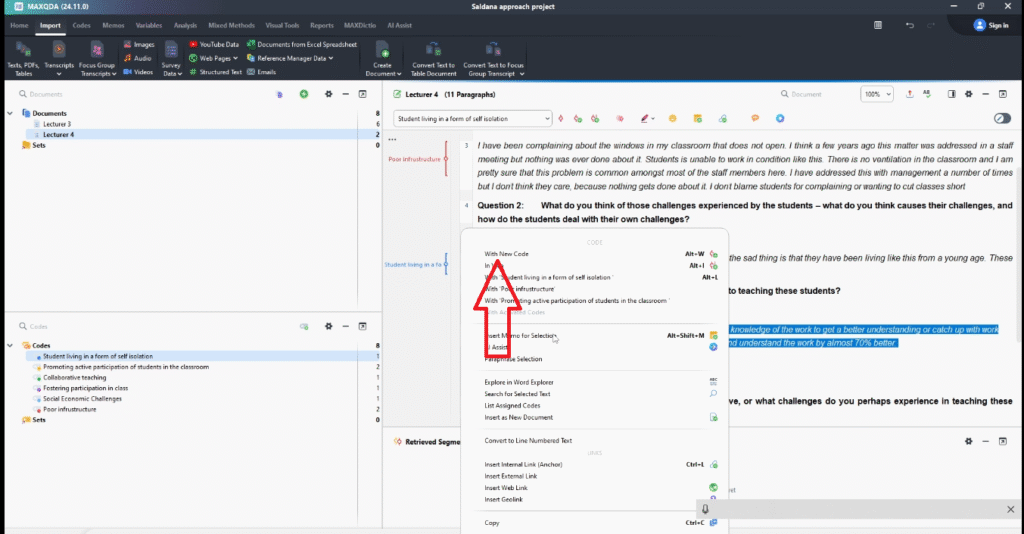
Go to With New code .
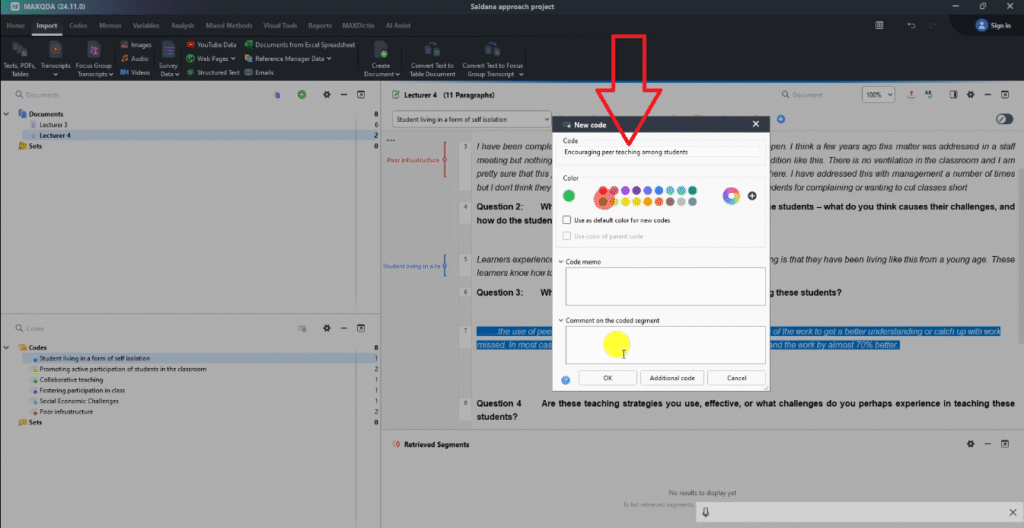
And say encouraging peer teaching among students.
That code is green.
Let’s keep coding.
Are these teaching strategies you use effective, or what challenges do you perhaps experience in teaching these students?
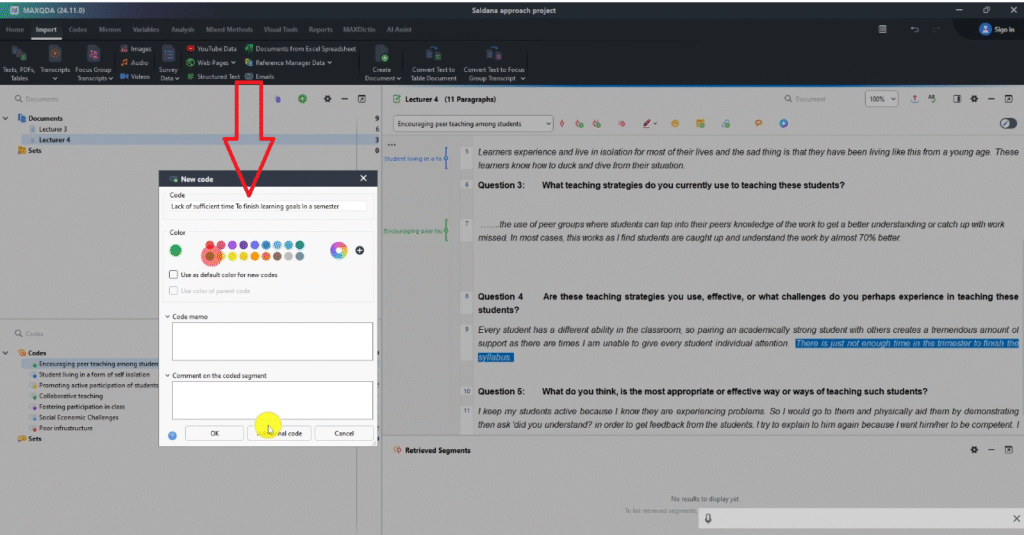
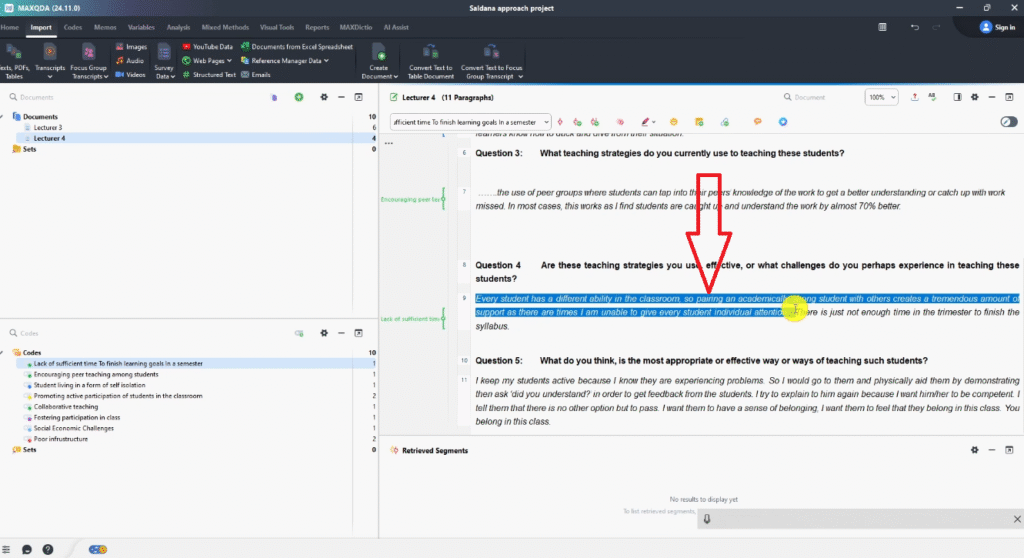
Every student has a different ability in the classroom, so pairing an academically strong student with others creates a tremendous amount of support as there are times I am unable to give every student individual attention. There is just not enough time in the trimester to finish the syllabus.
one of the challenges is lack of sufficient time to finish learning goals in a semester.
The color code for that code is green.
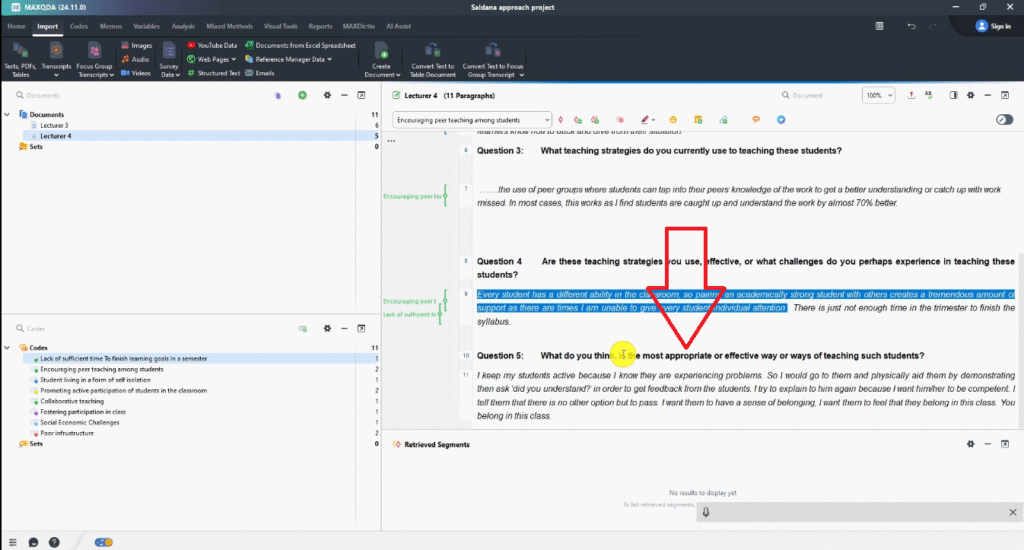
There is this other section where this respondent is talking about pairing strong students with other students who might not be as strong.
So drag and drop that section in the code encouraging peer teachings among students.
Final question that was asked to this person was, So what do you think is the most appropriate or effective way or ways of teaching such students?
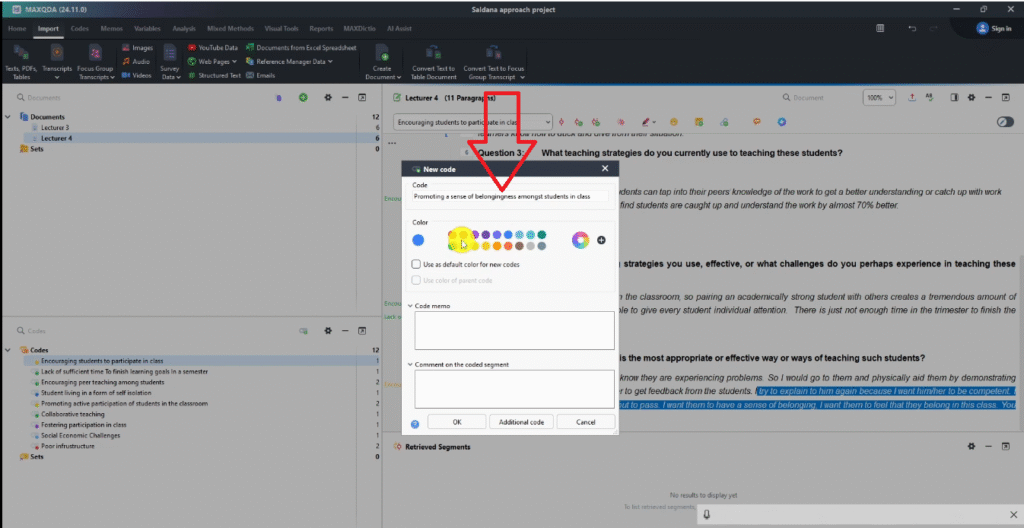
I keep my students active because I know they are experiencing problems. So I would go to them and physically aid them by demonstrating then ask ‘did you understand?’ in order to get feedback from the students. I try to explain to him again because I want him/her to be competent. I tell them that there is no other option but to pass. I want them to have a sense of belonging, I want them to feel that they belong in this class. You belong in this class.
I keep my students active because I know they’re experiencing problems.
So most effective way of teaching students is…
I want to highlight this section.
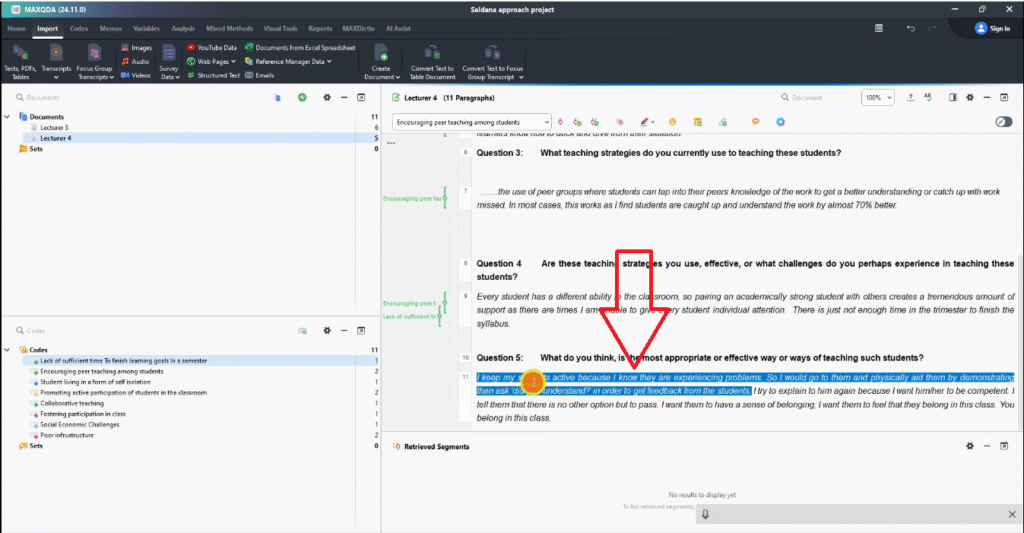
And say encouraging students to participate in class.
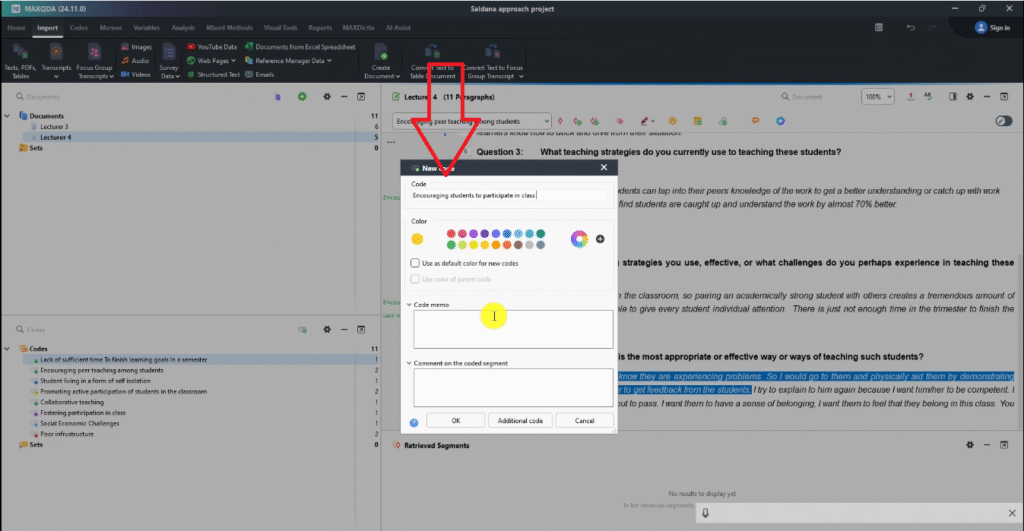
Promoting a sense of belongingness amongst students in class is another code from that question.
Now this are some example of codes that we have had.
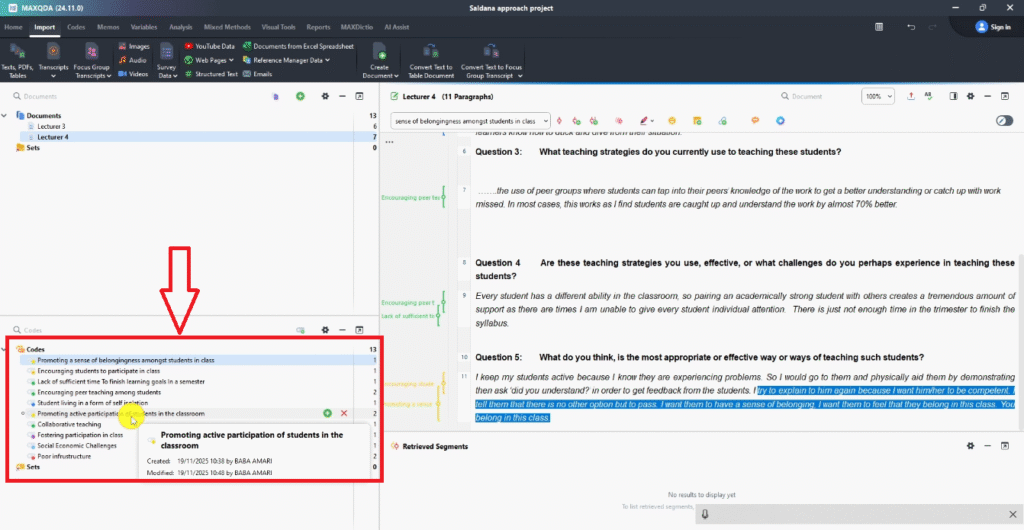
This is the first step of the Saldana approach of doing inductive thematic analysis which is coming up with some codes.
Developing high-level Categories
Let us now look at another step of the Saldana’s approach of conducting inductive thematic analysis which is developing high level categories.

How do we do that?
If we look at the questions, we can get an idea of what this person is asking about.
For example, if you look at the first question, what kind of teaching and learning strategies do students with learning challenges in your class experience?

That question is marked as red, and we have a form of codes that are color red, that means that the codes relate to the first question.
We can find them and group them under a category.
Let us form a category called learning challenges experienced by the students.
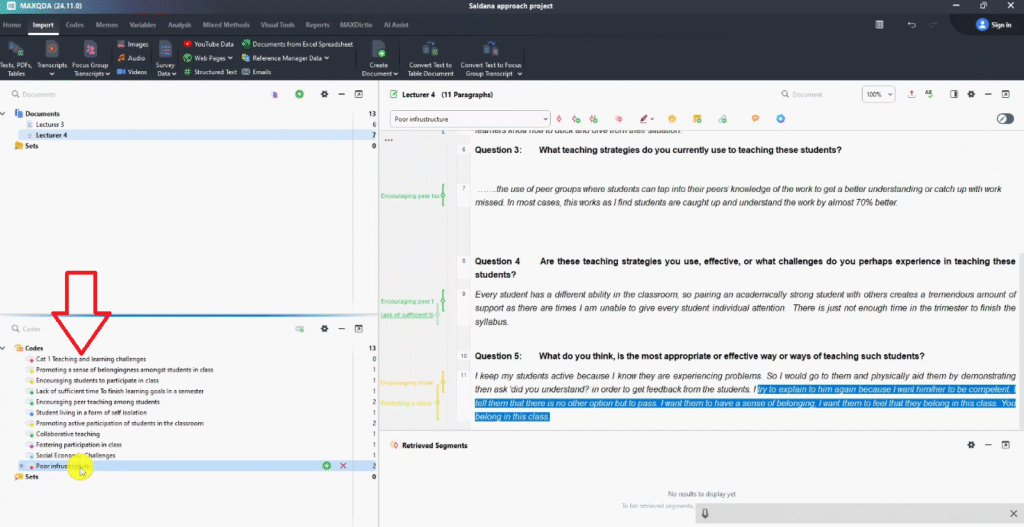
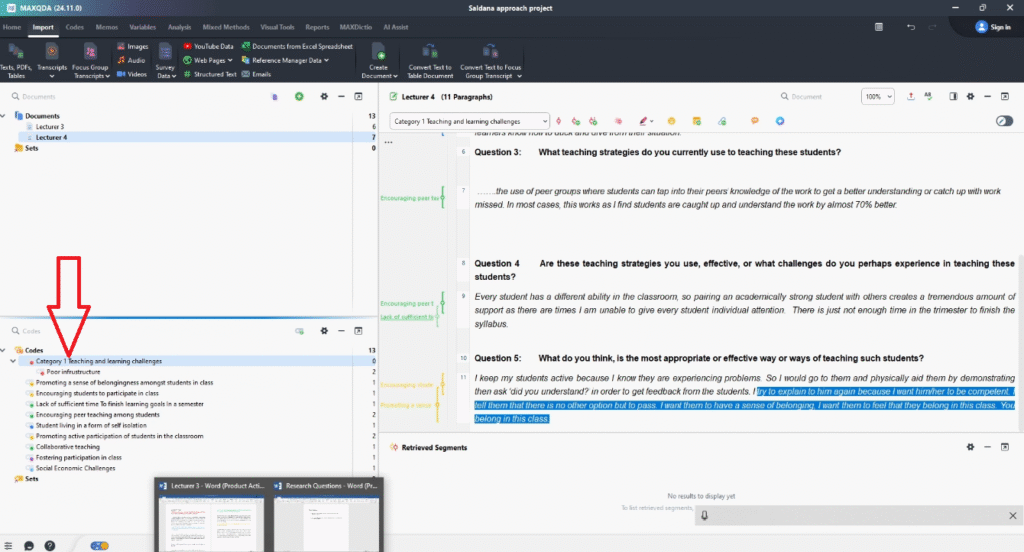
So we can go and revise the red codes and state teaching and learning challenges.
I am only putting codes with the color red into the category I just created.
Let us look at the other question and get an idea of another category that we can develop.
So the second question relates to challenges experienced by the students, and that is blue.
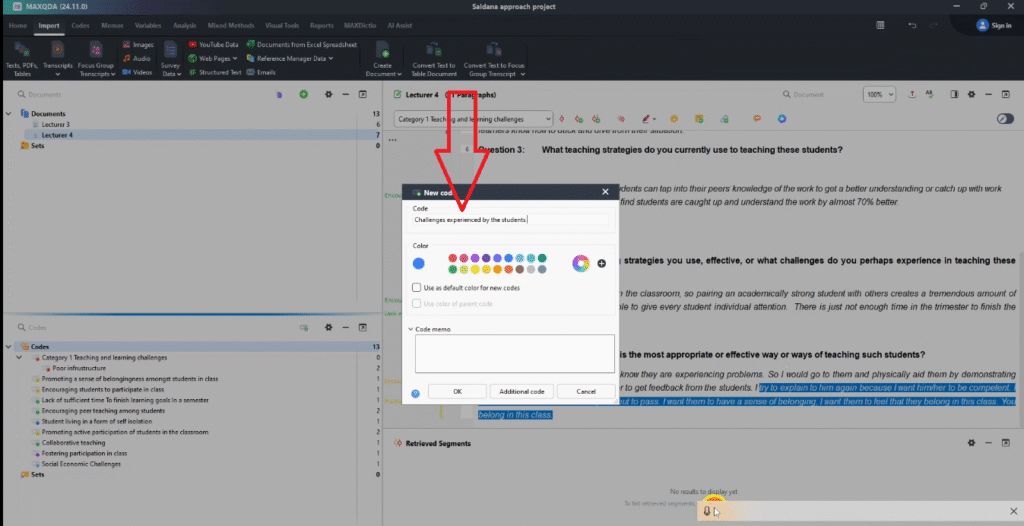
I think we only had one code that came from that question.
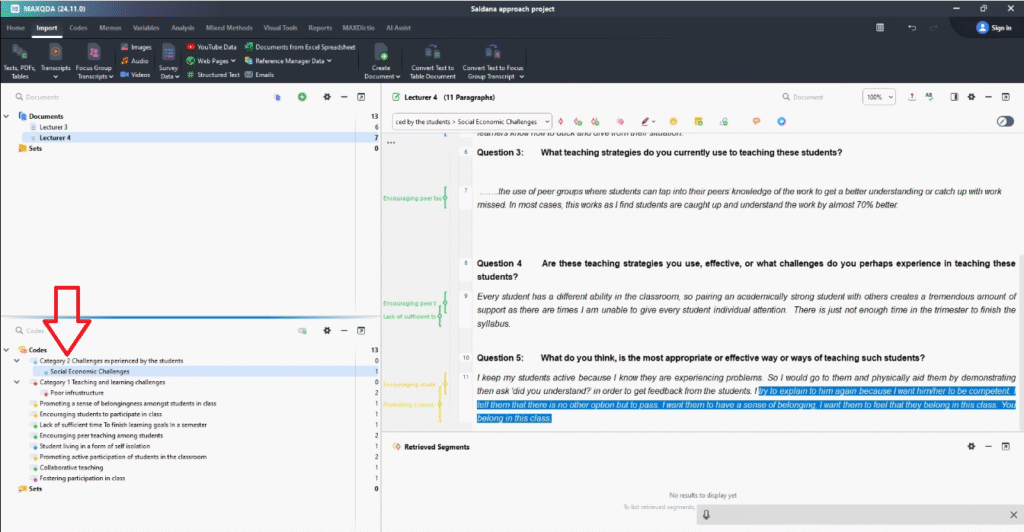
Let’s have another category.
What teaching strategies do you currently use to teach these students?
Of course we are going to have a category called Teaching Strategies.
So category three can be about teaching strategies, and the color for that is purple.
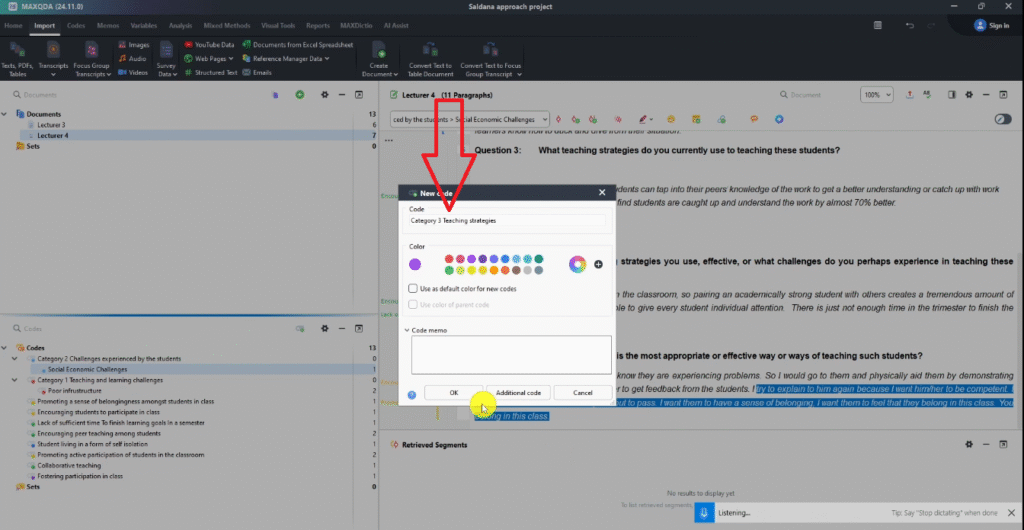
Then we place all the codes marked as purple under that category.
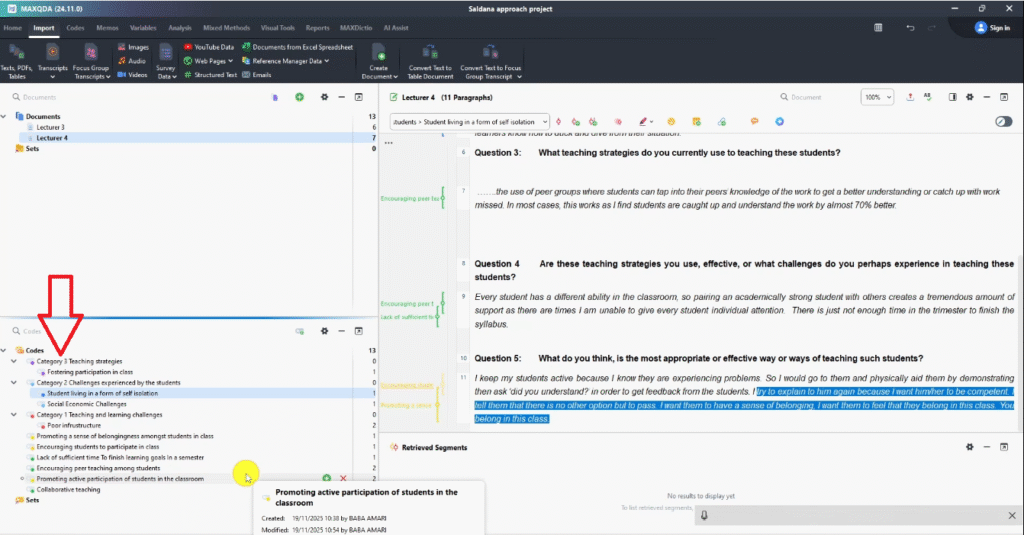
Let us find another category.
Are these teaching strategies you use effective, or what challenges do you perhaps experience in teaching these students?
I want to create a category called teaching challenges.
And for category four, the color is green.
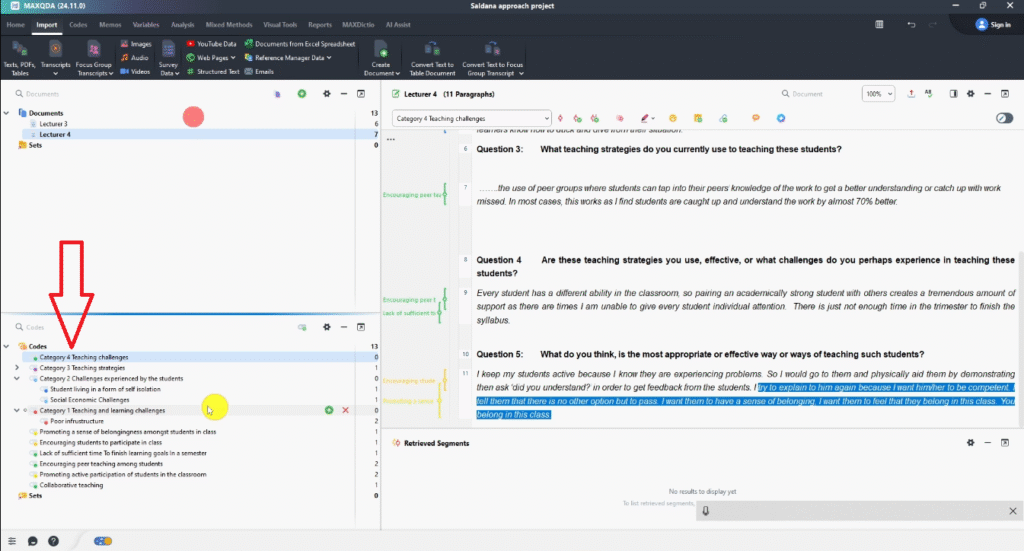
Then I will find all the codes with the color green, and drag and drop them under category four.
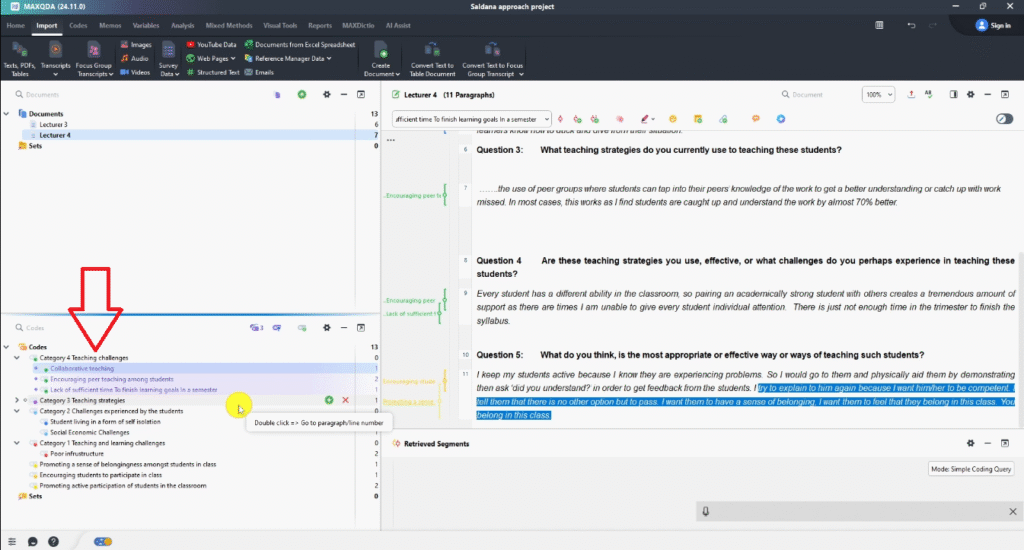
And then we can have category five that relates to the final question, which is what do you think is the most appropriate or effective way or ways of teaching students?
So category five effective ways of teaching students.
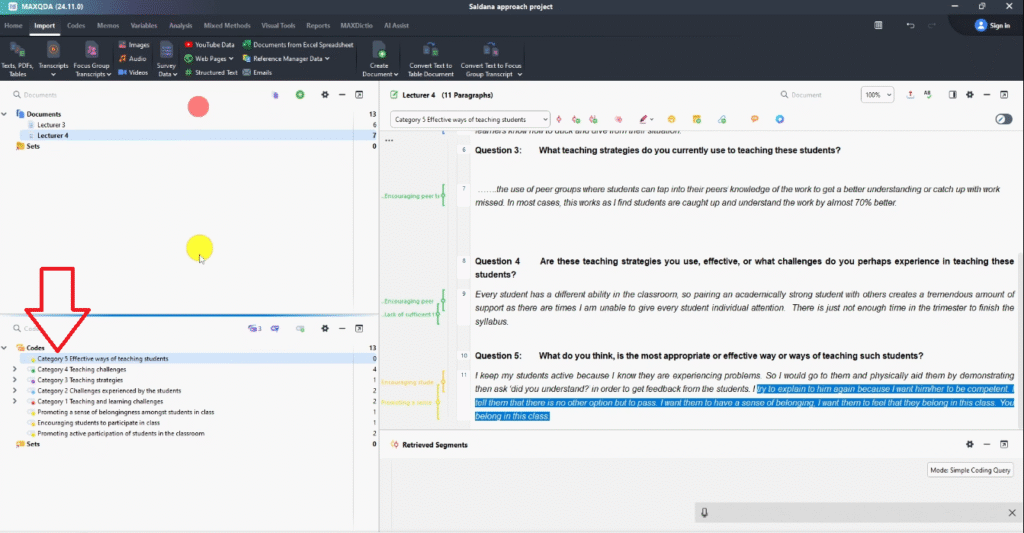
Then I want to grab all codes that came from that question, drag and drop them into category 5.
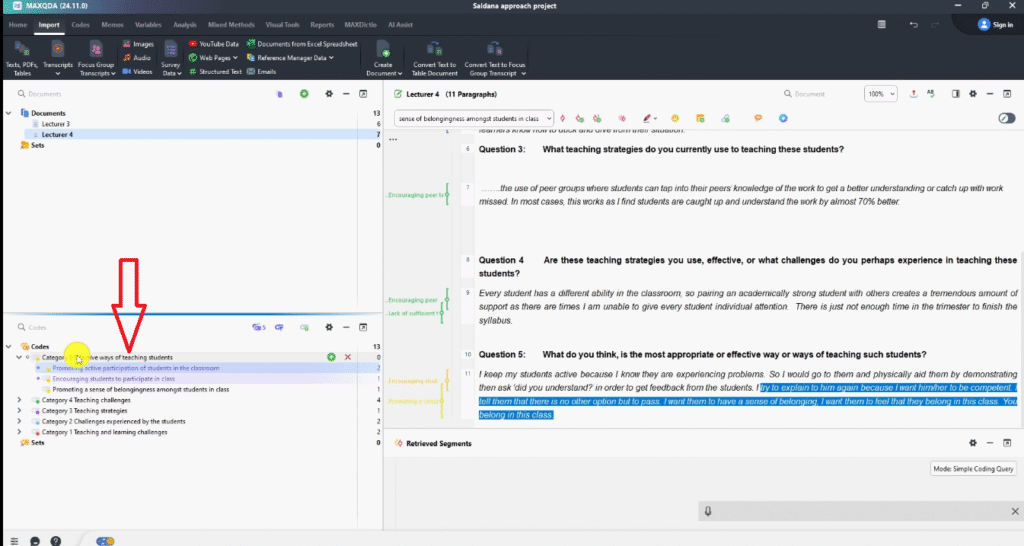
That is the second step of saldana’s approach of doing inductive thematic analysis, which is trying to combine the codes based on shared meaning to get some categories.
Generate themes through Analytic Memoing
The third step of the saldana’s approach to inductive thematic analysis is to generate themes through analytic memory.

So we are going to move from this categories to themes.
What is the difference?
Themes are well defined, and they have descriptions.
I can now move from categories to themes.
There are different ways of doing this.
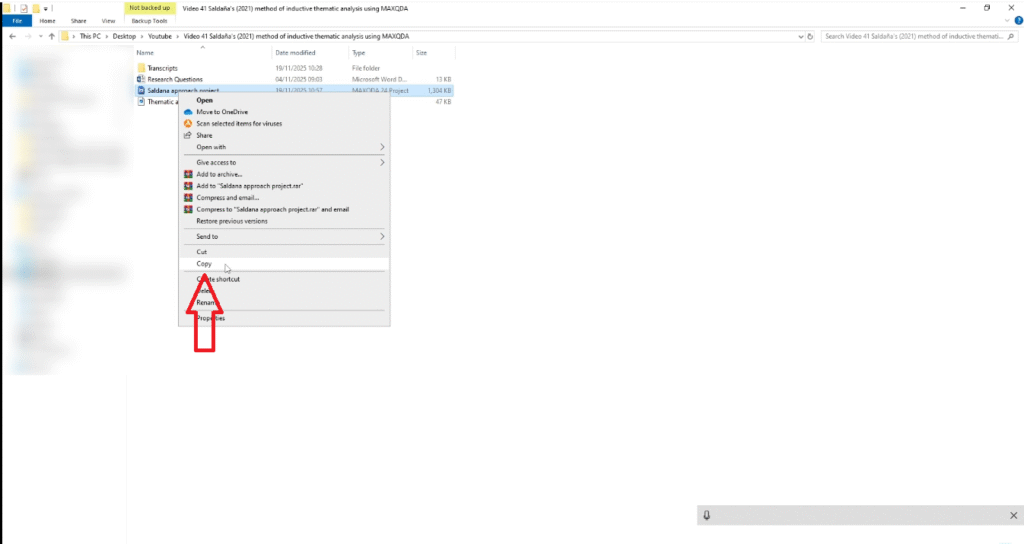
I can open another MAXQDA file and duplicate this file.
Let me begin by copying the MAXQDA file.
Then paste that copy.
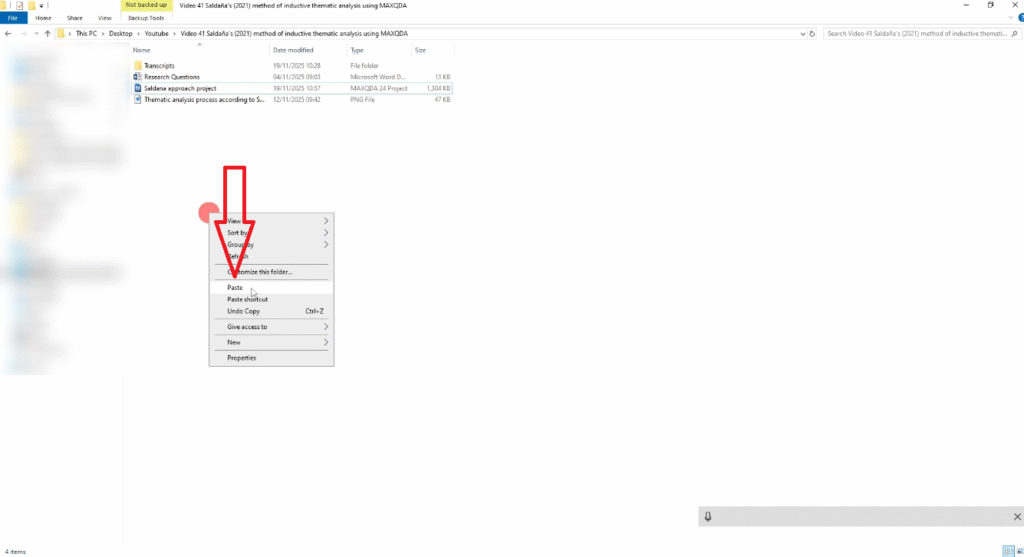
Then rename it to themes because I want to make changes and I also want to have the original file.
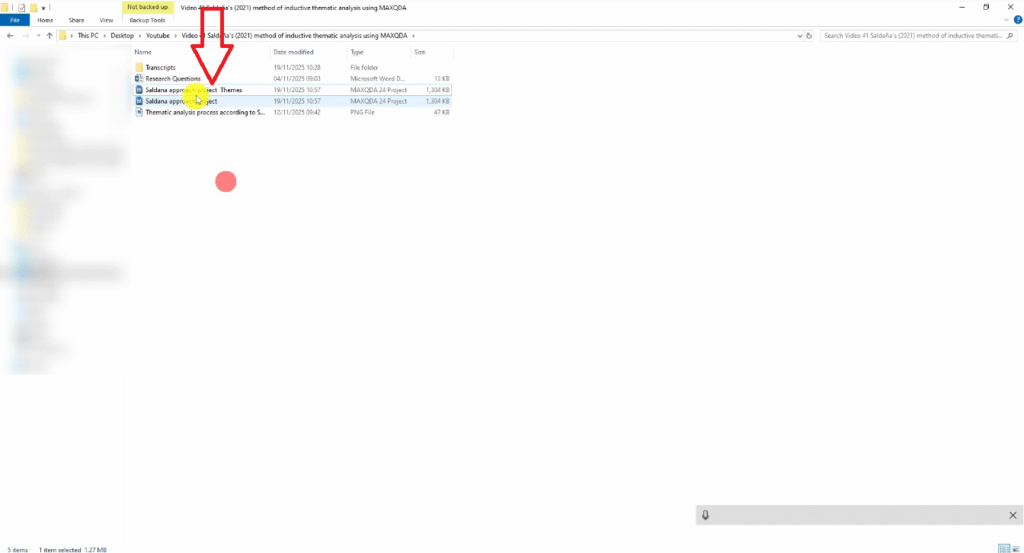
Then we open the renamed MAXQDA file.
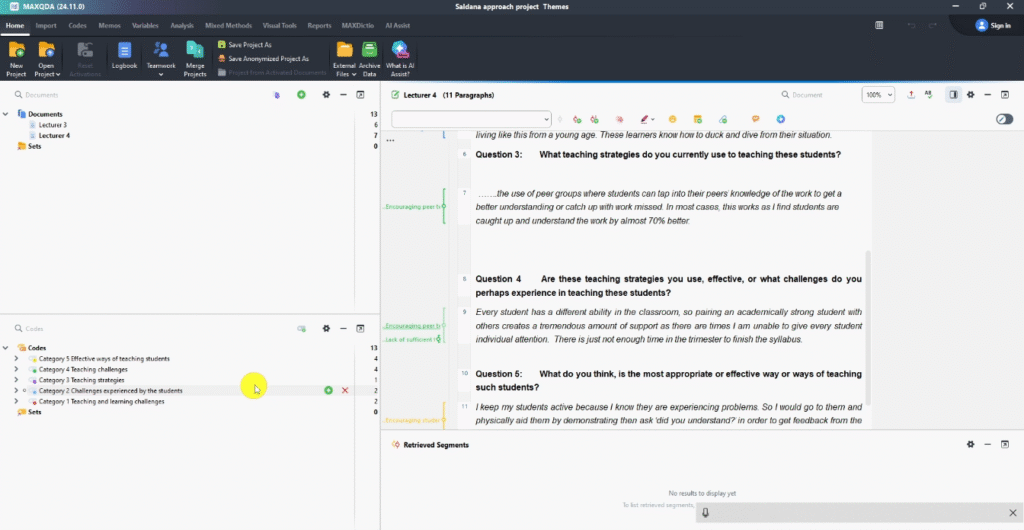
Analytic memoing means taking notes and trying to explain where these themes came from.
So in your opinion, what kind of teaching and learning strategies student with learning challenges in your class experience.

I want to write a memo for this category, then convert it to a theme.
Go to write a memo, and say, this theme represents the different teaching and learning challenges that the interviewees experience including both teachers and learners experience.
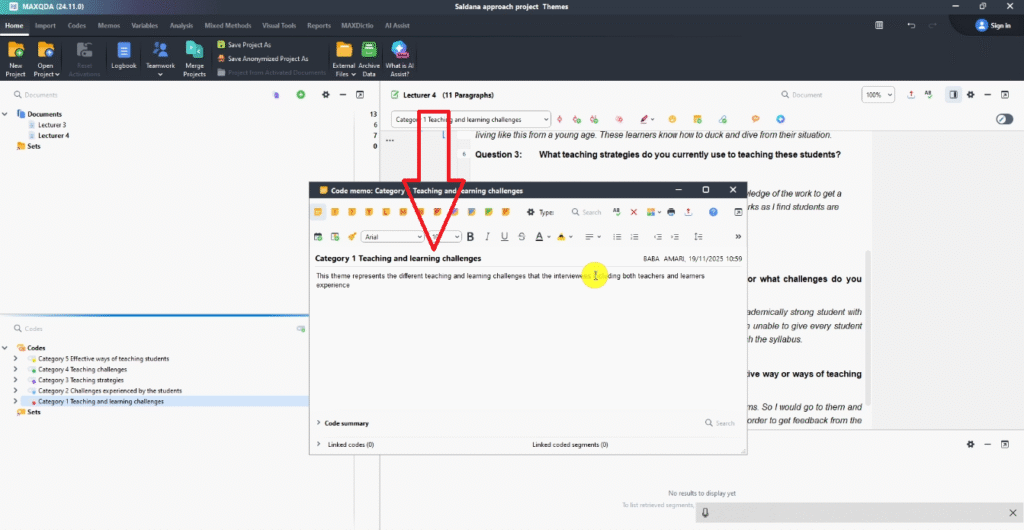
So this is the analytic memoing we are talking about in third step of the saldana’s approach to thematic analysis.
And I also want to come and rename it from category to theme.
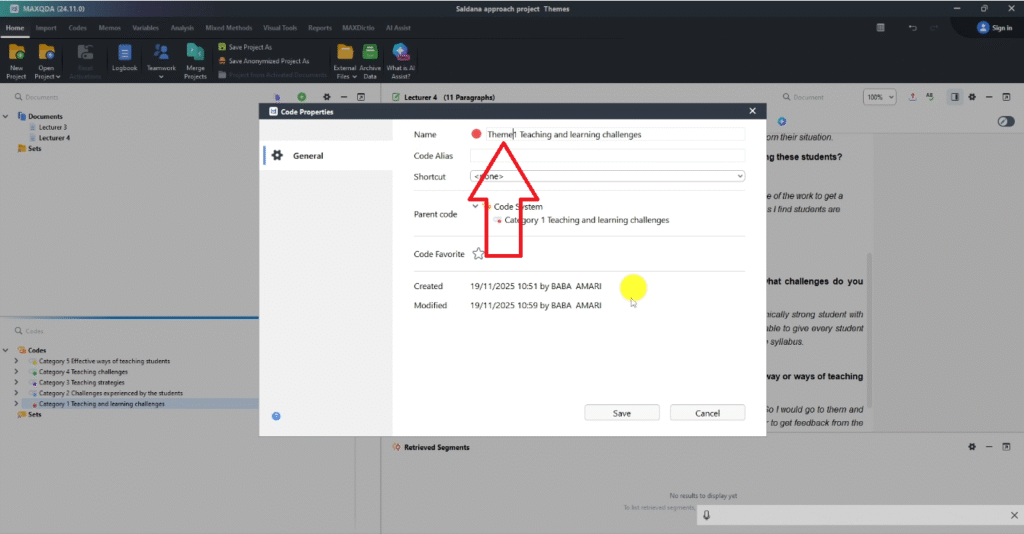
This is not a category now we are trying to refine the meaning.
If this was a lot of data, I could have taken time to provide more explanations, but this is just a short example.
So teaching and learning strategies.
Let’s see whether we can find another theme.
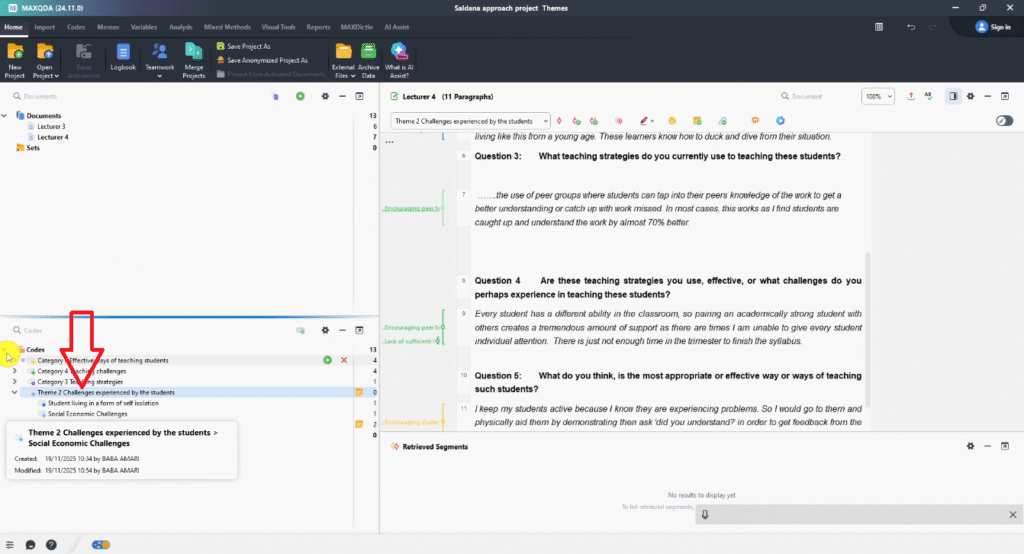
We are going to write a memo and say this theme represents the different challenges experienced by students who are interviewed from the target community college.
And I want to call this theme two.
we have another category called teaching strategies, I want to first write a memo for it.
This represents the different strategies adopted by the interview teachers to teach students in the community college.
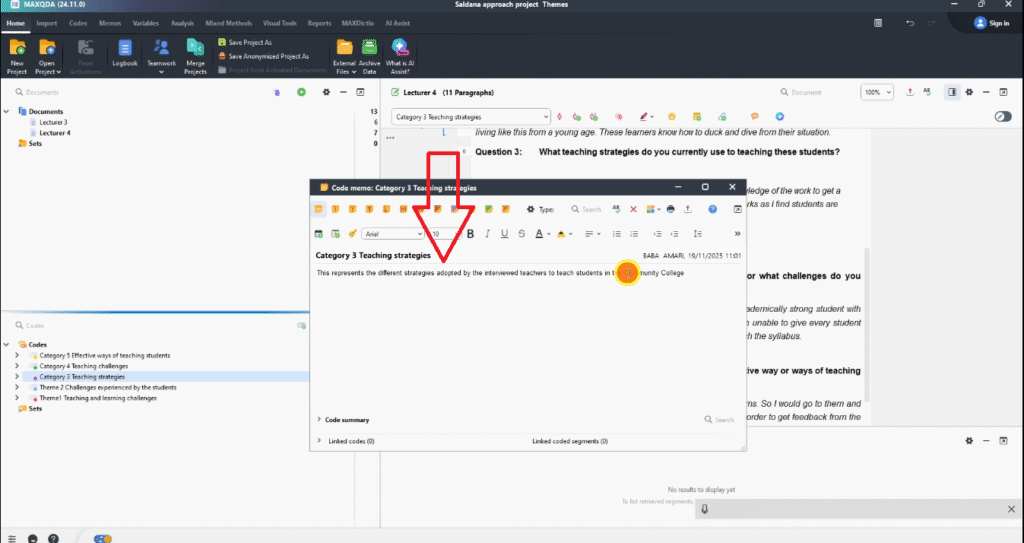
That is the memo.
Then I go to properties, and call this theme three.
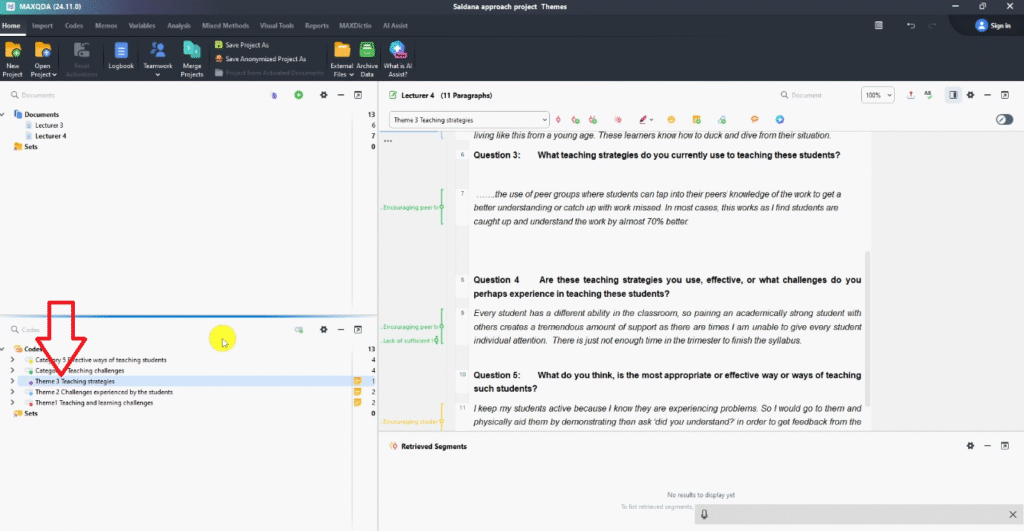
That is a theme.
I’m not doing too much because this is just an example.
Then we have teaching challenges.
Let us read that question.
Are these teaching strategies you use effective, or what challenges do you perhaps experience in teaching these students?
So new memo.
This represents the different challenges that teachers may experience while teaching students.
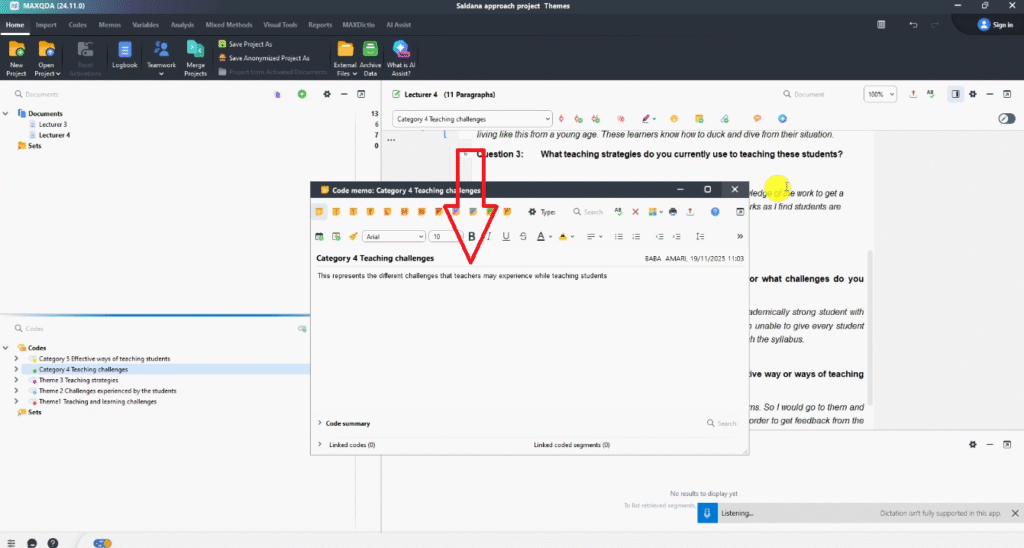
This one will be theme number four.
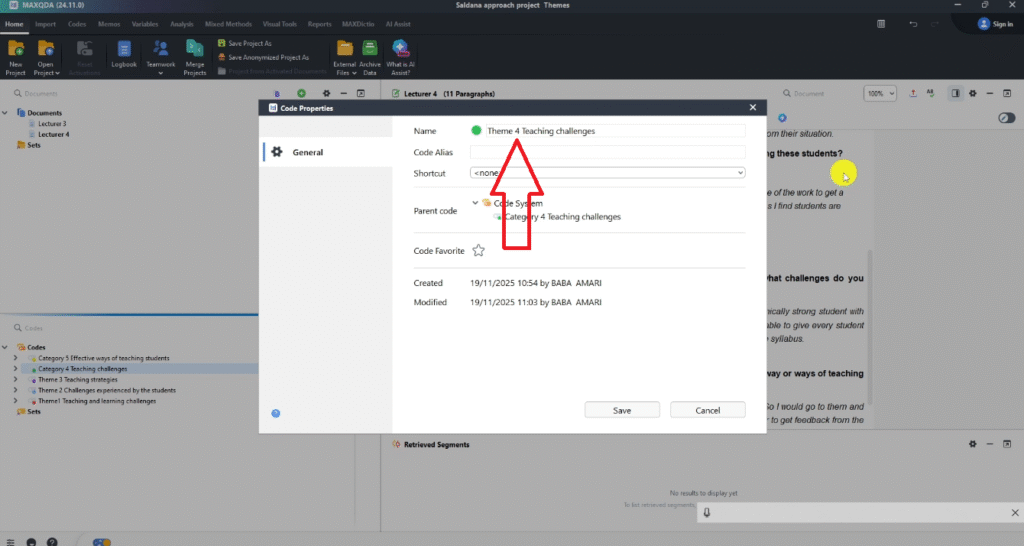
Remember, we are just doing memoing or coming up with memos which is the third step of Saldana’s inductive process of doing thematic analysis.
And finally, let us write a memo for theme five.
This theme represent the different strategies used by teachers to educate students.
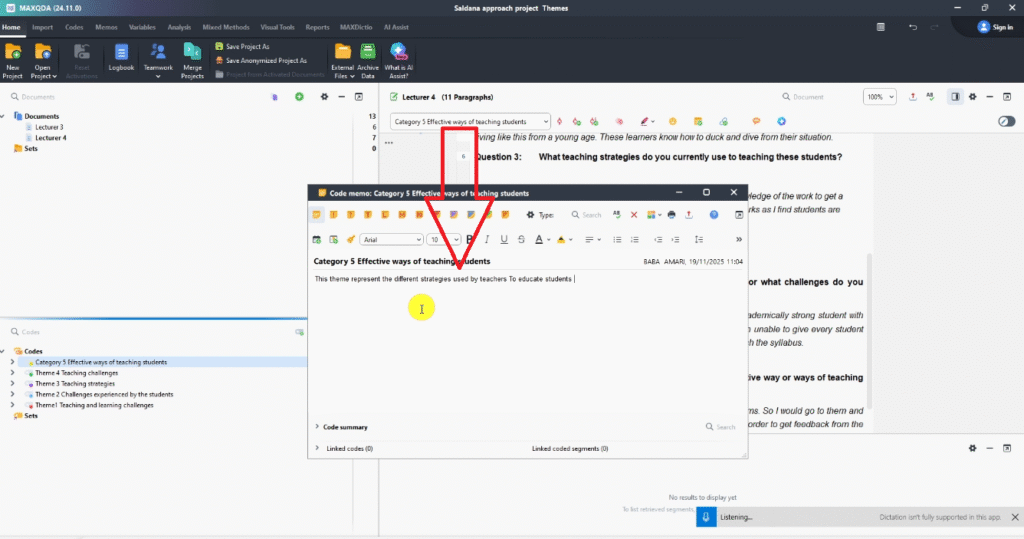
Connecting themes to their Research Questions
The fourth and final step proposed by Johnny Saldana in his method of inductive thematic analysis is connecting the themes to their research questions.

So we can copy this MAXQDA file again.
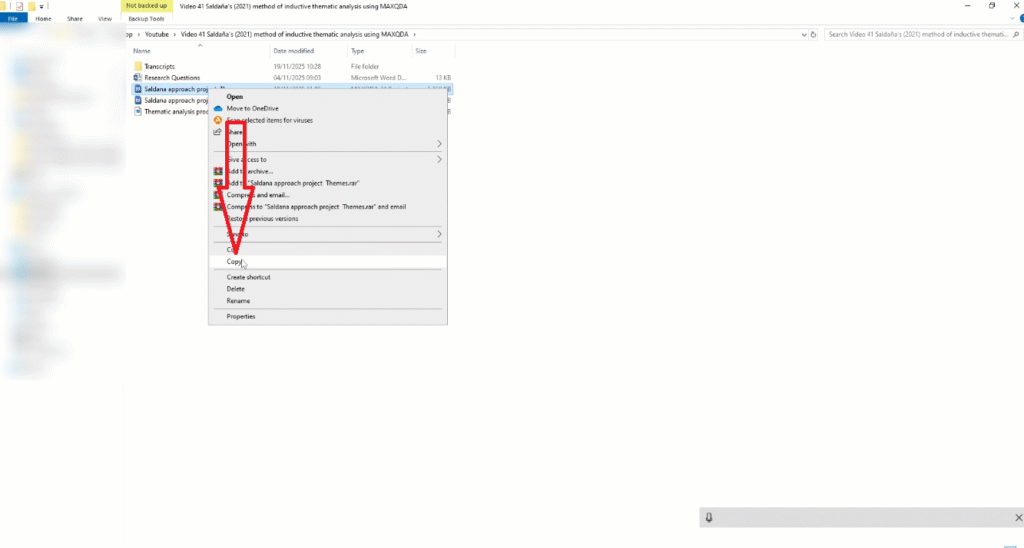
Then paste, and then rename the copy to connecting themes to RQs.
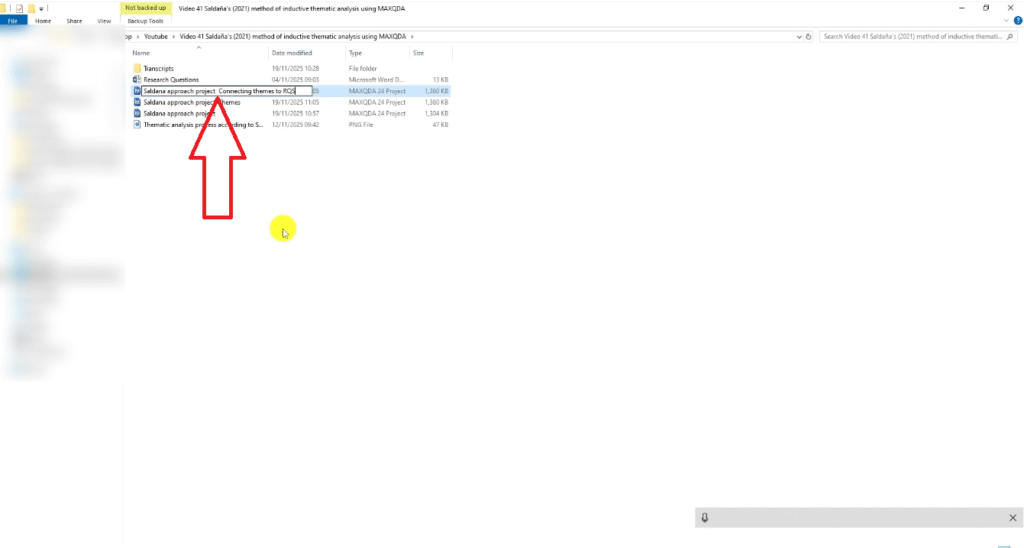
So let us go to the fifth step of saldana’s approach to inductive thematic analysis, which is connecting themes to research questions.
For this study, there were two main research questions of what are the main challenges teachers experience when working in a community college, and what are the different teaching strategies employed by teachers when working in a community college?
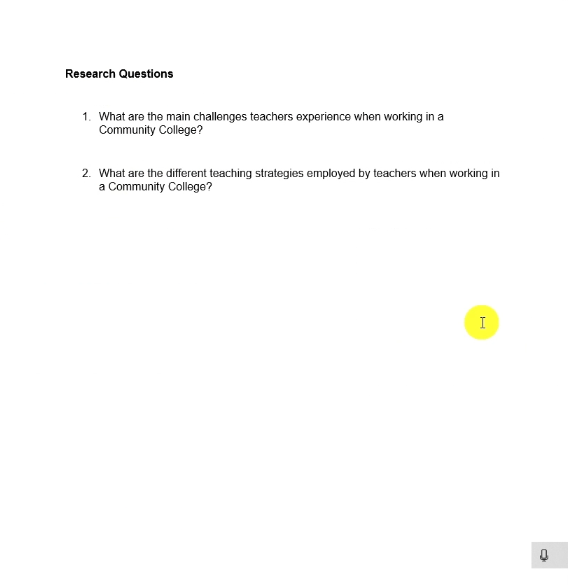
So we are gonna import these two questions inside the coding structure.
Let me show you how we do that.
I am going to copy this question.

Then go to MAXDA.
Create a container.
Call it RQ 1 or research question one.
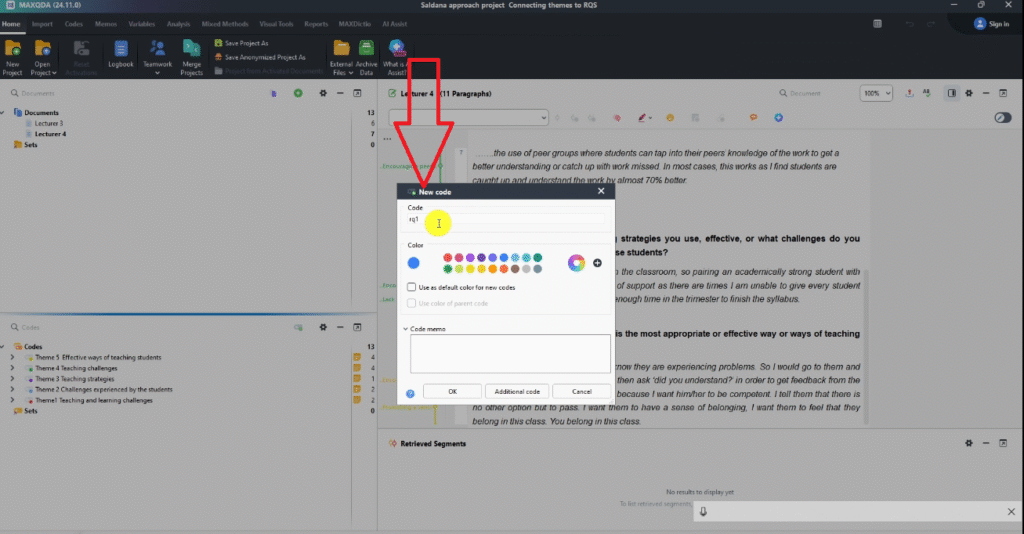
Then paste the question.
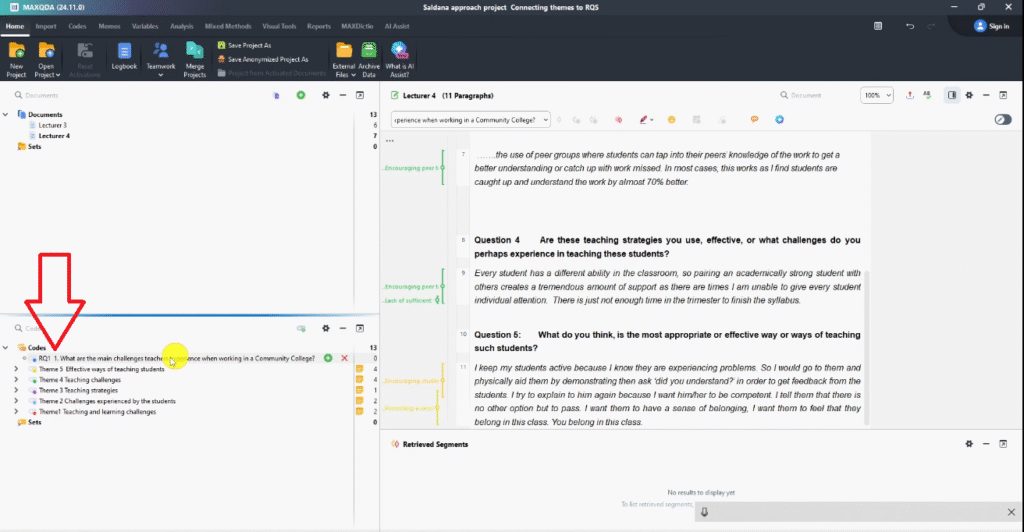
So that’s research question one.
And then we are going to have research question 2 here.
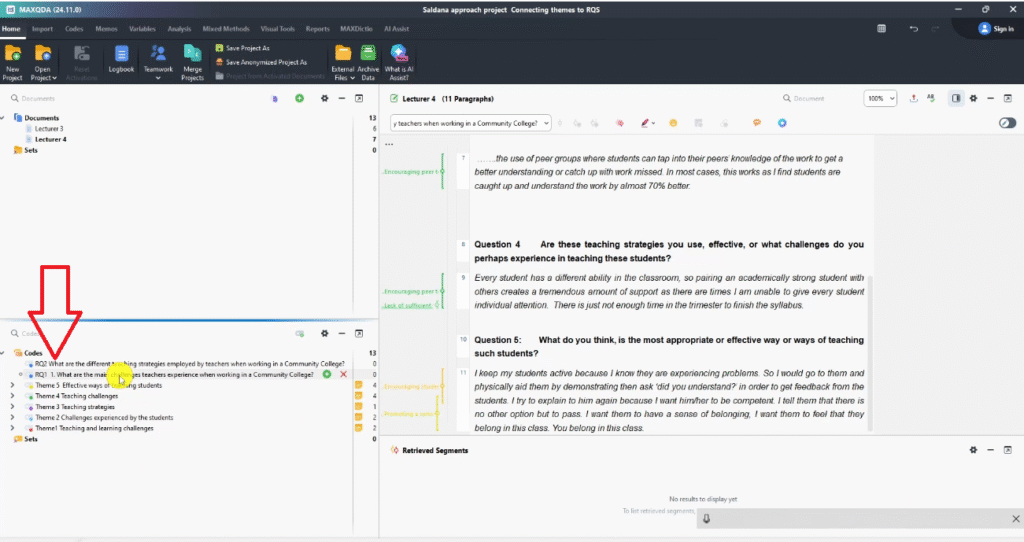
So that one is RQ two.
What are the main challenges teachers experience when working in a community college?
Drag and drop all the challenges experienced by students inside RQ 1.
Then drag and drop all the teaching and learning challenges into RQ 2.
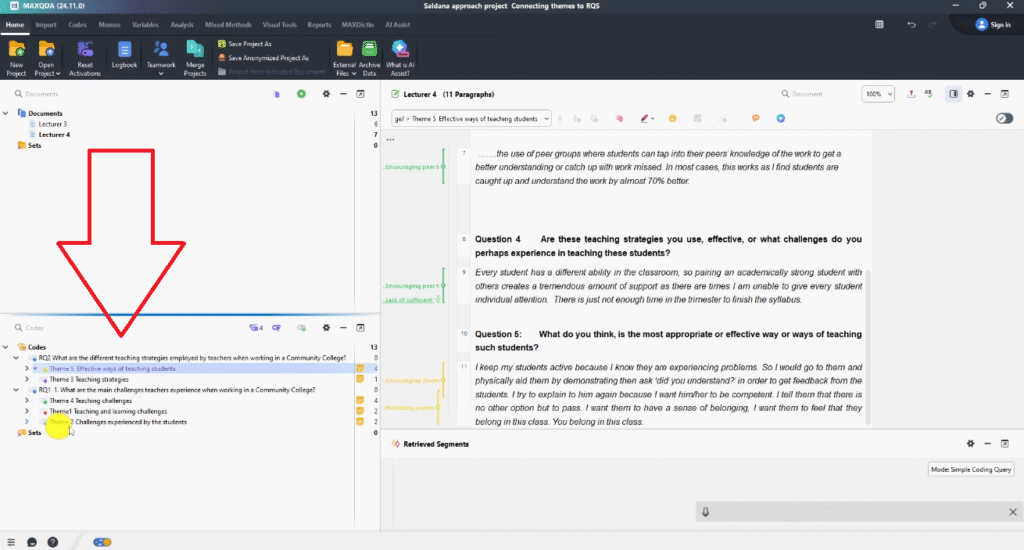
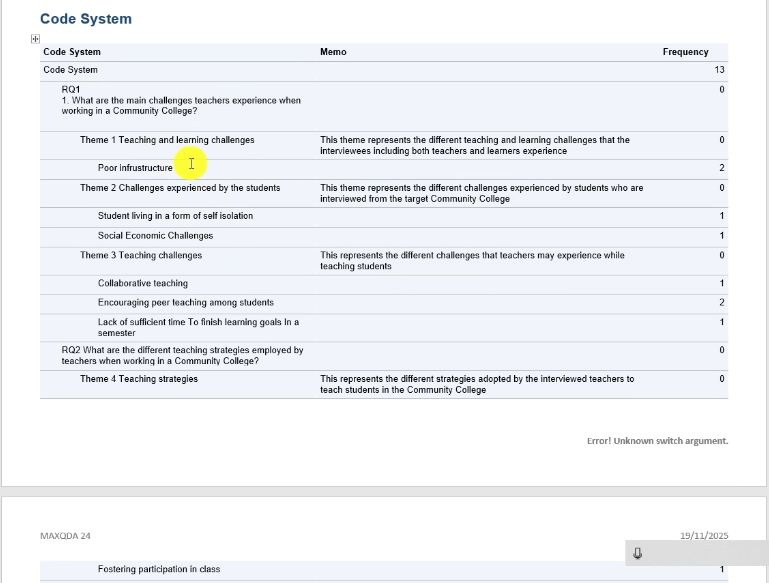
The final coding structure involves three themes that are connected to research question one, and two themes that are connected to research question two.
We rename the themes because we have shuffled the structure of the themes
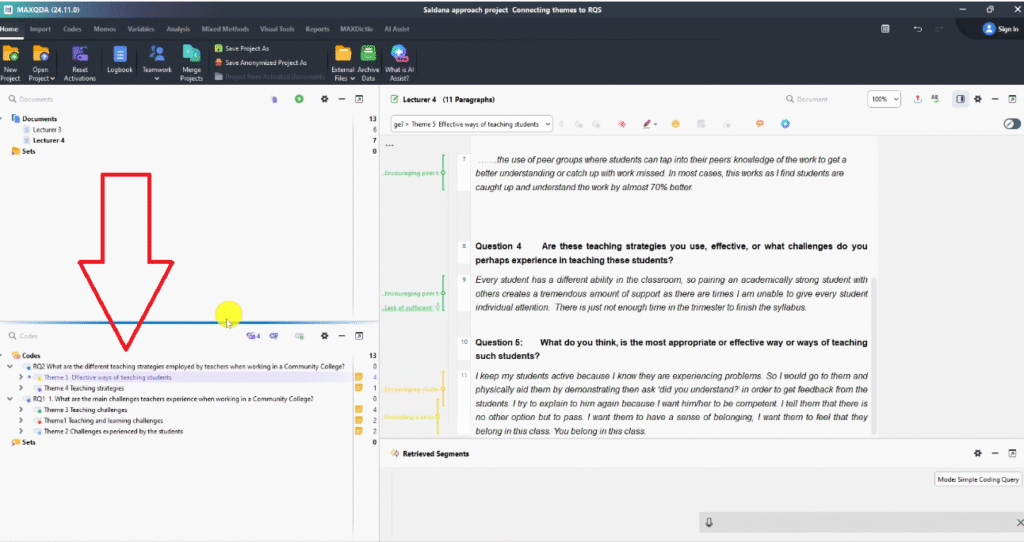
So to organize things well in MAXQDA, we go to sort A to Z so that you can see everything in a well sorted manner.
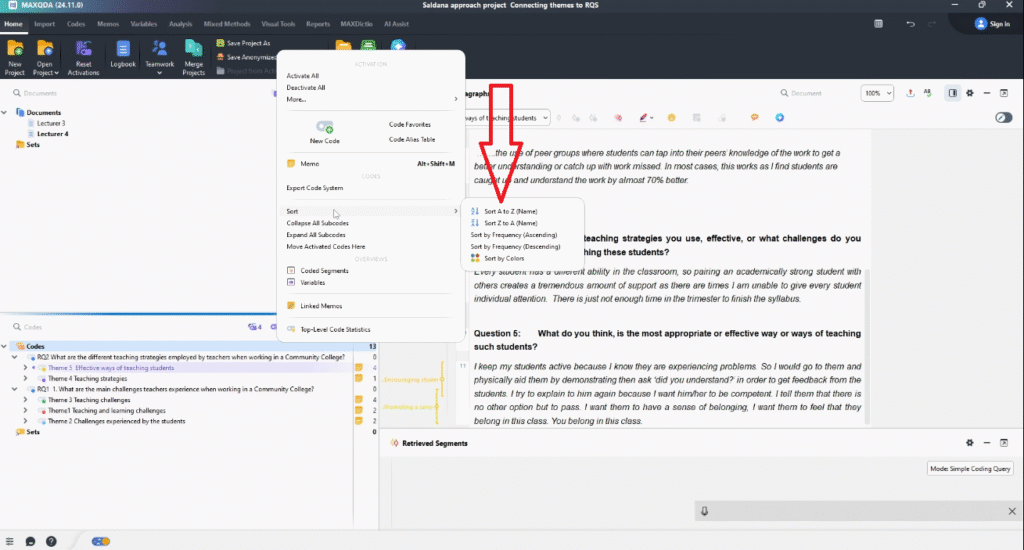
Then we go to the research questions and sort everything.
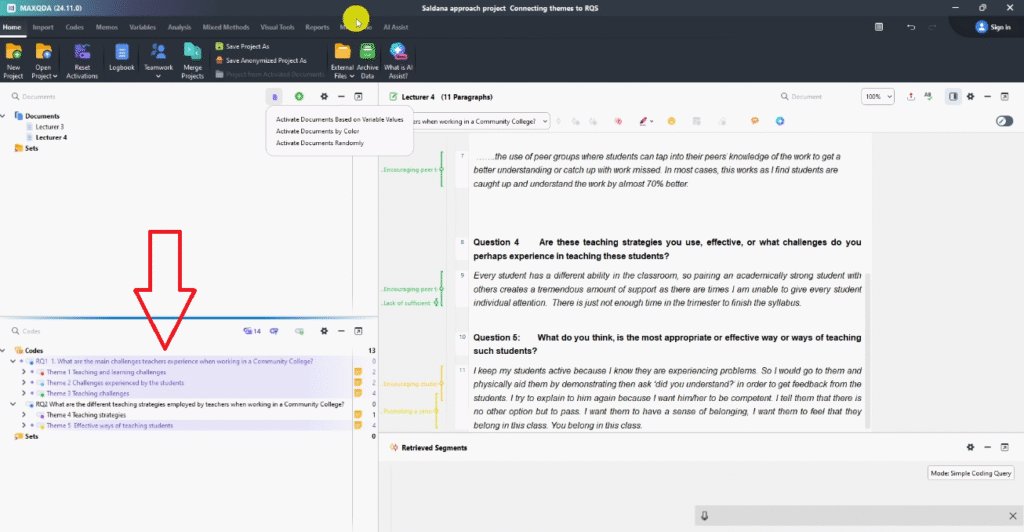
And with that we can go to reports.
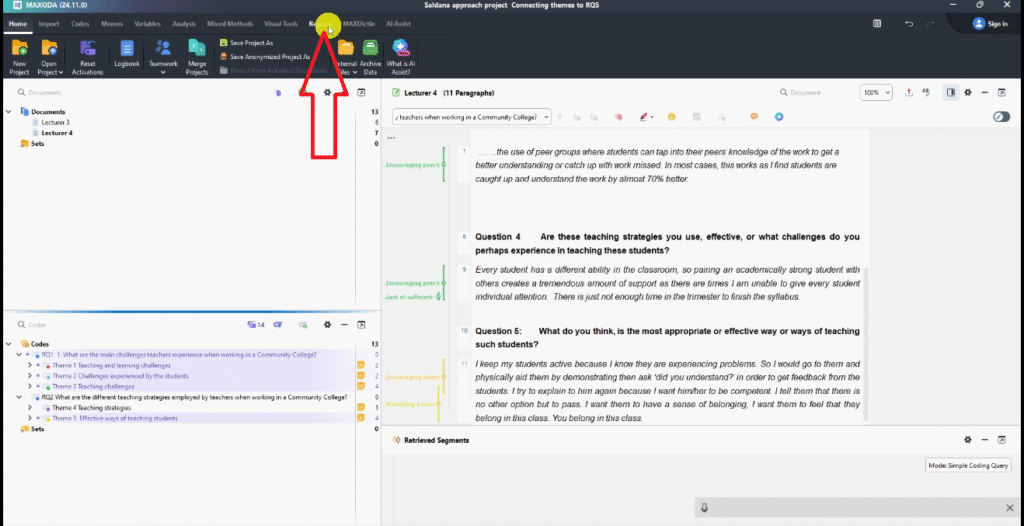
Export then code system.
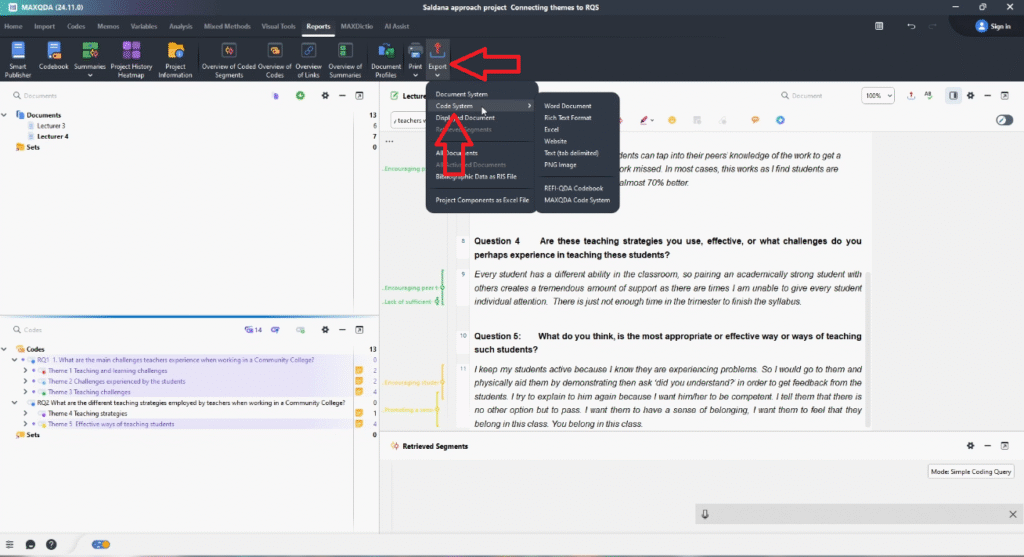
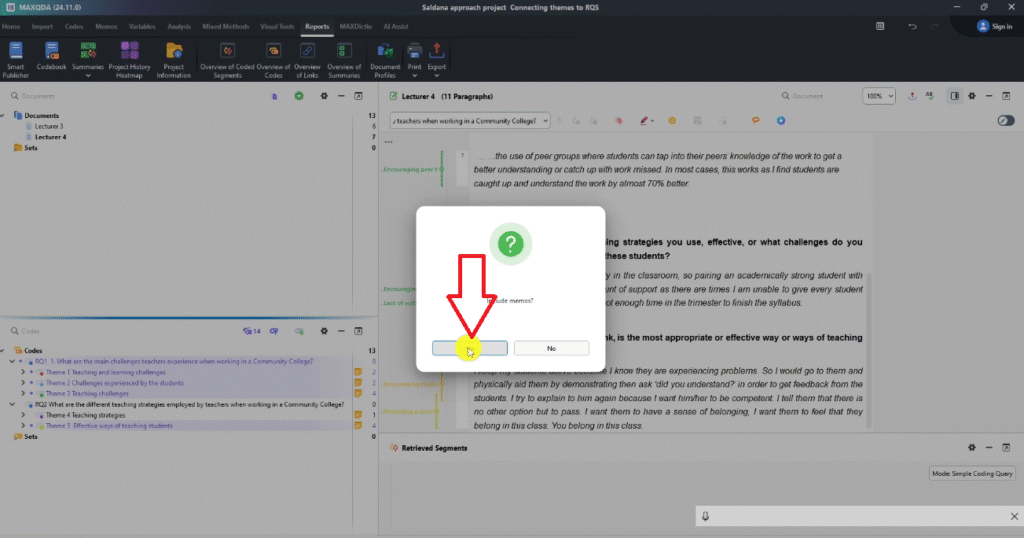
Let us include memos because memos are the descriptions.
This is the final code structure under.
This is just a highlight of how we conduct the saldana’s inductive approach of thematic analysis by going through the different steps, including
- Identifying and categorizing codes
- Developing high level categories
- Generating themes through analytic memoing
- Applying themes to their research questions

