

Last Updated on 5 months ago by Bernard Mugo
| Quick Summary: NVivo 15 includes an AI Assistant that can suggest codes for your interview data. After testing it head-to-head with manual coding on the same transcripts, my verdict is clear: AI coding in NVivo generates more work than it saves, forces a deductive approach, and raises serious data confidentiality concerns. I’ll walk you through exactly what I found — and when AI in NVivo is actually worth using. |
- What Is Qualitative Coding? (A Quick Definition)
- What Manual Coding Looks Like in NVivo 15
- How AI Coding Works in NVivo 15
- Comparing the quality of AI codes with manual codes
- 5 Reasons I Don't Use AI for Qualitative Coding in NVivo
- When Is AI in NVivo Actually Useful?
- Frequently Asked Questions
- Key Takeaways
In the past few years, AI has entered almost every corner of academic research — and qualitative analysis is no exception. NVivo 15 now includes a built-in AI Assistant that promises to speed up the coding process for interview and focus group data. For researchers facing tight deadlines and mountains of transcripts, that sounds like exactly what they need.
But does it actually work? I tested the NVivo 15 AI coding feature directly against manual coding, using the same transcripts, same research questions, and same analytical lens. What I found surprised me — and not in the way AI advocates would hope.
In this article I’ll show you what both processes look like side by side, share my honest verdict, and explain the five specific reasons I still don’t use AI for qualitative coding. If you’re new to NVivo, my step-by-step guide to thematic analysis in NVivo 15 is a good place to start before reading this.
What Is Qualitative Coding? (A Quick Definition)
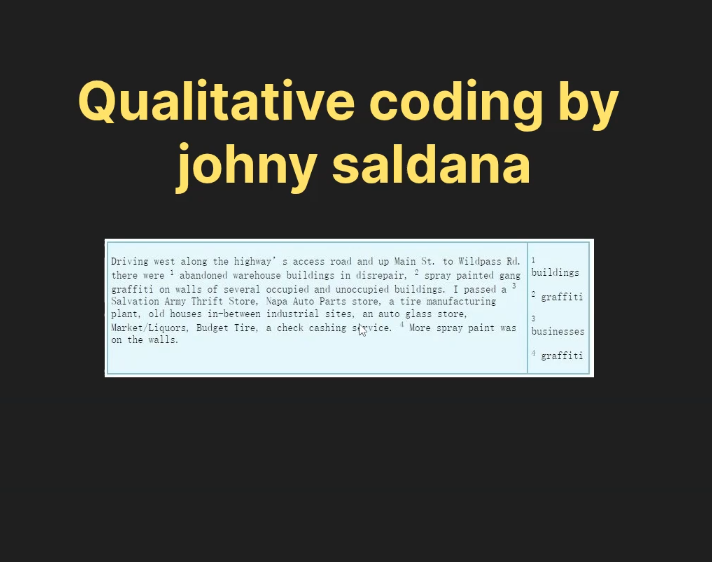
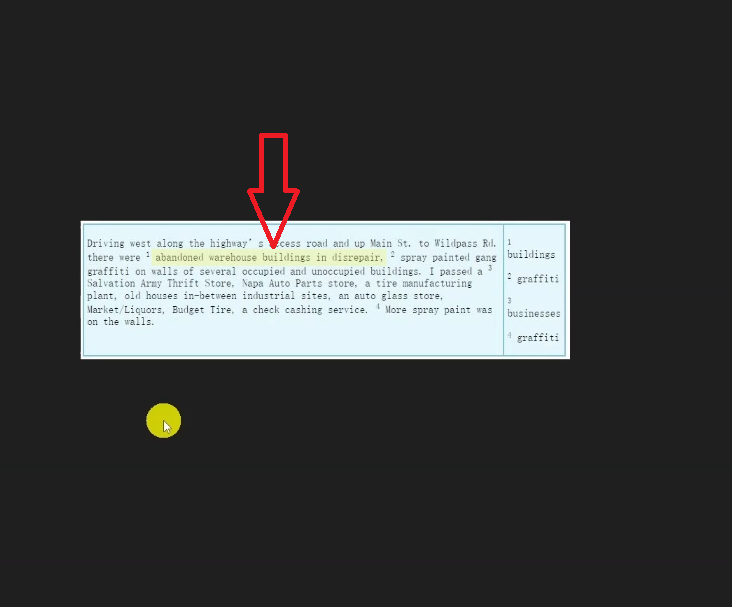
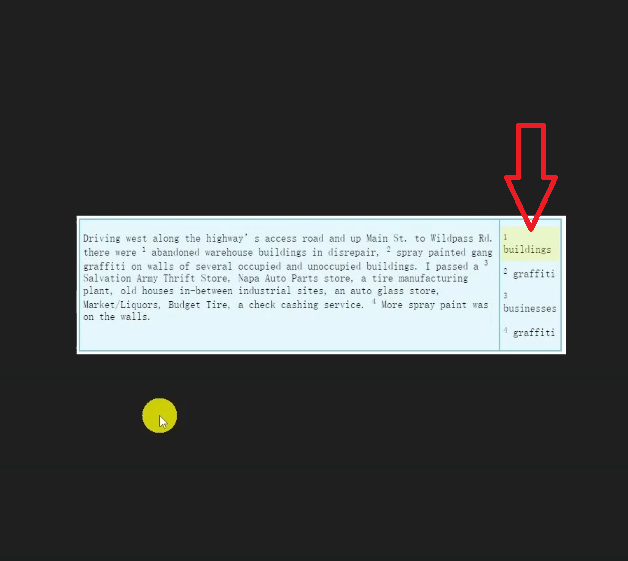
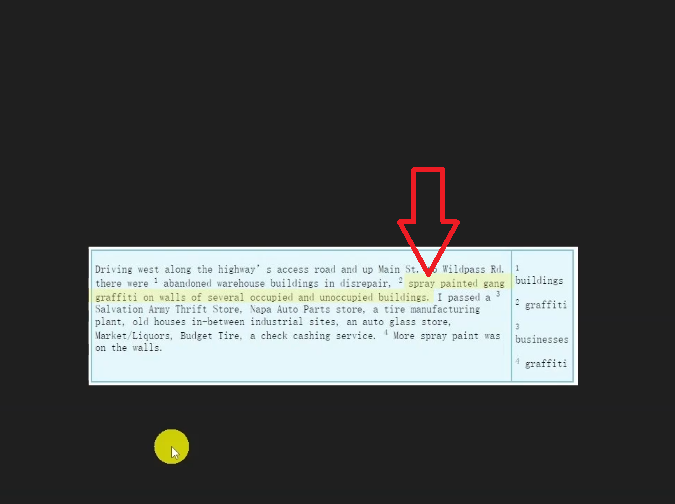
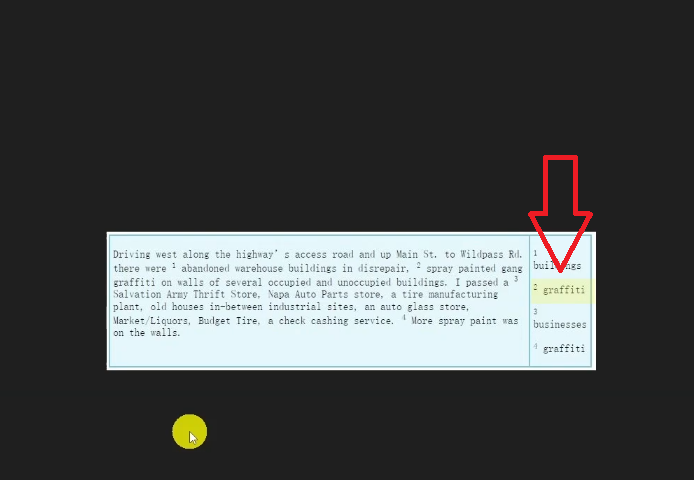
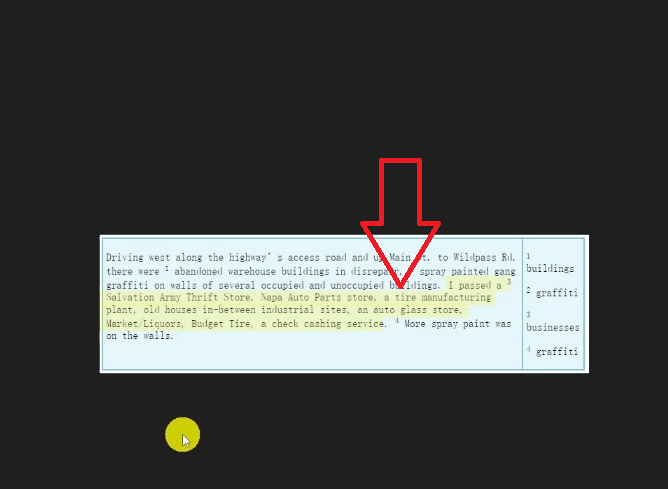
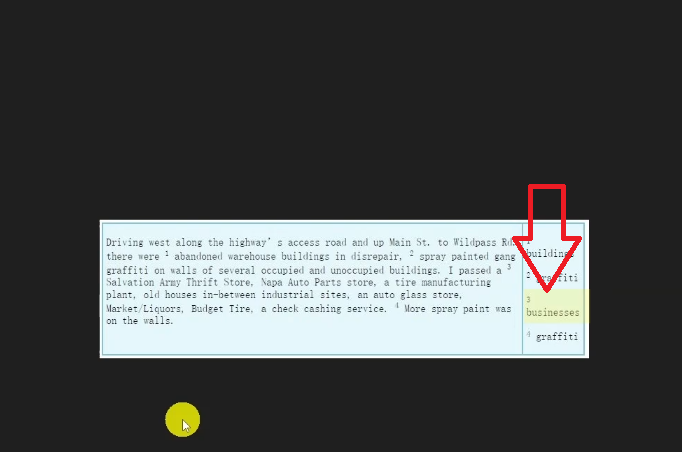
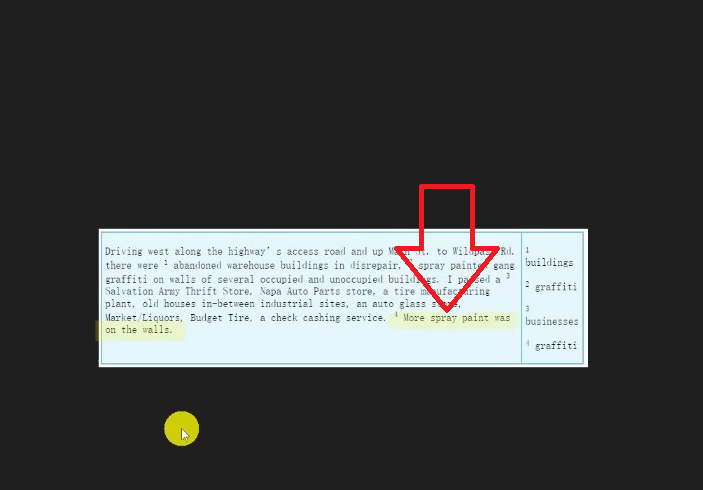
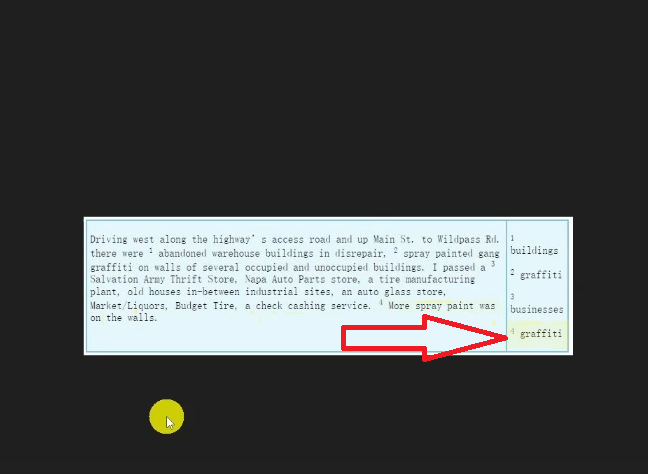
Qualitative coding is the process of systematically reading through your interview transcripts, identifying meaningful passages, and assigning these interpretive labels. Here’s a quick example of how it works. Take this excerpt:
| Driving West along the highway access road, there were abandoned warehouse buildings in disrepair, spray-painted gang graffiti on walls, a Salvation Army thrift store, a tire manufacturing plant, old houses in between industrial sites. |
A researcher reading this passage would assign codes like:
- Buildings → ‘abandoned warehouse buildings in disrepair’
- Graffiti → ‘spray-painted gang graffiti on walls’
- Businesses → ‘Salvation Army thrift store, tire manufacturing plant, old houses’
Coding is the first step of thematic analysis. Get it right and everything downstream — themes, findings, your Chapter 4 — becomes significantly easier. For a deeper grounding in how the process works, SAGE Research Methods has excellent methodological resources on qualitative coding.
What Manual Coding Looks Like in NVivo 15
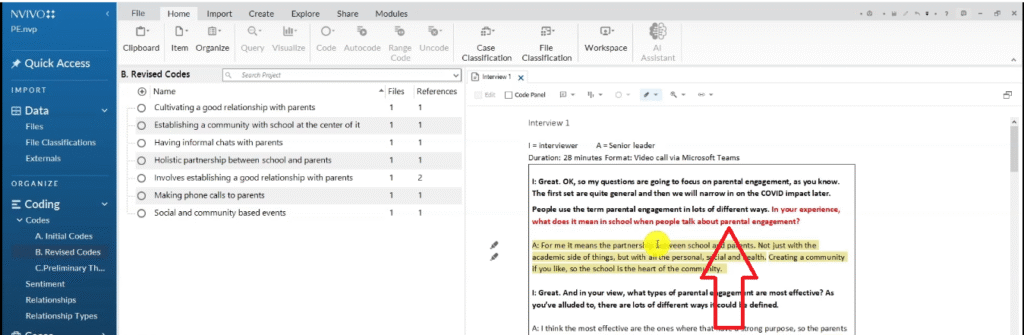
Before testing the AI feature, I coded two interview transcripts manually in NVivo. The study focused on parental engagement in elementary schools — participants were asked about what parental engagement means in their school and what effective forms of it look like.
Creating and Refining Your Initial Codes
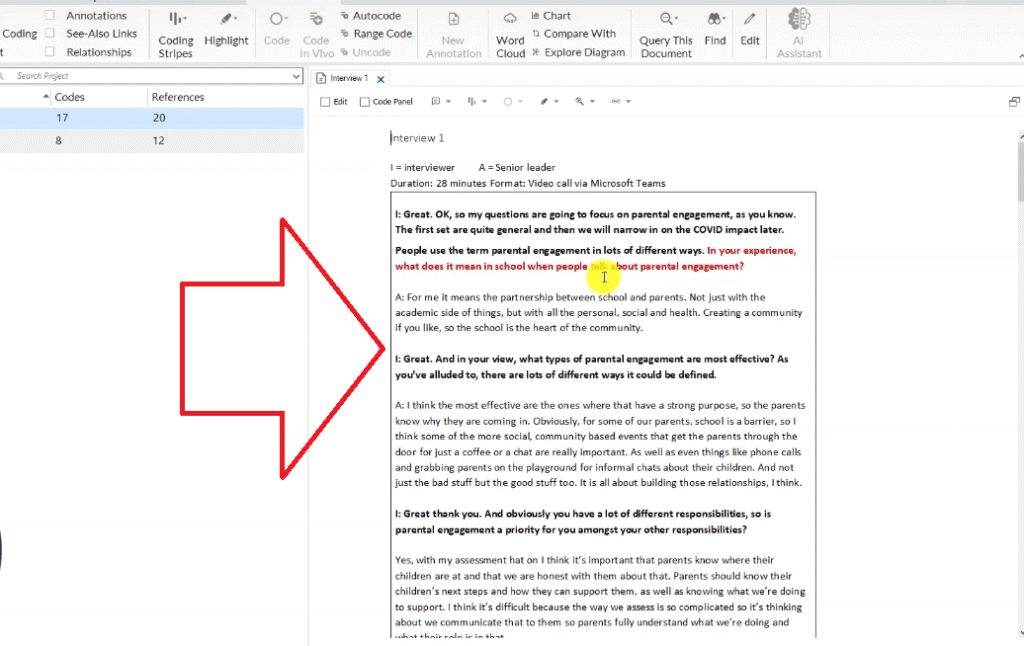
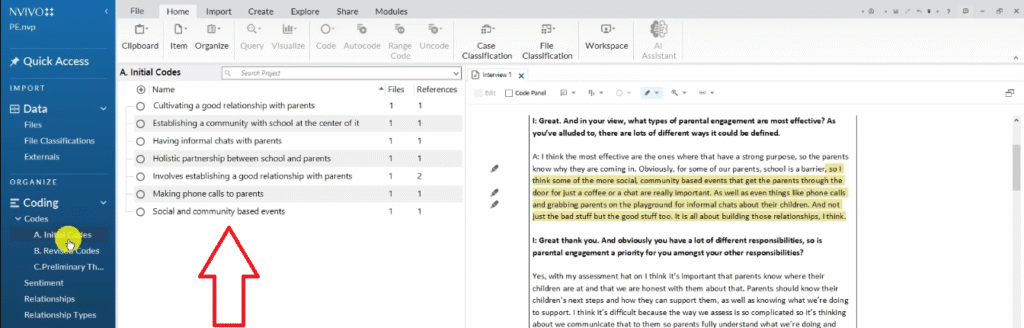
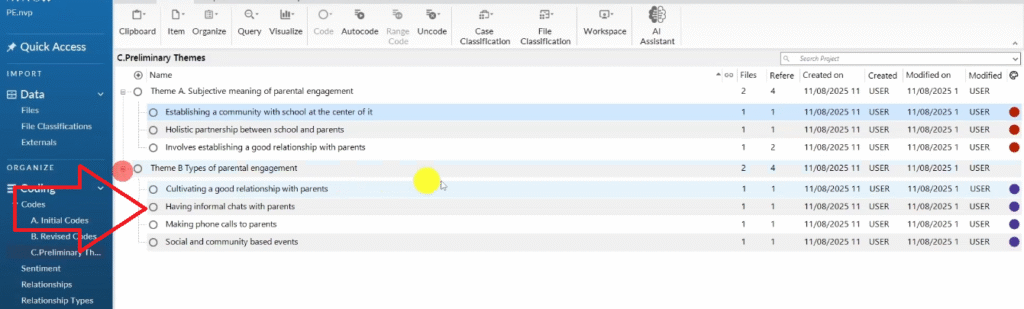
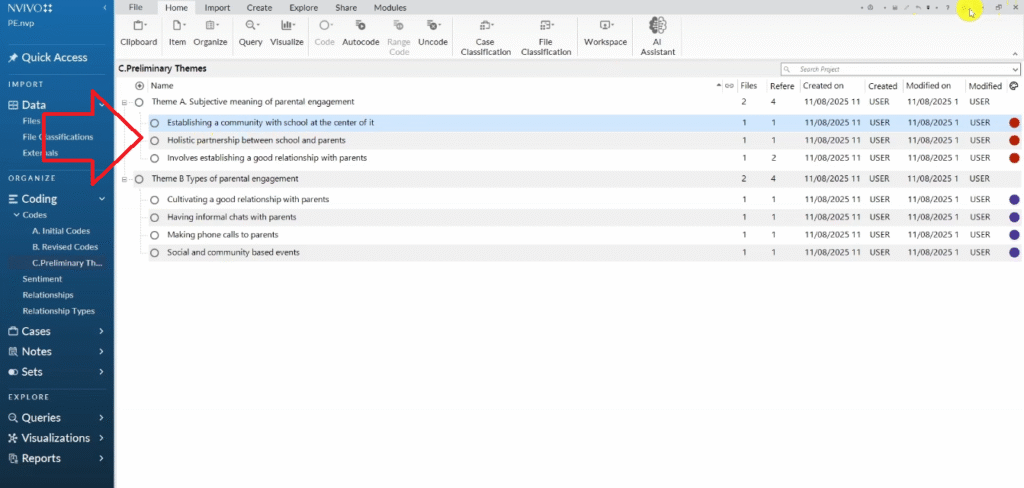
Reading through the first transcript, I highlighted key passages and created interpretive codes — not descriptions, but labels that captured the meaning behind what participants said. My initial codes included:
- Making phone calls to parents
- Social and community-based events
- Establishing a good relationship with parents
- Holistic partnership between school and parents
- Having informal chats with parents
- Establishing a community with the school at the centre
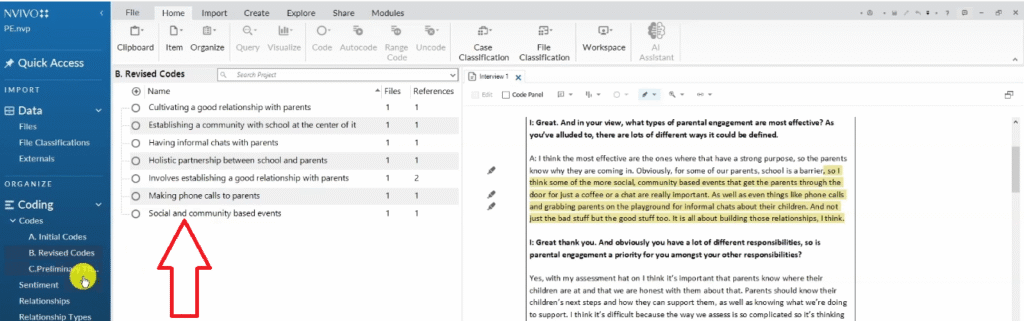
I then applied a colour-coding system — red for codes from the first research question, blue for codes from the second. This makes the transition from codes to themes much faster, and it’s a technique I use consistently with every client project. Once I had all codes from both transcripts, I reviewed and refined them to remove duplicates and sharpen the language.
Moving from Codes to Themes
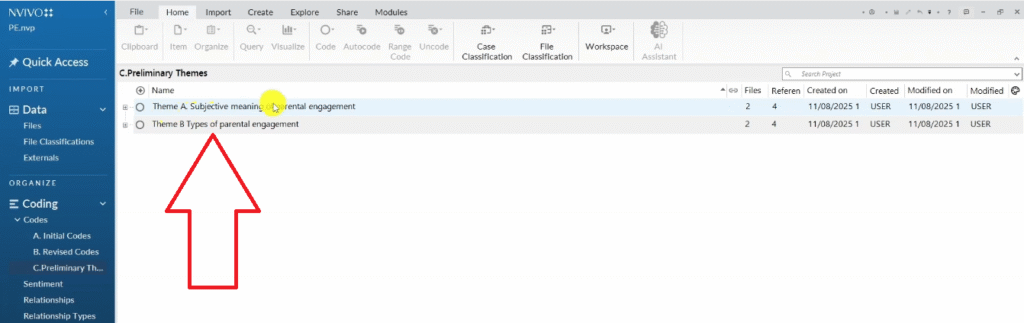
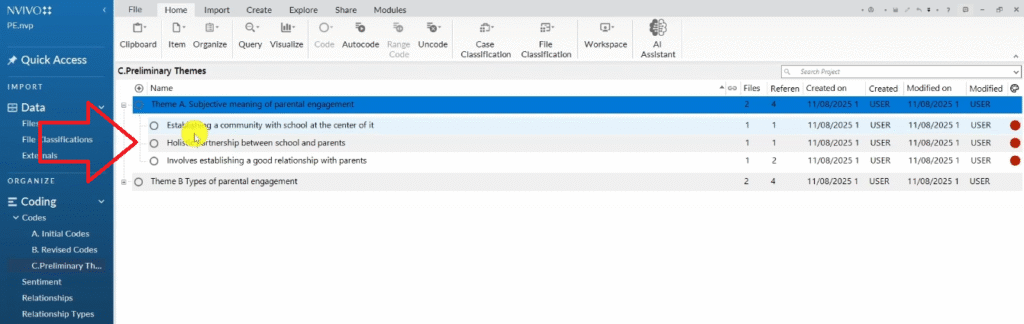
After refining the initial codes, I grouped them by shared meaning and developed two themes. The first was Subjective Meaning of Parental Engagement — supported by codes like ‘holistic partnership between school and parents’, ‘establishing a community with the school at the centre’, and ‘good relationship with parents’. The second was Types of Parental Engagement — supported by ‘informal chats’, ‘making phone calls’, ‘social and community-based events’, and ‘cultivating good relationship with parents’.
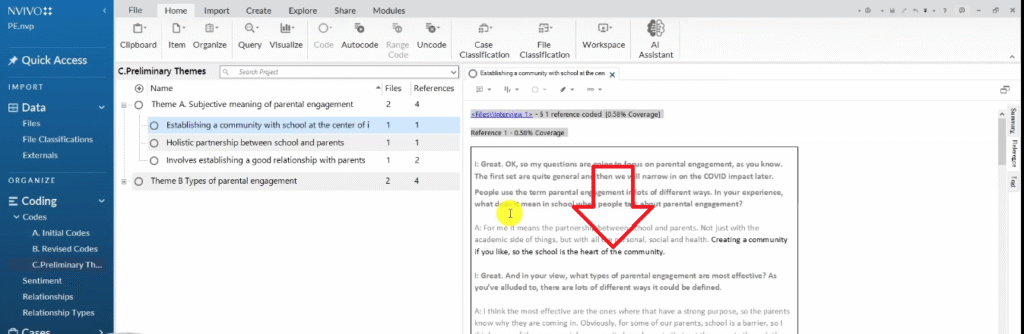
Each code retained the original participant quotes, which I could access by double-clicking the code in NVivo — a critical requirement for writing up your findings. For a full walkthrough of this process, see my guide on how to do qualitative analysis of interviews with NVivo.
How AI Coding Works in NVivo 15
The Core Problem — AI Forces a Deductive Approach
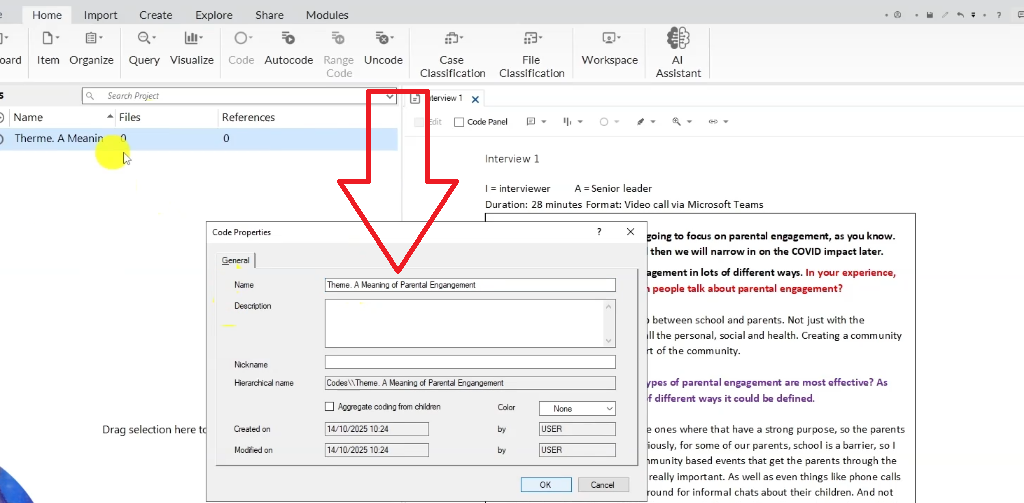
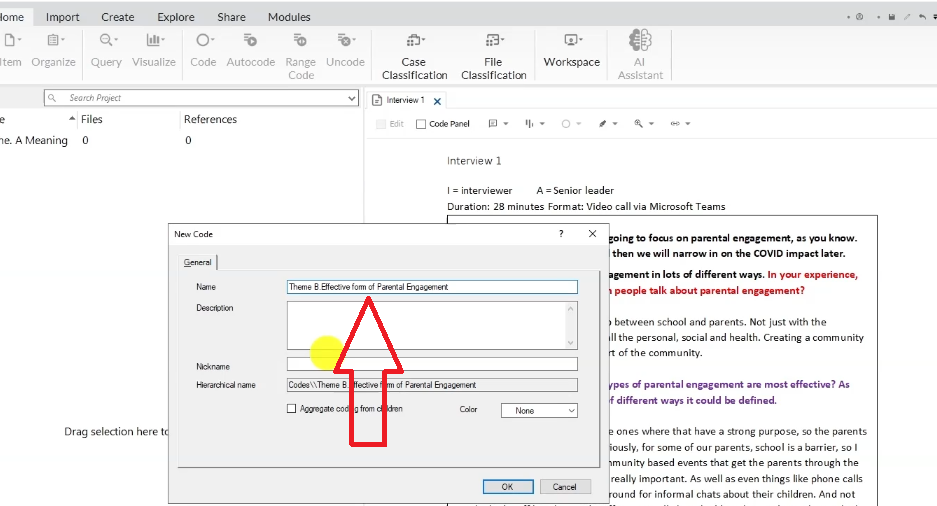
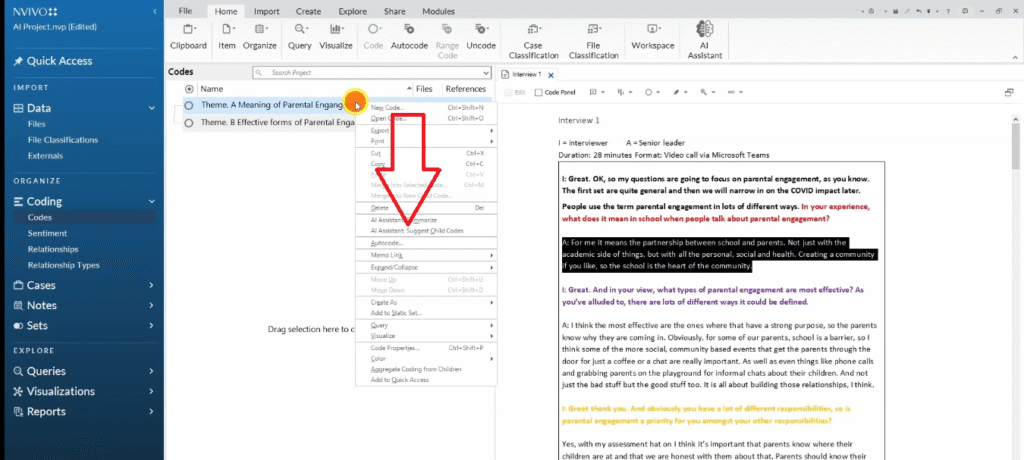
Here is the most important thing to understand about AI coding in NVivo 15: the AI Assistant does not generate codes inductively from your data. It suggests child codes — which means you have to create a parent theme first before the AI can do anything.
This is a fundamental problem. Inductive thematic analysis — where codes and themes emerge from the data — is the standard approach for most qualitative research. Deductive thematic analysis — where you bring predetermined themes to the data — is a different methodology entirely. By requiring you to create themes before coding, the NVivo AI Assistant forces a deductive workflow, even when your methodology calls for an inductive one. For a detailed explanation of this distinction, see my article on Saldaña’s inductive thematic analysis approach in MAXQDA.
Generating AI Codes: A Step-by-Step Walkthrough
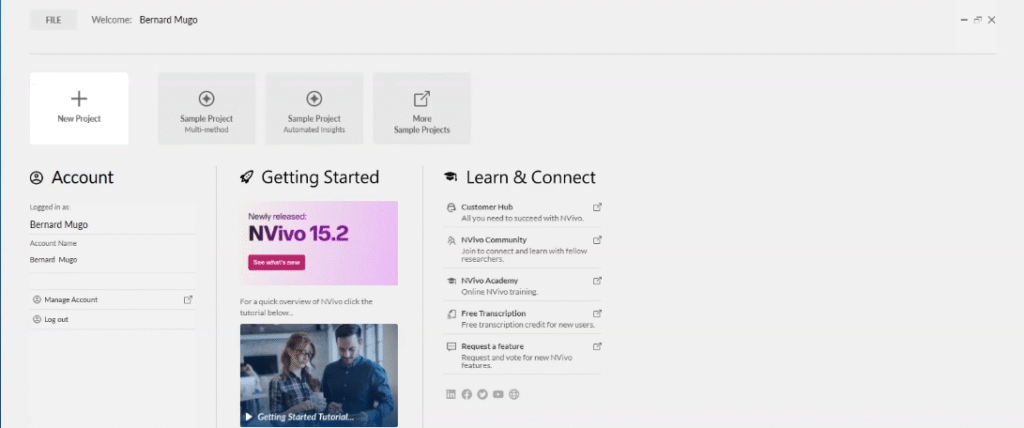
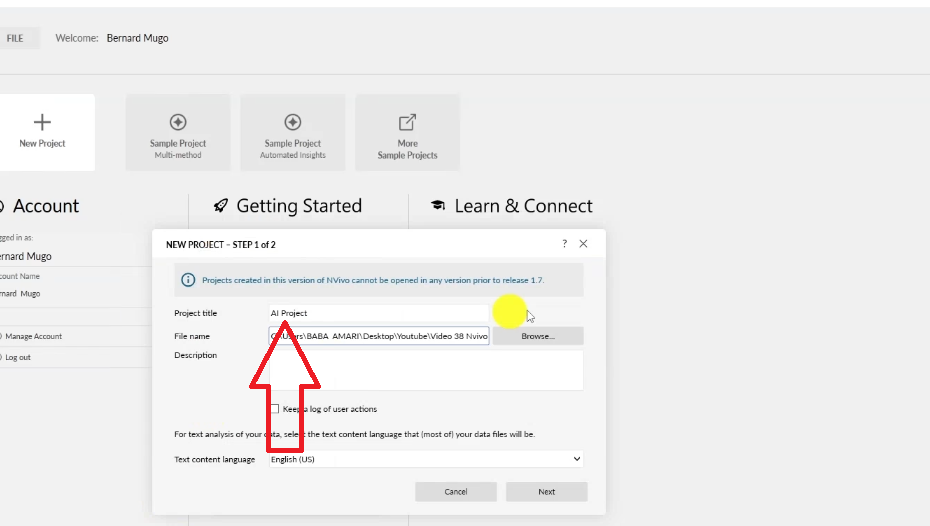
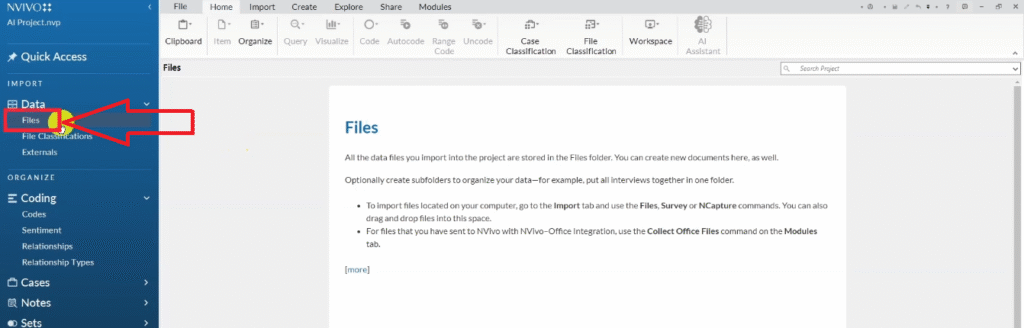
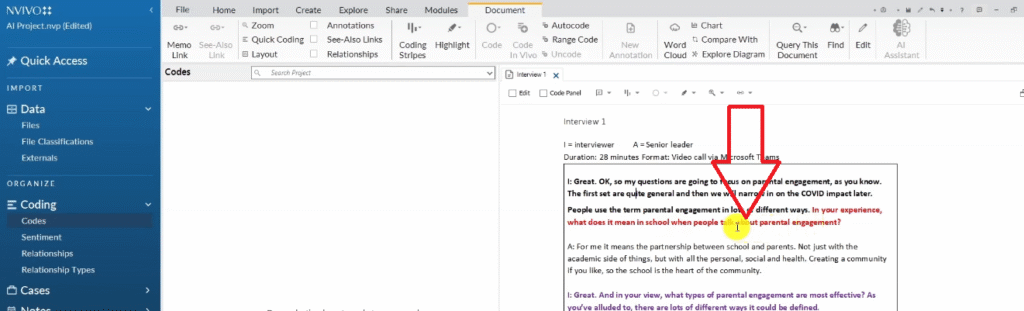
Here is what the AI coding process actually looks like in NVivo 15. I created a new project, imported the same two parental engagement transcripts, and attempted to code them using the AI Assistant.
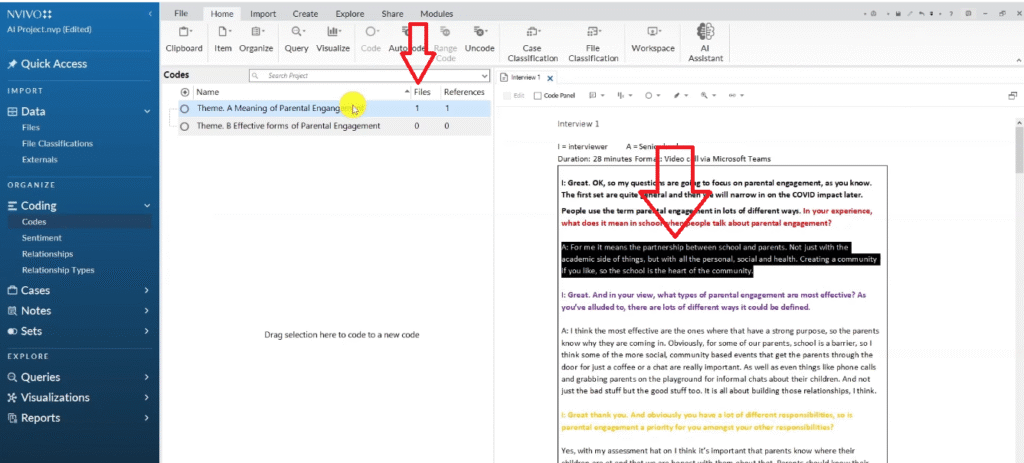
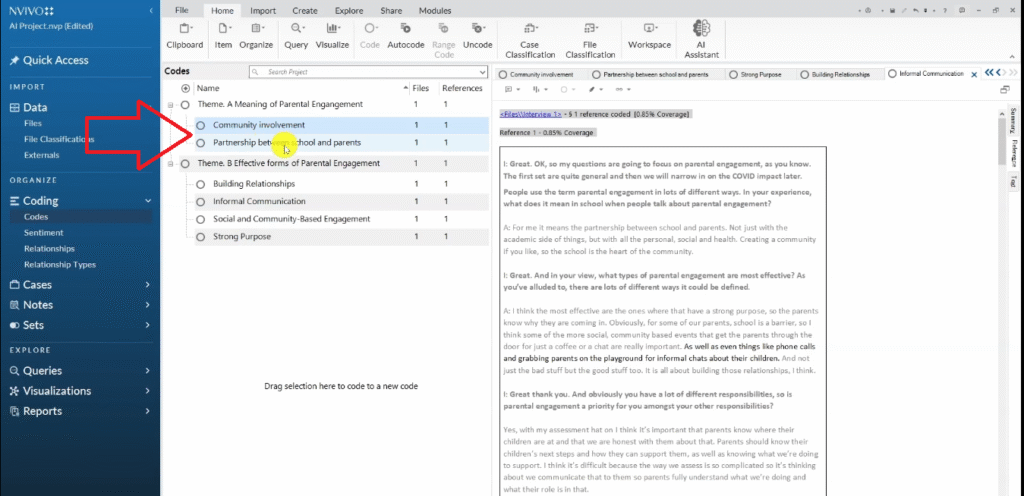
- Create your themes first. I created two themes: ‘Meaning of Parental Engagement’ and ‘Effective Forms of Parental Engagement’. Without these containers, the AI has nothing to work with.
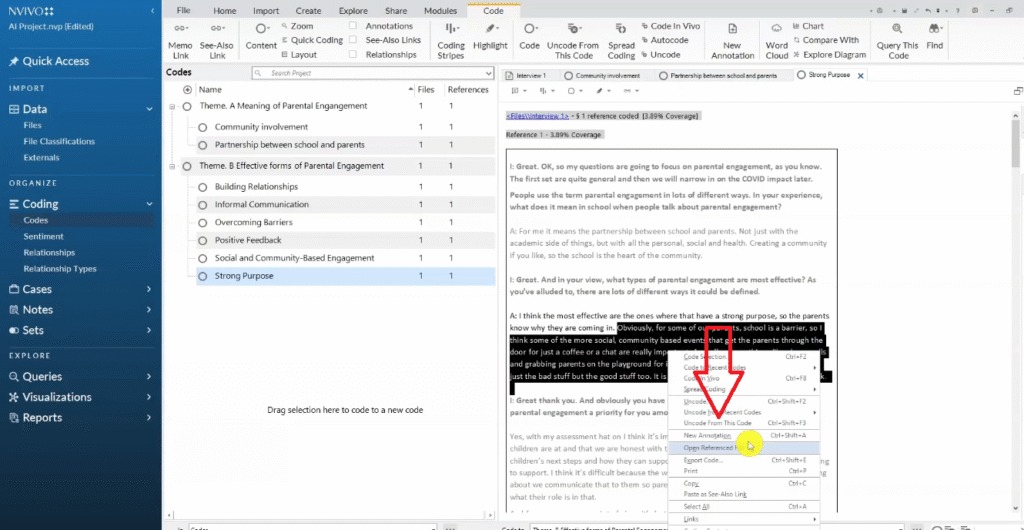
- Highlight and drag text into a theme. I highlighted a section of transcript, dragged it into the relevant theme container, then clicked ‘Suggest child codes’.
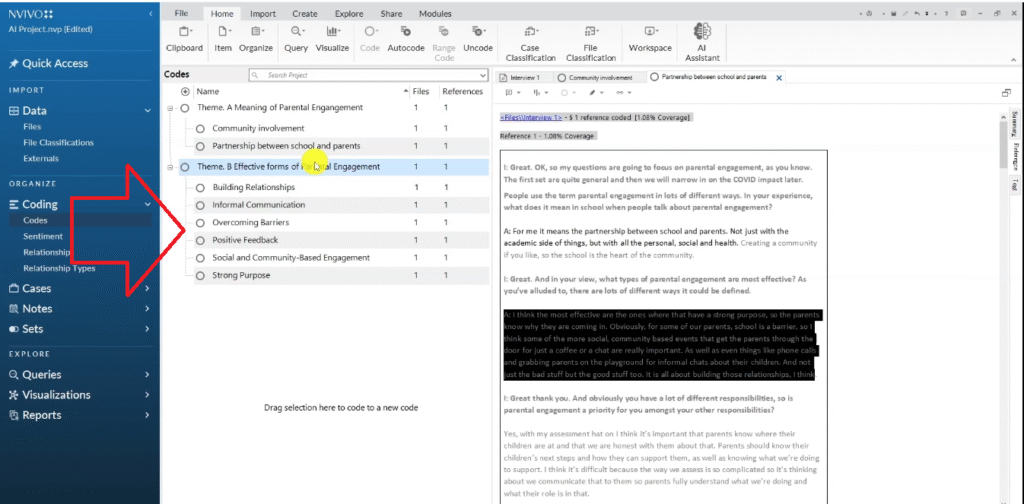
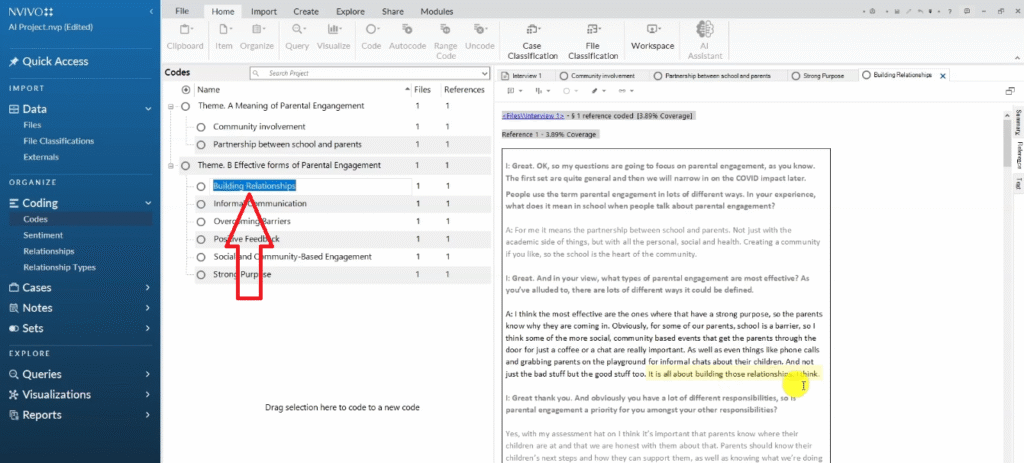
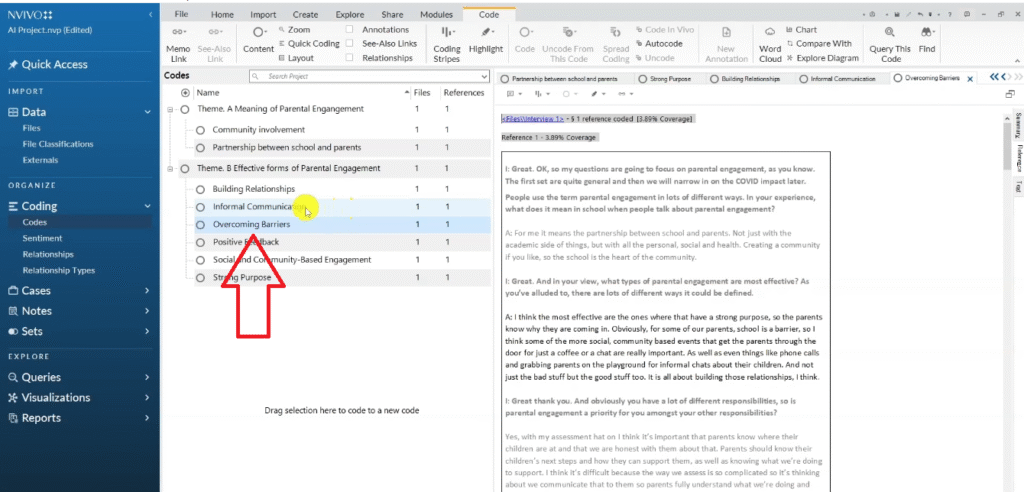
- Review the AI-generated codes. For the ‘Effective Forms’ theme, the AI suggested: Building Relationships, Informal Communication, Overcoming Barriers, Positive Feedback, Social and Community Based Engagement, Strong Purpose.
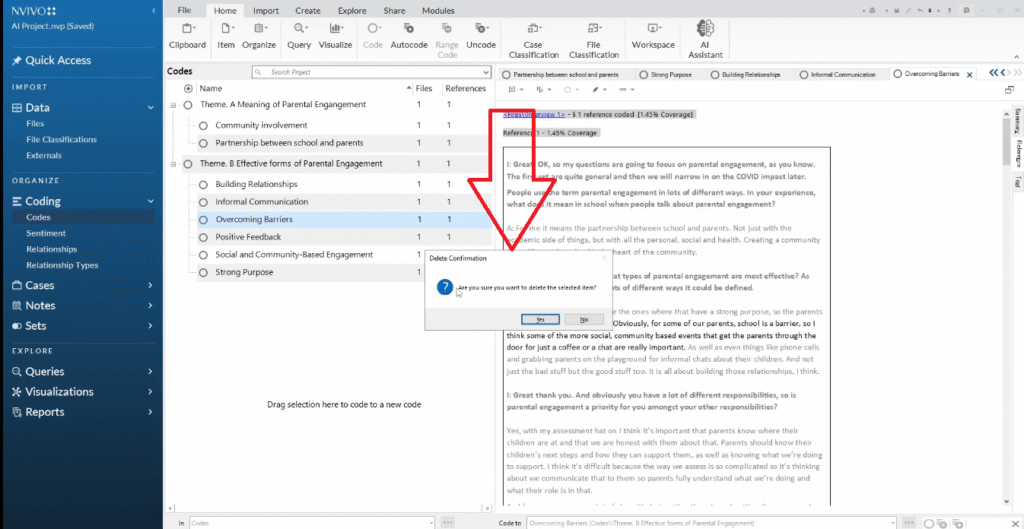
- Audit and delete bad codes. ‘Overcoming Barriers’ and ‘Positive Feedback’ were not valid codes for that theme. I had to manually review every suggestion and delete the ones that didn’t fit.
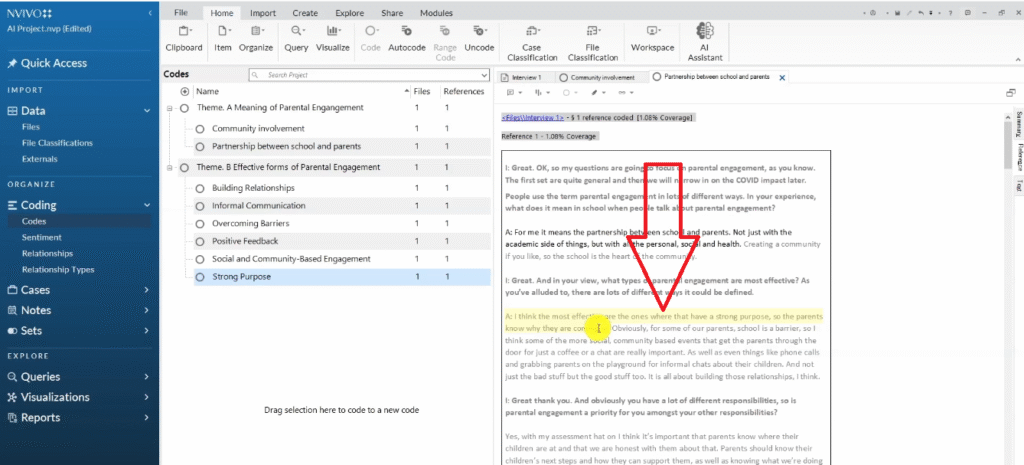
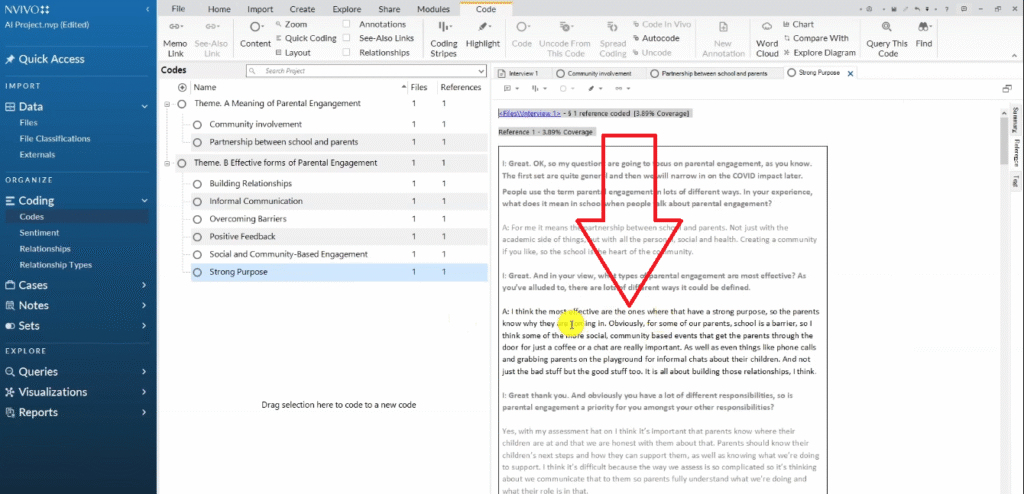
- Locate the source quotes manually. The AI included the entire dragged paragraph as the source — not the specific passage that justifies the code. I had to read back through the data to identify and clean up the references.
That five-step process took longer than simply coding manually from the start.
Comparing the quality of AI codes with manual codes
After running both processes on the same transcripts, here is how the outputs compared:
| Factor | Manual Coding | AI Coding (NVivo 15) |
| Approach | Inductive — themes emerge from data | Deductive — themes must be created before coding |
| Code accuracy | High — researcher interprets meaning directly | Medium — AI suggestions need review and cleanup |
| Quote accuracy | Exact — you select the specific passage | Low — AI attaches the whole paragraph |
| Time | Faster once practiced | Slower — requires review, editing, and cleanup |
| Researcher insight | Deep — you build understanding of the data | Surface — AI misses nuance and context |
| Data privacy | All data stays in your NVivo file | Data is sent to OpenAI servers |
| Turnitin risk | None | Your data may be flagged as AI content |
5 Reasons I Don’t Use AI for Qualitative Coding in NVivo
After running this comparison and using NVivo 15 extensively with client projects, here are the specific reasons I still avoid AI for qualitative coding:
- AI forces a deductive workflow
Inductive thematic analysis — the standard for most qualitative research — requires themes to emerge from the data. NVivo’s AI Assistant requires you to create themes before it will generate any codes. If your methodology specifies an inductive approach, using AI immediately creates a methodological inconsistency you’ll have to explain to your examiner.
- AI does not accurately locate source quotes
A code without a precise source quote is analytically weak. When AI generates a code in NVivo, it attributes the entire highlighted paragraph as the source — not the specific sentence or phrase that justifies the code. You then have to go back through the data manually to find the exact passage. This defeats the main purpose of using AI.
- AI increases your workload rather than reducing it
Because every AI-generated code needs to be reviewed, validated, and cleaned up — and because the source quotes need to be located manually — the total time spent is greater than if you had coded manually from the start. The AI does not save time; it redistributes the work into less efficient tasks.
- AI raises serious data confidentiality concerns
When you use the NVivo AI Assistant, your transcript data is sent to OpenAI’s servers. For most PhD research, your interview participants gave informed consent for their data to be used in your study — not shared with a third-party AI company. Using AI coding without explicit consent from participants and ethics board approval is a significant research ethics violation.
- AI-generated outputs can trigger Turnitin’s AI detection
Once your data has been processed by an AI system, there is a risk that your analytical outputs — even your written findings — may be flagged by AI content detectors like Turnitin. For a PhD student, having your analysis flagged as AI-generated is a serious academic integrity risk, even if the original data is entirely your own.
When Is AI in NVivo Actually Useful?
After everything I’ve said, there is one scenario where I think the NVivo AI Assistant adds legitimate value: suggesting alternative names for codes you’ve already created manually.
If you’ve done your coding manually and you’re unsure whether your code labels are clear and precise, you can use the AI to suggest rephrasing — without sending your raw participant data. This is a low-risk use that doesn’t compromise your methodology or your ethics, and it can genuinely improve the quality of your code labels.
That is the only AI-assisted step I would recommend for most qualitative researchers. Everything else — generating codes, developing themes, sourcing quotes — should be done manually.
Frequently Asked Questions
Can I use NVivo AI coding for my PhD dissertation?
Technically yes, but with significant caveats. You would need to disclose in your methodology chapter that you used AI-assisted coding, explain its limitations, obtain ethics board approval for sharing participant data with a third-party AI system, and be prepared to defend your coding decisions in your viva. Given these requirements, most PhD students are better served by manual coding.
Is AI coding in NVivo inductive or deductive?
Deductive, by design. NVivo’s AI Assistant requires you to create theme containers before it will suggest child codes — meaning you must already know what themes you’re looking for. This makes it incompatible with inductive thematic analysis, where the research goal is for themes to emerge from the data.
Does AI coding in NVivo save time?
Not in practice. While the code suggestion step is fast, you spend significantly more time reviewing AI suggestions, deleting invalid codes, and manually locating the source quotes that AI failed to identify accurately. Experienced qualitative coders consistently report that manual coding is faster overall.
What is the difference between inductive and deductive thematic analysis?
In inductive thematic analysis, you read your data first and allow codes and themes to emerge from what participants actually said. In deductive thematic analysis, you bring predetermined categories to the data and code against them. For a full explanation of both approaches, Scribbr’s guide to thematic analysis is a well-sourced starting point, and my guide on getting themes in qualitative analysis using NVivo covers the inductive process in detail.
Are there ethical issues with using AI for qualitative coding?
Yes — specifically around data confidentiality. When using NVivo’s AI Assistant, your participant data is transmitted to OpenAI’s servers. Unless your ethics approval explicitly covers this, and unless your informed consent process informed participants their data would be shared with third-party AI systems, this is an ethics violation. Always check with your IRB or ethics board before using any AI tool that processes participant data.
Key Takeaways
- NVivo 15’s AI Assistant generates codes deductively — you must create themes before it will suggest codes, making it incompatible with inductive thematic analysis.
- AI coding in NVivo does not accurately locate source quotes — it attaches entire paragraphs as evidence rather than specific passages.
- In practice, AI coding takes longer than manual coding because every suggestion requires review, cleanup, and manual quote verification.
- Using NVivo’s AI Assistant sends your participant data to OpenAI — raising serious data confidentiality and research ethics concerns.
- AI-processed data can trigger Turnitin’s AI detection tools, creating academic integrity risks for PhD students.
- The only legitimate use for AI in NVivo coding is suggesting alternative names for codes you’ve already created manually — not generating codes or themes from scratch.
- For a complete manual coding walkthrough, see my guide on how to do qualitative analysis of interviews with NVivo.
| Code Your Interviews the Right Way — With or Without Help. |
| Whether you want to learn manual coding properly or hand your transcripts to an expert, I have two options. |
| → Done-for-You NVivo Service — full coding, themes, and findings report → Book a One-on-One Consulting Session. |
You can also reach me at bernardmugo@survivingresearch.com — tell me about your project and I’ll advise you on the right approach. I reply within 24 hours.

Pingback: ChatGPT for Thematic Analysis: Why 419 Researchers Say No -