
Last Updated on 5 months ago by Grace Nyambura
- What Is Qualitative Data?
- What Is Quantitative Data?
- Key Differences Between Qualitative and Quantitative Data
- Data Collection Methods: Qualitative vs Quantitative
- Quantitative Data Collection Methods
- When Should You Use Qualitative Data?
- When Should You Use Quantitative Data?
- What About Mixed Methods Research?
- Which Type of Data Is Right for Your Dissertation?
- Frequently Asked Questions
- Key Takeaways
Quick Definition
| Qualitative data is non-numerical — it captures meaning, experience, and interpretation through words, narratives, and descriptions. Quantitative data is numerical — it captures what can be counted, measured, and statistically analysed. The key difference is not just the type of data but the type of question each approach is designed to answer: qualitative asks “how” and “why”, quantitative asks “how many” and “how much”. |
Understanding the difference between qualitative and quantitative data is one of the most important foundations for any PhD student or early-career researcher. These two data types shape how your research questions are framed, how data is collected, and how findings are analysed and presented.
Whether you are designing a dissertation, writing a research proposal, or deciding on a methodology, this guide will give you a clear, practical understanding of both approaches — and help you make the right choice for your study. For a broader look at what shapes qualitative work, see my article on the key characteristics of qualitative research.
What Is Qualitative Data?
Qualitative data is non-numerical data that focuses on meaning, experience, and interpretation rather than measurement. Instead of asking “how many” or “how much,” qualitative data helps researchers understand how people experience a phenomenon and why they interpret it the way they do.
Common sources of qualitative data include:
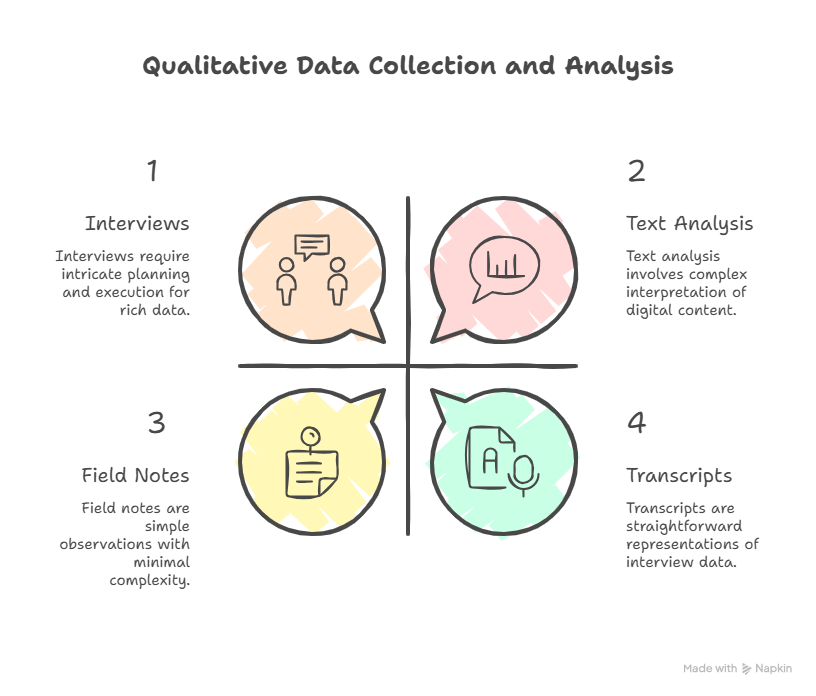
- Interview transcripts
- Focus group discussions
- Field notes from observations
- Open-ended survey responses
- Documents, texts, and archival materials
If your data consists primarily of words, narratives, or descriptions — you are working with qualitative data.
Why Qualitative Data Matters in Research
Qualitative data is especially valuable when context and nuance matter, when the topic is complex or underexplored, or when human experience is central to the research question. It is widely used in social sciences, education, health research, and critical studies — any field where understanding meaning and perspective is as important as measuring outcomes.
The strength of qualitative data lies in its depth. A survey might tell you that 70% of doctoral students feel unsupported by their supervisors. But only qualitative interviews can tell you why they feel that way, what that experience looks like day to day, and what would make a difference.
Example of Qualitative Data in a Dissertation
Consider a study on doctoral supervision. A qualitative approach might involve in-depth interviews with PhD students, asking questions such as: ‘How would you describe your experience working with your supervisor?’
Participants might discuss mentorship, power dynamics, emotional support, or institutional pressure. These interview transcripts form the qualitative dataset. Rather than producing a numerical score, the data provides rich, contextual insight into how doctoral students experience supervision — something no Likert scale could fully capture.
What Is Qualitative Data Analysis?
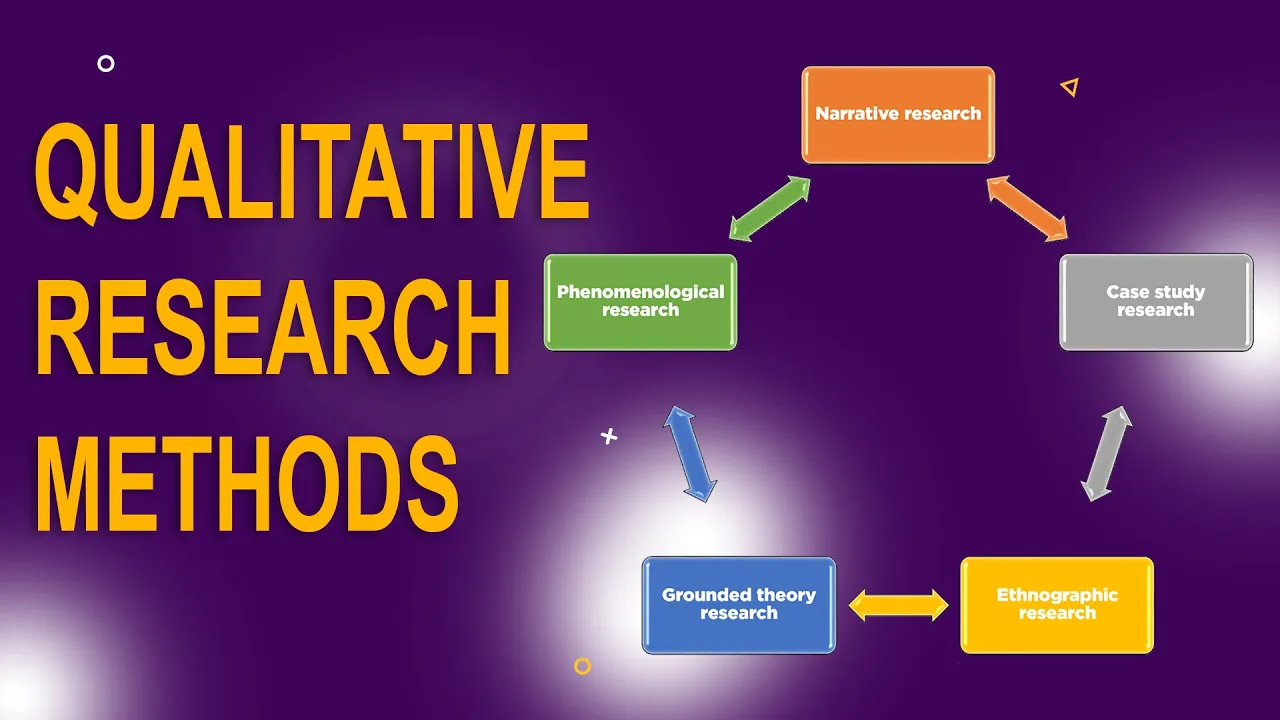
Qualitative data analysis is an interpretive process focused on identifying patterns and meaning within textual or visual data. It is not a single method but a family of approaches — including thematic analysis, content analysis, narrative analysis, discourse analysis, and grounded theory.
In most qualitative studies, the researcher:
- Reads through the data multiple times to become familiar with it
- Applies codes — labels — to meaningful segments of text
- Groups codes into broader themes or categories
- Develops interpretations grounded in participants’ perspectives
The outcome is not a statistic — it is an explanation, a conceptual framework, or a theory. For a full breakdown of the different approaches available, see my guide on the six main approaches to qualitative data analysis.
What Is Quantitative Data?
Quantitative data is numerical data that can be counted, measured, and statistically analysed. It answers questions such as: How many people experience this? How often does it occur? Is there a statistically significant difference between groups?
Common examples of quantitative data include:
- Survey ratings and Likert scales
- Test scores and exam results
- Frequencies, percentages, and proportions
- Experimental measurements
- Existing numerical datasets
Quantitative data is used to test hypotheses, identify patterns at scale, and generalise findings to larger populations. For an accessible explanation of what this looks like in practice, Scribbr’s overview of qualitative vs quantitative research covers both approaches clearly.
Example of Quantitative Data in a Dissertation
Using the same doctoral supervision example: a quantitative approach might involve distributing a structured survey to 200 PhD students, asking them to rate their satisfaction with supervision on a scale from one to five. The results are analysed statistically — averages calculated, departments compared, relationships between variables tested.
These numbers tell researchers what is happening at scale. They do not, however, explain why students feel the way they do. That is the gap qualitative data fills.
Key Differences Between Qualitative and Quantitative Data
| Qualitative Data | Quantitative Data |
| Non-numerical (words, narratives) | Numerical (counts, measurements) |
| Focuses on meaning and interpretation | Focuses on measurement and comparison |
| Small, purposively selected samples | Large, representative samples |
| Interpretive analysis (coding, themes) | Statistical analysis (tests, averages) |
| Explores “how” and “why” | Answers “how many” and “how much” |
| Inductive — theory emerges from data | Deductive — hypotheses tested against data |
| Context-dependent findings | Generalisable to larger populations |
Both approaches are valuable. The choice depends entirely on your research question — not on which approach seems more rigorous or more scientific.
Data Collection Methods: Qualitative vs Quantitative

Qualitative Data Collection Methods
Qualitative data is collected using flexible, open-ended methods that allow participants to express their perspectives in their own words. Common approaches include:
- Semi-structured or in-depth interviews
- Focus group discussions
- Participant or non-participant observation
- Open-response questionnaires
- Document analysis and archival research
Each of these methods is designed to capture depth and nuance rather than breadth. For practical guidance on conducting interviews for qualitative research, see my article on how to choose the right qualitative research method for your study.
Quantitative Data Collection Methods
Quantitative data is collected using structured, standardised tools designed for consistency and comparability. Common approaches include:
- Closed-ended surveys and questionnaires
- Experiments and randomised controlled trials
- Standardised tests and assessments
- Secondary datasets and administrative records
The goal is statistical reliability — collecting data in a form that can be meaningfully compared across participants, settings, and time points.
When Should You Use Qualitative Data?
Qualitative data is the right choice when your research question is exploratory, interpretive, or concerned with lived experience. Specifically, it is most appropriate when:
- You are investigating a new, complex, or underexplored topic
- You want to understand how and why people experience something the way they do
- Context, meaning, and participant perspective are central to your research
- You need to generate theory or conceptual frameworks rather than test them
- Your sample is small and purposively selected rather than random and representative
If your research question begins with ‘How do people experience…’ or ‘What does it mean to…’ or ‘How do participants make sense of…’, qualitative methods are almost certainly the right fit. Your methodology chapter should make this alignment explicit — explaining not just that you chose qualitative research but why it is the most appropriate approach for your specific question.
When Should You Use Quantitative Data?
Quantitative data is the stronger choice when your research question involves measurement, comparison, or generalisation at scale. It is most appropriate when:
- You are testing a hypothesis or measuring the effect of an intervention
- You need to identify patterns or trends across a large population
- You want to compare groups statistically
- Your variables can be operationalised and measured consistently
- Generalisability to a broader population is important
Quantitative methods are especially useful in fields such as psychology, public health, economics, and education, where measuring outcomes and comparing groups at scale is central to the research purpose.
What About Mixed Methods Research?
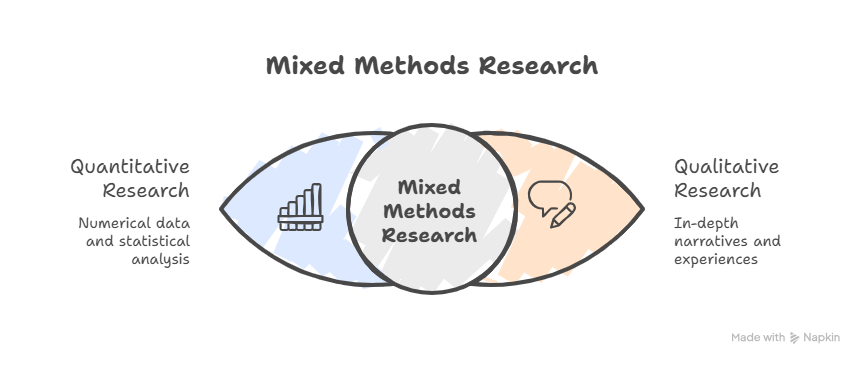
Many PhD projects use mixed methods — combining qualitative and quantitative data within a single study. This approach offers both depth and breadth, but it requires careful design and a clear rationale for why both types of data are needed.
A common mixed methods sequence might look like this:
- Phase 1: Qualitative interviews explore participants’ experiences and generate initial themes
- Phase 2: A quantitative survey tests whether those themes hold across a larger sample
This sequential design uses qualitative work to inform the quantitative instrument — and the quantitative results to show whether the qualitative findings generalise. Alternatively, the order can be reversed: quantitative data identifies a pattern, and qualitative data explains it.
Mixed methods research is methodologically powerful, but it is also significantly more demanding to design and execute. SAGE Research Methods is the most comprehensive resource for understanding how to design and justify a mixed methods study at doctoral level.
Which Type of Data Is Right for Your Dissertation?
The single most important factor is alignment with your research question. Not your supervisor’s preferences. Not what feels more scientific. Not what other people in your department are doing.
Ask yourself: what does my research question actually require? If it asks why or how people experience something, you likely need qualitative data. If it asks how many, how much, or whether there is a difference between groups, you likely need quantitative data. If it genuinely needs both, mixed methods may be appropriate — but only if you have the time, resources, and methodological clarity to do it well.
Once you know which approach fits your question, your methodology chapter needs to make that case explicitly. See my article on how to write the methodology chapter for a qualitative study for a step-by-step guide to justifying your methodological choices.
Frequently Asked Questions
Is qualitative research less rigorous than quantitative research?
No. Rigour in qualitative research looks different from rigour in quantitative research, but it is no less real. Qualitative rigour involves strategies such as member checking, reflexivity, triangulation, and thick description — approaches that ensure findings are credible and trustworthy rather than statistically reliable and generalisable. Neither approach is inherently superior; each is rigorous on its own terms.
Can qualitative and quantitative data be used in the same study?
Yes — this is called mixed methods research. The two approaches can be combined in various ways: sequentially (one informing the other), simultaneously (both collected at the same time), or in a nested design (one embedded within the other). The key is having a clear rationale for why both types of data are necessary to answer your research question.
What is the difference between qualitative and quantitative data collection?
Qualitative data collection methods — interviews, focus groups, observations — are flexible and open-ended, designed to capture depth and nuance. Quantitative data collection methods — surveys, experiments, standardised tests — are structured and fixed, designed for consistency and comparability across participants. The method you choose should follow directly from your research question and the type of data it requires.
Does qualitative research require a larger or smaller sample than quantitative research?
Smaller. Qualitative research typically works with purposively selected samples of 10–30 participants, chosen because of their relevant experience or perspective — not because they are statistically representative. The goal is depth of understanding, not generalisability. Quantitative research typically requires larger, randomly selected samples to achieve statistical power and allow generalisation to a broader population.
Key Takeaways
- Qualitative data is non-numerical — it captures meaning, experience, and interpretation through words and narratives
- Quantitative data is numerical — it captures what can be counted, measured, and statistically analysed
- Qualitative research asks ‘how’ and ‘why’; quantitative research asks ‘how many’ and ‘how much’
- The right type of data is whichever best answers your research question — not whichever seems more rigorous