

Last Updated on 4 months ago by Bernard Mugo
The quality of your qualitative research findings depends almost entirely on what happens in the interview. A poorly conducted interview produces thin, ambiguous data that is difficult to analyze and easy to challenge. A well-conducted one produces rich, detailed accounts that make your analysis genuinely meaningful.
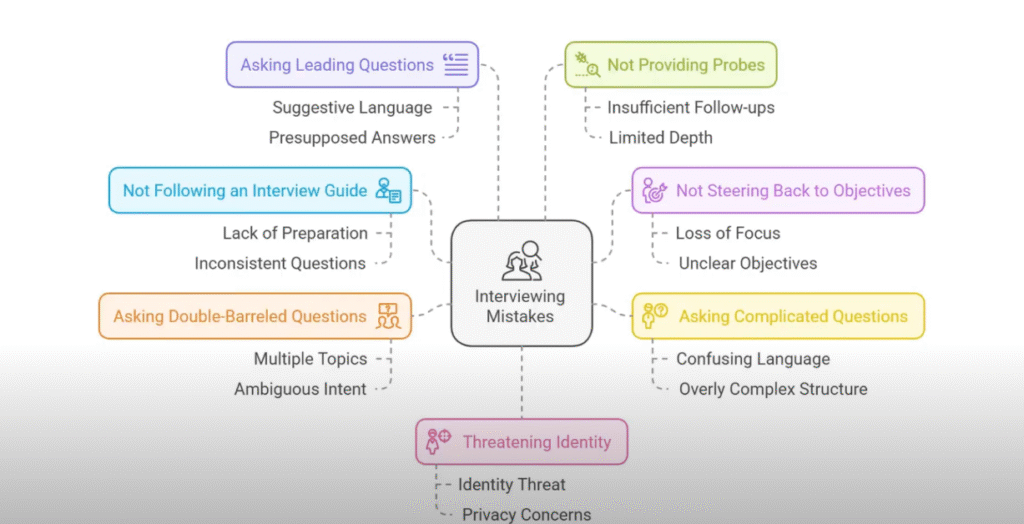
In this article, I will walk you through seven interview mistakes that I see PhD students and new researchers make repeatedly — and show you exactly what to do instead.
- Why Interview Quality Determines Data Quality
- Mistake 1: Not Using an Interview Guide
- Mistake 2: Letting Interviewees Stray Without Redirecting Them
- Mistake 3: Asking Long, Complicated Questions
- Mistake 4: Asking Double-Barrelled Questions
- Mistake 5: Asking Leading Questions
- Mistake 6: Failing to Use Probes
- Mistake 7: Asking Identity-Threatening Questions
- Quick Reference: Good vs. Bad Interview Questions
- Frequently Asked Questions
- Key Takeaways
- Ready to Analyze Your Interview Data?
Why Interview Quality Determines Data Quality
In qualitative research, your interview transcript is your primary data. Unlike quantitative research — where you can re-run a survey or collect more responses — a qualitative interview is a one-time, context-specific exchange. If the questions were poorly designed, or the interview was poorly managed, there is no way to recover that data later.
The seven mistakes below fall into three categories:
- Preparation mistakes — errors made before the interview begins
- Question design mistakes — problems with how questions are phrased
- Facilitation mistakes — errors in how you manage the interview as it happens
Mistake 1: Not Using an Interview Guide
An interview guide is a document that lists all the questions and topic areas a researcher intends to cover in a qualitative interview. It is one of the most important tools for maintaining consistency across interviews and ensuring that all your research objectives are addressed.
Without an interview guide, researchers tend to:
- Skip important questions when the conversation flows naturally in a different direction
- Ask questions in an inconsistent order, making it harder to compare responses across participants
- Miss entire topic areas that only become apparent during analysis — when it is too late to go back
An interview guide does not mean a rigid script. In semi-structured qualitative interviews, you still follow the conversation and let participants elaborate. The guide simply ensures you do not leave the interview without the data you need.
What to Do Instead
Before your first interview, develop a written interview guide that includes:
- An opening question to establish rapport and help the participant feel comfortable
- Core questions tied directly to each of your research objectives
- Follow-up prompts you can use if a participant’s response is brief
- A closing question that gives the participant a chance to add anything they feel was not covered
Keep your interview guide close during every session. As you gain experience, you will refer to it less — but in the early stages of your fieldwork, it is your most reliable safeguard against data gaps.
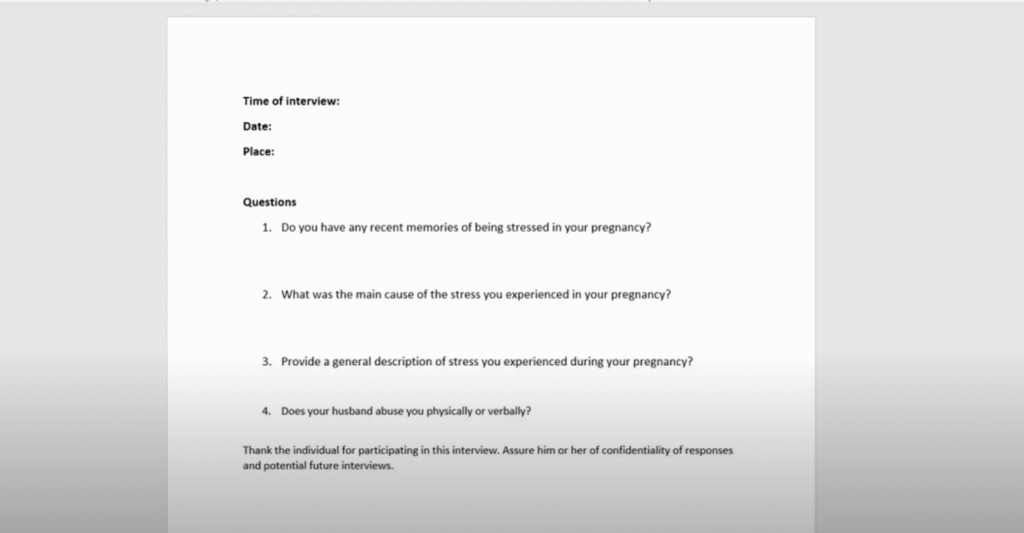
I cover how to build a research interview guide in detail in my guide to developing your qualitative interview protocol.
Mistake 2: Letting Interviewees Stray Without Redirecting Them
In qualitative research interviews, participants sometimes move away from the topic and share stories or details that, while interesting, do not contribute to your research objectives. This is natural — and it is your responsibility as the researcher to gently steer the conversation back.
New researchers often feel uncomfortable interrupting or redirecting a participant, so they let the interview drift. The cost of this is real: a 60-minute interview session can yield only 20 minutes of usable data if large portions of it go off-topic.
What to Do Instead
Use a transitional phrase to redirect without being dismissive. Examples:
- “That is really helpful context — I would like to come back to [topic X] if we can. Could you tell me more about…”
- “Thank you for sharing that. I want to make sure we cover [objective Y] — could you walk me through…”
- “That is a really interesting point. We can explore that further — but first, could you tell me about…”
The key is to acknowledge what the participant has said before redirecting. This preserves the rapport you have built and ensures the participant does not feel dismissed.
Mistake 3: Asking Long, Complicated Questions
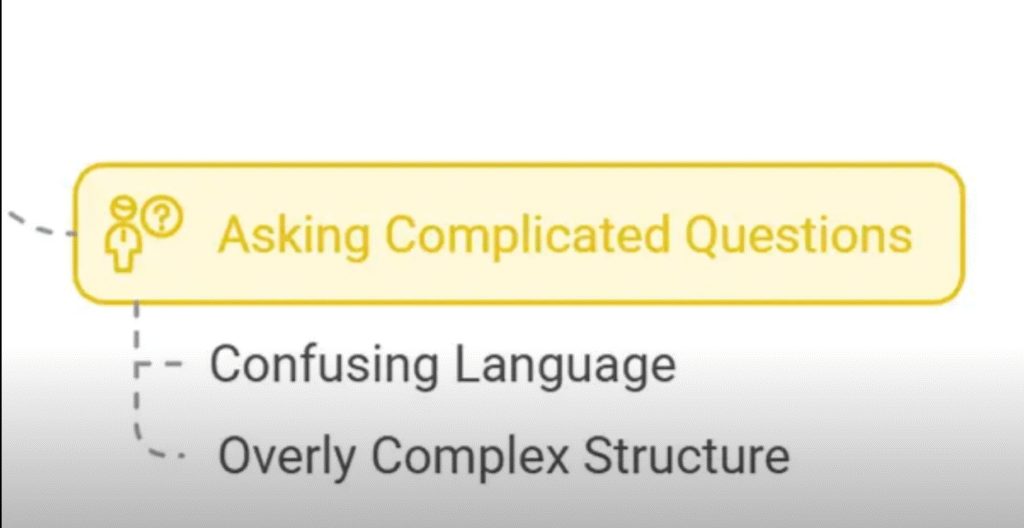
A long, multi-part question overwhelms participants. When a question contains too many sub-topics or is grammatically complex, participants either answer only the last part they heard, or give a vague response that tries to cover everything at once — neither of which gives you usable data.
Here is an example of a problematic question:
“Can you walk me through how changes in workflow processes, training programmes, technology adoption, team dynamics, and individual performance goals over the past year have each contributed to or detracted from your department meeting its quarterly targets?”
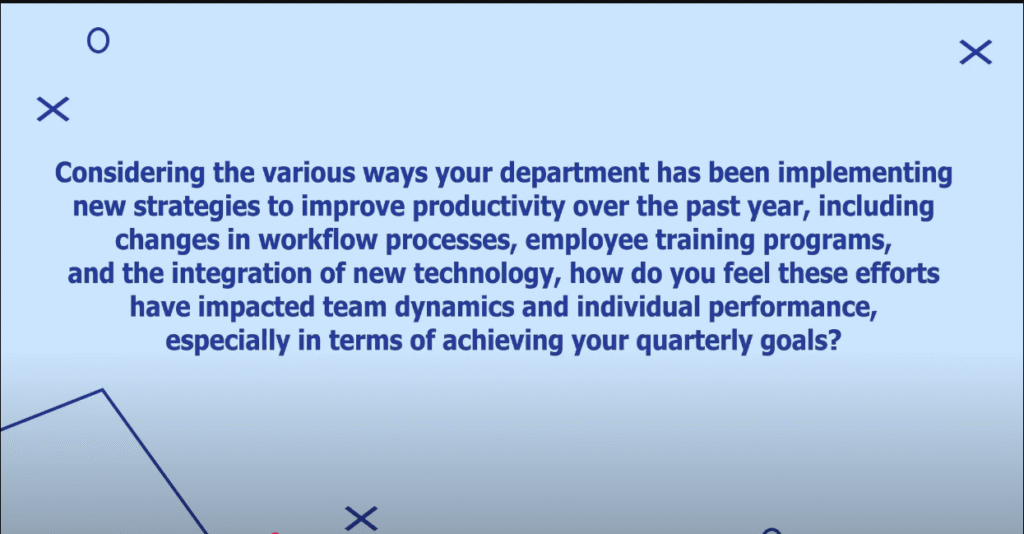
This single question covers five distinct topics: workflow, training, technology, team dynamics, and individual performance. A participant cannot meaningfully address all five in a single answer.
What to Do Instead
Break long questions into a sequence of focused, shorter questions. Using the example above:
- “What changes has your department made to improve productivity over the past year?”
- “How have those changes affected how the team works together?”
- “How have they affected individual performance and quarterly goals?”
Each of these questions targets a single idea. The participant can answer fully, and you can probe each response before moving on. This approach also makes your transcript much easier to code when you begin your qualitative analysis.
Mistake 4: Asking Double-Barrelled Questions
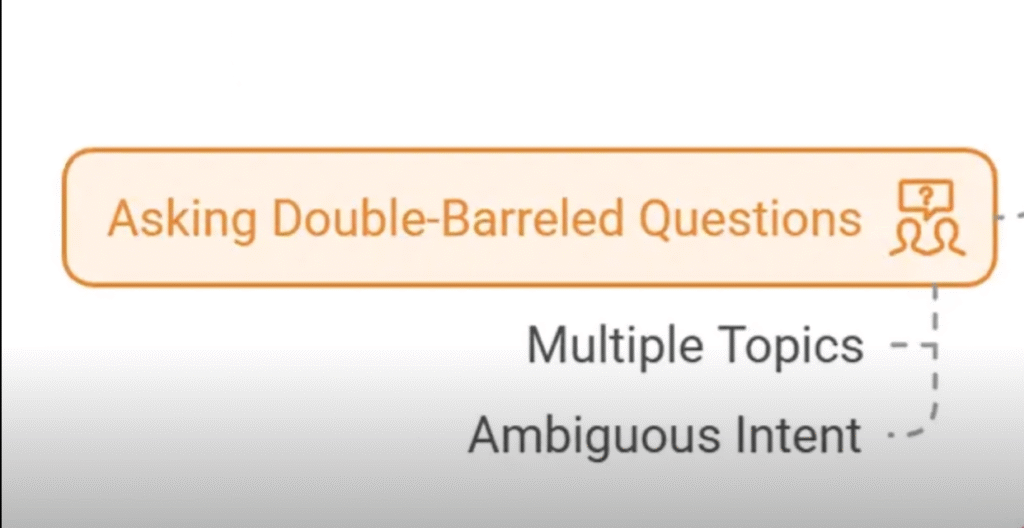
A double-barrelled question asks about two different things at once, but only allows for one answer. This creates an ambiguity problem: you cannot tell which part of the question the participant is responding to, and they may feel differently about each part.
A classic example: “How satisfied are you with your job and your work-life balance?”

Job satisfaction and work-life balance are related but distinct. A participant might be very satisfied with their work but deeply dissatisfied with how it affects their personal life. A single answer to this question will blend or obscure both.
What to Do Instead
Ask each topic as a separate question:
- “How satisfied are you with your job overall?”
- “How satisfied are you with your work-life balance?”
This gives you distinct, clean responses to two distinct constructs — which is exactly what you need when you begin coding your transcripts. As a rule: one question, one topic.
Mistake 5: Asking Leading Questions
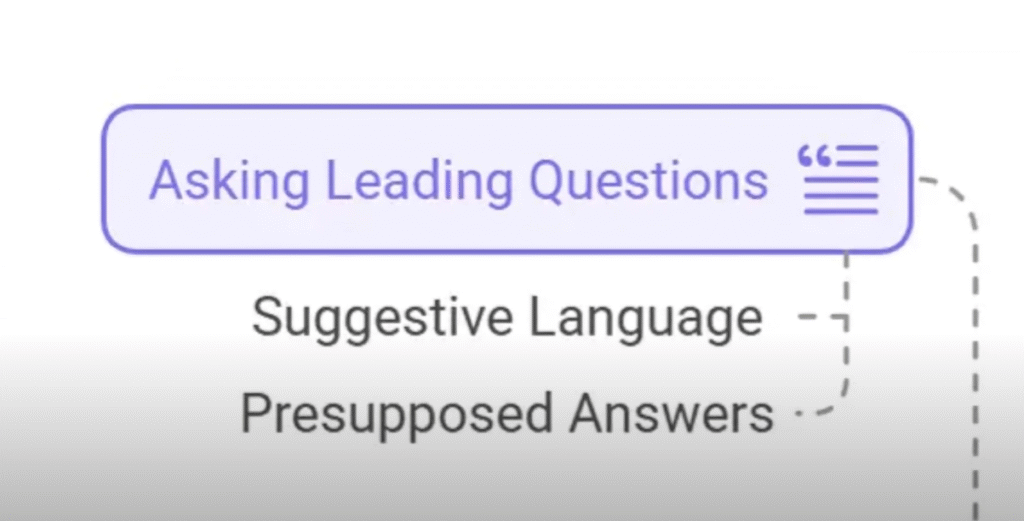
A leading question is one that hints at or implies the desired answer. In qualitative research, this is a serious methodological problem because it introduces researcher bias directly into the data — the participant’s response reflects the question framing, not their genuine experience.
Example of a leading question: “Wouldn’t you agree that this new programme has improved employee morale?”

The phrasing “wouldn’t you agree” signals to the participant that you expect agreement. Most participants will comply, especially in a one-on-one interview setting where social pressure is strong.
A neutral alternative: “How has the new programme affected employee morale?”
This version invites the participant to share their own perspective without any directional push from the researcher. In qualitative research, data quality depends on participants answering freely and authentically — and that requires questions that are genuinely neutral.
What to Do Instead
Before your interviews, review each question in your interview guide and ask: “Does this question suggest what I think the answer should be?” If yes, rewrite it. The test for a good qualitative interview question is that it genuinely could produce any answer.
Mistake 6: Failing to Use Probes
A probe is a follow-up question or prompt that encourages the participant to elaborate, clarify, or provide a concrete example. Probes are one of the most powerful tools in qualitative interviewing — and new researchers consistently underuse them.
Without probes, interviews can become a flat sequence of questions and single-sentence answers. The rich, detailed accounts that make qualitative data valuable come from the moments after the initial answer — from the follow-up that pulls the story out.
Common situations where new researchers fail to probe:
- The participant gives a very brief answer and the researcher moves to the next question
- The participant uses a vague term like “difficult” or “challenging” without explaining what they mean
- The participant describes an experience but does not explain how it felt or what they did
What to Do Instead
Keep a list of standard probing phrases ready to use at any point in the interview:
- “Could you tell me more about that?”
- “Can you give me an example of what that looked like?”
- “How did that make you feel?”
- “What happened next?”
- “You mentioned [X] — could you elaborate on that?”
For example, if a participant who was laid off from a job says “it was a very difficult time”, do not move on. Probe: “Could you explain more about how you experienced that difficulty?” That follow-up question is where the meaningful data lives.
Mistake 7: Asking Identity-Threatening Questions
An identity-threatening question is one that implicitly challenges or questions the legitimacy of something a participant holds as a core part of who they are — their profession, beliefs, activism, role, or values. These questions put participants on the defensive and typically produce guarded, minimal responses rather than open and honest ones.
Example of an identity-threatening question asked to a social activist: “Do you think your social activism has any real benefit to society?”
The phrase “any real benefit” implies doubt about the value of the participant’s work. A participant who has dedicated years to activism will either become defensive or shut down — neither produces the rich, nuanced data you need.
A neutral alternative: “What benefits has your social activism brought to the communities you work with?”
This version accepts the premise that the participant’s work has value — which respects their identity — and invites them to describe and elaborate on that value in their own terms.
What to Do Instead
When designing questions about sensitive topics — profession, identity, beliefs, activism, or controversial decisions — apply this test: does this question require the participant to defend themselves in order to answer it? If yes, reframe it so they are describing rather than defending.
- Instead of “Do you think X was the right decision?”, ask “What informed your decision about X?”
- Instead of “Do you believe your approach is effective?”, ask “How have you seen your approach play out in practice?”
- Instead of “Is your work making a difference?”, ask “What changes have you observed as a result of your work?”
Quick Reference: Good vs. Bad Interview Questions
Use this table when reviewing your interview guide before going into the field.
| Mistake Type | ❌ Problematic Version | ✓ Better Version |
| Leading question | Wouldn’t you agree the new policy improved staff morale? | How has the new policy affected staff morale? |
| Double-barrelled question | How satisfied are you with your job and your work–life balance? | How satisfied are you with your job? (ask separately) How satisfied are you with your work–life balance? |
| Long/complicated question | Can you describe how workflow changes, training programmes, technology, and team dynamics have each affected quarterly performance goals? | What changes has your department made to improve productivity? (then follow-up questions per topic) |
| Identity-threatening question | Do you think your activism has any real benefit to society? | What benefits has your activism brought to the community? |
| Missing probe | Participant: ‘It was a very difficult time.’ Interviewer: [moves to next question] | Participant: ‘It was a very difficult time.’ Interviewer: ‘Could you tell me more about how that felt?’ |
Frequently Asked Questions
What is a semi-structured interview in qualitative research?
A semi-structured interview is the most common format in qualitative research. It uses an interview guide with predetermined questions, but allows the researcher to follow the conversation, probe interesting responses, and adapt the order of questions based on what the participant says. It sits between a fully structured interview (fixed questions, fixed order) and an unstructured interview (open conversation with no set questions).
How do I know if my question is leading?
A question is leading if it implies a particular answer, contains evaluative language, or uses phrasing that pressures the participant toward agreement. Read each question and ask: could this question produce a wide range of answers, or does it point in one direction? Phrases like “wouldn’t you agree”, “don’t you think”, and “surely you would say” are the clearest signals of a leading question.
How many questions should a qualitative research interview guide have?
Most qualitative interview guides for PhD research contain between 8 and 15 core questions, with 2 to 4 follow-up probes suggested for each. A one-hour interview typically covers 8 to 12 questions in depth when probing is used effectively. Having more questions than you can cover is better than having too few — you can always skip questions if time is short.
Should I record qualitative research interviews?
Yes, whenever possible and with participant consent. Recording allows you to focus on the conversation rather than note-taking, ensures accuracy in your transcript, and captures nuances in language that would be lost in notes. Most ethics protocols require informed consent before recording. Always have a backup note-taking system in case the recording fails.
How many interviews do I need for qualitative research?
The answer depends on your research design and methodology, but most qualitative studies reach data saturation between 12 and 25 interviews. I cover this in detail in my guide on how many interviews you need for qualitative research.
Key Takeaways
- Always prepare a written interview guide before going into the field — it is your safeguard against data gaps
- Redirect participants who stray using transitional phrases that acknowledge what they have said before guiding them back
- One question, one topic — break long or complicated questions into a sequence of shorter, focused ones
- Avoid double-barrelled questions by separating any question that covers two distinct constructs
- Never use leading questions — phrase questions so that any answer is genuinely possible
- Use probes consistently — the richest qualitative data almost always comes from the follow-up, not the initial answer
- Avoid identity-threatening questions by framing sensitive topics as descriptions rather than defences
Ready to Analyze Your Interview Data?
If you are under time pressure or want expert support, I offer a done-for-you thematic analysis service where my team handles your full qualitative analysis — from transcript to finished findings report.
For deeper reading on the theory behind qualitative interviewing, Braun and Clarke’s foundational work on reflexive thematic analysis is the most widely cited reference in the field.


Pingback: NVivo 15 Tutorial: Thematic Analysis Step-by-Step Guide -