

Last Updated on 2 months ago by Bernard Mugo
9 Tips for Conducting Qualitative Research Interviews
Interviews are central to the qualitative research process — the quality of your interviews largely determines the quality of your entire study. An interview is a social interaction built around a conversation on a given topic, where knowledge is constructed as interviewer and interviewee engage with each other. Here are 9 practical tips for preparing and conducting the best qualitative research interviews.
- 9 Tips for Conducting Qualitative Research Interviews
- What Makes a Good Qualitative Interview?
- Tip 1: Define the Research Questions Your Interview Will Answer
- Tip 2: Design a Clear Interview Guide or Protocol
- Tip 3: Identify the Right Participants with Purposeful Sampling
- Tip 4: Choose the Right Interview Format
- Tip 5: Obtain Informed Consent
- Tip 6: Choose a Distraction-Free Setting
- Tip 7: Run a Pilot Test First
- Tip 8: Record Your Interviews with the Right Tools
- Tip 9: Follow Good Interviewing Practices
- Common Mistakes to Avoid in Qualitative Interviews
- Frequently Asked Questions
- Key Takeaways
- Get Help Analyzing Your Interview Data
What Makes a Good Qualitative Interview?
A good qualitative interview is guided by clear research questions, uses a well-designed protocol, recruits the right participants, and creates the conditions for participants to speak openly. Get these fundamentals right and the data you collect will be rich enough to support meaningful thematic analysis later.
Tip 1: Define the Research Questions Your Interview Will Answer
Determine the research questions that your interviews need to answer. These should focus on understanding the central phenomenon in your study.

For example, in a study titled “Causes of depression among pregnant women living in low-income urban areas,” the main research questions might be:
- What are the main causes of depression among pregnant women living in low-income areas?
- What are the effects of depression among pregnant mothers?

Tip 2: Design a Clear Interview Guide or Protocol
Once your research questions are clear, design an interview guide or protocol.

Brinkmann and Kvale (2015) suggest asking approximately 5 to 7 open-ended questions per interview. You can ask more, but keep in mind: the more questions you ask, the more data you generate, and the more complex your analysis becomes. Aim for the minimum number of questions that will answer your research questions. For a deeper look at how question design varies by interview type, Scribbr’s guide to types of interviews in research is a useful reference.
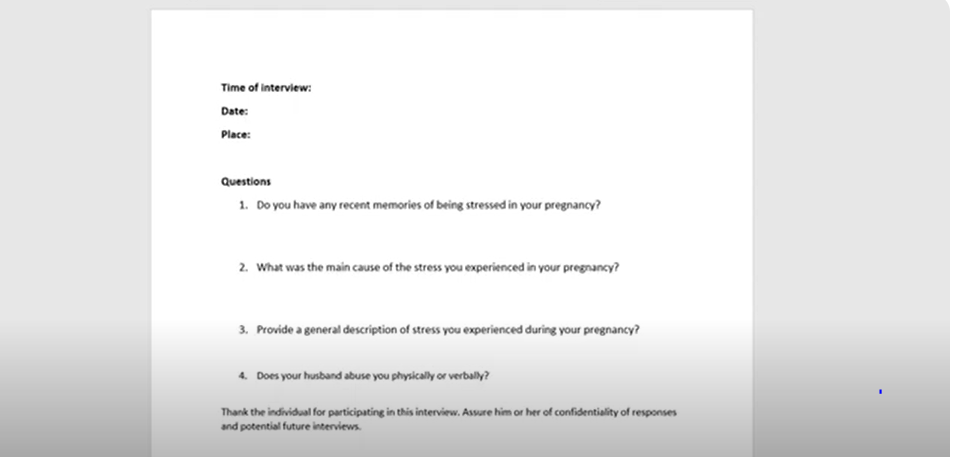
Example Interview Guide
Tip 3: Identify the Right Participants with Purposeful Sampling
Identify the group of individuals best positioned to answer your questions. Most qualitative research relies on purposeful sampling rather than random sampling.

Common purposeful sampling strategies include:
- Maximum variation sampling — deliberately including a diverse range of participants to enrich the responses.
- Homogeneous sampling — focusing on participants who share specific similar characteristics.
- Snowball (chain) sampling — asking each interviewee to refer other potential participants, continuing until you reach saturation.
- Random purposeful sampling — adding credibility when your eligible population is large.
- Criterion sampling — selecting only cases that meet a specific, predefined criterion.
- Convenience sampling — recruiting whoever is easiest to reach, which saves time but can affect credibility.
For a research-backed overview of when to use each strategy, Palinkas et al.’s widely-cited paper on purposeful sampling is an excellent academic reference, and Grad Coach’s sampling methods guide breaks the same strategies down in plain English.
Tip 4: Choose the Right Interview Format
Determine the interview format best suited to your study. The right choice depends on which interaction style will surface the most useful information for your research questions.

Common formats include one-on-one interviews conducted in person, over video platforms like Google Meet, Microsoft Teams, or Zoom, over the phone, or even through text-based chat.
Tip 5: Obtain Informed Consent

Obtain consent from every interviewee before the interview begins, typically through a signed consent form that explains the study, how their data will be used, and their right to withdraw.
Tip 6: Choose a Distraction-Free Setting

Locate distraction-free settings for your interviews, particularly for one-on-one, in-person sessions where background noise or interruptions can derail the conversation.
Tip 7: Run a Pilot Test First

Conduct pilot interviews before your main data collection. Pilot testing helps you refine your questions, spot potential bias in how they’re framed, and adjust your procedures before it matters.
Through pilot testing, you can refine your data collection plan and sharpen your questions. Recruit pilot participants based on geographic proximity, access, and convenience.
Tip 8: Record Your Interviews with the Right Tools

Record every interview, whether it’s a focus group or one-on-one session, using a reliable microphone (lapel mics work well for capturing clear audio). Tools like Otter AI can also transcribe your interviews live as you record, saving significant time during analysis.
Tip 9: Follow Good Interviewing Practices

During the interview itself:
- Stay within the study’s boundaries and avoid going off-topic.
- Rely on your interview protocol to guide the flow of questions.
- Try to memorize your questions so you can maintain eye contact with participants.
- Provide smooth transitions from one question to the next.
- Complete interviews within the time you specified to participants.
- Be courteous and respectful throughout.
- Be a good listener, and avoid interrupting participants while they’re speaking.
Common Mistakes to Avoid in Qualitative Interviews
Even experienced researchers slip into a few avoidable habits. Watch for these:
- Writing leading questions: questions that hint at the answer you expect bias your data. Keep questions open-ended and neutral.
- Skipping the pilot test: questions that make sense to you on paper often confuse real participants. A single pilot interview can catch this before it costs you a whole dataset.
- Over-scripting the conversation: rigidly following your protocol word-for-word can shut down valuable tangents. Use your guide as a map, not a script.
- Under-recruiting: stopping too early, before reaching data saturation, leaves gaps that are hard to fill later. Build in flexibility to recruit more participants if new themes keep emerging.
- Poor audio quality: a distorted recording can make transcription and coding far harder than the interview itself. Test your equipment before every session, not just the first one.
Frequently Asked Questions
How many questions should a qualitative interview have?
Brinkmann and Kvale (2015) recommend around 5 to 7 open-ended questions. More questions generate more data, which increases analysis time and complexity, so keep your list to the minimum needed to answer your research questions.
What sampling method should I use for interview participants?
Most qualitative studies use purposeful sampling. Which specific strategy, maximum variation, snowball, criterion, or convenience, depends on your population size, access, and research goals.
Should I record or just take notes during interviews?
Recording is strongly recommended. Notes alone risk missing nuance and exact wording, both of which matter for thematic analysis. Pair a good recorder with a tool like Otter AI for live transcription.
What’s the difference between a structured, semi-structured, and unstructured interview?
A structured interview asks a fixed set of questions in a fixed order. An unstructured interview has no predetermined questions at all. A semi-structured interview, the most common format in qualitative research, uses a flexible guide with open-ended questions asked in a natural order — see Tip 2 above before choosing a format.
Key Takeaways
- Start from your research questions, not from a list of interesting things to ask.
- Use purposeful sampling to recruit participants who can genuinely answer your questions.
- Pilot test your protocol before your real data collection begins.
- Record every interview and consider live transcription tools to save time later.
- Good interview etiquette, staying on topic, listening well, respecting time, directly affects data quality.
Get Help Analyzing Your Interview Data
Are you overwhelmed by your qualitative data? I offer two specialized services for PhD students who need support with N-Vivo analysis. The first is my done-for-you qualitative data analysis service, where I handle the full coding, theme development, data visualization, and a findings report — including a walk-through recording of the entire analysis. The second is one-on-one N-Vivo consulting, where we work together on a video call via Zoom or Microsoft Teams, and I guide you through your analysis step by step.

Pingback: Qualitative Analysis of Interviews in NVivo: 6-Step Guide -
Pingback: Tips For Conducting Participant Observation In Qualitative Research -