
Last Updated on 2 months ago by Grace Nyambura
Qualitative Analysis of Interviews in NVivo [6-Step Guide]
| Qualitative analysis of interviews is the systematic process of reading, coding, and interpreting your interview transcripts to identify patterns and themes in the data. In this guide, I walk you through the complete 6-step reflexive thematic analysis process using NVivo 14 — one of the most powerful tools for qualitative data analysis available today. |
What Is Qualitative Data Analysis?
You’ve finished your interviews. You’ve transcribed them. Now you’re staring at pages of raw text wondering what to do next. This is exactly where qualitative data analysis begins.
Qualitative data analysis is the process of making sense of non-numerical data — interview transcripts, focus group recordings, open-ended survey responses — by identifying patterns, meanings, and themes. One of the most widely used methods for doing this is thematic analysis.
Thematic analysis involves systematically searching for recurring patterns across your dataset. The patterns you identify are called themes, and they form the core findings of your qualitative study. According to Braun and Clarke’s foundational 2006 paper — the most cited work on thematic analysis in qualitative research — themes represent important patterns of meaning that capture something significant about your research question.
If you’re unsure whether thematic analysis is the right fit for your study, Scribbr’s guide to thematic analysis gives a clear overview of how it compares to other qualitative approaches.
Two Approaches to Thematic Analysis in NVivo
Before you open NVivo, you need to decide which approach to thematic analysis you will use. The approach you choose determines how you develop your codes and themes.
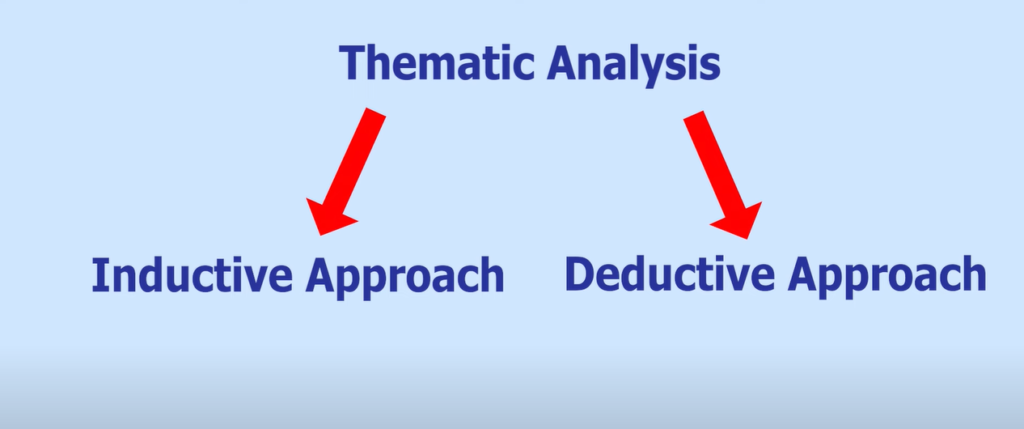
Diagram illustrating thematic analysis methods with the title ‘Thematic Analysis’ at the top in bold blue text. Two red arrows point downward toward ‘Inductive Approach’ on the left and ‘Deductive Approach’ on the right against a light blue background
Inductive Thematic Analysis
In an inductive approach, you let the data determine your themes. You come to the transcripts without predefined categories — you read what participants said, develop codes from their language, and then look for patterns across those codes to generate themes. Braun and Clarke’s reflexive thematic analysis is the most widely used inductive approach, and it is what I demonstrate in this guide.
I recommend the inductive approach for PhD students conducting phenomenological or exploratory research. It keeps your analysis grounded in participants’ actual experiences. For a broader picture of what this approach involves, see my post on key characteristics of qualitative research.
Deductive Thematic Analysis
In a deductive approach, you come to the data with a predefined coding framework based on existing theory or literature. The codebook approach is the most common example. You use it when you already know the themes you expect to find and want to assess how well they are reflected in your data.
How to Do Qualitative Analysis of Interviews in NVivo
For this tutorial, I’m using an example study that examines the experiences of patients with prostate cancer. The research question is: What are the experiences of people with prostate cancer? I’m using NVivo 14 and following Braun and Clarke’s 6-step reflexive thematic analysis framework.
Before working through the steps, make sure your interview transcripts are imported into NVivo’s Files section. Simply drag and drop your transcript documents into the Files panel — this is your data area. For a detailed overview of the NVivo interface itself, my post on the complete guide to qualitative analysis in NVivo covers the workspace setup.
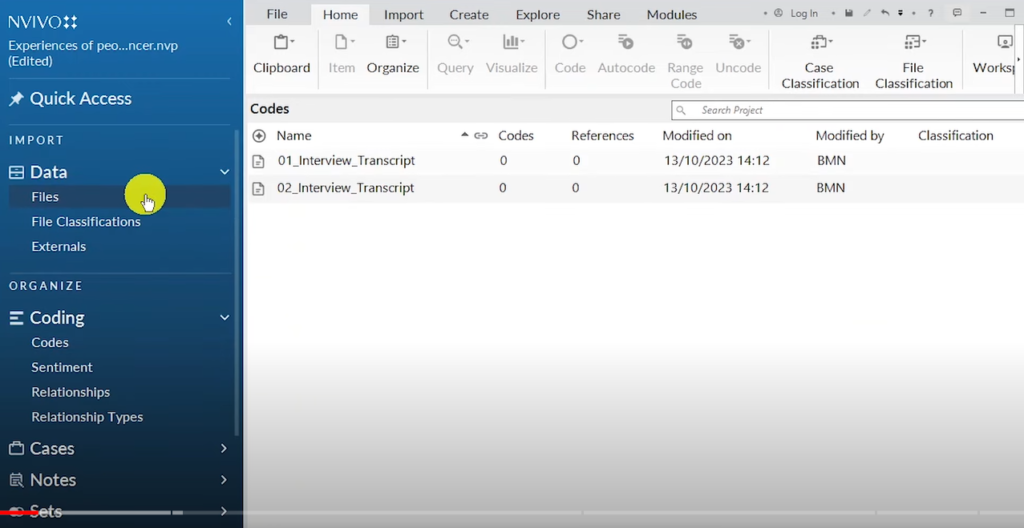
Two interview transcripts in the NVivo 14 Files section ready for coding
Reflexive thematic analysis involves six major steps in qualitative analysis of interviews.
- Familiarizing with the data
- Generating initial codes
- Generating themes
- Reviewing potential themes
- Defining and naming themes
- Producing the report
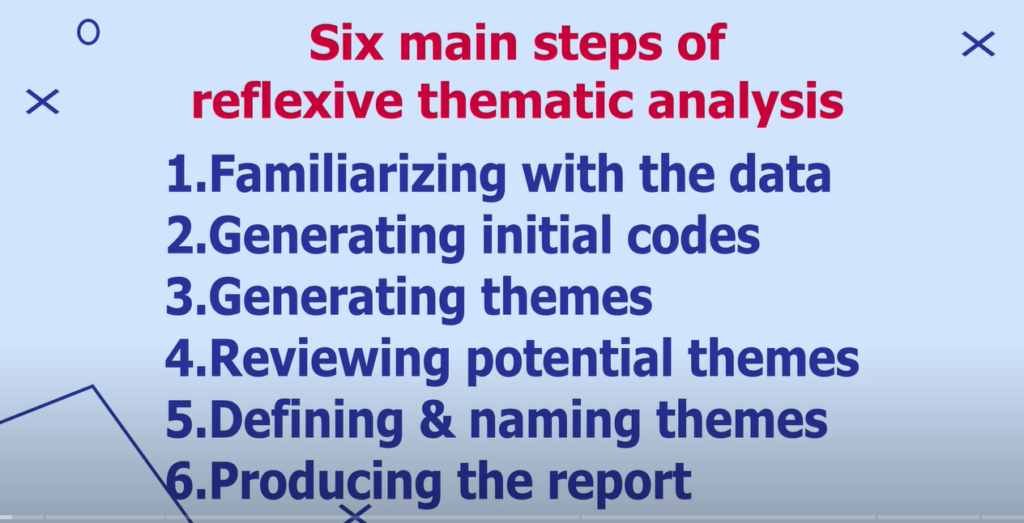
The Six Steps of the Braun and Clarke Thematic Analysis Framework
Step 1 — Familiarize Yourself with the Data
Step 1 of Braun and Clarke thematic analysis — familiarizing with interview transcripts
The first step is immersing yourself in the data before you attempt to code anything. For most researchers, this starts during transcription — typing out your interviews word for word already forces close attention to what participants said. Once transcription is complete, read through each transcript again and jot down your initial impressions.
In NVivo, open each transcript in the Files section and read it straight through. You can use the Memos feature to record your early thoughts. There is no coding yet at this stage — the goal is to understand the overall texture and shape of your data before you begin to organize it. If you need guidance on what to listen for during your interviews, my post on how to conduct qualitative research interviews covers the data collection side.
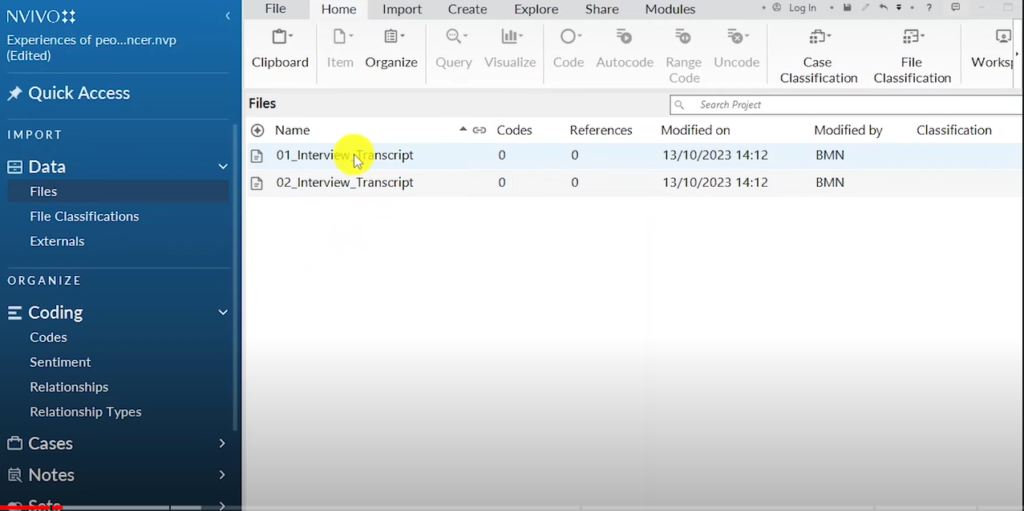
Two interview transcripts in the NVivo 14 Files section ready for coding
Step 2 — Generate Initial Codes in NVivo
Step 2 of inductive thematic analysis — generating initial codes in NVivo 14
Step 2 is where the analysis work begins. A code is a label that captures the meaning or significance of a piece of data. In the inductive approach, codes come directly from what participants say — you are not imposing categories from outside the data.
In NVivo, the coding process is straightforward: open a transcript in the Files section, highlight a meaningful statement, and drag it into the Codes panel on the left. A dialog box appears where you name the new code. The coded excerpt is then stored inside that code so you can retrieve and compare it later.
Here is an example from the prostate cancer study. One participant said he was “a little bit more health conscious” after his diagnosis. I coded this as more health conscious. A few lines later, the same participant mentioned he tries to keep a better eye on his weight — I coded that as more conscious about weight. The statement “I take statins, which has a bit of a neutralizing effect” became takes prescriptions to preserve health.
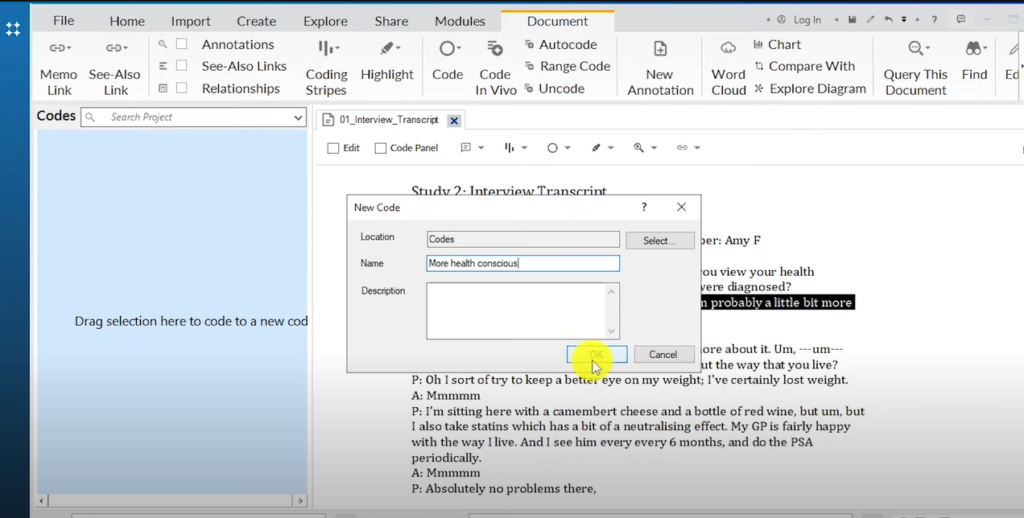
Creating the code: more health conscious— NVivo 14
At this stage, move quickly and do not overthink. You can always merge, rename, or delete codes later. The goal is to code all your data thoroughly. Here are the initial codes I generated from both transcripts in this study:
- More health conscious
- More conscious about weight
- Takes prescriptions to preserve health
- Regular health check-ups
- More relaxed about life
- Views physical activity positively
- Walking
- Golfing
- Unfavourable weather conditions
- More conscious about health
- Healthy diet
- Physically active
- Lack of sufficient time to exercise
NVivo organizes all codes in the Codes panel where you can see how many references each one has and navigate back to the original transcript with a single click. For a more in-depth walkthrough of NVivo’s coding tools specifically, see my post on coding interview transcripts in NVivo.
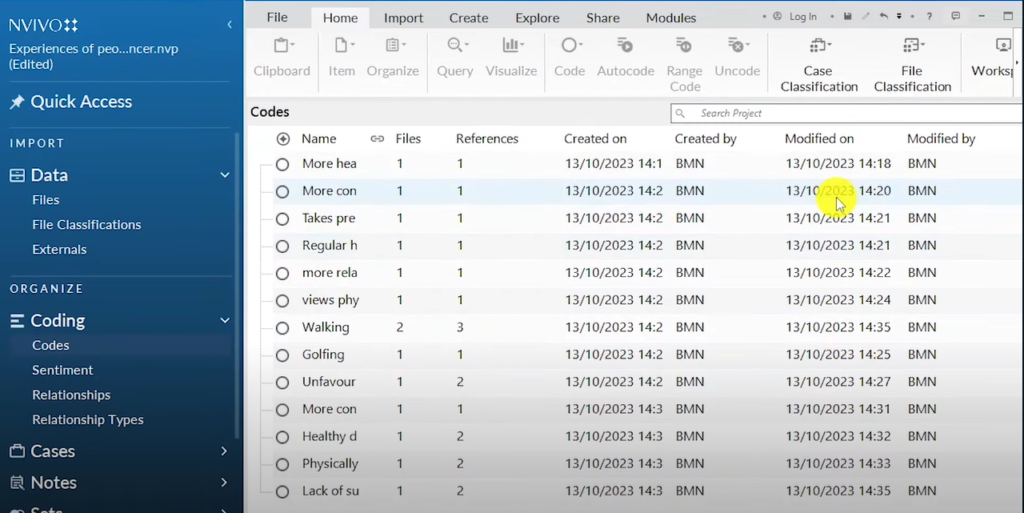
All initial codes generated from two interview transcripts in NVivo 14
If you’d rather have a professional handle the full coding and analysis for you, take a look at my done-for-you NVivo thematic analysis service — I work directly with your transcripts and deliver a complete findings report.
Step 3 — Generate Initial Themes

Step 3 of Braun and Clarke thematic analysis — generating initial themes from codes in NVivo 14
Step 3 is where patterns begin to emerge. A theme is a pattern of meaning that runs across multiple codes — it is more than a summary of one statement; it captures something significant that recurs in the data.
To generate themes in NVivo, right-click in the Codes panel and create a new code named as a theme. Then drag the relevant codes underneath it. Looking at the codes from this study, I identified four clear patterns:
- Barriers to Physical Activity— “Lack of sufficient time to exercise” and “unfavourable weather conditions” both prevent participants from being active. I dragged both codes into this theme.
- Physical Activities— “Walking,” “golfing,” and “views physical activity positively” all relate to the same topic.
- Current Health Perceptions— “More health conscious,” “more conscious about health,” and “more conscious about weight” all describe how participants think about their health since diagnosis.
- Current Health Promotion Activities— “Takes prescriptions to preserve health,” “regular health check-ups,” “more relaxed about life,” and “healthy diet” describe what participants actively do to stay well.
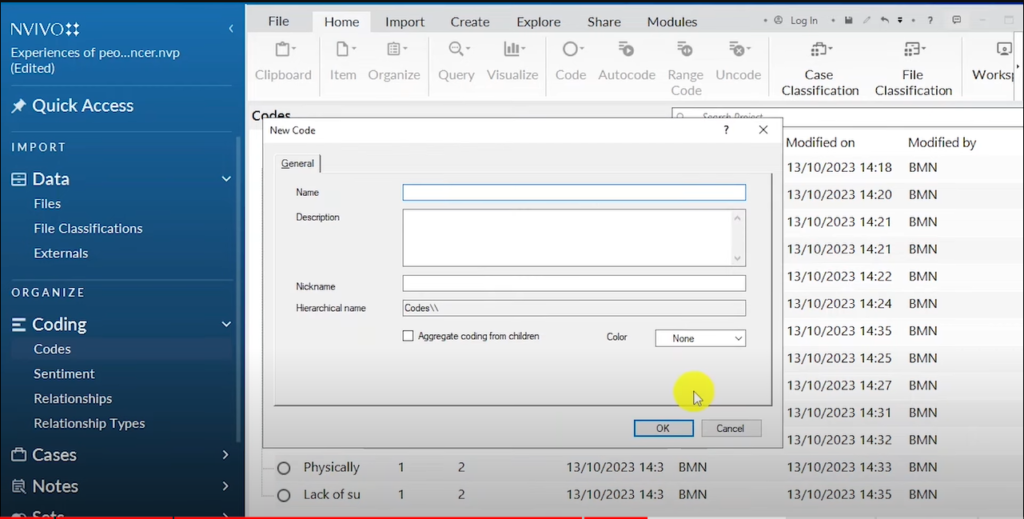
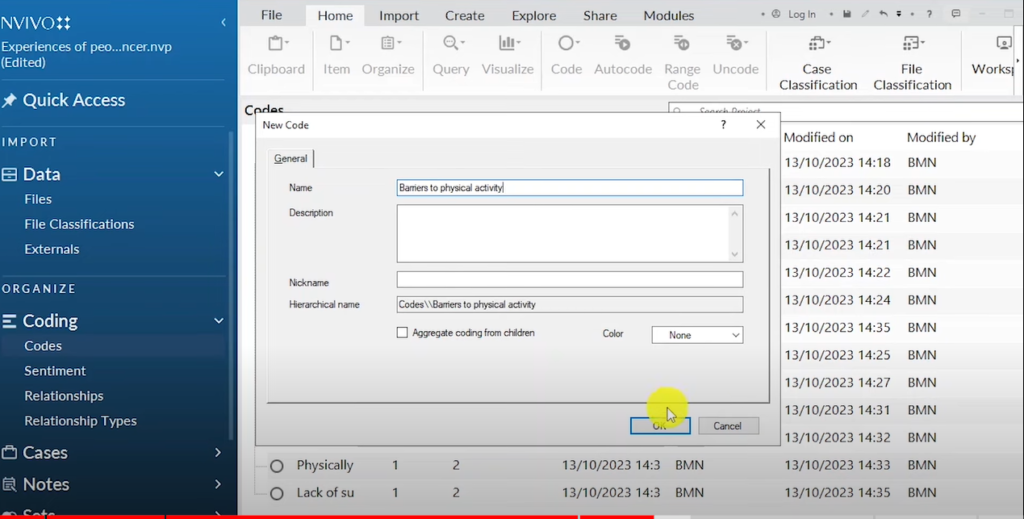
Creating the theme: Barriers to physical activity — NVivo 14

All the codes related to Barriers to physical activity were grouped in that theme
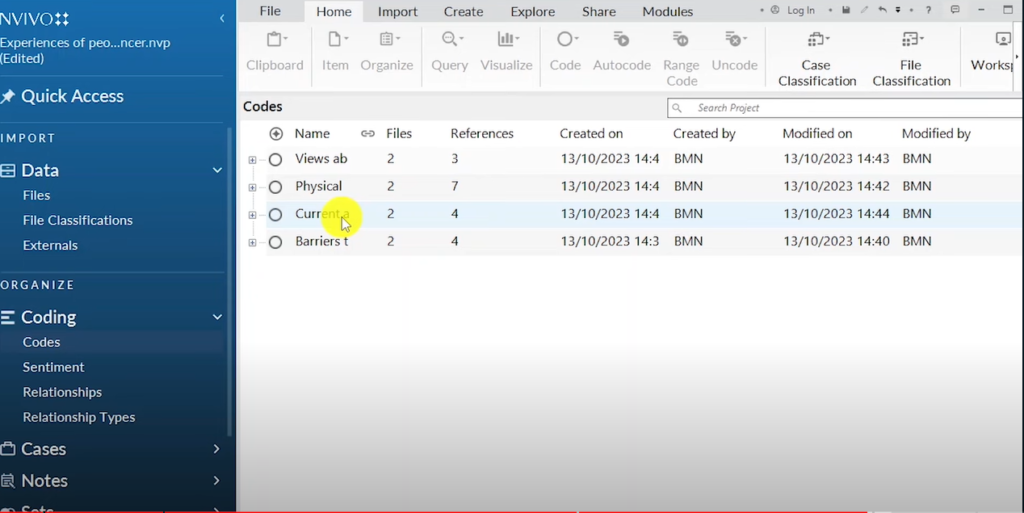
All the themes organized in NVivo 14 during Step 3 of inductive thematic analysis
These four themes are provisional. They exist to be questioned and refined in the next step.
Step 4 — Review Your Themes

Step 4 of Braun and Clarke thematic analysis — reviewing and refining themes in NVivo 14
Step 4 is reviewing and refining your themes. Go back through each theme and ask: do the codes inside genuinely fit together? Is the theme name accurate? Should any themes be merged or split?
In this study, I reviewed “Views About Health” and decided the name didn’t fully capture what the codes were showing — participants were describing a specific shift in perception since their cancer diagnosis, not just general views. I renamed it Current Health Perceptions. I refined “Current Activities to Maintain Health” to Current Health Promotion Activities, which is more precise and clinically meaningful.
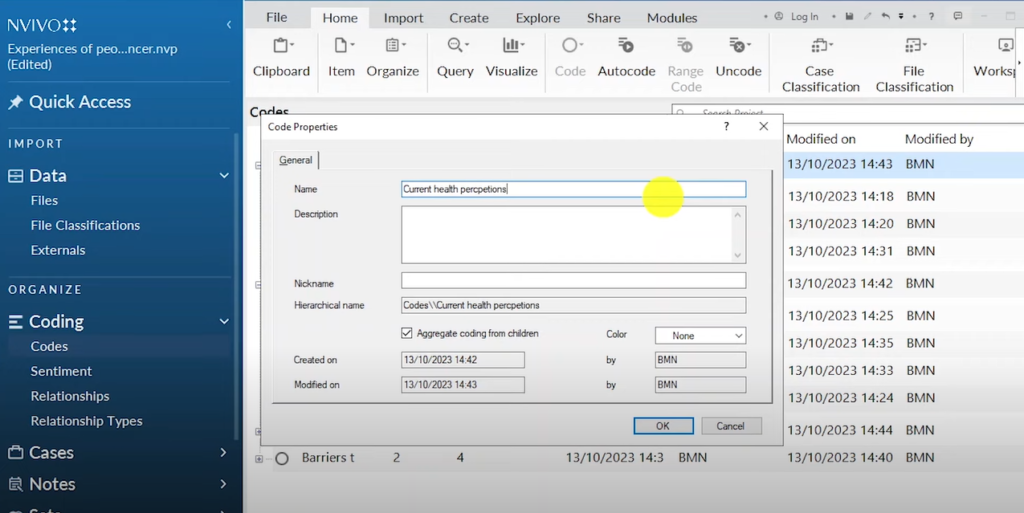
This step is iterative. You may move back and forth between your codes and themes several times before each theme tells a coherent, bounded story.
Step 5 — Define and Name Your Themes

Step 5 of Braun and Clarke thematic analysis — defining and naming themes in NVivo 14
Step 5 is formalizing your themes with clear names and written definitions. In NVivo, right-click on each theme in the Codes panel, go to Code Properties, and write a brief description of what the theme captures.
For example, I defined Current Health Perceptions as: “This theme captures how the interviewees currently view and understand their health, particularly in relation to their cancer diagnosis.” I defined Physical Activities as: “This theme captures the specific physical activities that interviewees are currently engaged in.”
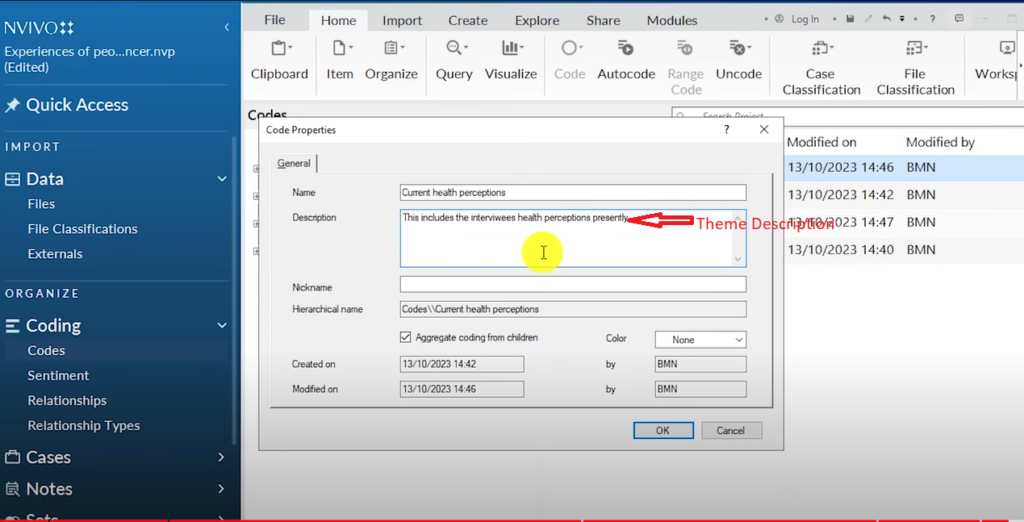
Theme description written in NVivo 14 Code Properties — Step 5 of thematic analysis
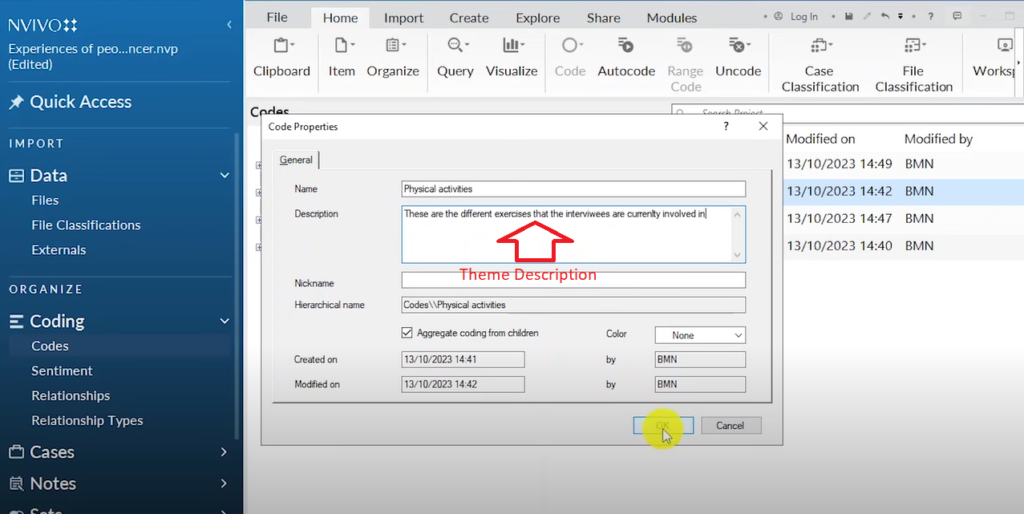
Theme description written in NVivo 14 Code Properties — Step 5 of thematic analysis
Once your themes are defined, you can export a codebook from NVivo by going to Share → Export → Export Codebook. According to Lumivero’s NVivo documentation, the codebook lists each code and theme with its description, and is a useful document to include in your methodology appendix to demonstrate analytical rigour.
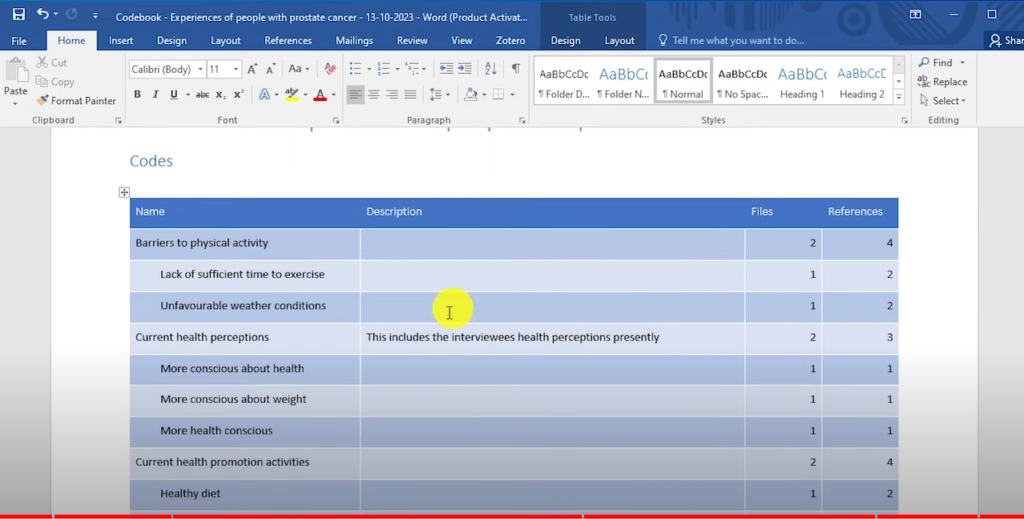
Complete codebook with three themes and descriptions
Step 6 — Write the Report
Step 6 of Braun and Clarke thematic analysis — writing the qualitative findings report
The final step is producing the report — typically Chapter 4 (Results) of your thesis or dissertation. This chapter has a structure that examiners expect and that follows logically from the analytical process.
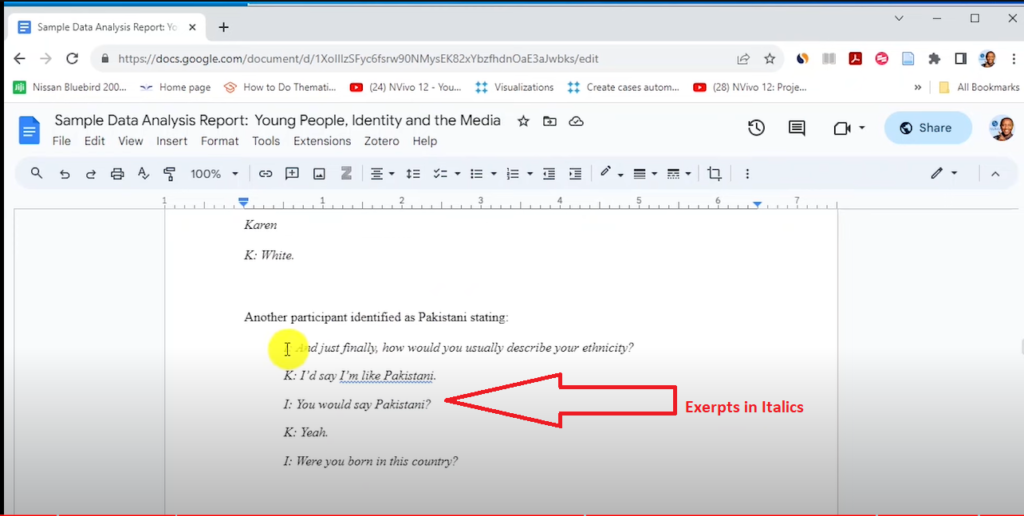
Begin by explaining your data analysis approach: state that you used reflexive thematic analysis following Braun and Clarke’s (2006) 6-step framework. Then present your themes one by one. For each theme, write a paragraph describing what it captures, followed by direct quotes from participants (formatted in italics) as evidence.
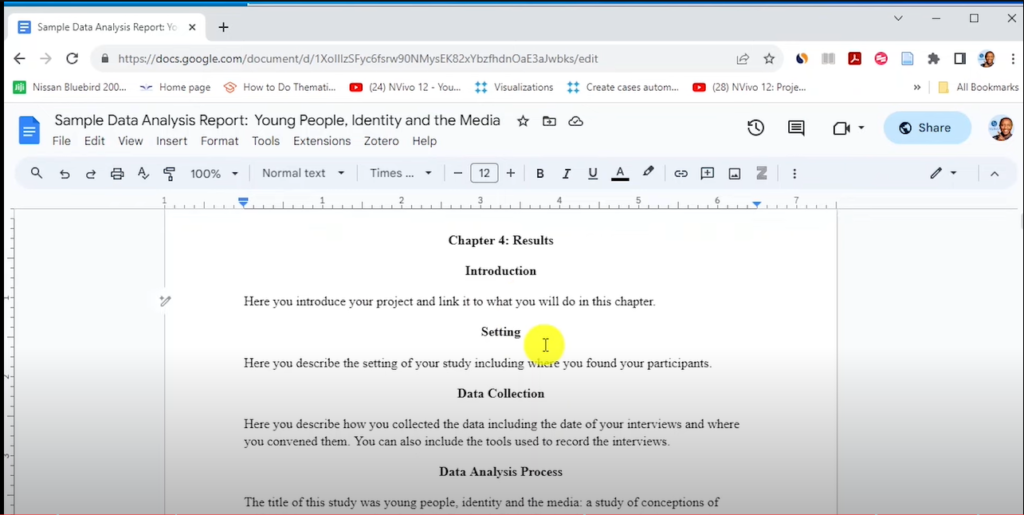
A Section of the Report
You can extract quotes directly from NVivo — right-click on any code to see all the excerpts stored inside it. A well-written results chapter doesn’t simply list themes; it tells a coherent story about what your participants experienced, using their own words as evidence. Always attribute each quote to a participant code (e.g., Participant 1) to protect confidentiality.
Common Mistakes to Avoid
- Coding too early. Some students rush to generate codes before they’ve read their transcripts thoroughly. Spend real time in Step 1 before you open the Codes panel.
- Confusing codes with themes. A code is a label for a specific piece of data. A theme is a pattern that spans multiple codes. If your “themes” each only have one or two codes underneath them, they are probably codes, not themes.
- Never revisiting the data. In Step 4, many students review their themes by looking only at the code names — not by going back to the actual transcript excerpts. Always check that the participant language genuinely supports your theme definition.
- Skimping on the write-up. Step 6 is not a list of theme names. Each theme needs a clear definition, supporting quotes, and an interpretation that connects back to your research question.
Frequently Asked Questions
Can I use NVivo for data other than interviews?
Yes. NVivo handles focus group transcripts, field notes, open-ended survey responses, social media data, and even audio and video files. The coding process is the same regardless of data type.
How many codes do I need before I can generate themes?
There is no fixed number. In a typical PhD study with 10–15 interviews, you might generate 50–100 initial codes before looking for patterns. The key is to code all your data thoroughly before moving to Step 3.
Do I have to use NVivo for reflexive thematic analysis?
No — you can do thematic analysis manually using Word or Excel. However, NVivo makes it significantly easier to manage large datasets, retrieve coded excerpts, and produce visualizations for your report. It is the industry standard for qualitative research in most academic disciplines.
What makes reflexive thematic analysis different from other types?
Braun and Clarke’s reflexive approach is inductive and researcher-centred — it acknowledges that the researcher’s perspective shapes the themes that emerge. This is different from a more positivist approach where themes are treated as objective facts hidden in the data.
Key Takeaways
- Qualitative analysis of interviews in NVivo follows six steps: familiarize, code, generate themes, review themes, define and name themes, and write the report.
- The reflexive thematic analysis approach is inductive — your codes and themes emerge from the data, not from a predefined framework.
- In NVivo, you generate codes by dragging transcript excerpts into the Codes panel, then group related codes into themes.
- The Step 4 review is critical — always go back to the actual excerpts, not just the code names, when evaluating whether a theme holds together.
- Your Chapter 4 results write-up should present each theme with a clear definition and direct participant quotes as evidence.
Need Help with Your Qualitative Analysis?
If you’re working through your qualitative data analysis and getting stuck — whether it’s coding, generating themes, or writing up your results — book a one-on-one consulting session and we’ll work through your specific dataset together.
Prefer to hand it off entirely? My done-for-you NVivo thematic analysis service covers the full process — from importing your transcripts to delivering a polished findings report ready for your dissertation.
For more on the coding approach demonstrated in this tutorial, see my post on inductive thematic analysis in NVivo step-by-step. And if you’re analyzing a different type of qualitative data, my guide on qualitative coding with MAXQDA covers the same framework in a different tool.

![NVivo Tutorial for Beginners [Step-by-Step Guide]](https://survivingresearch.com/wp-content/uploads/2024/07/Nvivo-for-Beginners.jpg)
Pingback: Thematic Analysis of Focus Group Data in NVivo [Step-by-Step Guide] -
Pingback: Template Analysis in Qualitative Research Using Nvivo -