- What Is Qualitative Data?
- What Is Quantitative Data?
- Key Differences Between Qualitative and Quantitative Data
- Data Collection Methods: Qualitative vs Quantitative
- Quantitative Data Collection Methods
- When Should You Use Qualitative Data?
- When Should You Use Quantitative Data?
- What About Mixed Methods Research?
- Final Thoughts
Understanding the difference between qualitative and quantitative data is essential for PhD students and early-career researchers. These two data types shape how research questions are framed, how data is collected, and how findings are analyzed.
If you are working on a dissertation, journal article, or research proposal, choosing the right type of data is not just a methodological decision. It directly affects the quality and credibility of your research.
In this guide, we will clearly explain what qualitative and quantitative data are, how they differ, and when each approach is most appropriate. The discussion is especially relevant for researchers working with qualitative data analysis.
What Is Qualitative Data?
Qualitative data is non-numerical data that focuses on meaning, experience, and interpretation rather than measurement.
Instead of asking “how many” or “how much,” qualitative data helps researchers understand how people experience a phenomenon and why they interpret it in certain ways.
Common examples of qualitative data include:
- Interview transcripts
- Focus group discussions
- Field notes from observations
- Open-ended survey responses
- Documents, texts, and archival materials
If your data consists primarily of words, narratives, or descriptions, you are working with qualitative data.
Why Qualitative Data Matters in Research
Qualitative data is especially valuable when:
- Context and nuance are important
- The topic is complex or underexplored
- Human experience is central to the research question
Qualitative research is often used in social sciences, education, health research, and critical studies, where understanding meaning and perspective is essential.
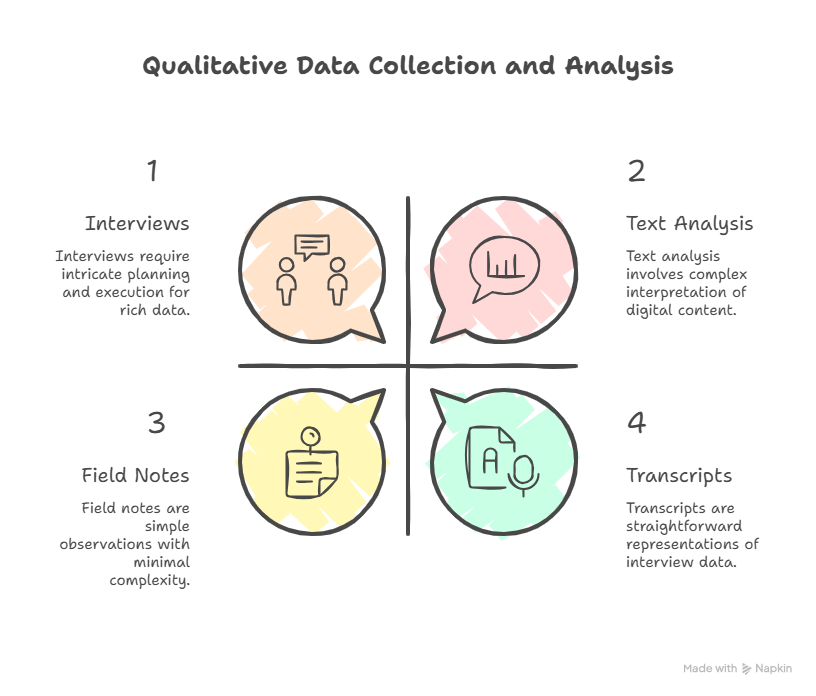
Example of Qualitative Data in Research
Consider a study on doctoral supervision.
A qualitative approach might involve conducting in-depth interviews with PhD students and asking questions such as:
“How would you describe your experience working with your supervisor?”
Participants may discuss mentorship, power dynamics, emotional support, or institutional pressure. These interview transcripts form the qualitative dataset.
Rather than producing a numerical score, qualitative data provides rich, contextual insight into how doctoral students experience supervision.
What Is Qualitative Data Analysis?
Qualitative data analysis is an interpretive process focused on identifying patterns and meaning within textual or visual data.
Researchers typically:
- Read the data multiple times
- Apply codes to segments of text
- Identify recurring themes or concepts
- Develop interpretations grounded in participants’ perspectives
The outcome is not a statistic but an explanation, conceptual framework, or theory.
What Is Quantitative Data?
Quantitative data is numerical data that can be counted, measured, and statistically analyzed.
It answers questions such as:
- How many people experience this?
- How often does it occur?
- Is there a difference between groups?
Examples of quantitative data include:
- Survey ratings and Likert scales
- Test scores and exam results
- Frequencies and percentages
- Experimental measurements
Quantitative data is commonly used to test hypotheses, identify patterns at scale, and generalize findings to larger populations.
Example of Quantitative Data in Research
Using the doctoral supervision example again, a quantitative approach might involve distributing a survey to 200 PhD students.
Participants are asked to rate their satisfaction with supervision on a scale from one to five.
The results are analyzed statistically to calculate averages, compare departments, or test relationships between variables.
These numbers tell researchers what is happening at scale, but they do not explain why students feel the way they do.
Key Differences Between Qualitative and Quantitative Data
| Qualitative Data | Quantitative Data |
| Non-numerical | Numerical |
| Focuses on meaning | Focuses on measurement |
| Small, in-depth samples | Large, representative samples |
| Interpretive analysis | Statistical analysis |
| Explores “how” and “why” | Answers “how many” and “how much” |
Both approaches are valuable and often complementary.
Data Collection Methods: Qualitative vs Quantitative
Qualitative Data Collection Methods
Qualitative data is typically collected using flexible, open-ended methods such as:
- Interviews
- Focus groups
- Observations
- Open-response surveys
These methods allow participants to express their perspectives in their own words.
Quantitative Data Collection Methods
Quantitative data is collected using structured and standardized tools, including:
- Closed-ended surveys
- Experiments
- Tests and assessments
- Existing numerical datasets
The goal is consistency, comparability, and statistical reliability.
When Should You Use Qualitative Data?
Qualitative data is most appropriate when:
- You are exploring a new or complex topic
- You want to understand lived experience
- Context and interpretation are central
If your research question begins with “How do people experience…” or “How do people make sense of…”, qualitative methods are often the best choice.
When Should You Use Quantitative Data?
Quantitative data is more suitable when:
- You are testing hypotheses
- You need measurable variables
- Generalization to a larger population matters
Quantitative methods are especially useful for identifying trends, comparing groups, and measuring outcomes.
What About Mixed Methods Research?
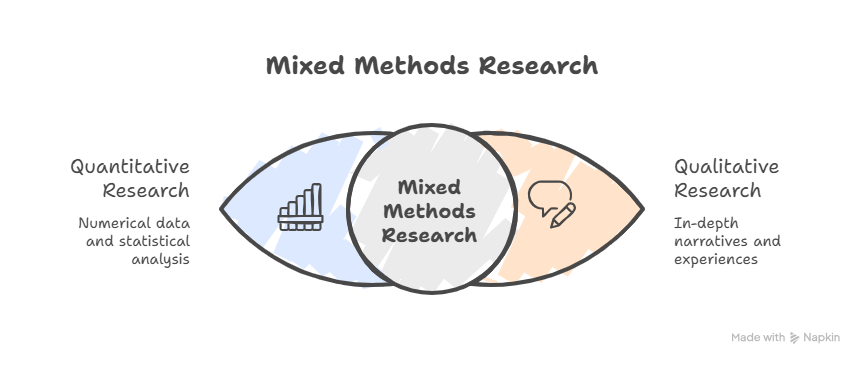
Many PhD projects use mixed methods, combining qualitative and quantitative data in a single study.
For example:
- Qualitative interviews may be used to generate hypotheses
- Quantitative surveys may then test those hypotheses at scale
Mixed methods research offers both depth and breadth, but it requires careful design and methodological clarity.
Final Thoughts
Qualitative and quantitative data serve different purposes in research.
- Qualitative data provides depth, meaning, and context
- Quantitative data provides scale, measurement, and comparison
Strong research does not choose sides. It chooses methods that align with the research question.
If your work focuses on qualitative data analysis, do not feel pressured to reduce everything to numbers. Meaning matters, and qualitative insights can be theoretically powerful and methodologically rigorous.