If you’re asking “how many interviews do I need for my qualitative research?” — you’re asking the right question, just framing it the wrong way. The real answer isn’t a number. It’s a principle called data saturation, and once you understand it, your entire approach to sample size in qualitative research changes.
In this guide, I’ll explain what data saturation is, how many interviews most PhD studies actually need, and exactly how to justify your sample size to your supervisor and examiners.
- Why There’s No Fixed Number of Interviews in Qualitative Research
- What Is Data Saturation? (The Real Answer)
- How Many Interviews Do Most Qualitative Studies Need?
- Why More Interviews Don’t Mean Better Research
- How to Know You’ve Reached Data Saturation
- How to Justify Your Sample Size in Your Thesis
- Frequently Asked Questions
- Key Takeaways
- Need Help With NVivo or Thematic Analysis?
Why There’s No Fixed Number of Interviews in Qualitative Research
One of the most common misconceptions among PhD students is that qualitative research has a standard sample size — something like “you need at least 20 interviews” or “30 is the gold standard.”
These figures float around in methodology textbooks and supervisors’ offices, but they are not universal rules. Here’s why:
Qualitative research is not designed to produce statistical generalisability. You’re not aiming for a large, representative sample the way a survey study would. Instead, you’re exploring experiences, meanings, and patterns in depth. The purpose of your interviews is to generate rich data — not a high volume of data.
This is why, as Scribbr’s guide to qualitative research methods explains, qualitative sample sizes are typically much smaller than quantitative ones, and are guided by the depth of the data rather than a preset number.
The bottom line: your sample size should be determined by your data, not by a number you chose before you started collecting.
What Is Data Saturation? (The Real Answer)
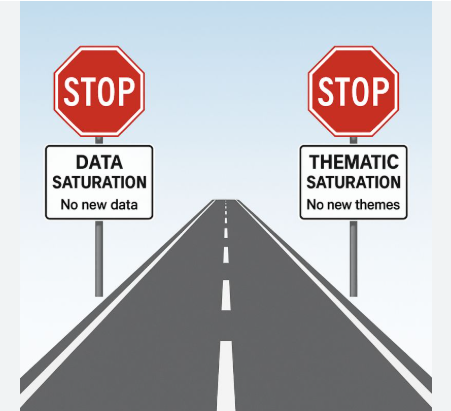
Data saturation is the point in qualitative data collection at which new interviews stop producing new information.
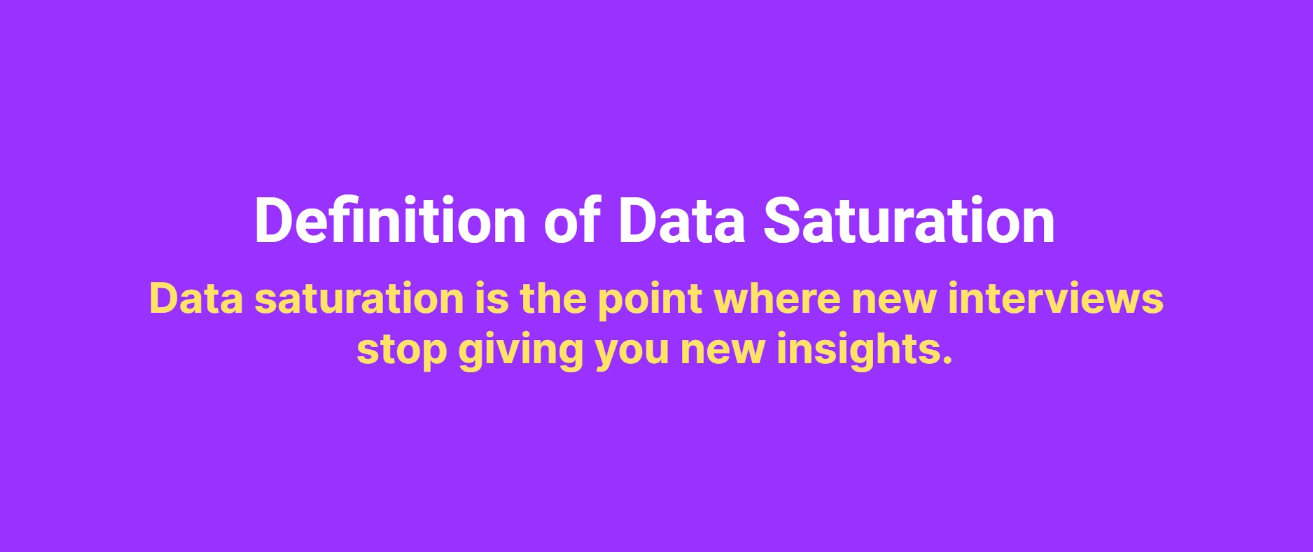
You’ve heard the same ideas, you’re seeing the same patterns, and no new themes or codes are emerging from your analysis.
When you reach saturation, you stop collecting data — not because you hit a number, but because your data has told you everything it can.
This concept was formally established in grounded theory by Glaser and Strauss, and has since been adopted across qualitative traditions including thematic analysis, phenomenology, and narrative inquiry. A widely cited study by Guest, Bunce, and Johnson (2006) found that in their sample, saturation was largely achieved within the first 12 interviews — a finding that has become a useful reference point for many PhD researchers.
| Quick definition: Data saturation = the point where new interviews stop generating new codes or themes. Once you reach it, additional data adds volume but not value. |
Common Mistake — Deciding Your Sample Size Too Early
Many PhD students make this mistake: they fix a number (“I will conduct 20 interviews”) before their study begins. This creates two problems.
- Stopping too early. If saturation hasn’t been reached, your findings may be incomplete.
- Collecting too much data. If saturation happens earlier, you waste time analysing repetitive data.
Both situations weaken your research efficiency and quality.
How Many Interviews Do Most Qualitative Studies Need?
While there is no fixed number, most qualitative studies reach saturation somewhere between 12 and 25 interviews, depending on several key factors.
Factors That Affect Your Sample Size
Complexity of the research topic. A study exploring a narrow, specific experience may reach saturation faster than a study exploring a broad or socially complex phenomenon.
Diversity of your participant group. Greater variation in age, geography, role, or experience typically means more interviews are needed to capture the full range of perspectives.
Depth of each interview. A 90-minute semi-structured interview generates far more analytical data than a 20-minute structured one. Richer interviews reduce the number you need — this is why purposive sampling (selecting participants for their relevance, not convenience) is so important.
Your research questions. Focused research questions converge faster. Broad or exploratory questions may require more interviews before patterns stabilise.
Why More Interviews Don’t Mean Better Research
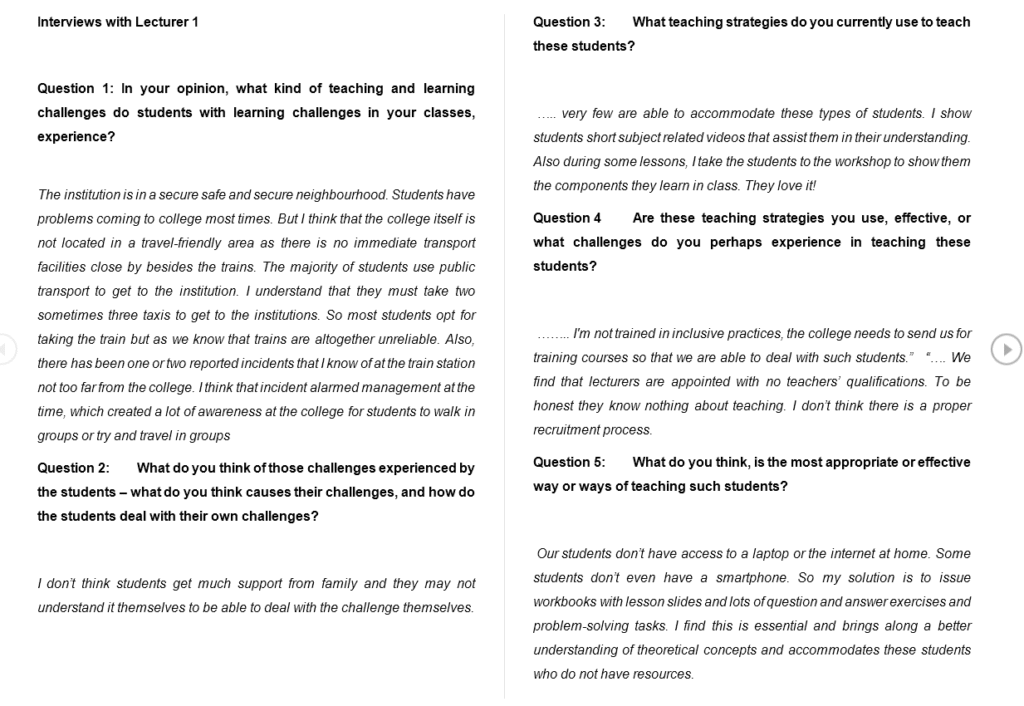
It’s natural to assume that more data makes your research stronger — but in qualitative work, that’s not always true. Too many interviews can actually harm your study by:
- Overcomplicating your analysis with redundant data
- Slowing down your progress significantly
- Producing repetitive findings that weaken rather than strengthen your argument
Here’s a simple way to think about it: imagine your first 8 interviews consistently reveal three core themes — lack of institutional support, time pressure, and limited access to resources. If interviews 9 through 20 all produce the same three themes without introducing anything new, you haven’t strengthened your study. You’ve just created more work for yourself.
At that point, more data adds volume — not insight.
How to Know You’ve Reached Data Saturation
This is where most PhD students struggle. Saturation isn’t an obvious moment — it emerges gradually as you analyse your data alongside collection. Here’s how to track it:
Document the pattern. Keep a log of which interview introduced which themes. This becomes part of your methodological justification.
Analyse as you go. Don’t wait until all interviews are completed to start coding. Iterative analysis is the key to identifying saturation in real time.
Track new codes. After each interview, note how many new codes or themes emerged. When new interviews stop generating new codes, you’re approaching saturation.
Using NVivo to Track Saturation
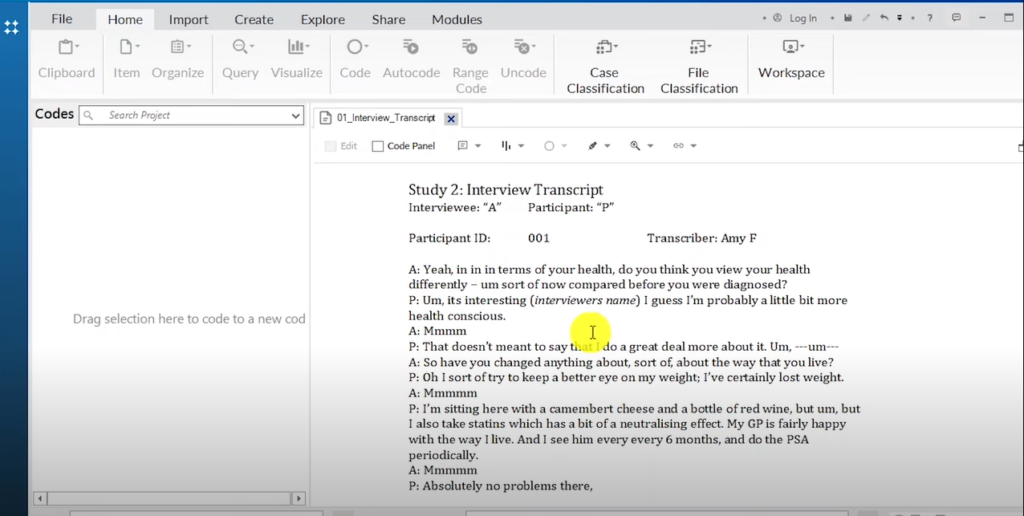
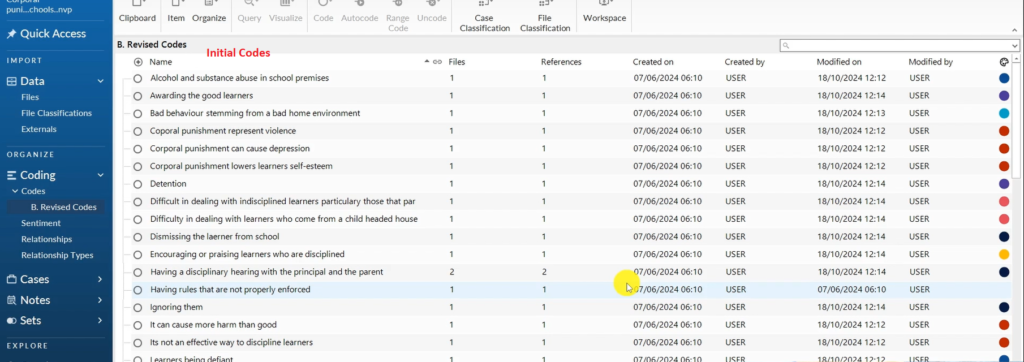
NVivo makes this process much more systematic. As you code your interview transcripts, you can monitor whether new nodes are emerging or whether your existing node structure is simply being reinforced.
Early in your data collection, new interviews will generate new codes constantly. Later, you’ll notice that new transcripts slot neatly into your existing coding framework — no new nodes needed. That shift is your saturation signal.
If you’re not yet confident with the coding process itself, my guide on qualitative coding of interviews with NVivo walks you through the full approach step by step. For a deeper theoretical grounding on how saturation connects to thematic analysis SAGE Research Methods has excellent resources on methodological rigour in qualitative research.
Common Mistake — Continuing After Saturation
Many PhD students continue collecting data well past saturation because of fear: “What if my supervisor says it’s not enough?” or “What if I missed something important?”
Here’s the truth: examiners care far more about how you justify your sample size than how large it is. A student who collected 12 interviews and can clearly articulate when saturation occurred — with documented evidence — is in a much stronger position than one who collected 30 interviews without a methodological rationale.
How to Justify Your Sample Size in Your Thesis
Don’t write: “I conducted 20 interviews.”
Write: “Data collection continued iteratively until data saturation was reached, defined as the point at which no new codes or themes emerged from subsequent interviews (Guest et al., 2006). Saturation was identified at interview 16, with final interviews confirming existing themes without introducing new analytical categories.”
That one paragraph demonstrates methodological rigour, awareness of qualitative research principles, and a defensible rationale — exactly what examiners want to see.
The Importance of Documenting Saturation
To write this kind of justification, you need to document your process as it happens. Keep a simple log that tracks:
- Which interview introduced which theme or code
- When new codes stopped emerging
- Any negative cases or deviant cases that challenged your emerging themes
This documentation transforms your sample size from a subjective decision into a credible, traceable methodological choice — and that distinction matters enormously at the thesis defence stage.
If you need hands-on help structuring your analysis, I offer a Done-for-You NVivo Thematic Analysis Service that covers coding, saturation tracking, and Chapter 4 preparation. Reach out here.
Frequently Asked Questions
Can I reach saturation in fewer than 12 interviews?
Yes, particularly in highly focused studies with homogeneous participant groups. Some phenomenological studies report saturation at 6–8 interviews. The key is documenting your process, not hitting a minimum.
Does my supervisor have to agree with when I call saturation?
It’s a good idea to discuss it with them, especially if you’re stopping earlier than expected. Show your saturation log and code frequency data — a data-driven conversation is far more persuasive than “I think I’m done.”
Is data saturation the same as theoretical saturation?
Not quite. Theoretical saturation is a concept from grounded theory specifically — it refers to when no new theoretical categories are emerging. Data saturation is a broader term used across qualitative traditions. Both refer to the same underlying principle: stop when you’ve stopped learning.
Key Takeaways
There is no fixed number of interviews required in qualitative research
Data saturation — not a preset number — determines your sample size
Most qualitative studies reach saturation between 12 and 25 interviews
More interviews do not automatically strengthen your research
NVivo helps you track saturation systematically through your coding process
Strong, documented justification matters far more to examiners than interview volume
Need Help With NVivo or Thematic Analysis?
If you’re struggling with:
- Coding your data
- Identifying saturation
- Developing strong themes
You’re not alone—this is where most PhD students get stuck.
I offer a Done-for-You NVivo Thematic Analysis Service that helps you:
- Code your data correctly
- Identify saturation
- Develop clear, defensible themes
- Structure your findings (Chapter 4 ready)
You might also find it helpful to read my guides on inductive thematic analysis using NVivo (Saldana’s method), how to conduct a qualitative research interview, and getting started with NVivo before your next data collection session.
Understanding data saturation transforms how you approach qualitative research — from guessing at numbers to making informed, methodologically sound decisions. That’s the difference between surviving your PhD and owning it.