

Last Updated on 5 months ago by Grace Nyambura
| Quick Definition: Qualitative research is a research approach that explores human experiences, meanings, and social processes through non-numerical data such as interviews, observations, and documents. It is guided by six core characteristics: naturalistic inquiry, rich description, participant-centered perspectives, context sensitivity, inductive data analysis, and flexible design. |
Qualitative research plays a critical role in doctoral studies — particularly in disciplines that seek to understand human experiences, meanings, and social processes. If you are a PhD student planning a qualitative study, or struggling to explain your methodology clearly in your dissertation, understanding the core characteristics of qualitative research is not optional. It is foundational.
This guide breaks down the six main characteristics in a practical, accessible way. Rather than dense textbook definitions, it explains how these features actually show up in real PhD research projects — and what they mean for your design decisions, analysis, and final write-up.
What Is Qualitative Research?
Qualitative research is an approach to inquiry that prioritizes depth over breadth. Rather than measuring variables or testing hypotheses statistically, it seeks to understand how people make sense of their experiences, how meaning is constructed within specific social contexts, and what factors shape human behavior in everyday settings.
It is widely used across social sciences, education, healthcare, and the humanities — and it is the methodological foundation for most PhD studies that rely on interviews, focus groups, ethnographic observation, or document analysis.

For a broader comparison of research approaches, Scribbr’s guide to qualitative research methods offers a well-organised overview of when and why to choose qualitative over quantitative methods.
If you are a doctoral student designing a qualitative study, understanding what defines this approach shapes every decision you make — from how you design your interview guide to how you justify your findings to your examiners.
The 6 Key Characteristics of Qualitative Research
1. Naturalistic Inquiry
One of the defining characteristics of qualitative research is that it takes place in natural, real-world settings rather than controlled or artificial environments.
Unlike laboratory-based experiments, qualitative researchers observe and engage with participants in everyday contexts — classrooms, workplaces, hospitals, online communities, or local neighborhoods. The goal is to study phenomena as they actually occur, without manipulating or isolating variables.
For PhD students, this means your research setting becomes part of your analysis. A study of how nurses manage stress on a ward, for example, gains credibility precisely because you observed real interactions in a real clinical environment — not simulated ones. This approach preserves the complexity and authenticity of human experience.

2. Rich and Thick Description
Qualitative research is known for producing detailed, layered accounts of the phenomena being studied — what researchers call “thick description,” a concept developed by anthropologist Clifford Geertz.
Unlike quantitative reports that summarize findings in tables or statistics, qualitative studies provide rich narratives supported by direct participant quotes, contextual background, observed behaviors, and interpretive commentary. This level of detail allows readers to fully understand the phenomenon being studied.
For doctoral research, thick description serves two critical functions. First, it strengthens the credibility of your interpretations by showing examiners exactly how you moved from raw data to conclusions. Second, it allows readers to judge the transferability of your findings to similar settings. If your dissertation feels thin or abstract, adding more descriptive depth is usually the most effective fix.

3. Focus on Participant Perspectives
Qualitative research places participants at the center of the inquiry. The goal is to understand experiences from the viewpoint of those directly involved — not to impose the researcher’s assumptions, theories, or categories onto the data.
This means using methods like semi-structured interviews, focus groups, and open-ended survey questions that give participants room to express their views in their own words. Being careful not to lead participants toward answers that confirm what you already expect to find is equally important.
For PhD students, honoring participant perspectives also requires reflexive practice — actively questioning how your own background and position as a researcher might be shaping what you hear and how you interpret it. Our guide to how to conduct a qualitative research interview covers practical strategies for keeping interviews genuinely participant-centered.

4. Sensitivity to Context
Human experiences are never context-free. Qualitative research acknowledges this directly by treating social, cultural, historical, and institutional contexts as central to understanding any phenomenon.
Rather than isolating variables and controlling for contextual factors, qualitative researchers lean into context. They ask: How does this setting shape what participants experience? How do power dynamics, institutional norms, or cultural practices influence behavior and meaning?
For doctoral researchers, this sensitivity to context prevents overgeneralization. Qualitative findings are interpreted within specific settings, and well-designed studies describe the context in enough detail for readers to make informed judgments about whether findings may apply elsewhere — what Lincoln and Guba called transferability.

5. Inductive Data Analysis
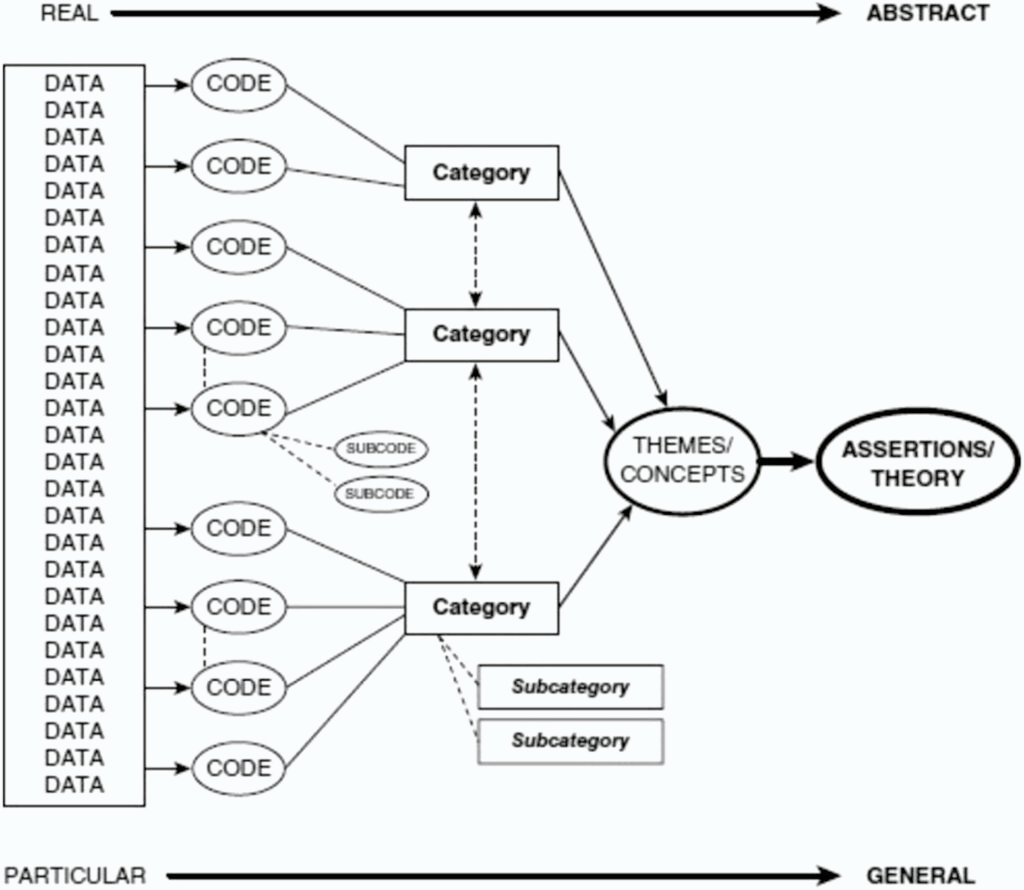
Most qualitative research uses an inductive approach, meaning that theories, patterns, and themes emerge from the data itself rather than being imposed from the outset.
The research process typically begins with raw data — interview transcripts, field notes, or documents — and moves gradually toward higher-level interpretations through coding and thematic development. This bottom-up logic allows the analysis to remain closely grounded in participants’ actual experiences.
If you are using NVivo, MAXQDA, or ATLAS.ti to analyze your qualitative data, the coding process you follow is a direct application of this inductive principle. You code what you see in the data, group related codes into categories, and develop themes that represent patterns across your dataset. Our post on inductive thematic analysis using NVivo walks through this step by step.
For deeper academic grounding on inductive coding approaches, SAGE Research Methods is the highest-authority resource in the field.
6. Flexibility and Emergent Design
Unlike quantitative studies with rigid pre-set protocols, qualitative research designs are often emergent — meaning they can evolve as new insights arise during data collection and analysis.
A researcher might revise interview questions after the first two interviews reveal unexpected themes. They might include an additional participant group when a new dimension of the phenomenon emerges. Or they might shift the focus of their analysis based on what the data is actually showing them.
For PhD students, this flexibility is a methodological strength — but only when it is deliberately managed and clearly documented. Examiners expect you to justify any changes to your research design and to show that these decisions were theoretically grounded, not arbitrary.
How These Characteristics Work Together in PhD Research
The six characteristics of qualitative research are not isolated features — they reinforce each other to form a coherent methodological logic.
Naturalistic inquiry produces the kind of rich, contextual data that makes thick description possible. A focus on participant perspectives shapes an inductive approach to analysis. Sensitivity to context gives flexibility its theoretical rationale. Together, they distinguish qualitative research from quantitative approaches in ways that go far beyond the type of data collected.
When you write your methodology chapter, one of the most effective strategies is to explicitly connect your design choices back to these characteristics. Do not just say “I used a qualitative approach.” Explain why your research questions call for naturalistic inquiry, why participant perspectives are central to your topic, and why an inductive analysis is the right fit for your data.
Common Mistakes PhD Students Make with Qualitative Research
Understanding the characteristics of qualitative research is one thing — applying them correctly in a doctoral study is another. Here are four mistakes that regularly appear in qualitative dissertations:
- Treating qualitative research as less rigorous. Qualitative research has its own standards of rigor — credibility, transferability, dependability, and confirmability. Failing to address these explicitly in your dissertation is a common examiner concern.
- Ignoring reflexivity. Because qualitative research centers participant perspectives, researchers must actively reflect on their own influence on the data. Glossing over reflexivity weakens your methodological justification considerably.
- Under-describing your context. Thin contextual descriptions make it impossible for readers to assess whether your findings are transferable. Describe your setting, participants, access process, and ethical considerations in detail.
- Abandoning flexibility too early. Some doctoral students stick rigidly to their original design even when the data is pushing them toward more productive territory. Emergent design is a strength — document every change with a clear rationale.
For more practical guidance on navigating qualitative methodology, Grad Coach’s qualitative research resources offer accessible, PhD-level advice on design decisions and methodology chapters.
Frequently Asked Questions
What are the main characteristics of qualitative research?
The six core characteristics of qualitative research are naturalistic inquiry, rich and thick description, focus on participant perspectives, sensitivity to context, inductive data analysis, and flexible emergent design. These features work together to support in-depth, contextual understanding of human experience.
How is qualitative research different from quantitative research?
Qualitative research explores meaning, context, and experience through non-numerical data such as interviews and observations. Quantitative research measures variables using numerical data and statistical analysis. For a detailed breakdown, see our post on qualitative vs quantitative research.
Is qualitative research appropriate for a PhD dissertation?
Yes, and it is widely used across disciplines including education, sociology, nursing, psychology, and business. The key is to match your method to your research question and to demonstrate methodological rigor through transparent design choices, reflexivity, and thick description.
Can qualitative research be combined with quantitative methods?
Yes. Mixed methods research combines both approaches within a single study. This is increasingly common in doctoral research, especially when researchers want both statistical patterns and in-depth explanations of why those patterns exist.
How do I analyze qualitative data for my PhD?
The most common approach is thematic analysis — coding your raw data (interview transcripts, observation notes, documents) and grouping codes into themes that address your research questions. Software tools like NVivo, MAXQDA, and ATLAS.ti can support this process. Our post on inductive thematic analysis using NVivo is a good starting point.
Key Takeaways
The six characteristics of qualitative research — naturalistic inquiry, rich description, participant perspectives, context sensitivity, inductive analysis, and flexible design — are not just academic concepts. They are practical principles that shape every stage of your doctoral study, from initial design through data collection to final reporting.
Understanding them clearly will help you write a stronger methodology chapter, conduct more rigorous analysis, and defend your approach with confidence in your viva.
Ready to Start Your Qualitative Analysis?
Are you overwhelmed by your qualitative data? I offer two specialized services for PhD students who need support with N-Vivo analysis. The first is my done-for-you qualitative data analysis service, where I handle the full coding, theme development, data visualization, and a findings report — including a walk-through recording of the entire analysis. The second is one-on-one N-Vivo consulting, where we work together on a video call via Zoom or Microsoft Teams, and I guide you through your analysis step by step.
![How to Conduct a Qualitative Research Interview [7 Steps]](https://survivingresearch.com/wp-content/uploads/2026/01/How-to-conduct-qualiataitve-interviews.jpg)

Pingback: Validity in Qualitative Research: 9 Proven Strategies -
Pingback: Qualitative vs Quantitative Data: A Guide for PhD -
Pingback: Thematic Analysis Examples: Inductive And Deductive (Step by Step Guide) -
Pingback: Qualitative Analysis of Interviews in NVivo: 6-Step Guide -
Pingback: How to Conduct a Qualitative Research Interview [7 Steps] -