

Last Updated on 6 months ago by Bernard Mugo
Interview Coding using MAXQDA
New to qualitative analysis and not sure how to start coding interviews.
You are in the right place.
In this article, I’ll show you the very first step of qualitative analysis using MAXQDA, which is how to code interview data.
We are going to go from raw transcripts such as this.
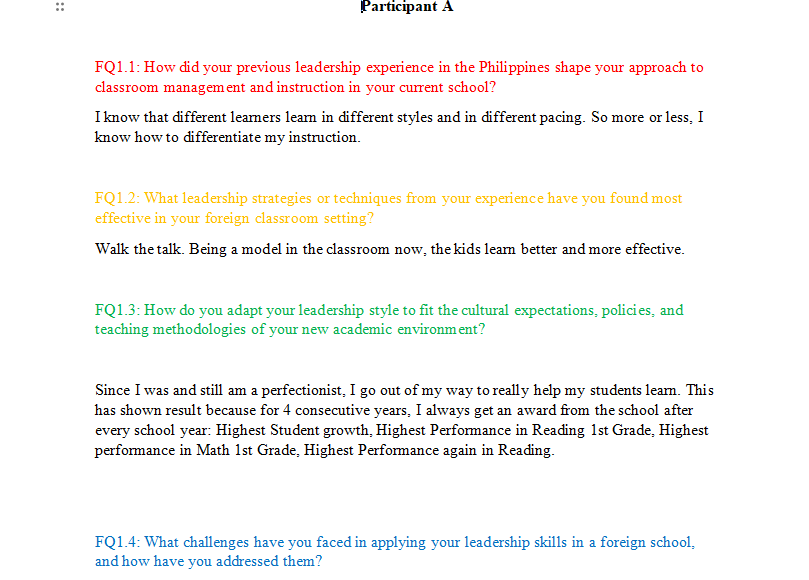
To well-developed codes like this.
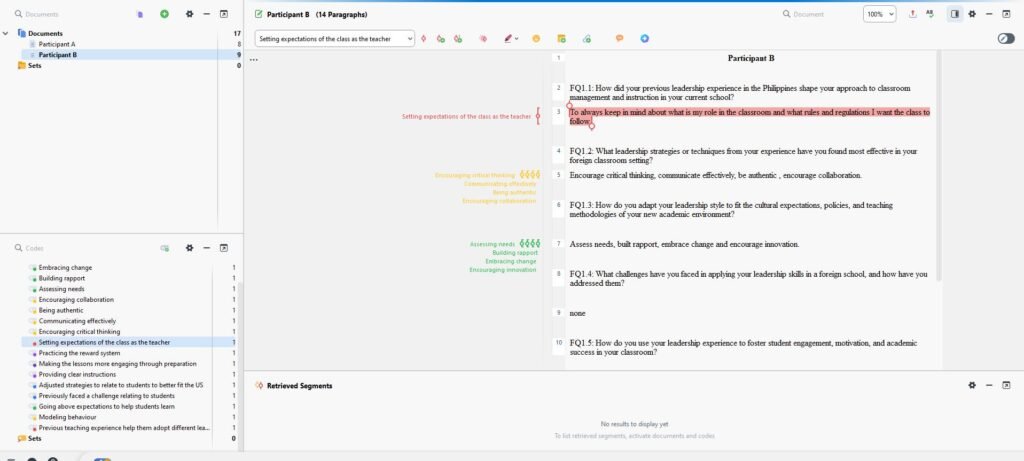
Well-developed codes
By the end of this article, you’ll know how to start your analysis without feeling overwhelmed.
My name is Bernard Mugo. I like to refer to myself simply as an academic.

In the past four years, I’ve helped more than 600 PhD students analyze qualitative data and finally complete their thesis or dissertations.
In the course of helping such a large number of students, I’ve gained invaluable experience in the best practices that you can use to perform analysis of your interviews and be able to retrieve quality findings.
Example of codes
The first thing that I will do is give you an example of codes that I developed before, I coded them in a basic Word document.
Then define what a code is, and then we go and do some coding inside MAXQDA on two sample transcripts that I got from a website called Fig Share.
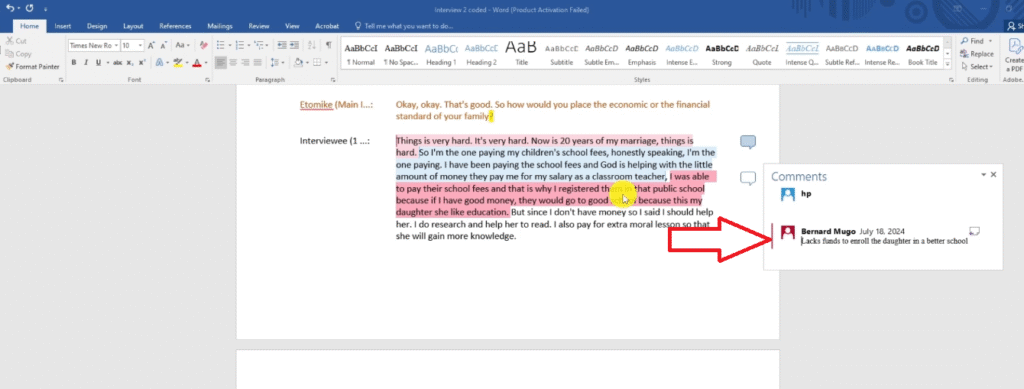
There is an interviewee who is asking, so how would you place the economic or the financial standard of your family?
Then the response, we are going to read the whole paragraph here.
It’s very hard now, 20 years of marriage. It’s hard.
So I’m the one paying my children’s school fees, honestly speaking. I’m the one paying.
I’ve been paying the school fees and God is helping me with the little amount of money they pay me for my salary as a classroom teacher, I was able to pay their school fees, and that is why I register them in that public school because if I have good money, they would go to a good school because this, my daughter, she likes education, but since I don’t have the money, so I said I should help her, I do research and help her to read. I also pay for extra lesson so that she will gain more knowledge.

I coded two quotes from that extract.
So the first code is:
Honestly speaking, I’m the one paying, I’ve been paying the school fees and God is helping me with the little amount of money they pay me for my salary as a classroom teacher.
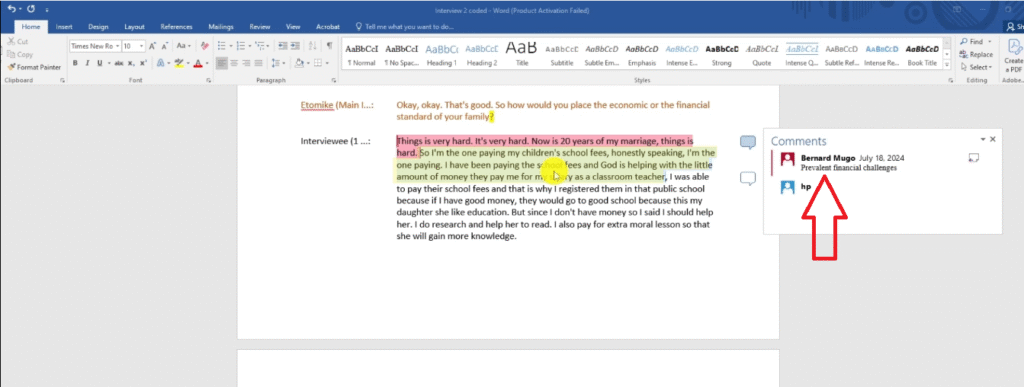
What this shows is that they have prominent financial challenges that this person is experiencing.
And then the next code I made relates to the sentence, I was able to pay their school fees and that is why I register them in a public school because if I have good money, they would go to good schools because this is my daughter and she likes education, so she lacks the funds, enroll her daughter in a better school.
So lacks the funds to enroll daughter in a better school is another code.
Let me give you an example of another code.
Let’s read this question and this response.
What I mean is, do you think that the IFOMSSA scholarship, the selection process and even selecting the winners, do you think it’s based on merit or not?
So the response they give is, I don’t think they select people for that. That is, it’s based on marriage, the students that merited it will go for it because when my daughter was preparing for it, she was preparing, since she was in junior class, she was preparing for it.
We were looking for to write the exam.
Even I always encourage her so they don’t select people. Just those brilliant people, at least from first end position, they will select people that will write the exams.
Yes.
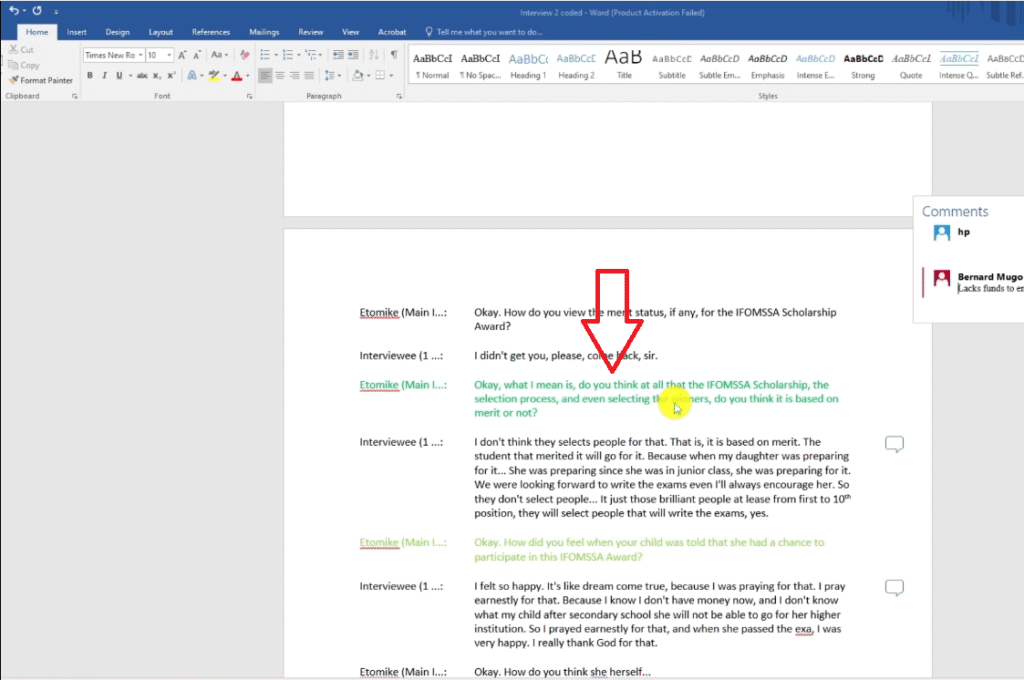
If you look at that, you can see that the scholarship is awarded based on merit, so they are saying that this scholarship can only be awarded based on merit.
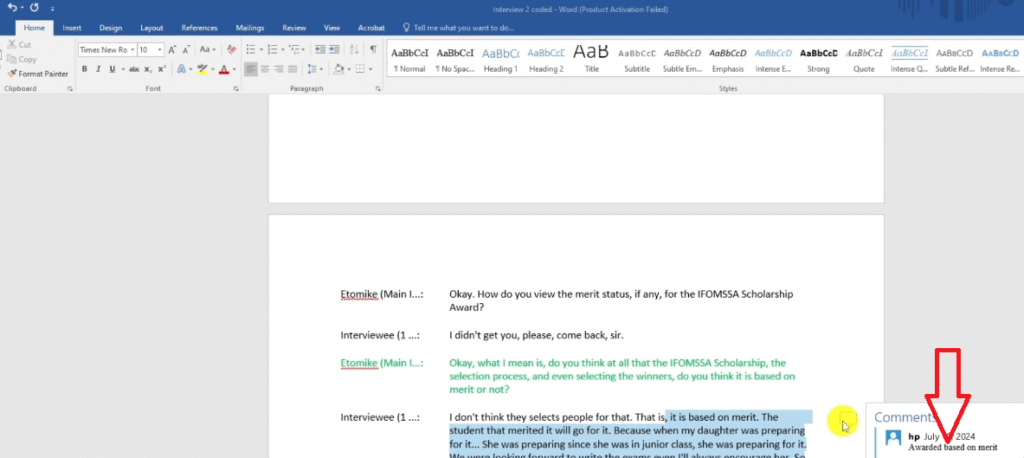
And that’s the code that I developed for that.
Let’s continue and see another question responses and the code that I have there.
How did you feel when your child was told that she had a chance to participate in I-F-O-M-S-A award?
I feel so happy. It’s like a dream come true because I was praying for that. I pray honestly for that ‘ cause I know I don’t have money now and I don’t know what my child will be able to go to a higher institution.
So I prayed honestly for that.
So they were overjoyed, that’s the code that I had there.
Overjoyed.
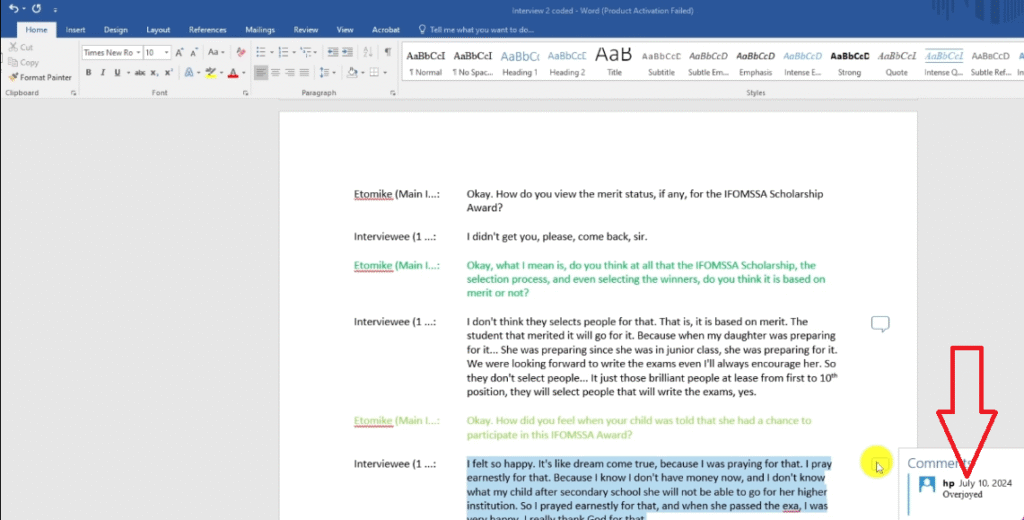
This are some examples of codes that I managed to develop for an interview that is not that clear, but I still manage to get some codes.
Definition of a Code
With these examples of codes, we can define a code.
So a code is a label or an interpretive statement to any information that’s important to our research question or objectives.
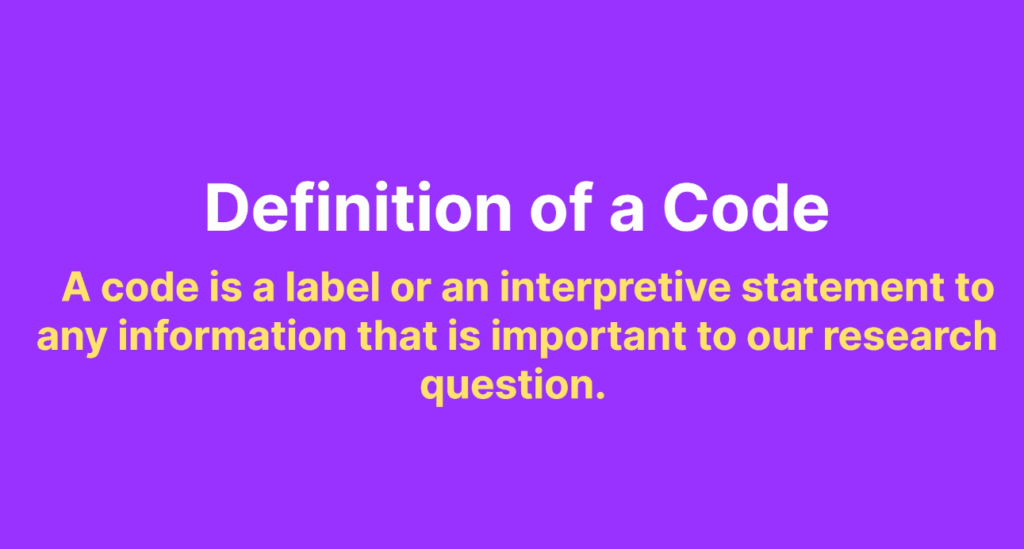
I want you to remember that as we work with MAXQDA.
Introduction to MAXQDA

I am going to open MAXQDA, and develop some codes across two transcripts.
I click on new in MAXQDA because I want to have a new project.
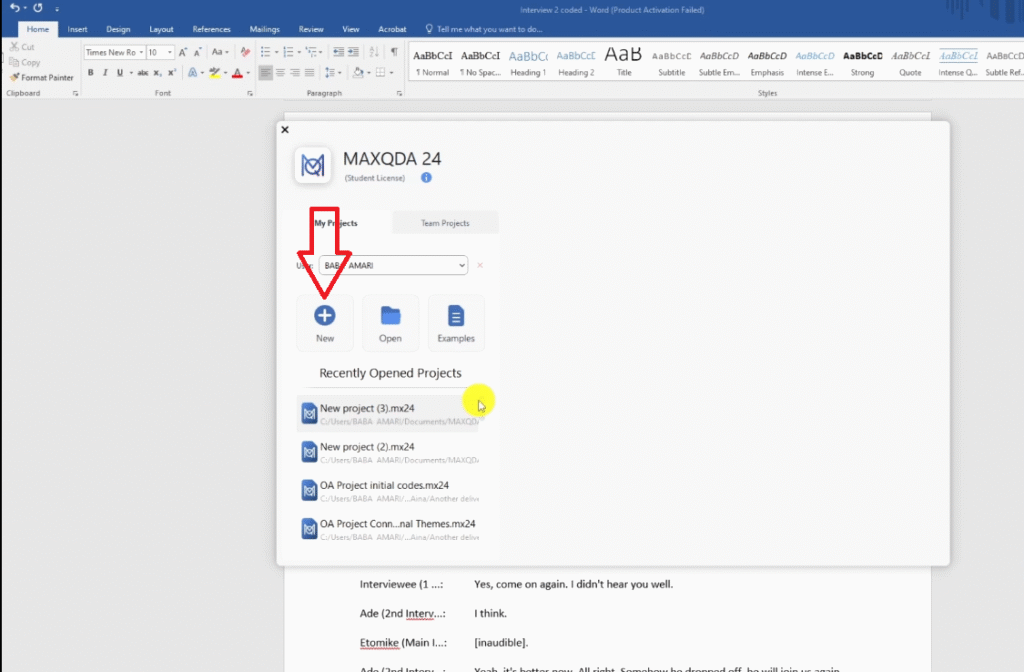
Then I name the new project.
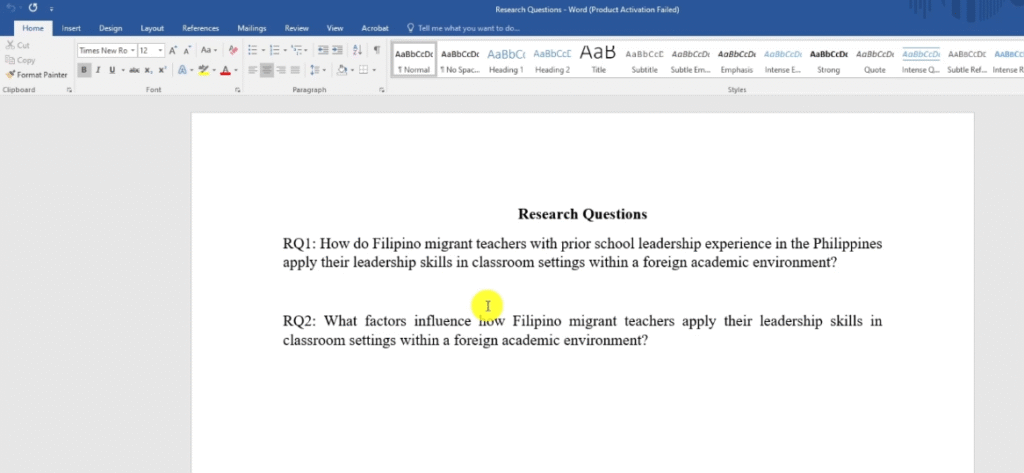
First let us look at the research questions.
The first question is: How do Filipino migrant teachers with prior school leadership experience in the Philippines apply their leadership skills in classroom settings within a foreign academic environment?
And research question two is what factors influence how Filipino migrant teachers apply their leadership skills in classroom settings within a foreign academic environment?
So in MAXQDA, we have at least five main sections.
We have the main menu.
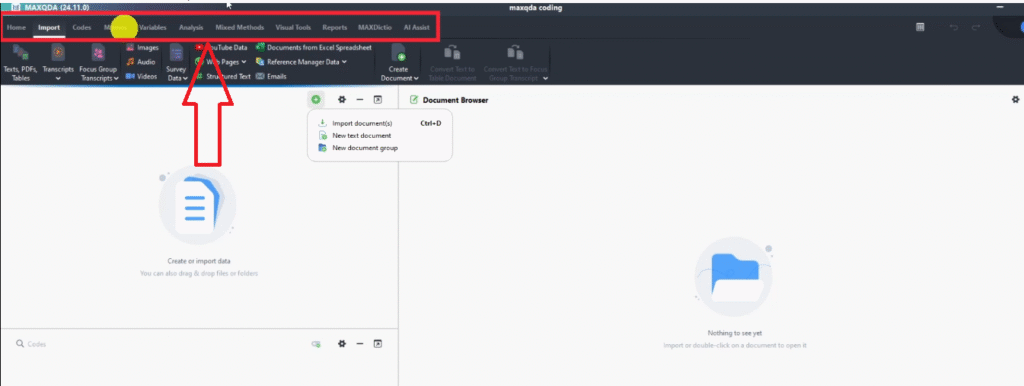
The top menu.
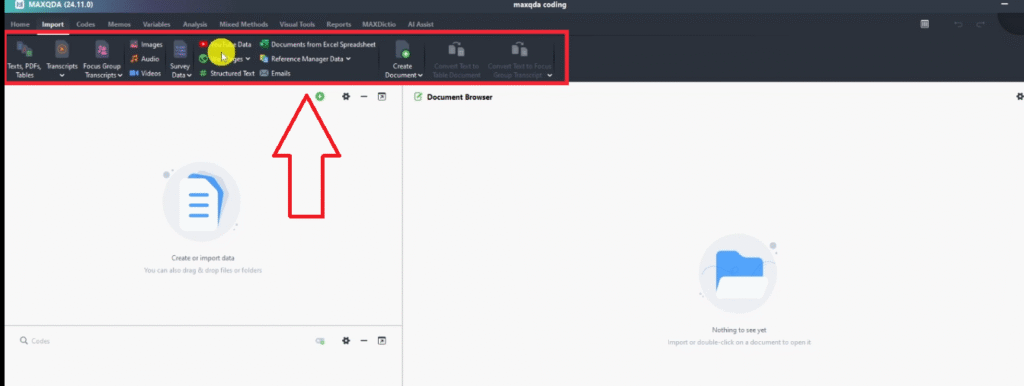
We have a section where I will import my transcripts.
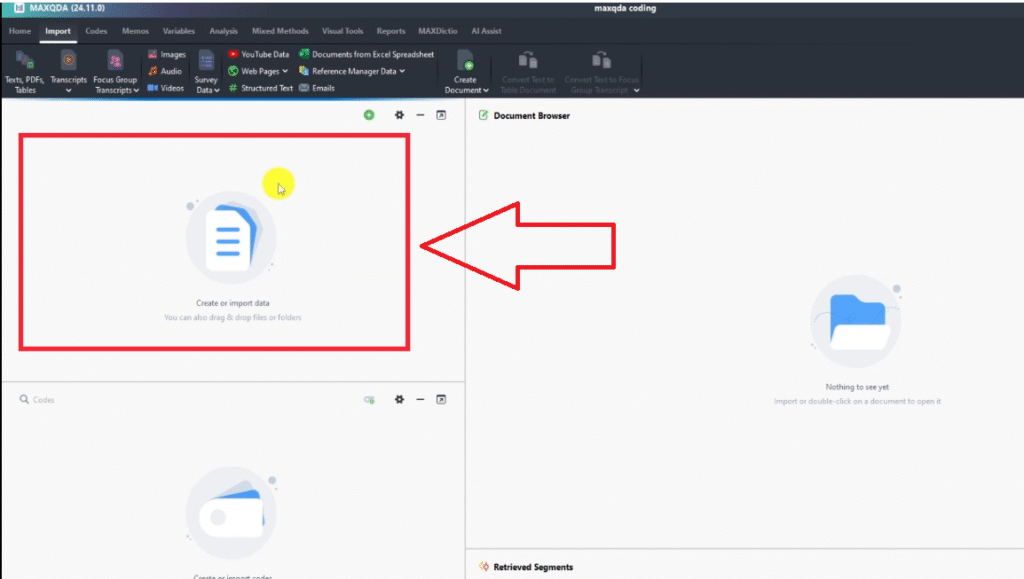
Here, I’ll create my codes.
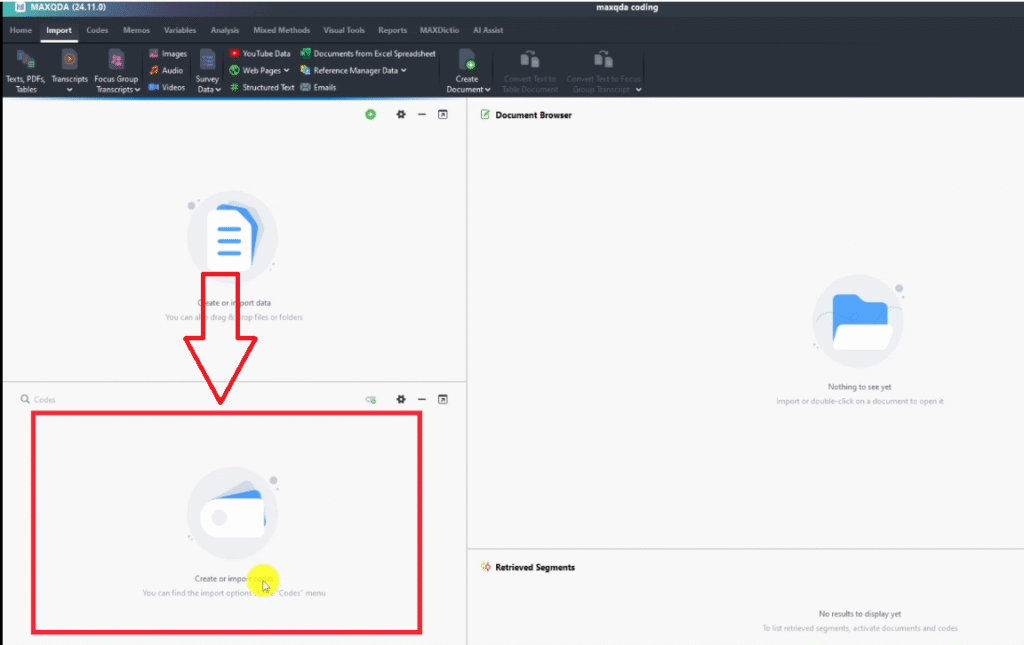
And then here is where we are gonna observe the transcript as we code it.
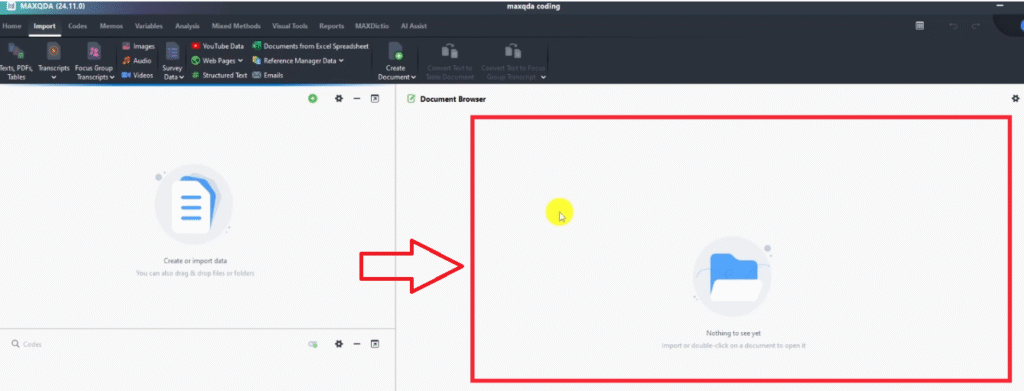
The process of Coding
Before we begin, I just want to open one of the transcripts from the participants and label the questions with colours.
For example, the first question, I want to label it as red.
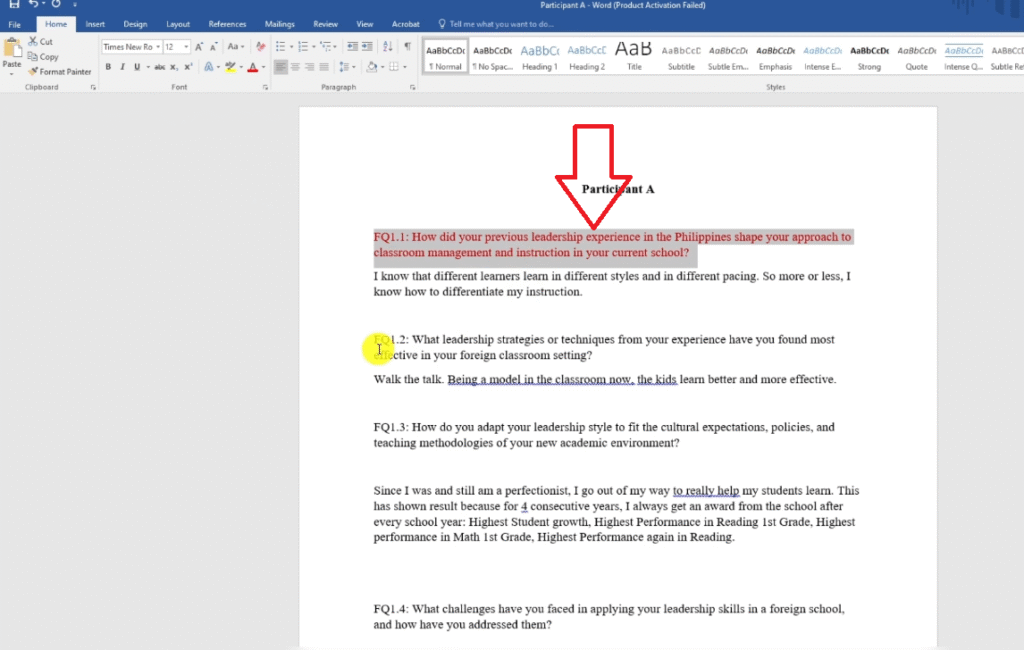
The second question, I want to label it as yellow.
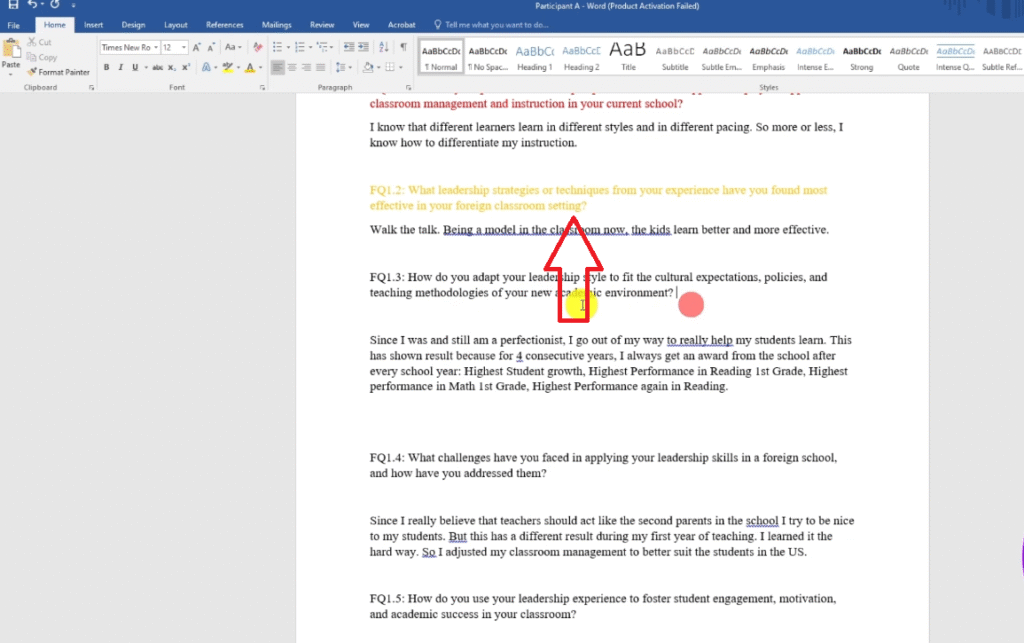
The third one, I want to give it the color green.
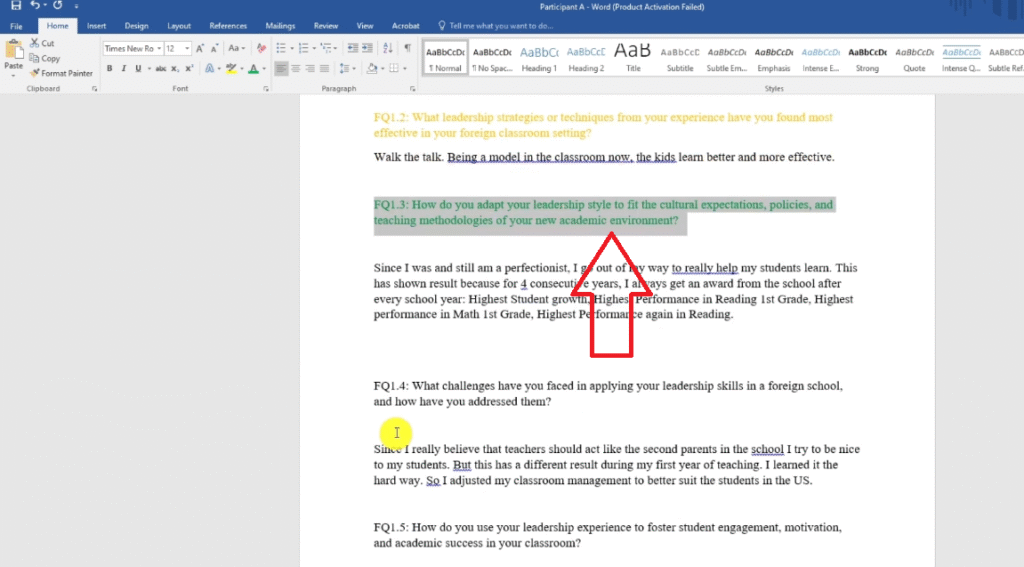
The fourth one, can be dark blue.
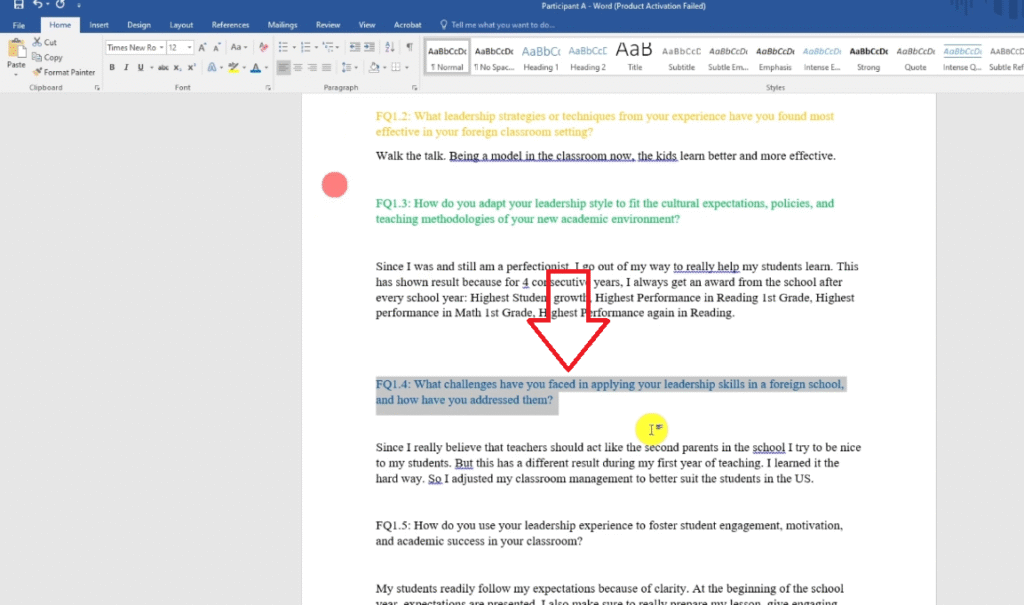
Another one, color purple.
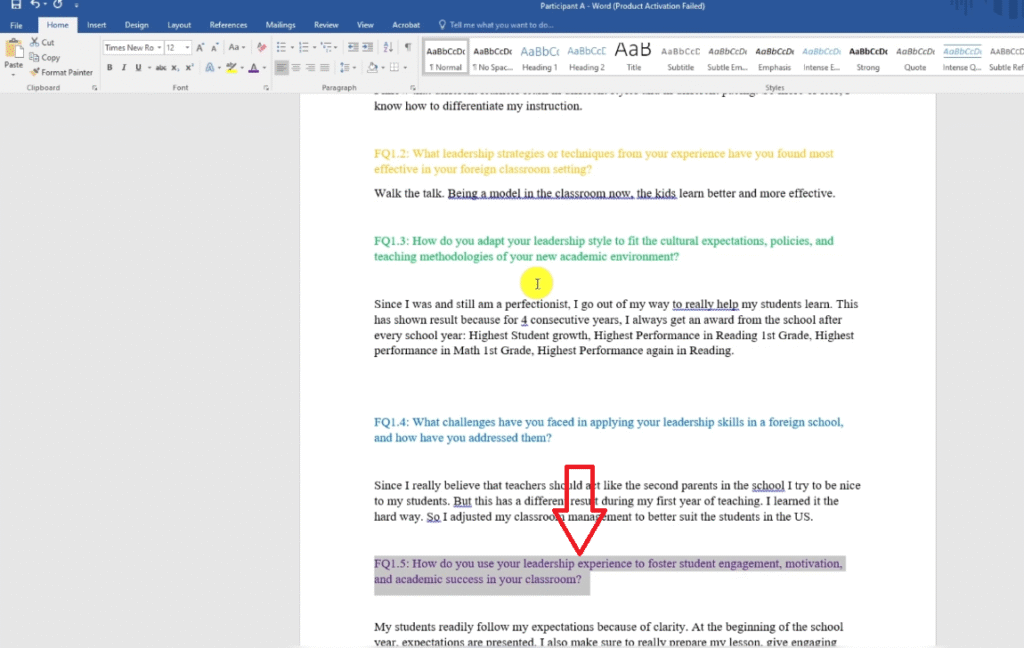
And the last question I mark it as black.
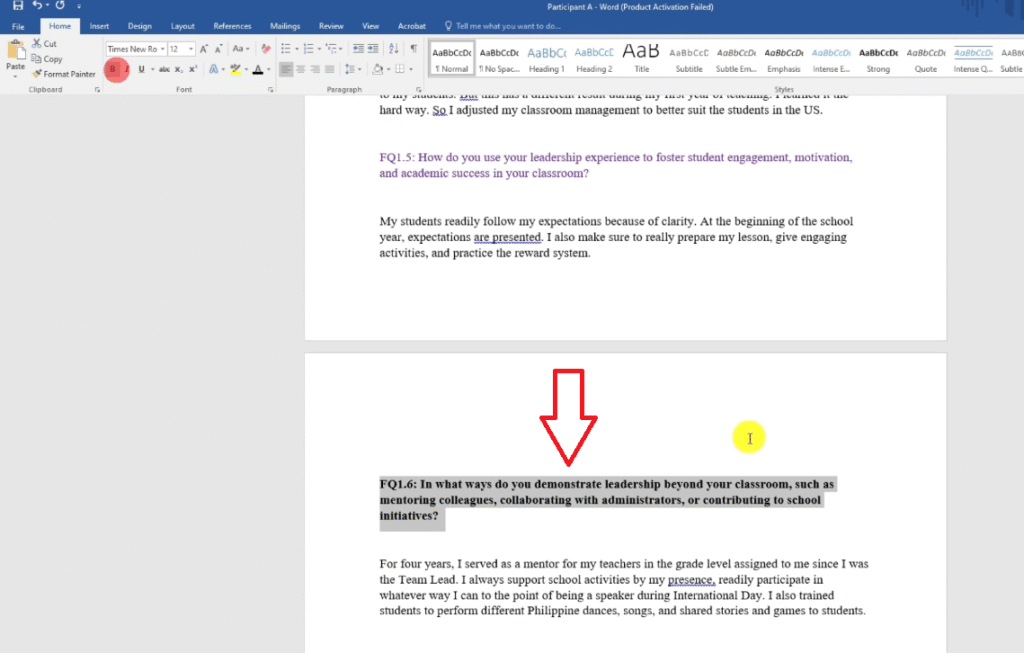
I have now marked all the questions with colours.
Why?
Because when we are coding, we will get so many codes from each question and I need to know which questions these codes came from.
That is why I use colors to tag them.
The next point will be importing the transcripts into MAXQDA.
So I go to transcripts without timestamps.
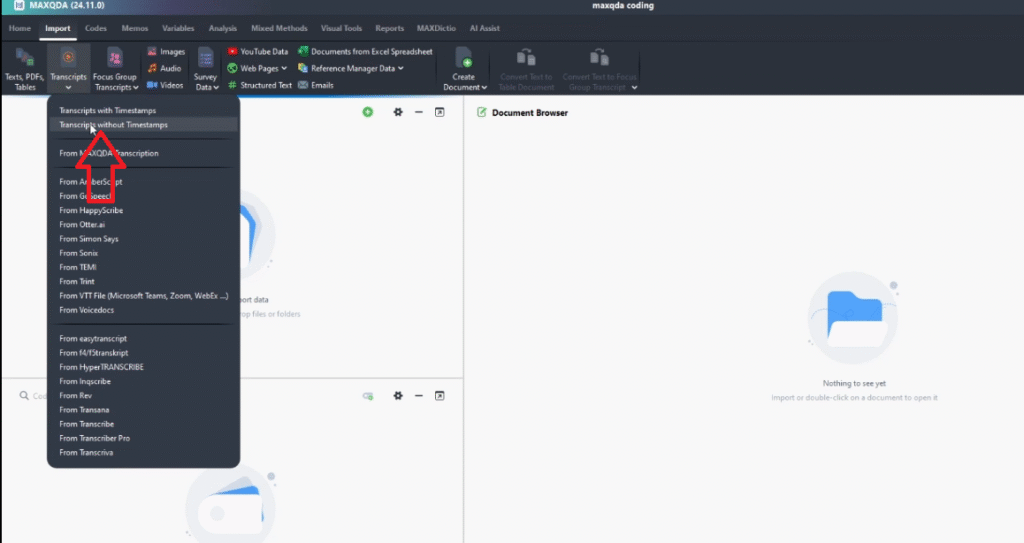
I locate the two transcripts that I want to code.
Then click on open.
Here we have transcript A and B.
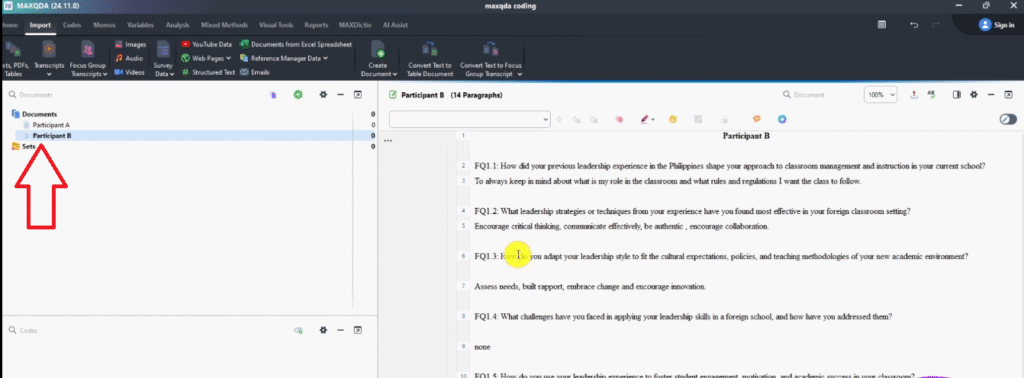
Then I’m going to go through them one by one.
So let’s do some coding.
Methods Used in Thematic Analysis Process
Remember, before we begin coding, it’s important to learn the different strategies of conducting thematic analysis.
Before you get to coding, you have to clarify which approach you are using to conduct the whole thematic analysis process.
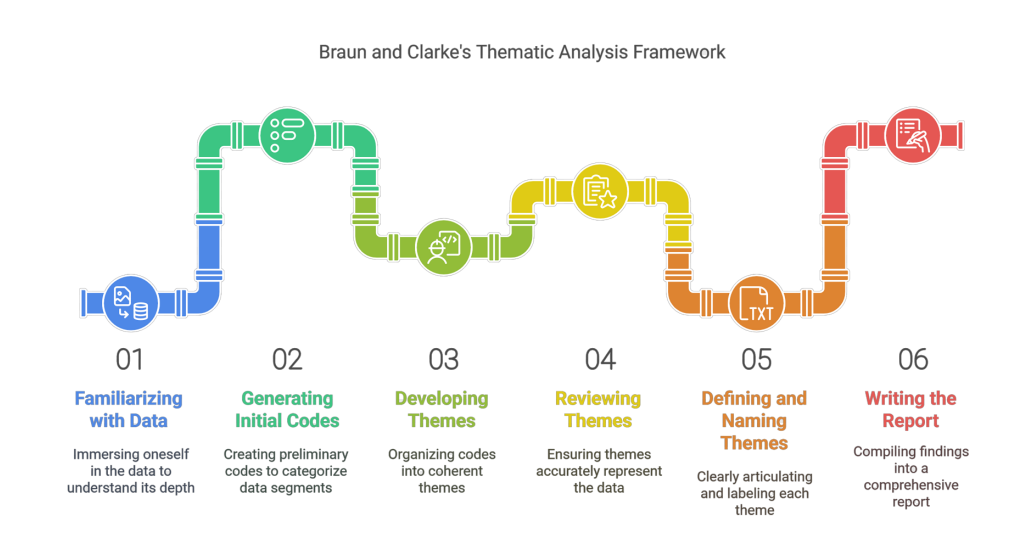
One of the methods is the Braun and Clarke approach.
We also have another method called the Saldana approach.
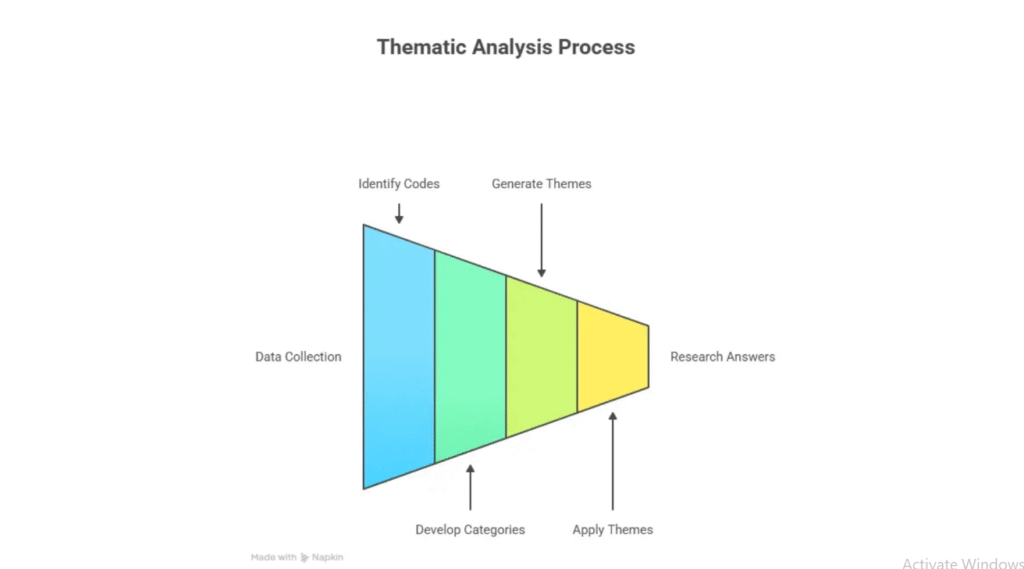
You can go and read my other article where I discuss these approaches in depth.
I will write another article about developing themes in MAXQDA, but first let’s explore developing codes.
So two scholars, one called Virginia Braun, and another called Clarke developed a guide on how we can conduct thematic analysis.
This guide is made up of six steps that they recommend for researchers, especially beginners to follow when conducting thematic analysis.
The steps include one:
- Familiarizing with the data.
- Generating initial codes.
- Developing themes.
- Reviewing themes.
- Defining and naming themes.
- Writing the report.
With familiarizing with the data, one should immerse their-self in the data and understand the data deeply.
Then the second approach would be generating codes which would involve creating preliminary codes to categorize data segments.
Then after that, you have to go and develop themes, review them, define and name them, and write the report.
Remember we previously defined codes as labels or interpretive statements to any information that is important to your research questions.
We have to notice that coding is the foundation of thematic analysis.
Once we get good codes, we can proceed.
If we don’t get good codes, we are going to have a lot of problems.
Now let’s go and do some coding in MAXQDA.
To code, we first read the question, then we read the responses fully, and then we label this or interpret what the participants are saying.
Let’s do this.
To open a transcript, I just double click on it and then we begin coding.
So how did your previous leadership experience in the Philippines shape your approach to classroom management and instruction in your current school?
I know that different learners learn in different styles and in different pacing. So more or less, I know how to differentiate my instruction.
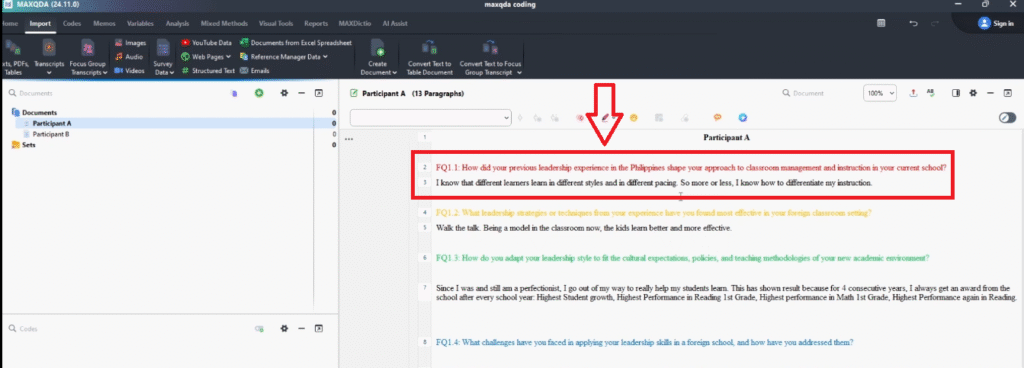
This responder is saying their experience help them to adopt to different learning styles and different pacing of learners.
So I can interpret that.
I go to with new code to develop a code.
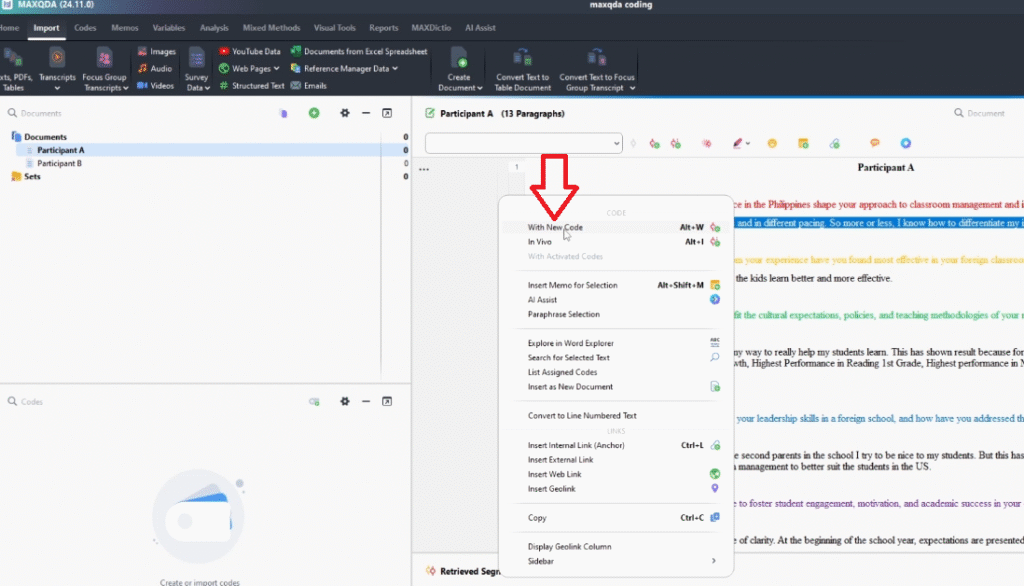
And say, previous teaching experience helped them adopt different learning styles and pacing.
You can see that code is a bit long, but remember, when we are coding we just have to focus on getting the most accurate code.
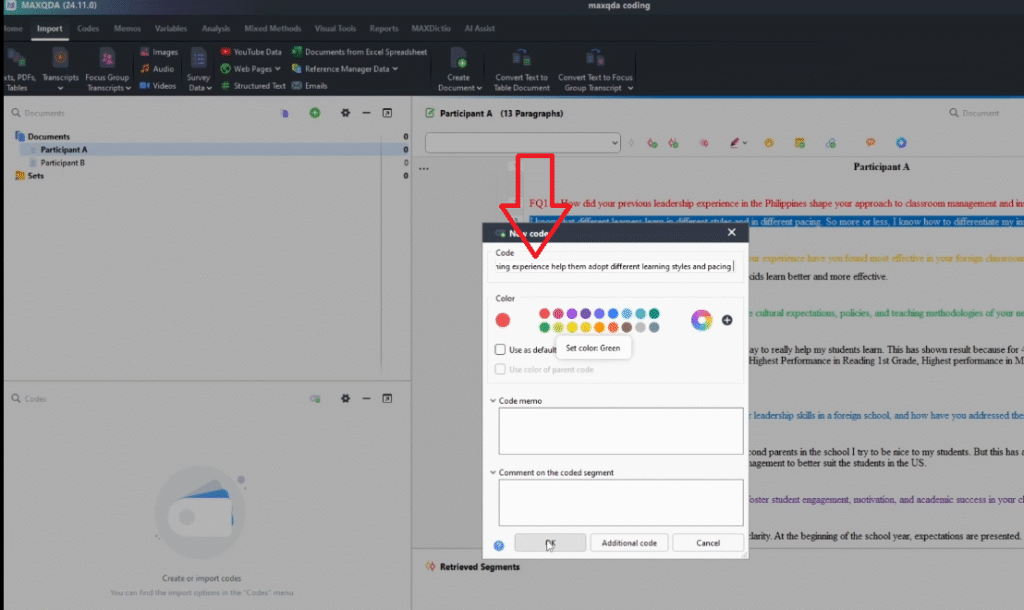
We can always minimize our codes, make them more concise or rename them.
Remember to mark this code as bright red.
Then click okay, check where the code goes, it goes to the code section in MAXQDA.
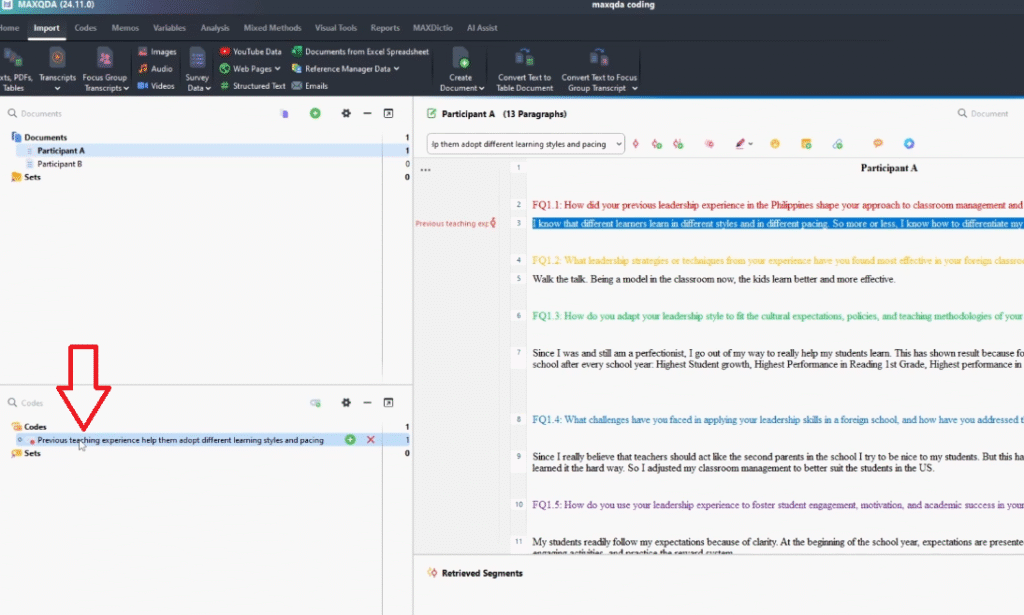
Let’s keep developing codes.
So what leadership strategies or techniques from your experience have you found most effective in your foreign classroom setting?
Walk the talk. Being a model in the classroom now, the kids learn better and more effective.
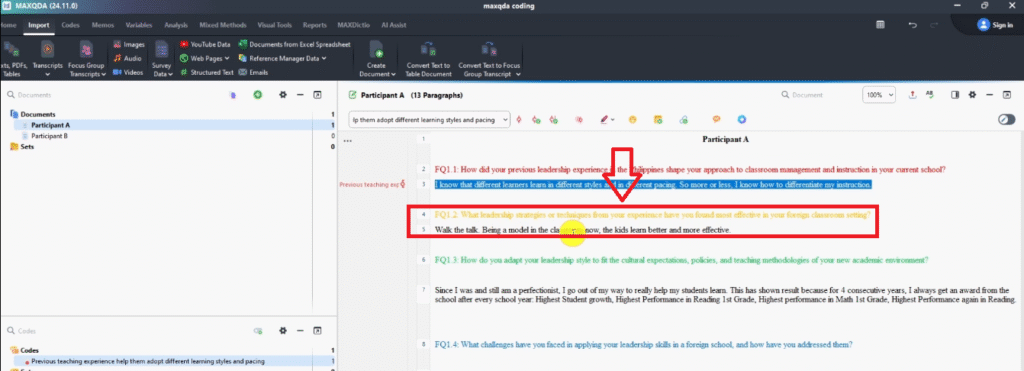
So this one is modeling behavior.
And I can go to properties if I want to edit code based on which code sounds better.
Modeling behavior, that is what they said.
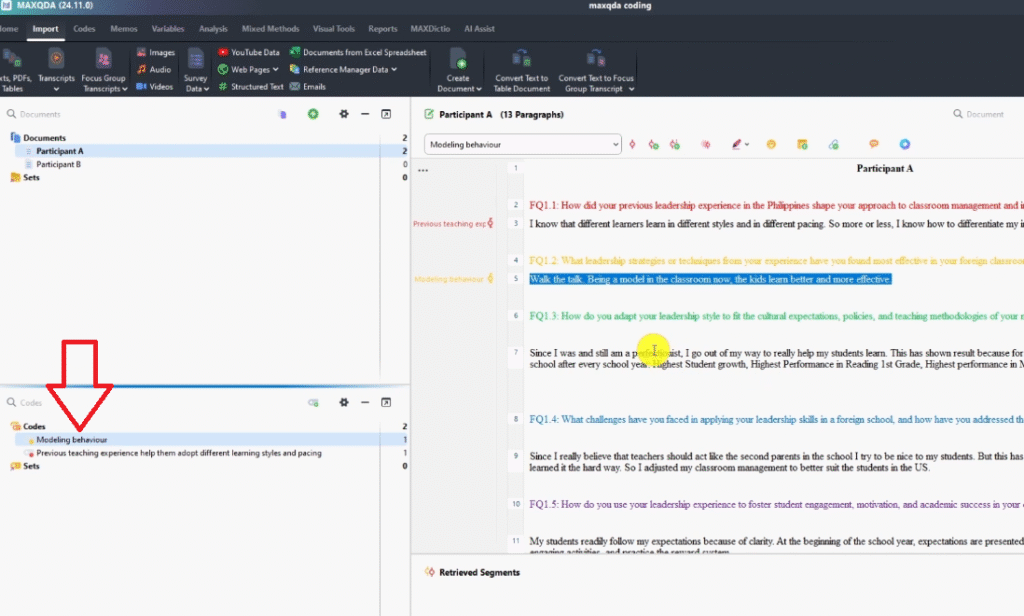
Then how do you adapt your leadership style to fit?
Since I was and still am a perfectionist, I go out of my way to really help my students learn. This has shown result because for 4 consecutive years, I always get an award from the school after every school year: Highest Student growth, Highest Performance in Reading 1st Grade, Highest performance in Math 1st Grade, Highest Performance again in Reading.
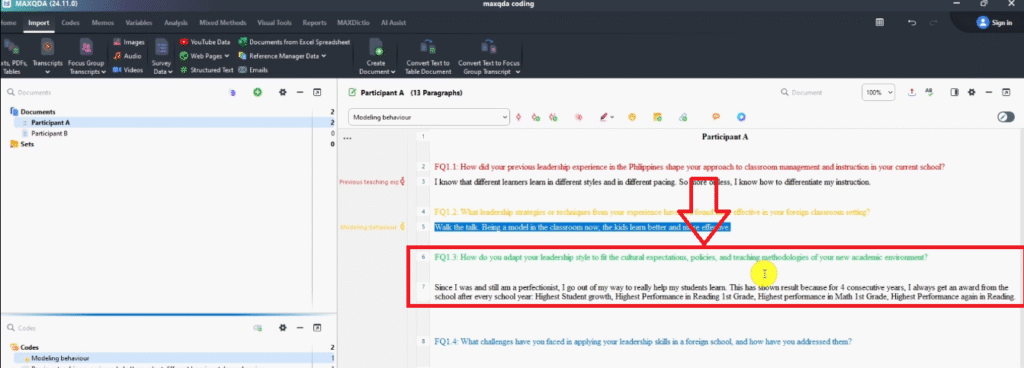
They are being asked, how do you adapt your leadership style to fit the cultural expectations, policies, and teaching methodologies of your new academic environments?
And they said that they go out of their way to help students.
I want to highlight this first section, right click with new code.
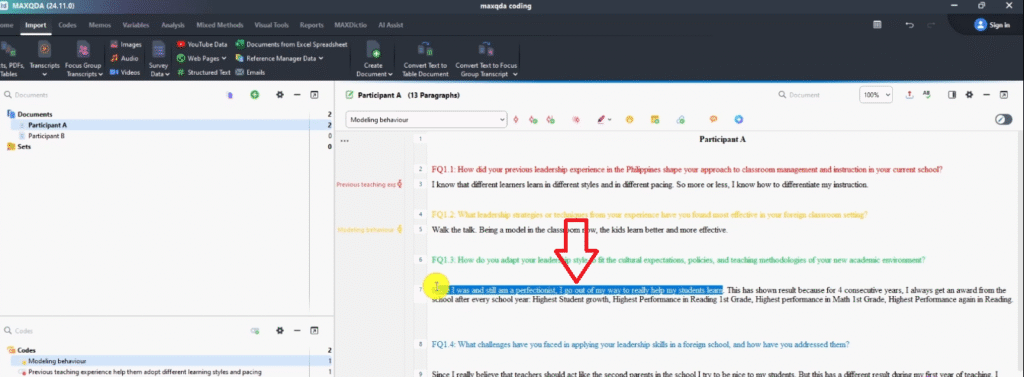
And say going above expectations to help students learn.
Then if you look at this code, I put light green here just to mark that code.
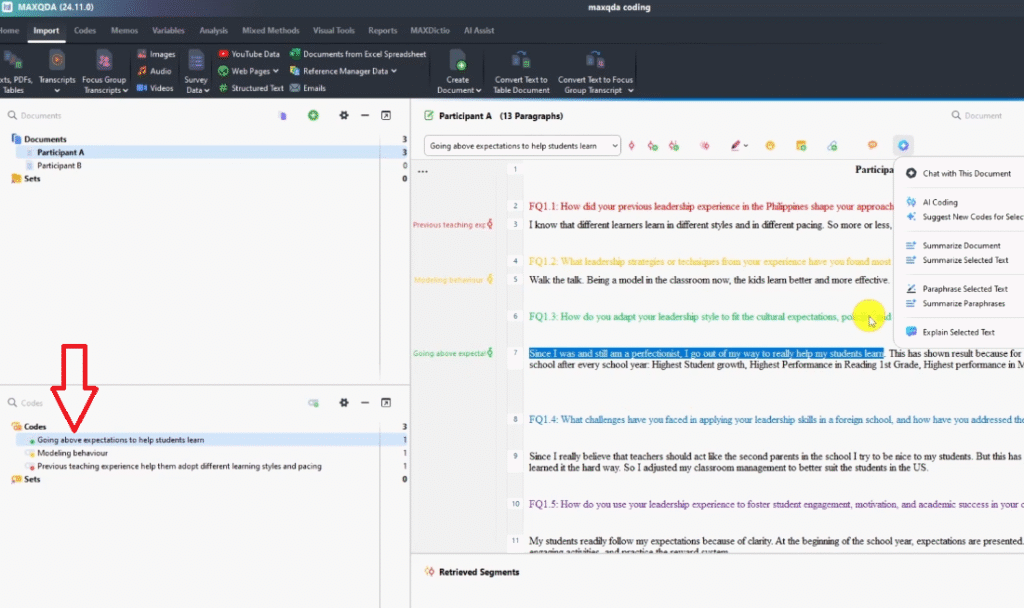
Iam using the colors to help differentiate where the codes, are coming from across different questions.
Let’s keep going.
What challenges have you faced in applying your leadership skills in a foreign school, and how have you addressed them?
Since I really believe that teachers should act like the second parents in the school I try to be nice to my students. But this has a different result during my first year of teaching. I learned it the hard way. So I adjusted my classroom management to better suit the students in the US.
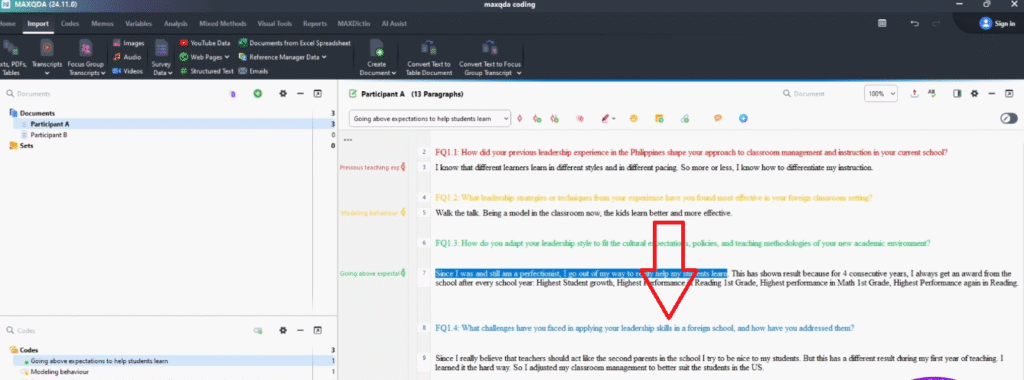
At first they are saying they were trying to be like parents with the students then they had to adjust.
Let’s highlight that part and code it as previously faced a challenge relating to students.
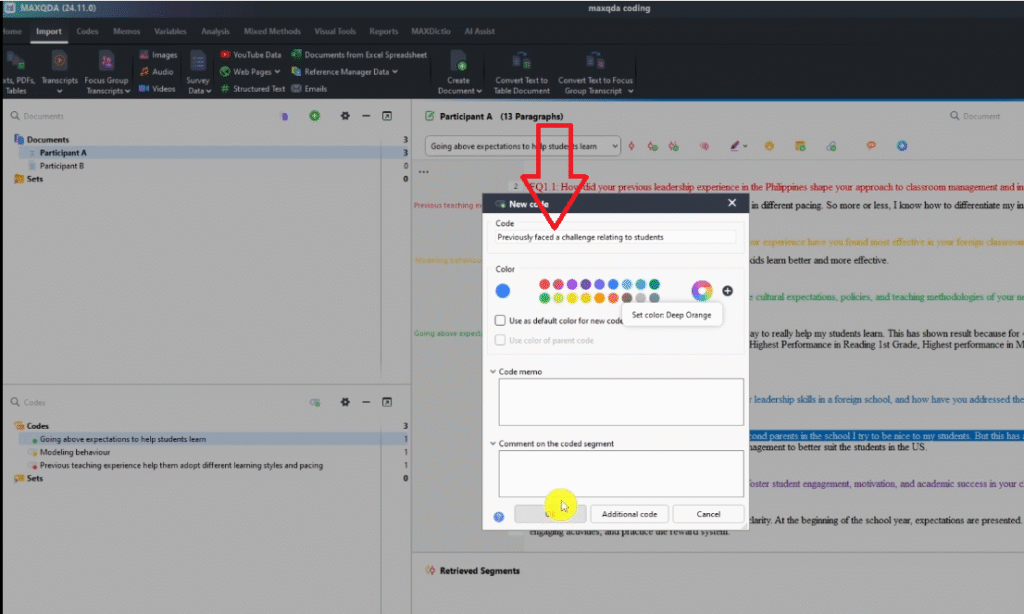
The color for that is blue click okay.
Then adjusted strategies to relate to students to better fit the us as another code.
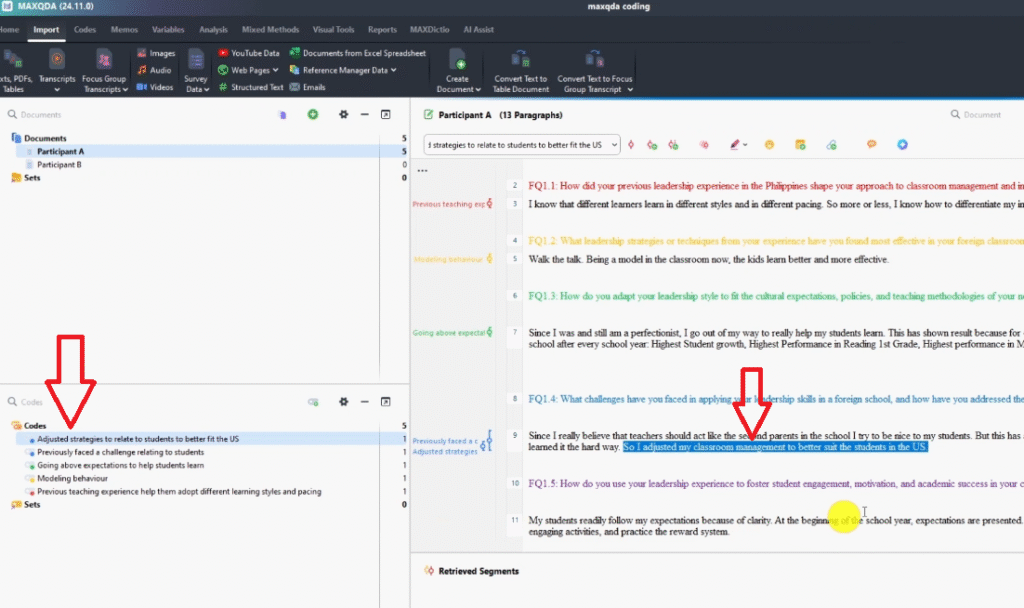
This is also blue color.
Those codes are kind of similar.
Let’s keep coding how do you use your leadership experience to foster student engagement, motivation in academic success in your classroom?
My students readily follow my expectations because of clarity. At the beginning of the school year, expectations are presented. I also make sure to really prepare my lesson, give engaging activities, and practice the reward system.
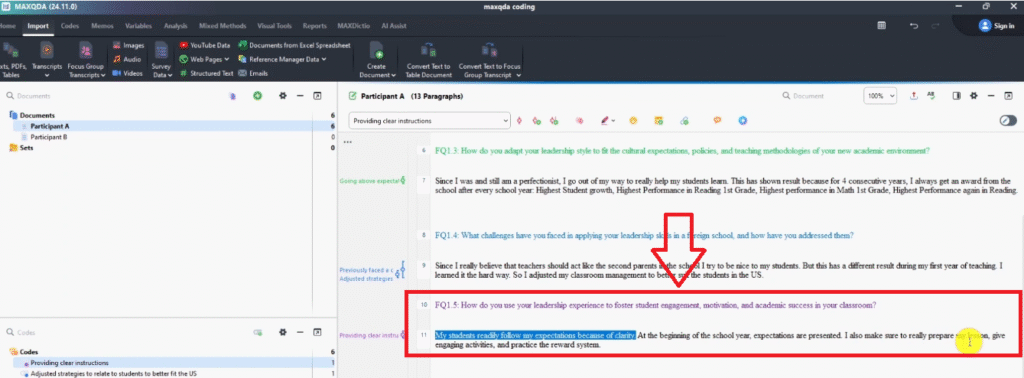
So how does your leadership experience foster student engagement, motivation?
They’re saying providing clear instructions.
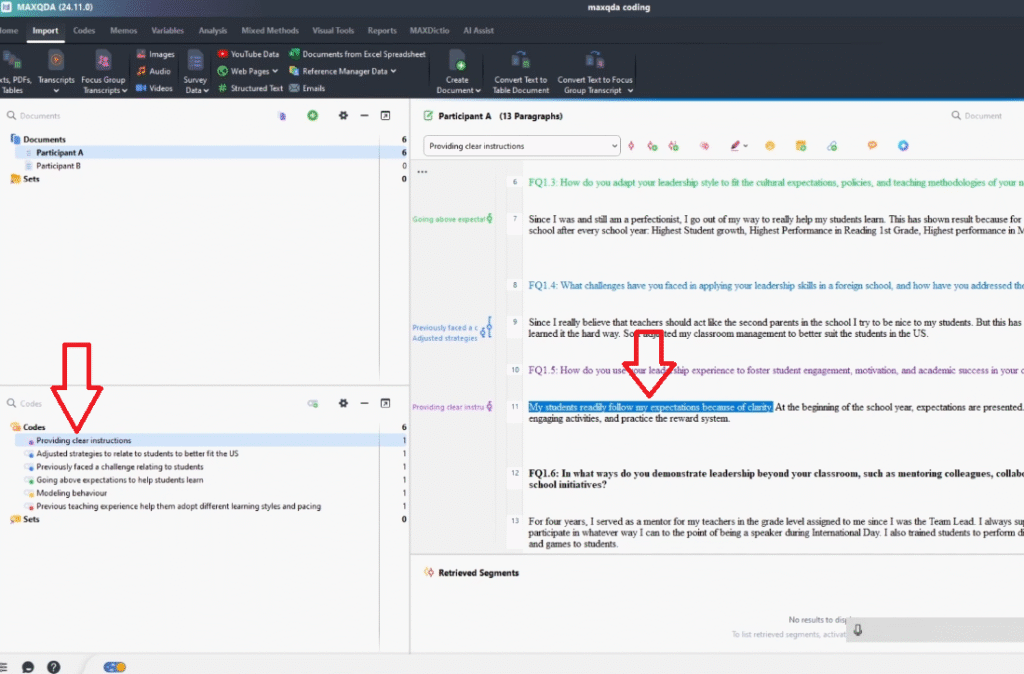
I also make sure I prepare for my lessons and give engaging activities and practice the reward system.
So.
Making the lessons more engaging through preparation.
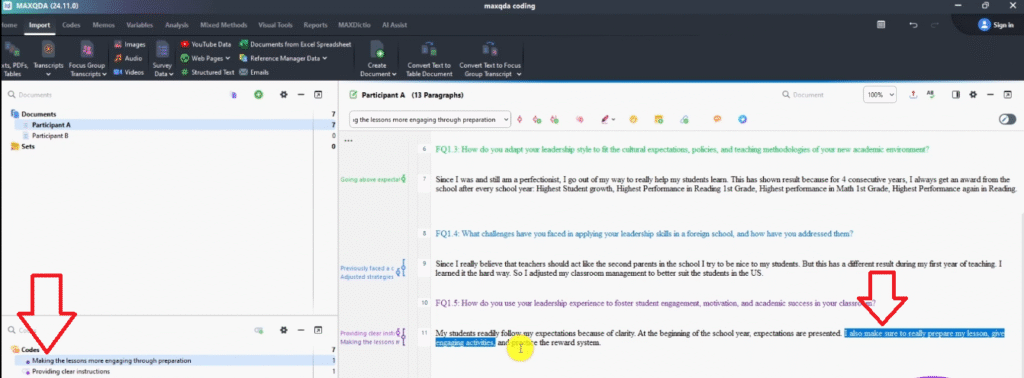
And also practicing the reward system.
so with new code and say practicing the reward system.
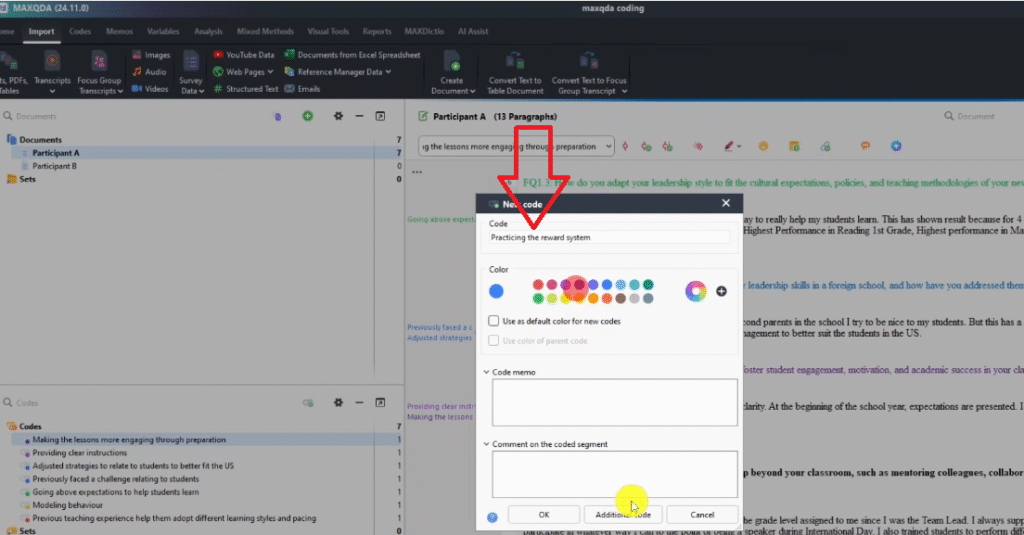
Perfect.
And that is just an example of how we code a transcript.
Let’s go and open a different transcript and let’s code again.
How did your previous leadership experience in Philippines shape your approach to classroom management and instruction in your current school?
So this person replies with to always keep in mind about what is my role in the classroom and what rules and regulations I want the class to follow.
So their previous experience I would say helps them set expectations.
Remember the first question was labelled as red in color.
I’ve said to always keep in mind what my role is in the classroom and what rules and regulations I want the class to follow.
So I code that statement as setting expectations of the class as the teacher.
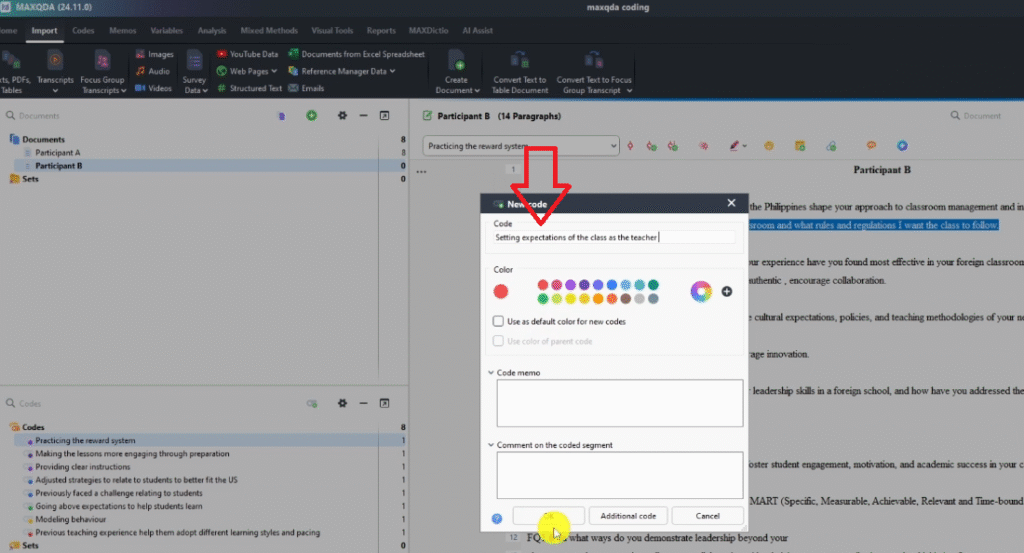
Click okay.
You see that code is red and a previous code that we got from a similar question from a past participant is red.
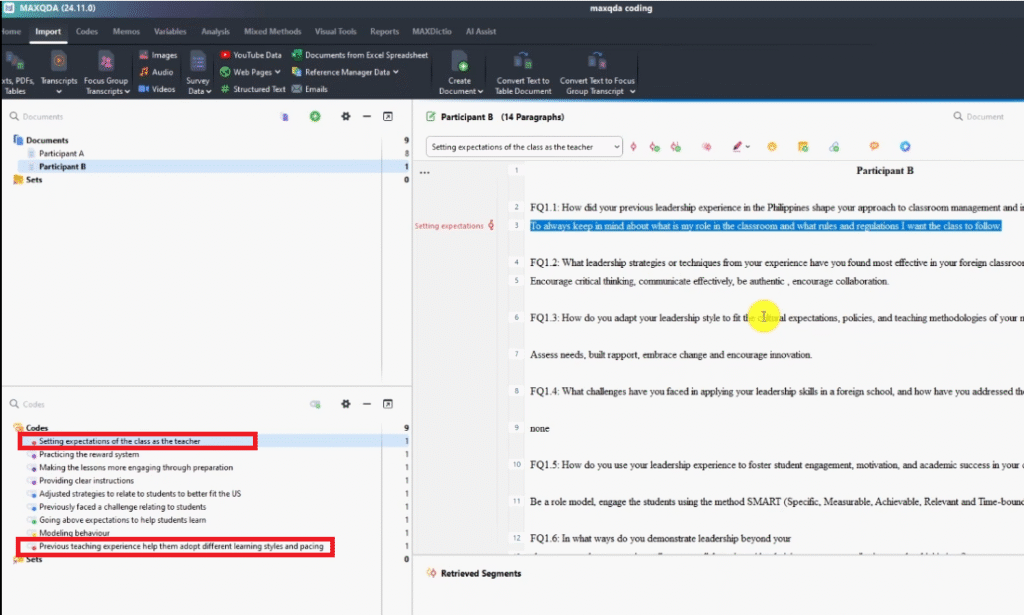
Let’s keep going.
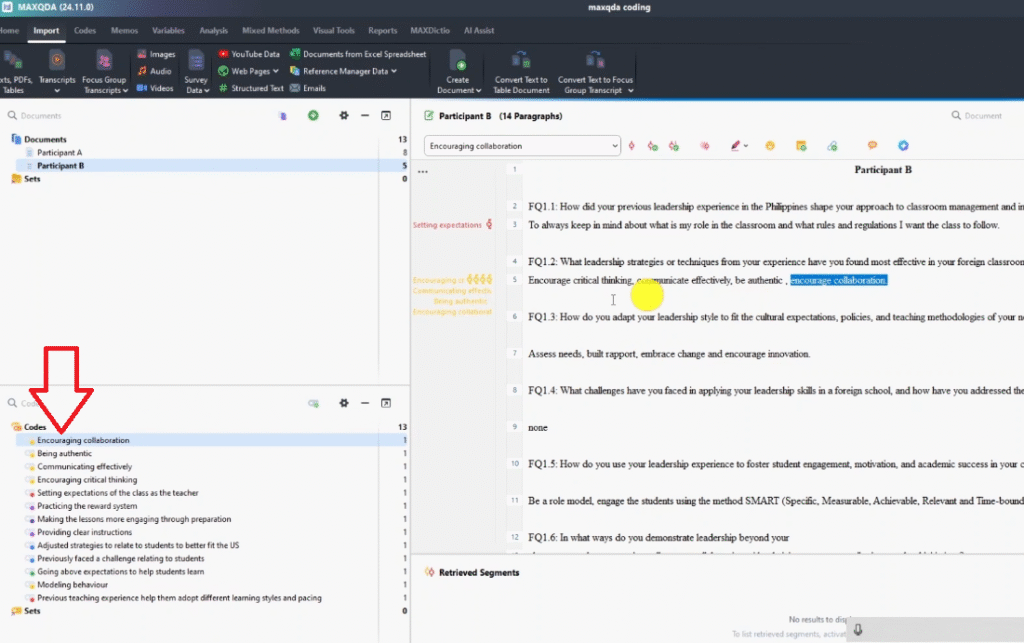
What leadership strategies or techniques from your experience have you found most effective in your foreign classroom setting?
So critical thinking.
I want to code that alone.
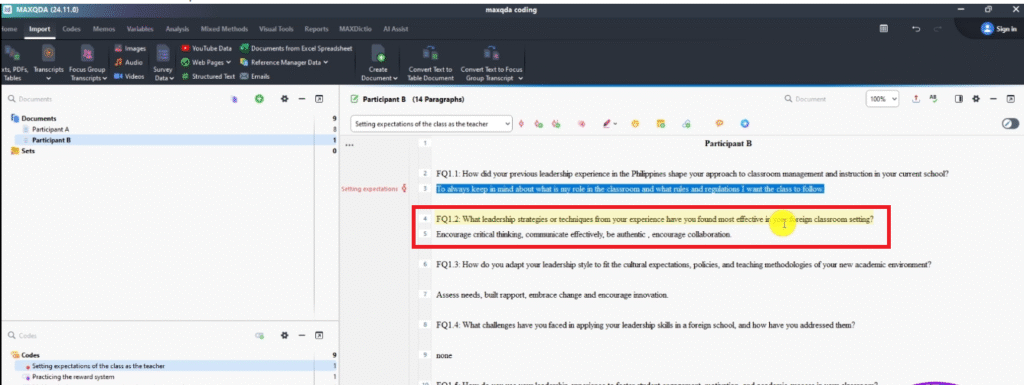
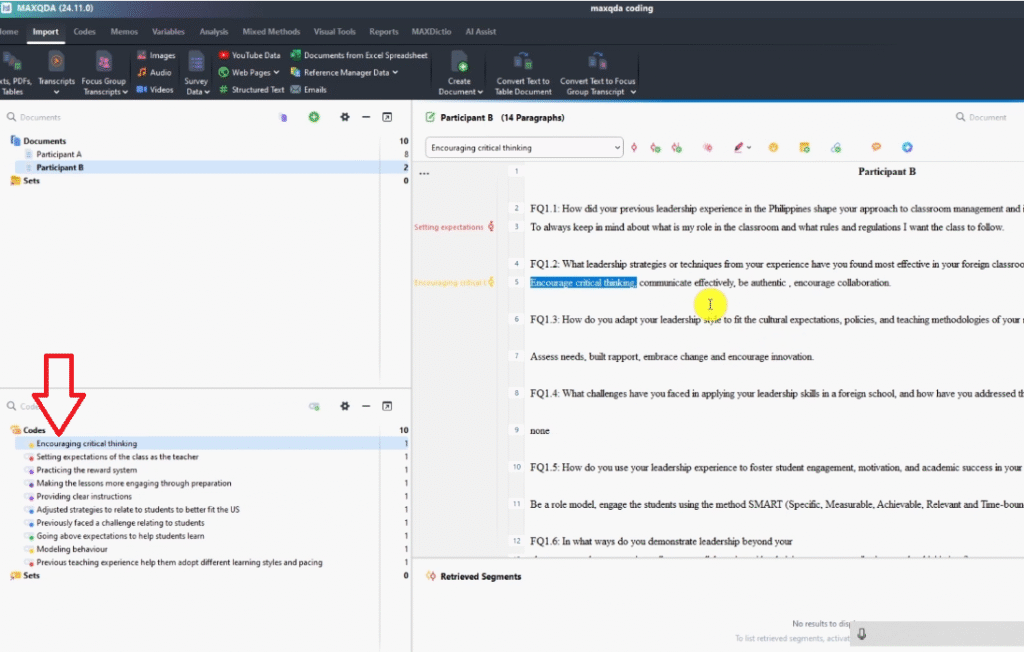
Remember question number two we marked it as yellow.
So encouraging critical thinking.
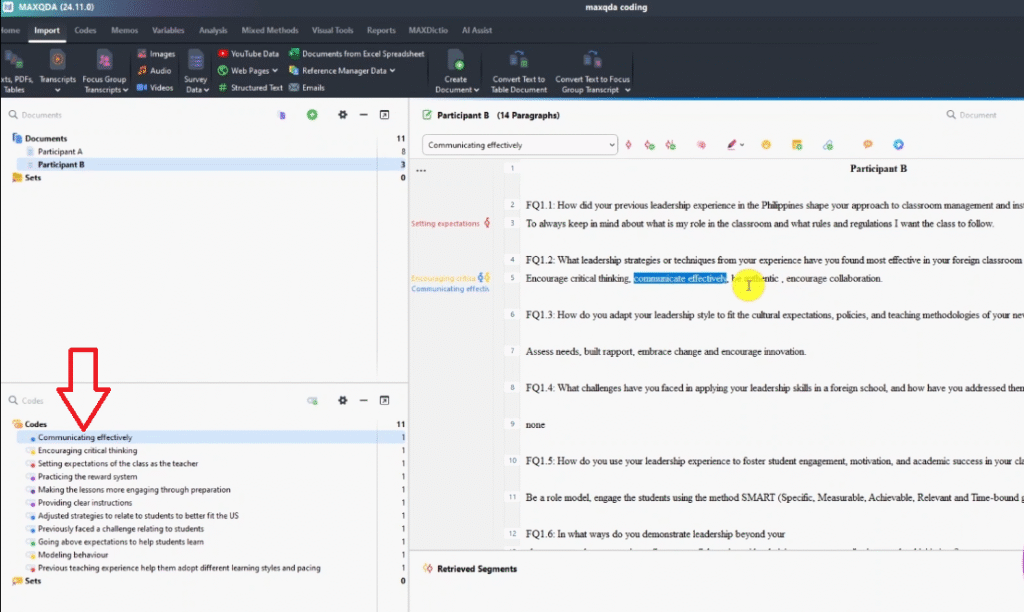
Then communicate effectively.
I want to go with new code, another yellow code, communicating effectively.
then being authentic.
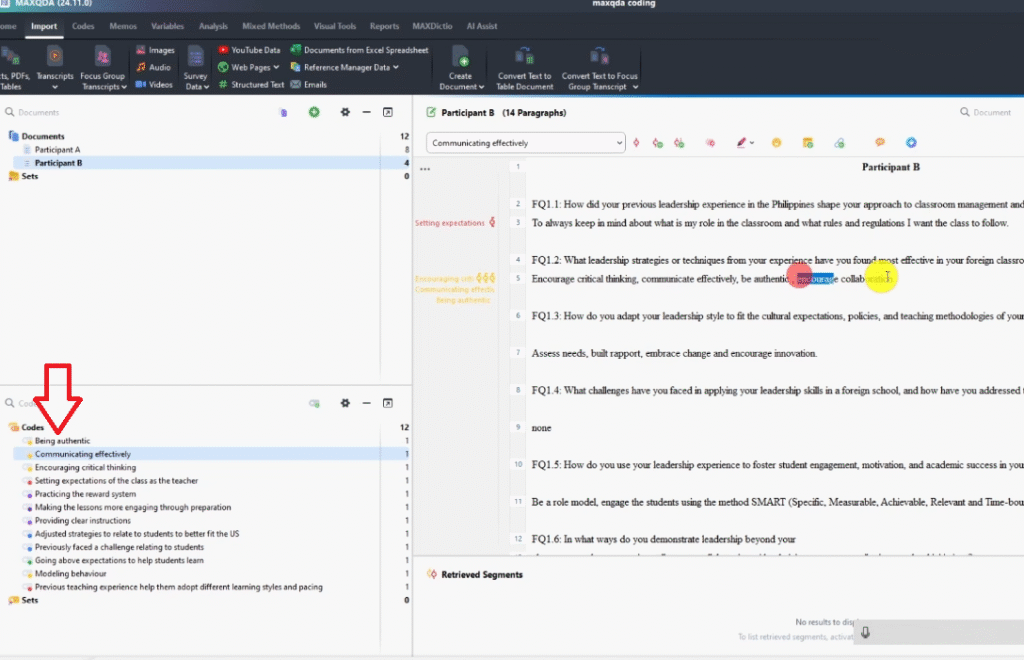
Then encouraging collaboration.
That’s another code encouraging collaboration.
Good.
Let’s just have another question.
How do you adapt your leadership style to fit cultural expectations, policies, and teaching methodologies of your new academic environment?
Assess needs, built rapport, embrace change and encourage innovation.
You remember question 1.3 is labeled as green.
So this person says, how do you adapt your leadership style?
And they say they assess needs, so assessing needs.
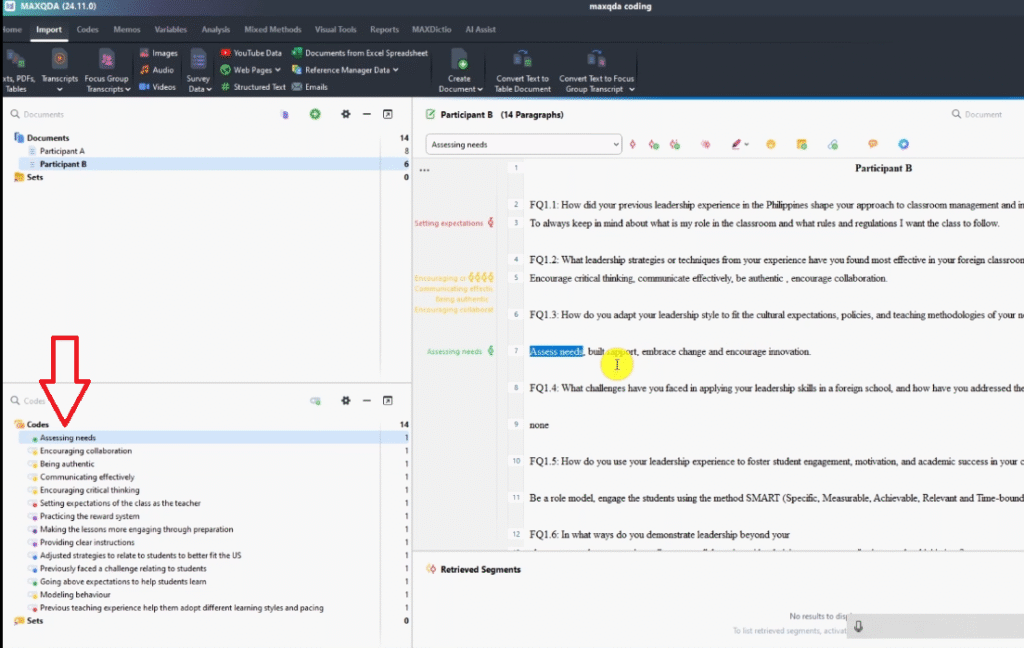
That’s green.
Building rapport.
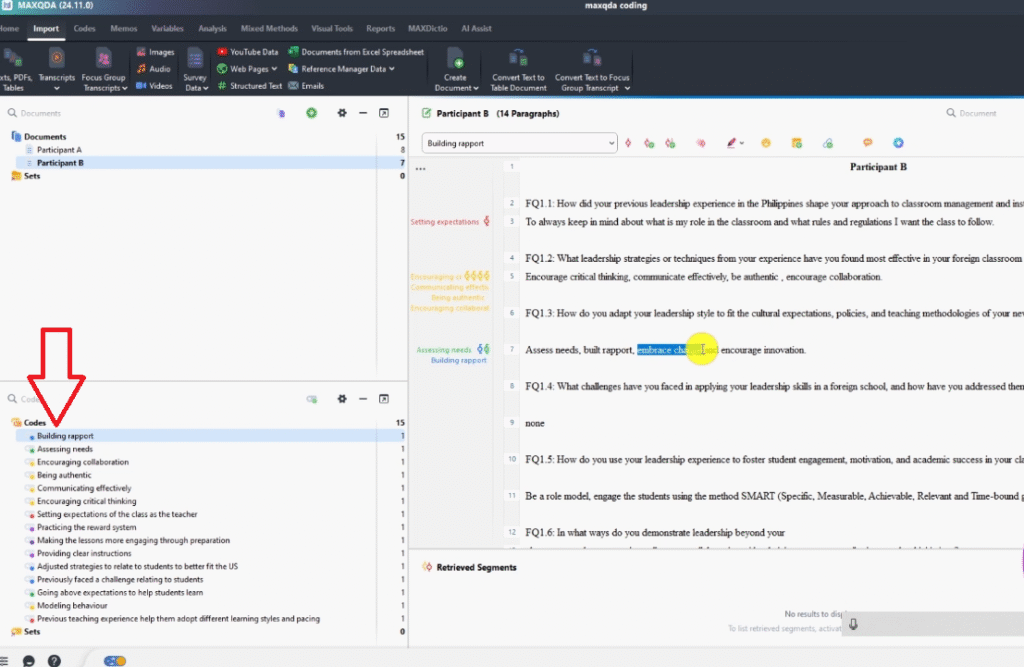
That’s another green code building rapport.
Embracing change.
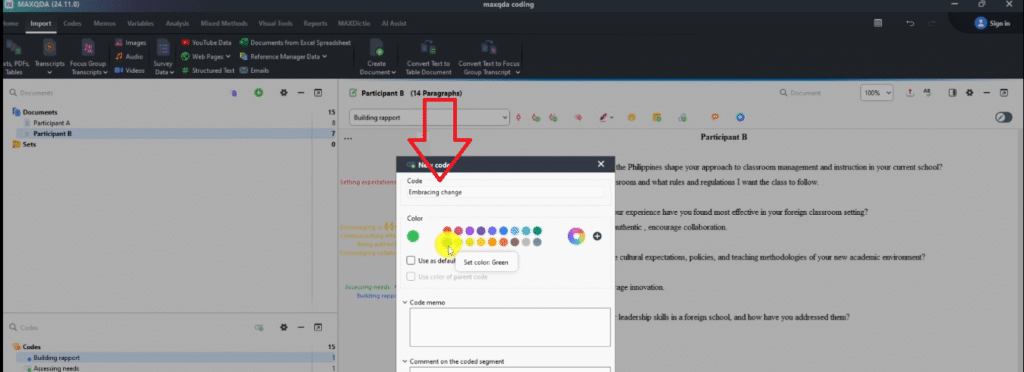
So that’s how we code.
What have we seen so far relating to coding using MAXQDA?
We have seen that codes are labels or interpretive statements to any information that’s important to our research questions.
That means that we are labelling codes
So that’s how we develop codes using MAXQDA.
I Tried Getting Themes in MAXQDA — Here’s the Exact Process
Introduction
Next we are going to see how we can develop themes in MAXQDA.
Let us go and generate some themes inside MAXQDA.
Before we begin finding the themes, I want to remind you of the research questions that we are looking at and show you some of the codes that we were generating.
So the research questions were: How do Filipino migrant teachers with prior school leadership experience in the Philippines apply their leadership skills in classroom settings within a foreign academic environment?
And the research question number two was what factors influence how Filipino migrant teachers apply their leadership skills in classroom settings within a foreign academic environment?
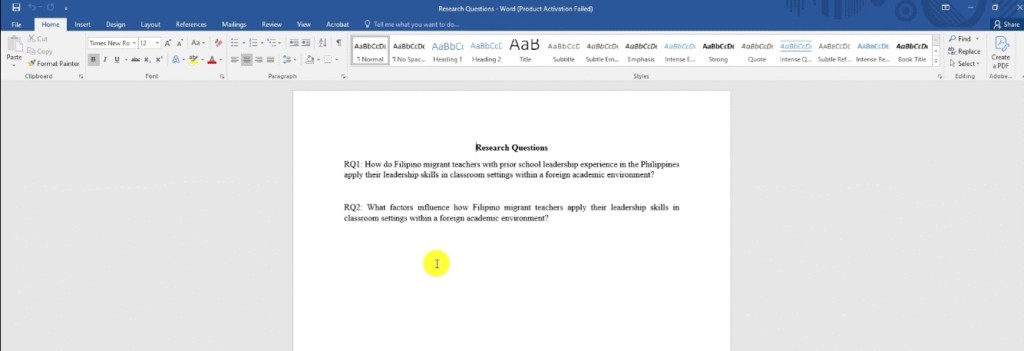
So these are the main objectives.
And ofcourse the objectives remain at the back of our minds because they guide our themes.
Now, let’s remind ourselves some of the codes that we were able to develop.
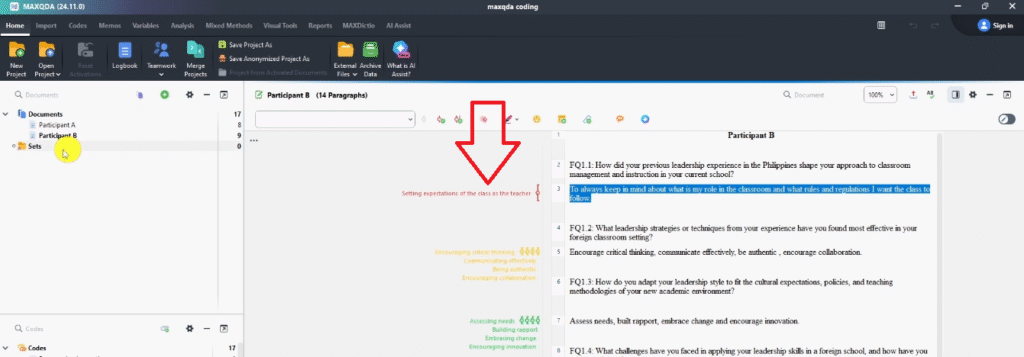
Some of the codes from participant B included:
- Assessing needs
- Building rapport
- Embracing change
- Encouraging motivation
- Encouraging critical thinking
- Communicating effectively
- Being authentic
- Encouraging collaboration
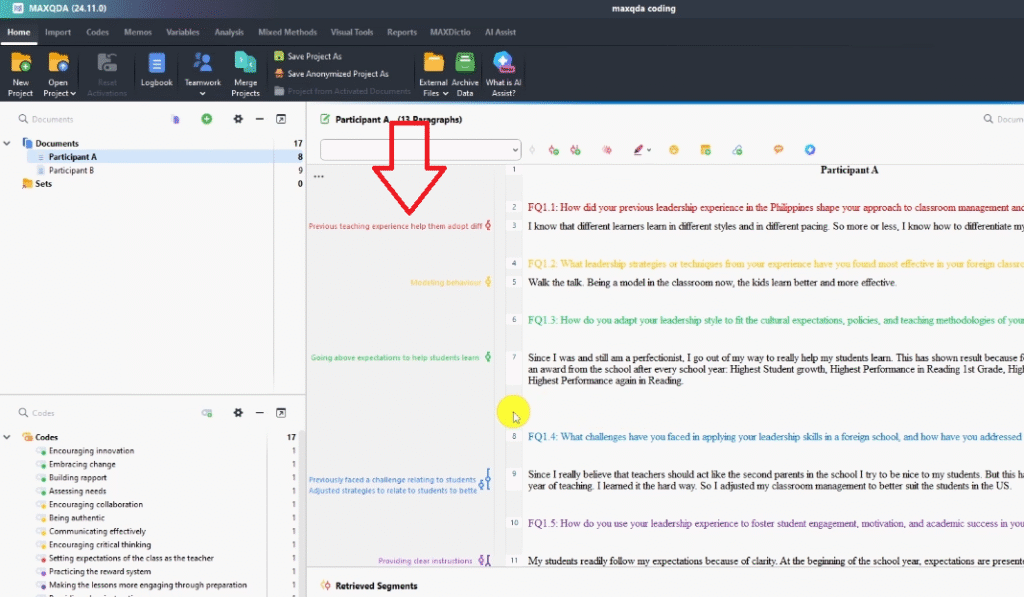
From participant A we have:
- Modeling behavior
- We are providing clear instructions
- Making lessons more engaging
- practicing reward systems, and so on
Definition of a Code
Remember we said that codes are labels or interpretive statements to any information that’s important to our research questions.
We went through the transcripts, we read and understood them, we looked at the nuance, then we started developing qualitative codes.
After coding, we now want to get the themes.
Definition of a Theme
Let’s define what a theme is.
A theme is made up of a collection of codes with a shared pattern of meaning.
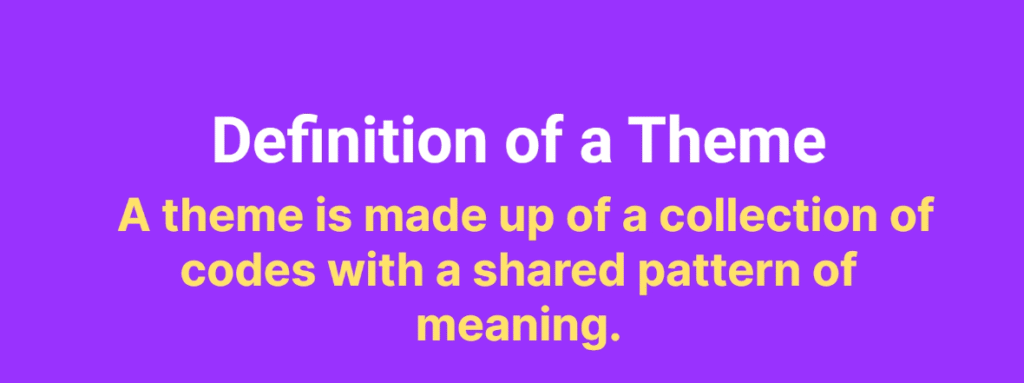
So codes with a shared pattern of meaning form a theme irrespective of the questions they came from.
Developing Themes
Remember we used color codes to show where the codes came from.
If we are doing inductive thematic analysis now, and I consider the questions I was asking and look at some of the codes it will shows the relationship between the codes even before we begin developing the themes.
For example, these green codes are related.
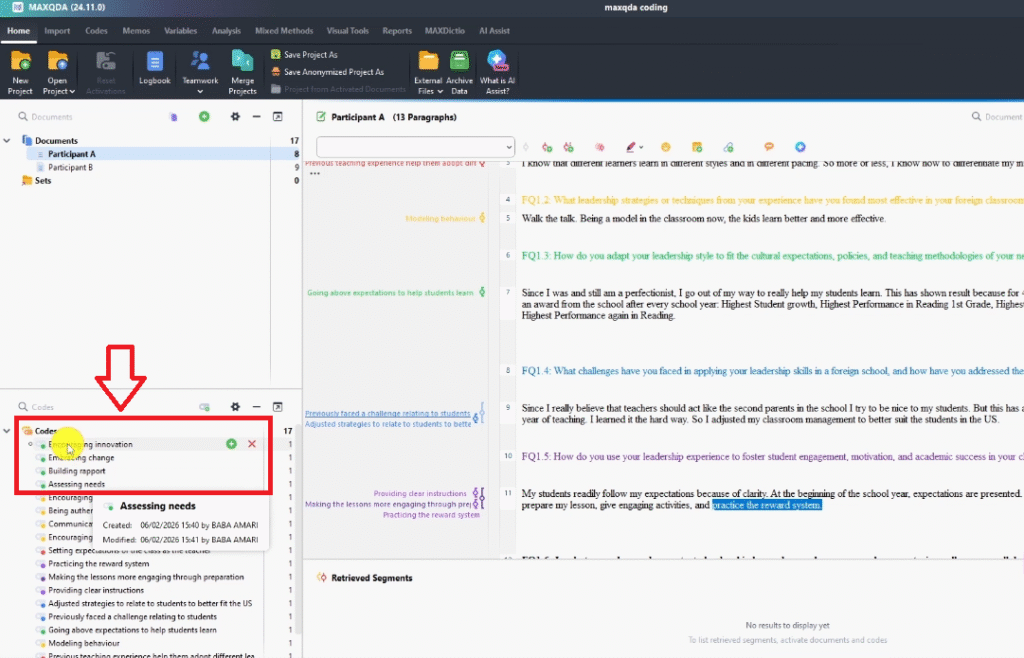
If you look at the question that was color-coded green, how do you adapt your leadership style to fit the culture or expectations, policies and teaching methodologies of your new academic environment?
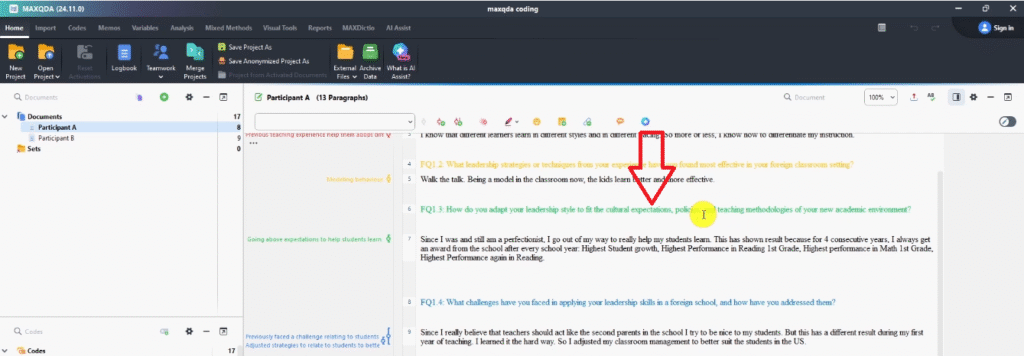
This theme can be adaptation of leadership style to fit new academic environments.
The best way to create themes is to duplicate the MAXQDA file, make changes on it, then preserve the original initial codes folder.
Let me copy this MAXQDA.
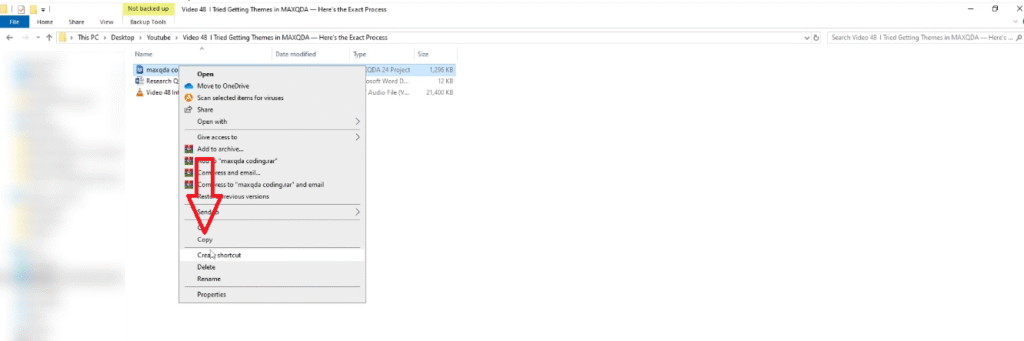
Then duplicate it because I want to preserve the original codes.
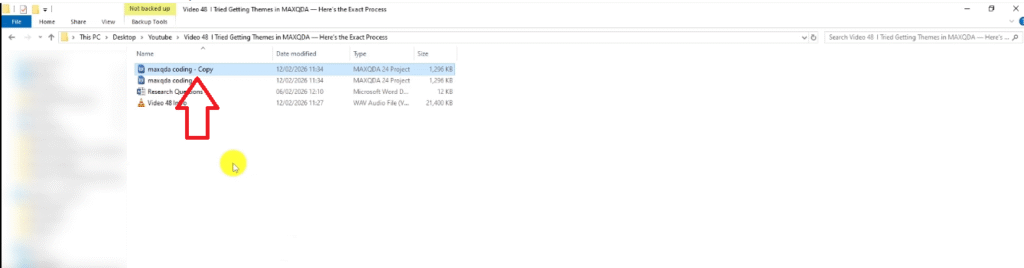
Then we rename the file as MAXQDA themes.
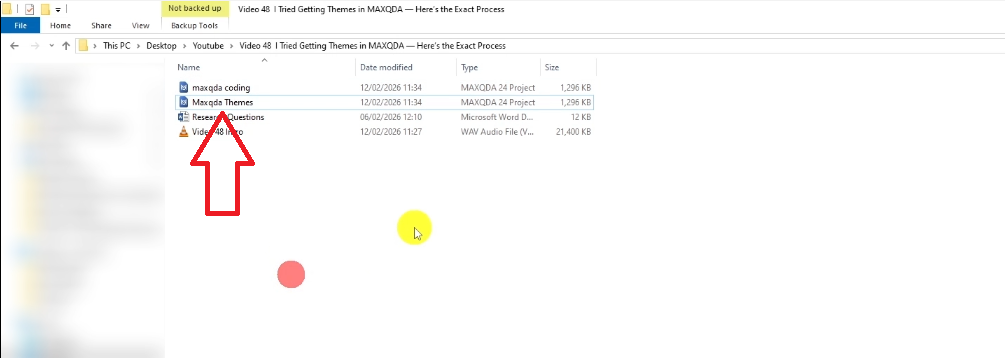
And then we open the themes file and start looking for the themes.
As we stated, we only combine codes with a shared pattern of meaning to get themes, and that’s what we are going to do.
As I said, if you look at the green codes,
- Encouraging innovation
- Embracing change
- Building rapport
- Assessing needs
- Going above expectations to help students
They talk about how these teachers adapt their leadership style to fit their new academic environments.
I want to have that theme.
I go to codes, click on the plus signs.
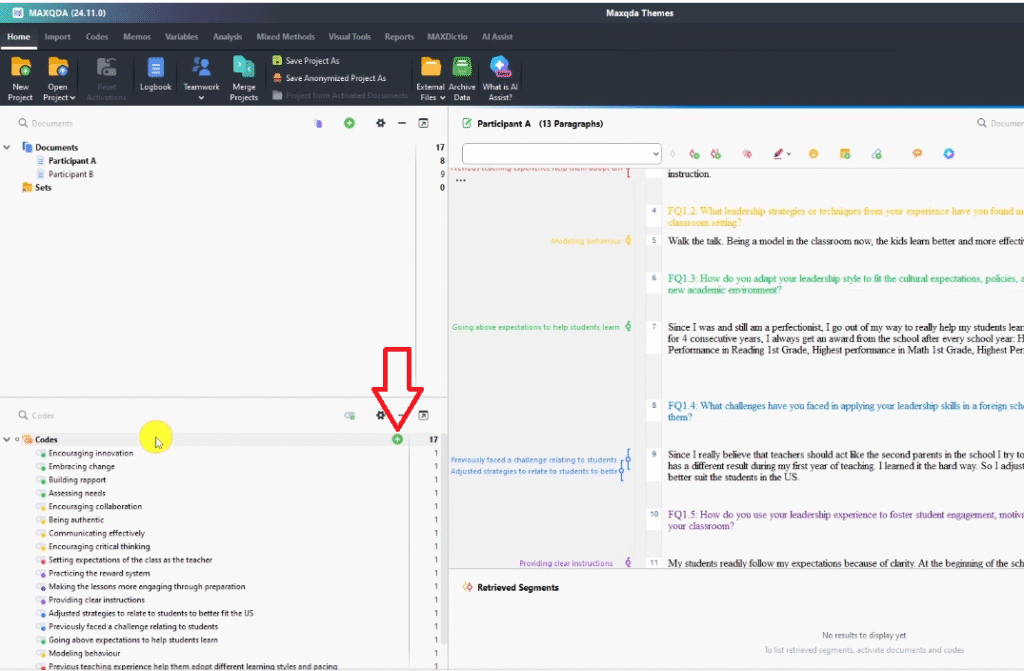
Remember that themes must sound like a heading.
Approaches of adapting leadership style to meet new teaching environments.
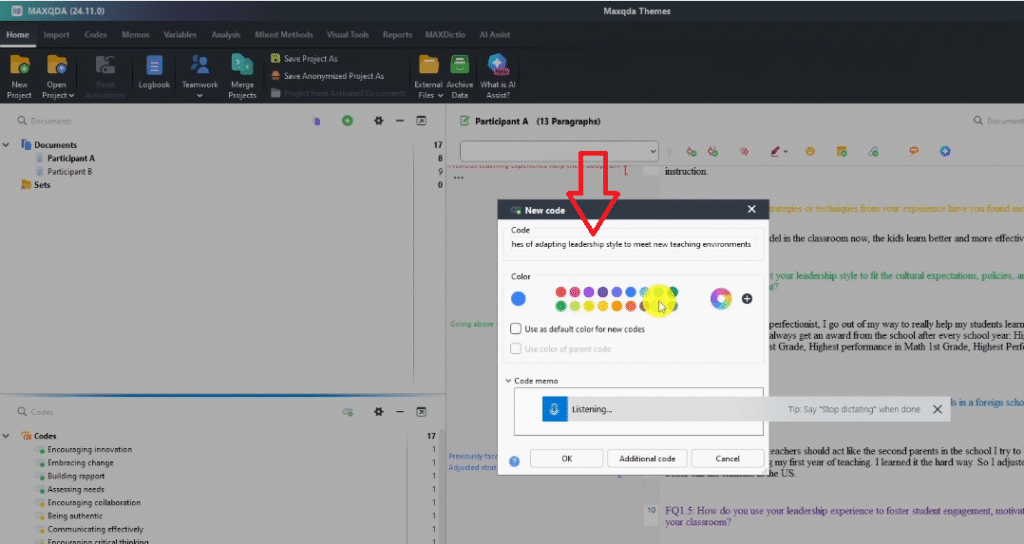
An image of the theme I created
So that will be my first theme.
Why will this be a theme?
Because I must have a description for that theme, what does this theme mean?
So , I right click.
I click on memo.
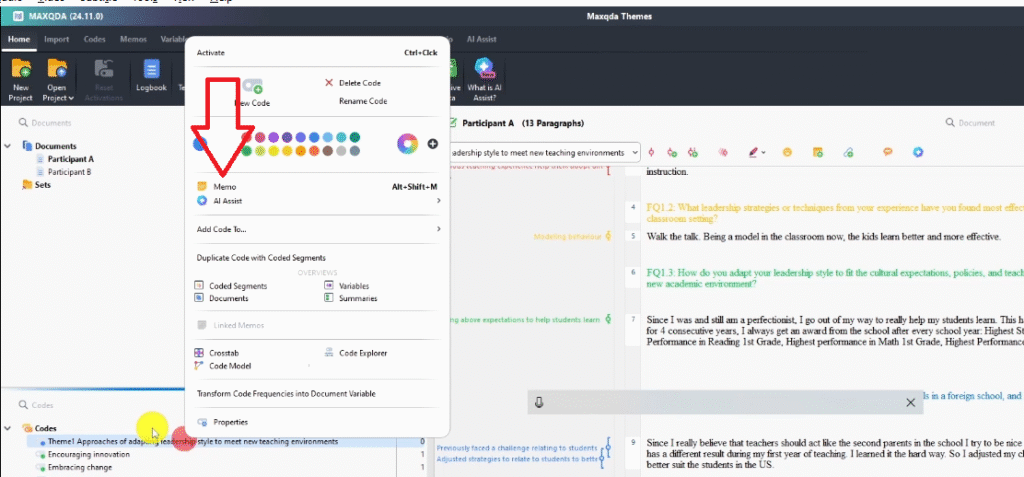
Then write a description for this theme.
This theme highlights the different strategies adopted by the interviewed teachers to adapt their leadership styles to fit in new teaching environments including new expectations, policies, and teaching methodologies.
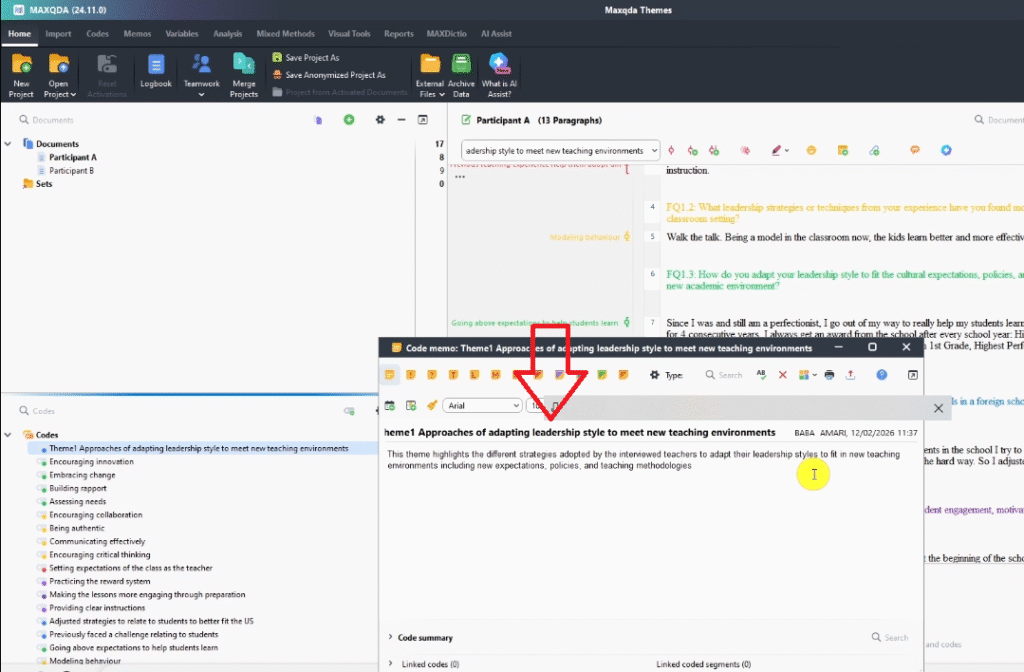
We can end it there, it could be better, but this is just an example.
So that’s how we define every theme.
It must have a clear description.
Remember if you’re following the Braun and Clarke method, the first step is familiarizing the data.
The second step is generating initial codes, which we did last time.
This is a step of coming up with themes and then reviewing and refining them, and adding descriptions.
We do the the three steps together, and that is what I am doing to make sure that every themes is clearly defined.
So if you double click on the memo , you can see the description for that theme.
And now let’s go and drag all the green codes, and put them under that theme.
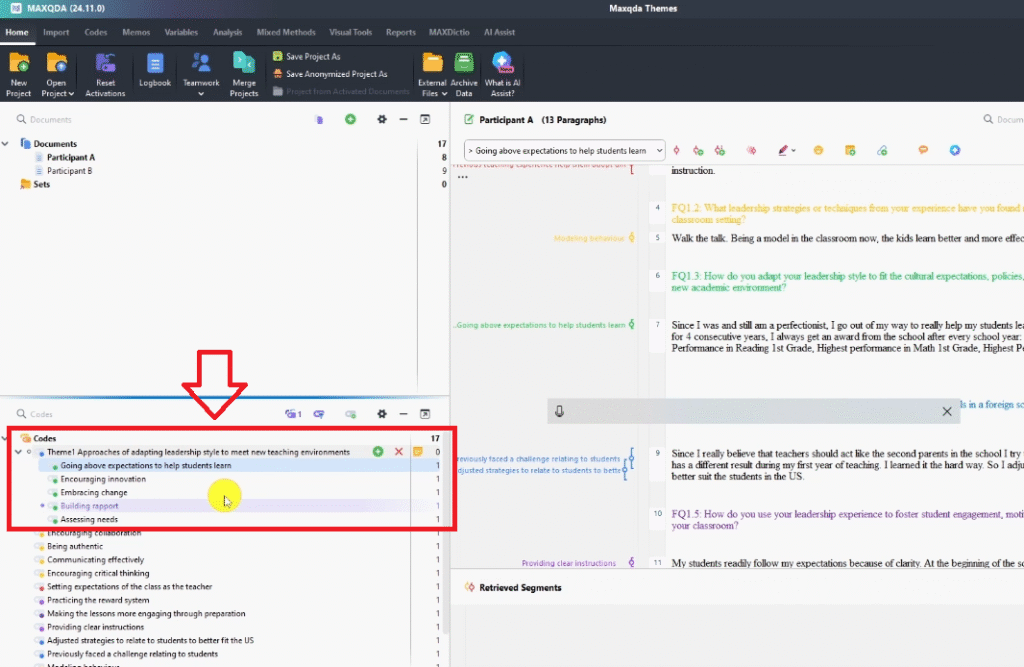
Look at that.
All those codes now belong to that theme.
Remember, I was color coding this because I knew I might need to classify these codes based on shared meaning, and I have to explore this so we can see the first theme.
We can develop another theme.
For example, if you look at the yellow color-coded codes, then read the question, what leadership strategies or techniques from your experience have you found most effective in your foreign classroom setting?
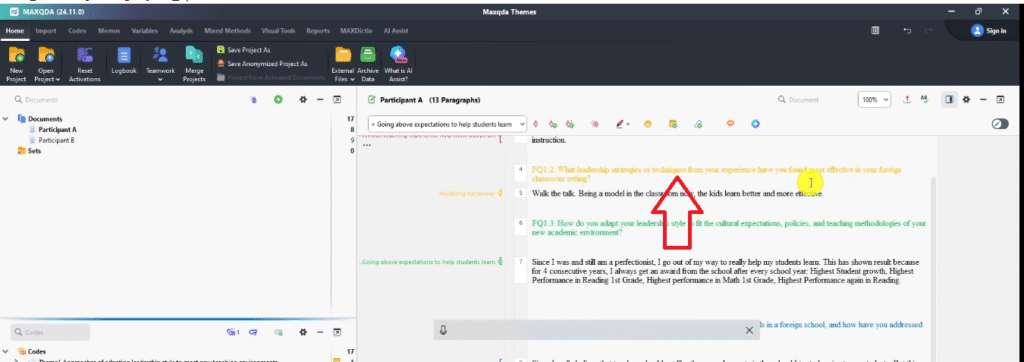
So here we can have a theme called effective leadership Strategies or Techniques.
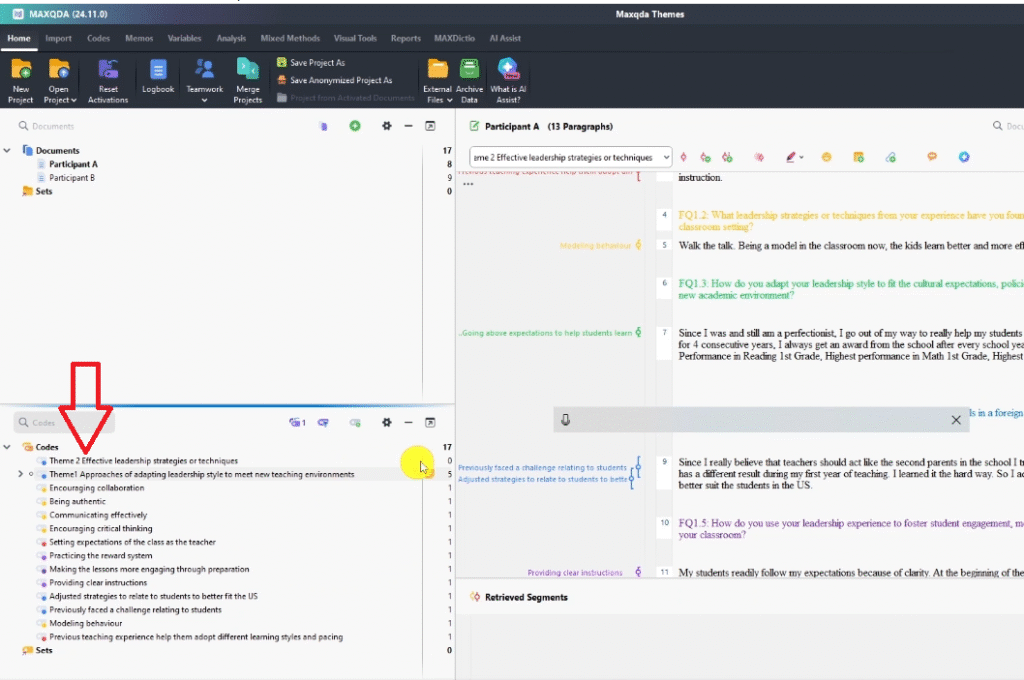
Then we can provide a clear description of what we mean.
We can right click and add a memo and say that this theme highlights the different leadership strategies and techniques that the interview teachers found to be the most effective in their classroom settings.
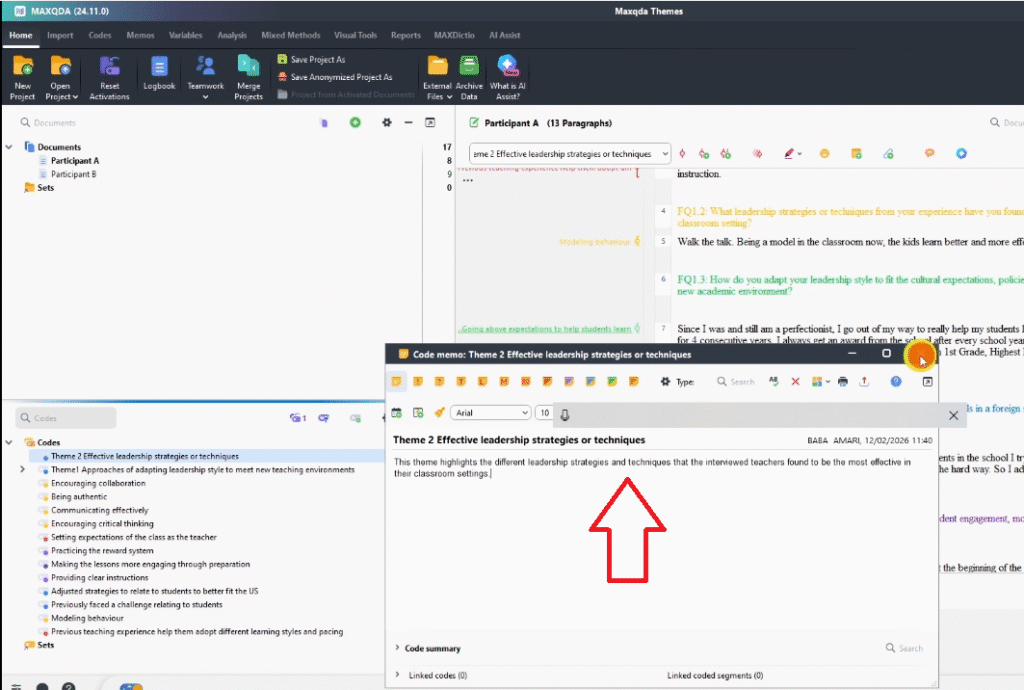
That is the description.
We go and select all the yellow codes, then drag and drop them inside the theme.
These codes have the same meaning.
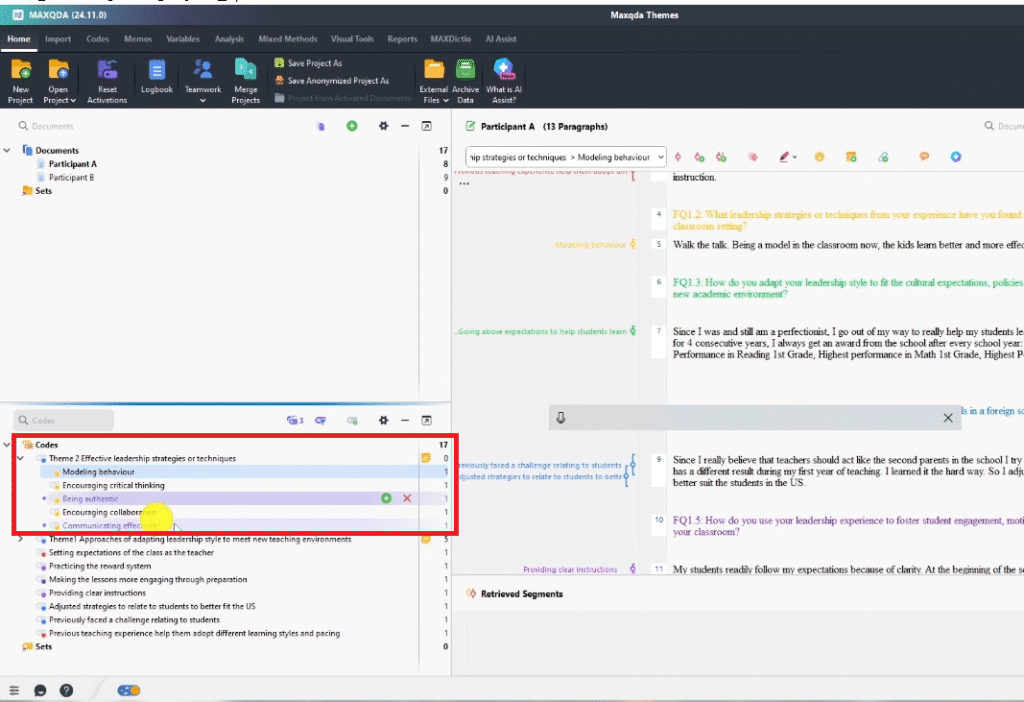
So that’s how we get another theme.
We can attempt another theme.
We asked them a question of challenges they faced in applying their leadership skills.
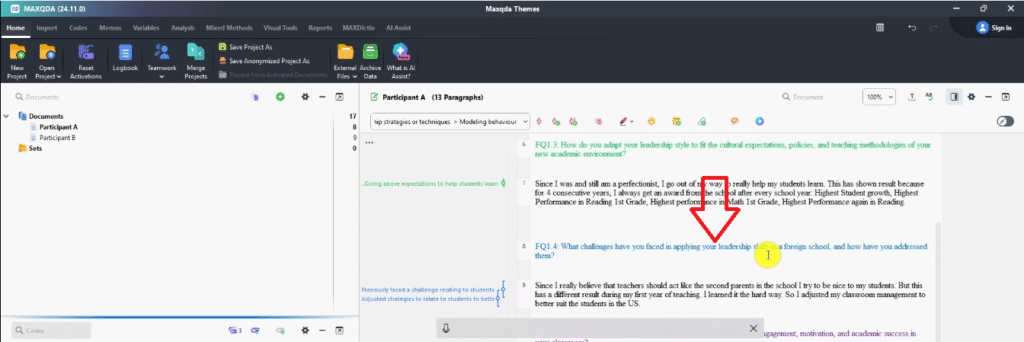
So we can have a theme called challenges in application of leadership skills.
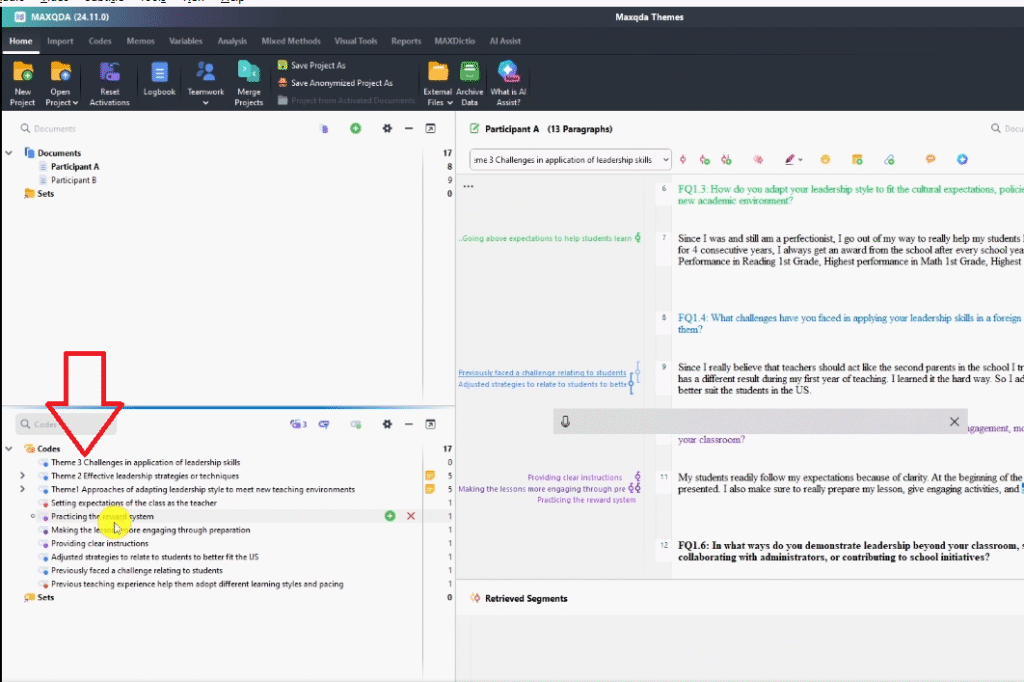
So challenges in application of leadership skills, and we get all the blue color-coded codes inside the theme created.
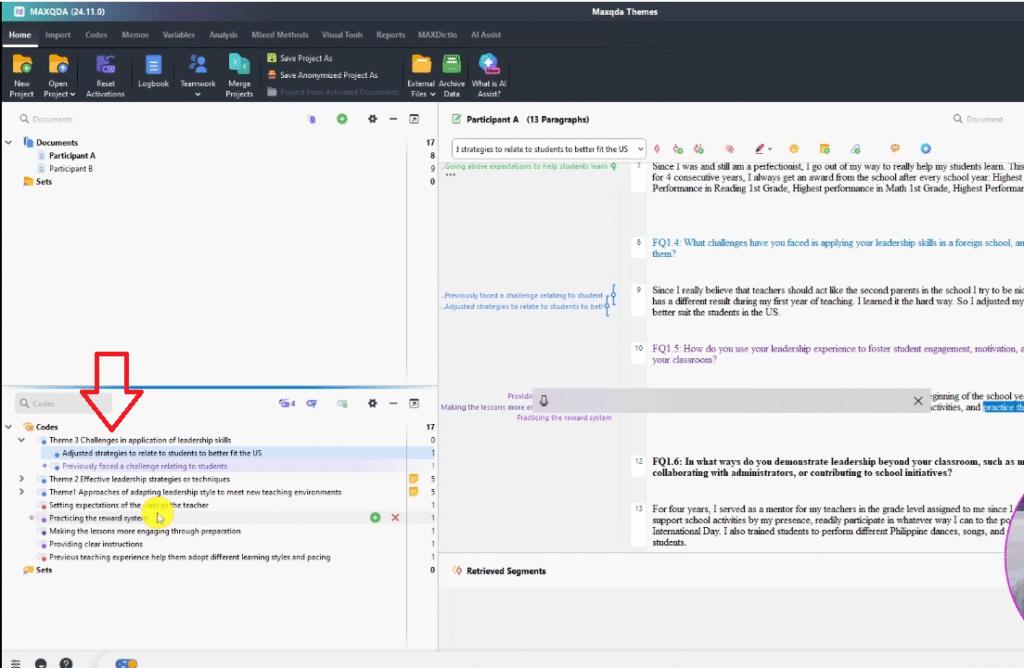
We can go on and on looking at the codes and putting them in themes.
Remember, themes are as a result of a shared pattern of meaning across the code.
So basically that’s how we do themes in MAXQDA, and those are the practical steps that we do.
We create the themes, we drag and drop the codes inside there.
Once we are done with themes, we can always go and do what we call finding the reports.
We are going to look at it later when we are looking at how we write or report our findings.
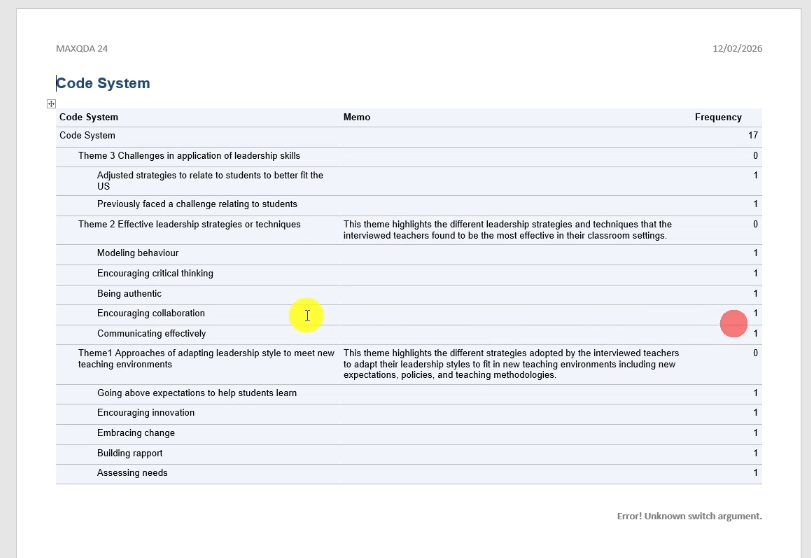
If you go to export.
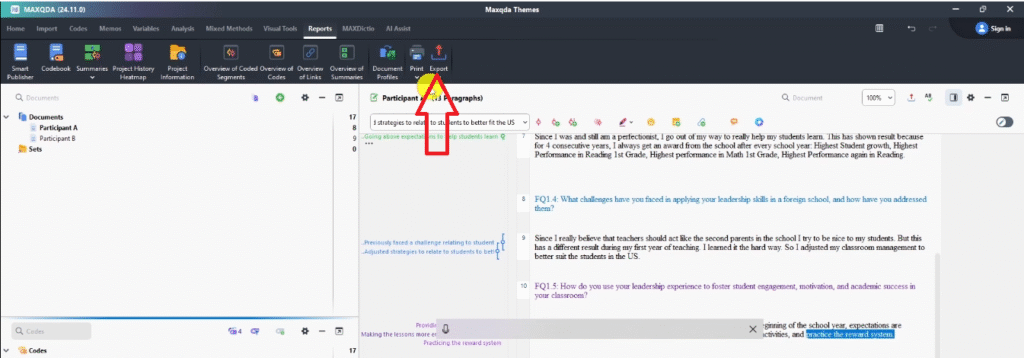
Go to code system.
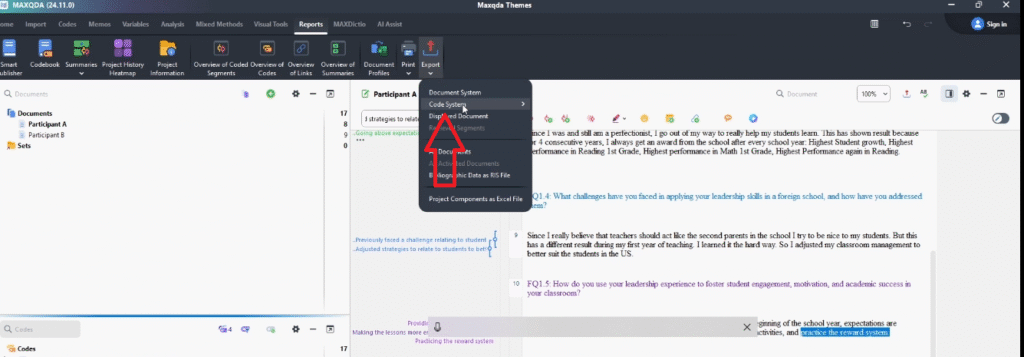
click on Word document and see the code system we just created.
How to Report Thematic Analysis Findings in MAXQDA (Step-by-Step Guide)
In this section, I will be showing you how to bring all this information together and compile your findings after conducting thematic analysis using MAXQDA .
Braun & Clarke Review
Now the first thing that we need to remember when we are analysing data is following the Braun and Clarke framework of doing thematic analysis.
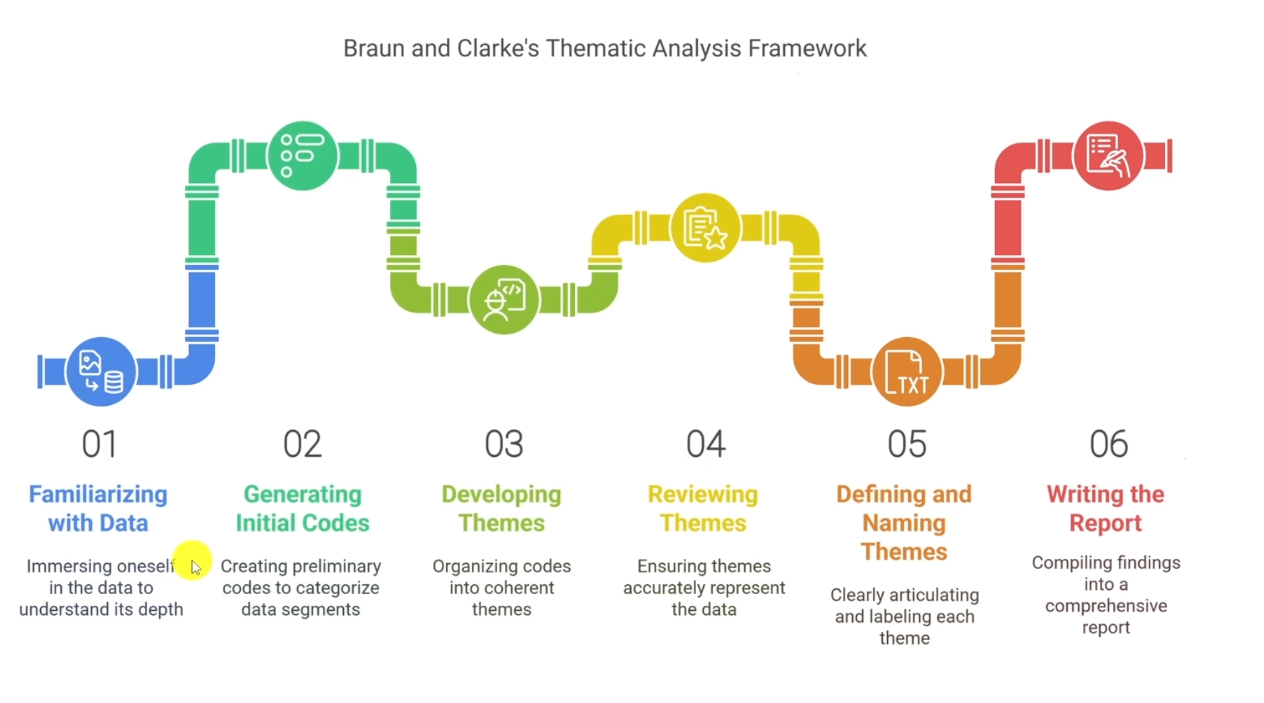
Basically, we are going through all the steps, which include:
- Familiarizing with the data
- Generating codes
- Developing themes
- Reviewing themes
- Defining and naming themes
And now we are writing the report, which is the final step.
How do we report the findings after we conduct thematic analysis in MAXQDA?
Export and Fix the Code System
The first thing that I will do is to open our previous MAXQDA project.
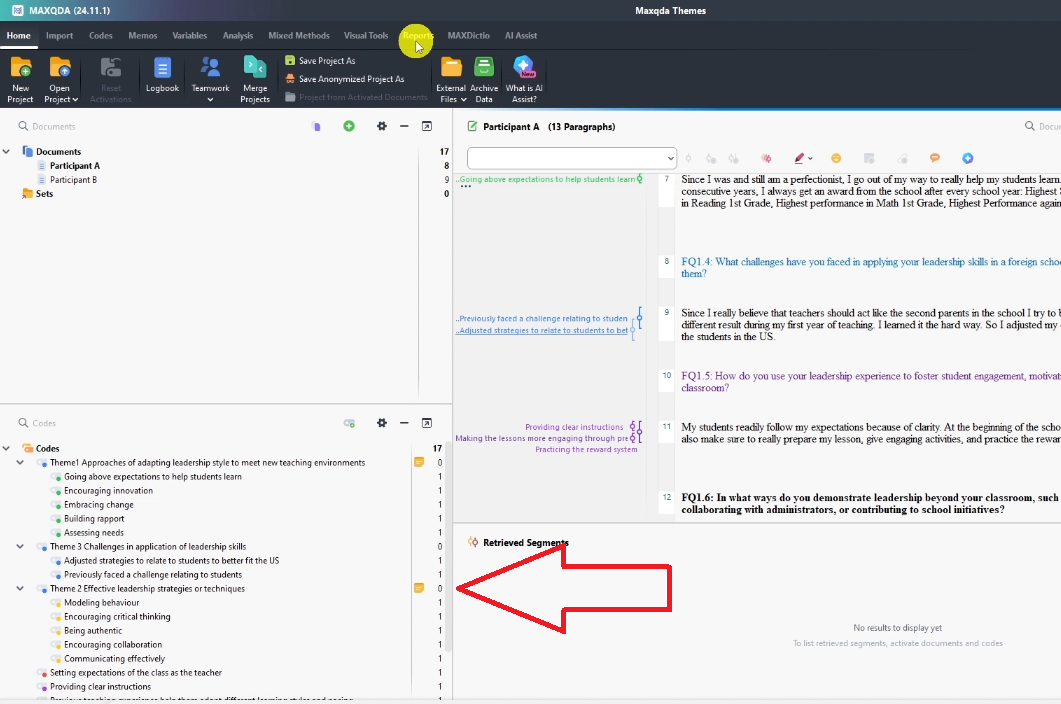
Remember we came up with codes, then developed themes, and also added descriptions.
The first thing that I will do is go to reports.
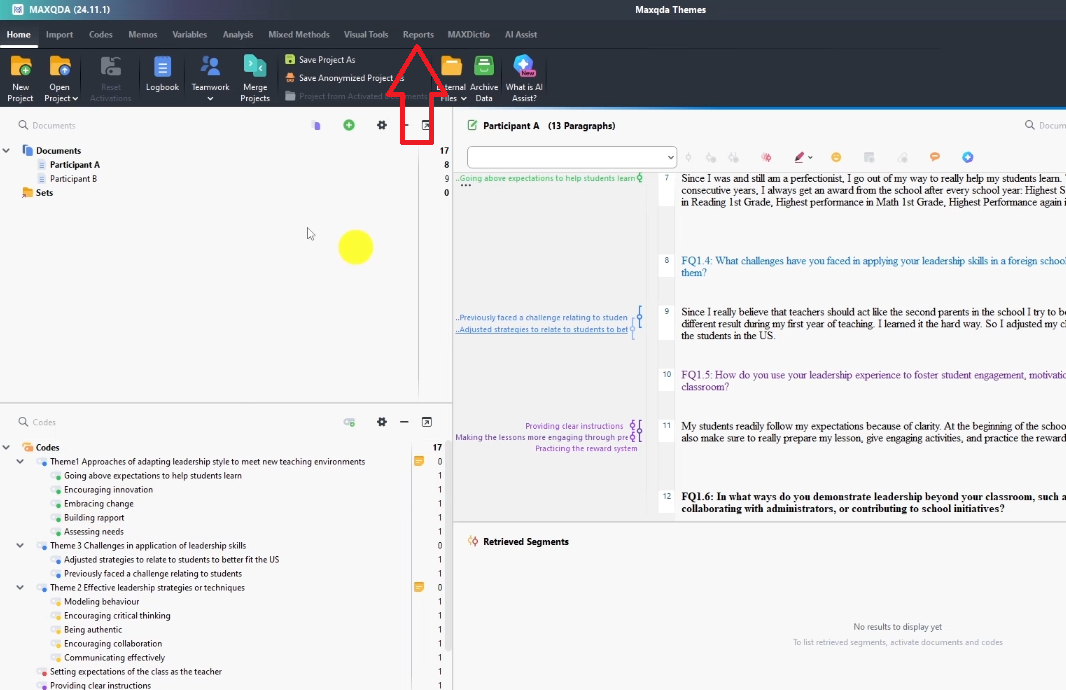
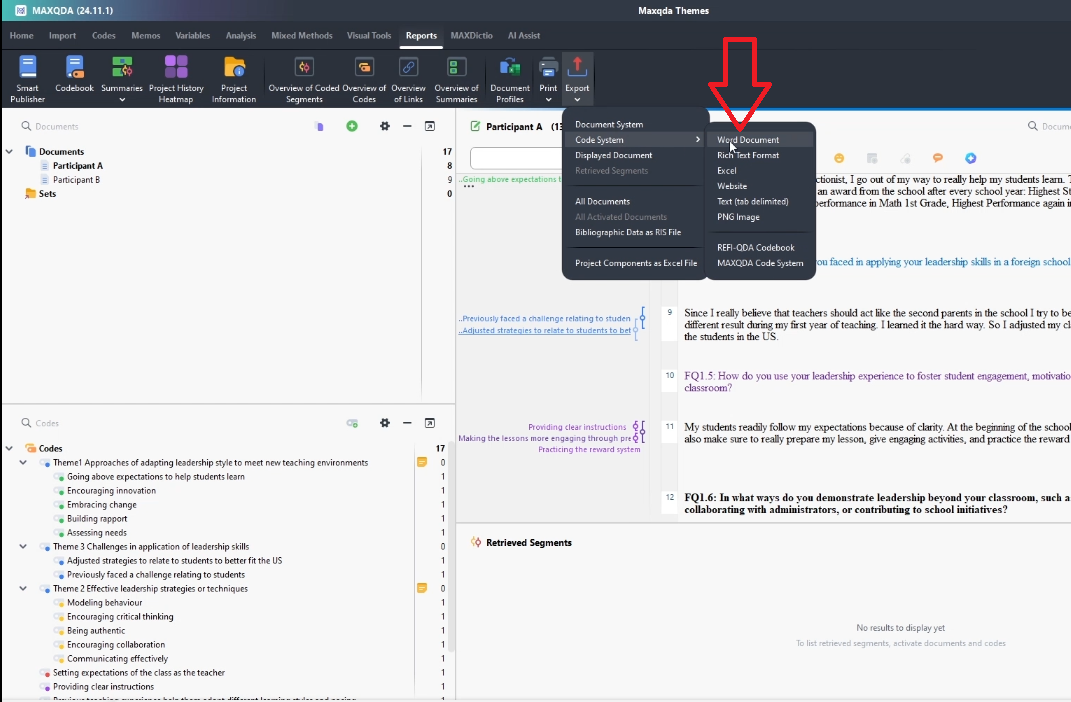
Export code system.
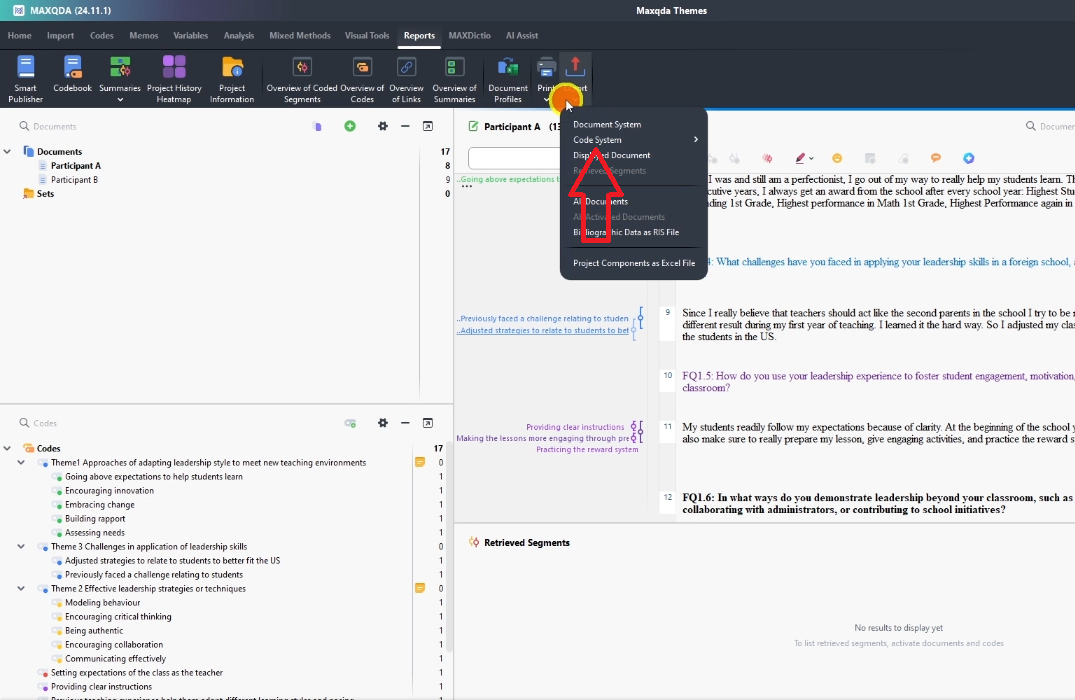
Then do a Word document.
A word document is like a code book.
Let us include memos.
So this is a code book from MAXQDA.
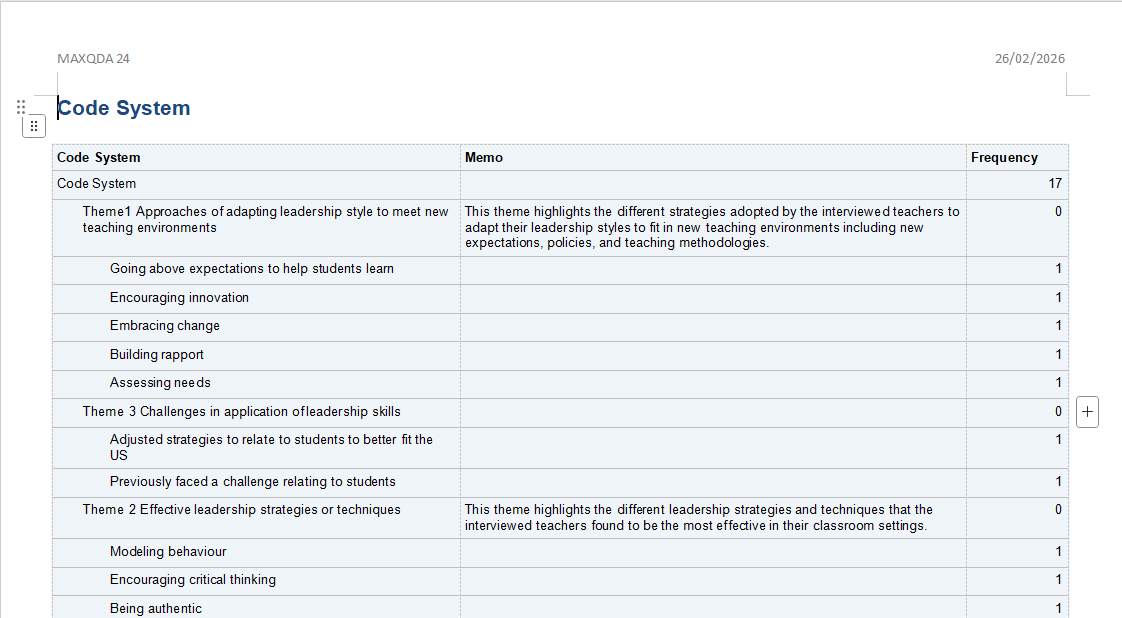
Why is the codebook important to begin with?
Because every table that we are going to put up in our findings report will come from here.
You notice that in MAXQDA when you export your code book, you will have this numbers.
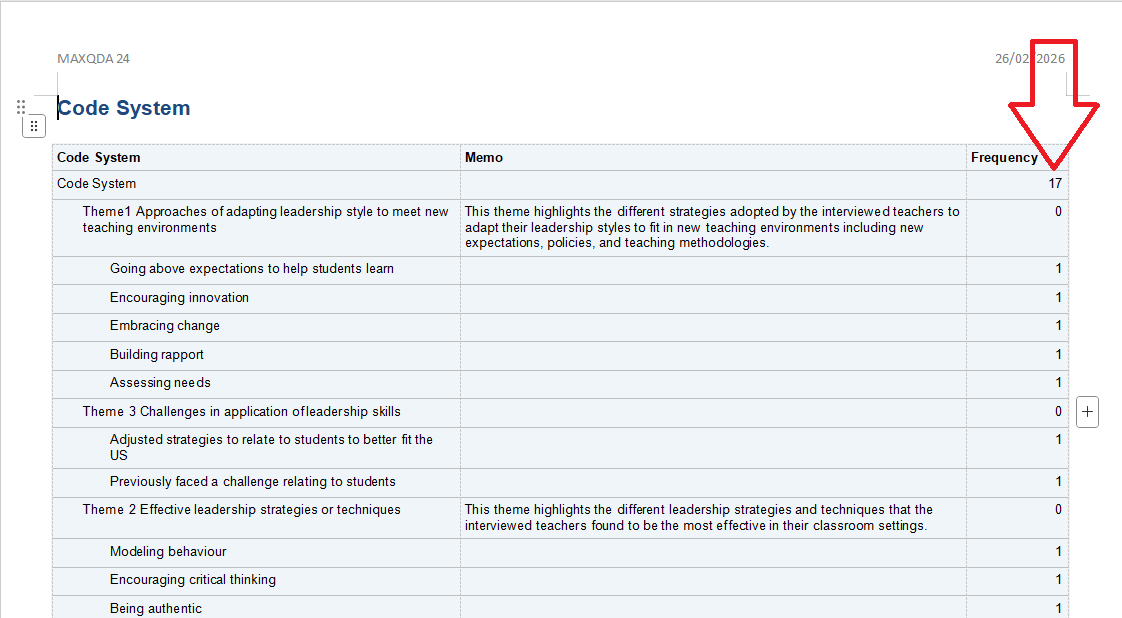
This are not the totals.
When we look at the project, you can see the numbers there.
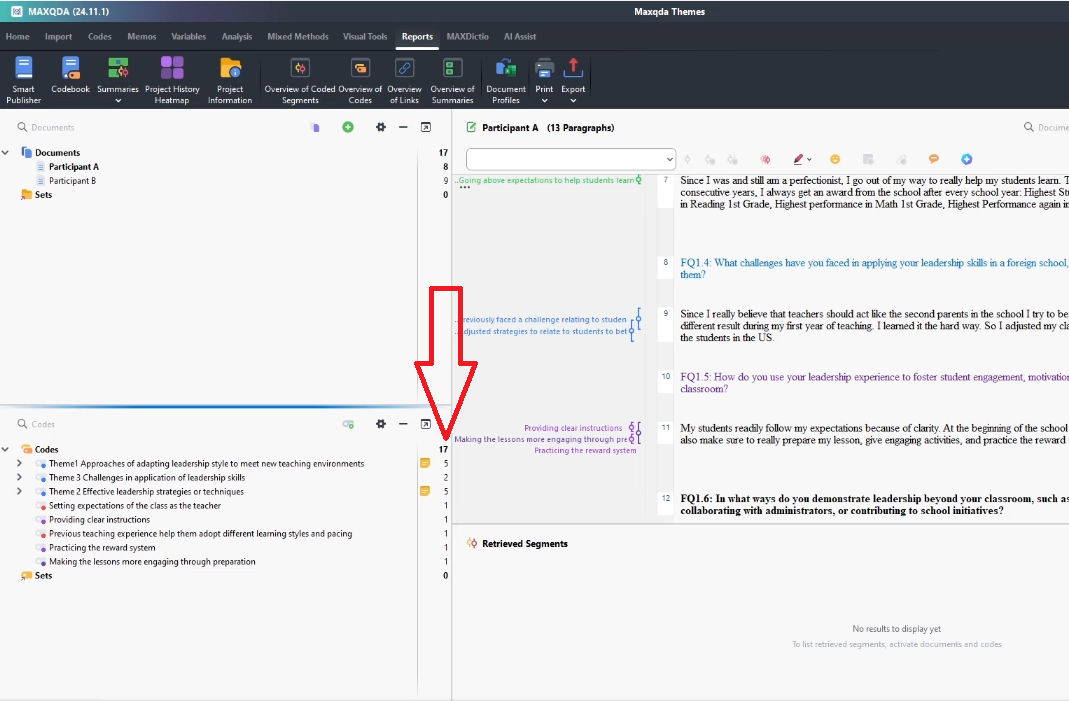
The first thing to do is to replace in those numbers, which are the number of codes.
And before we start exporting, I could edit my theme so that they are in order.
The only way we do that is to go to codes then sort A to Z.
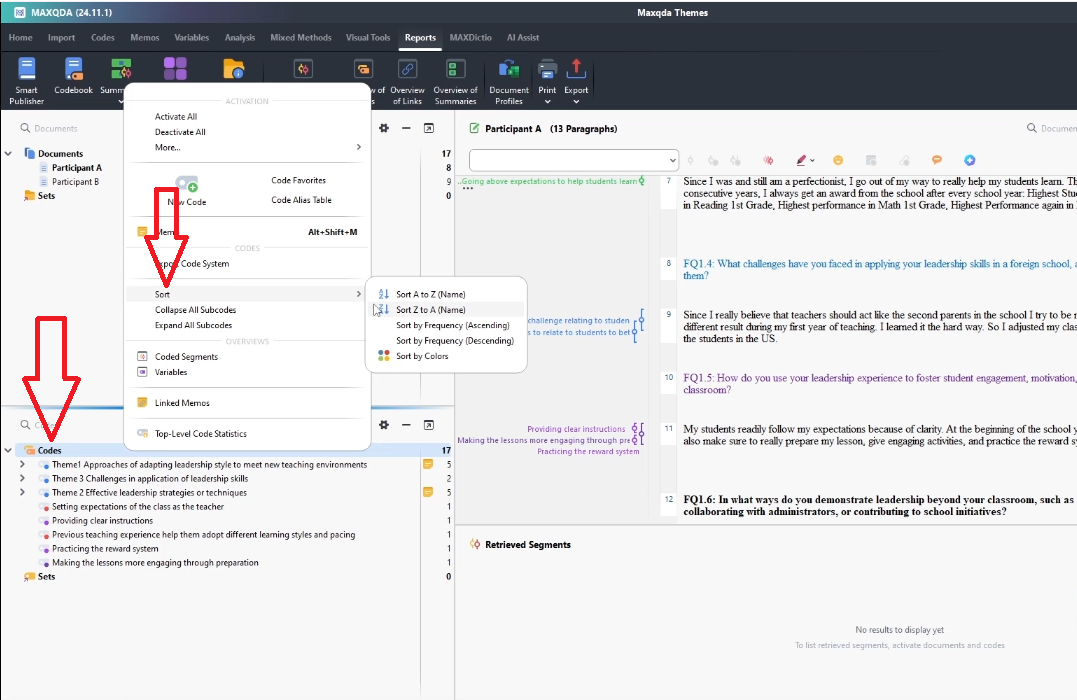
Basically that’s how we sort our themes.
This code system is important because it has themes, descriptions, and everything that came from the themes.
Findings Report Example
Now with this, we can proceed to seeing an example of a report, and I can explain how we report the findings after we conduct thematic analysis.
So this is an example of a findings report I’ve written before.
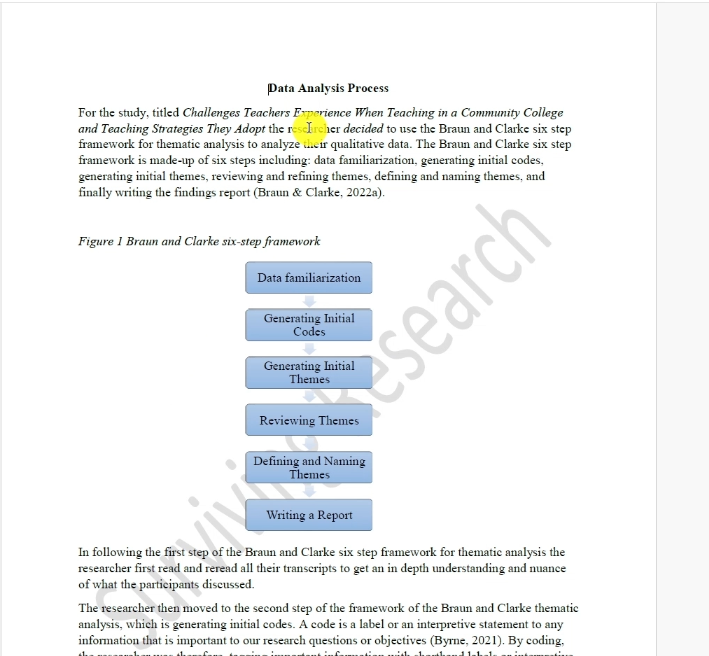
The first part of the findings report is the data analysis process.
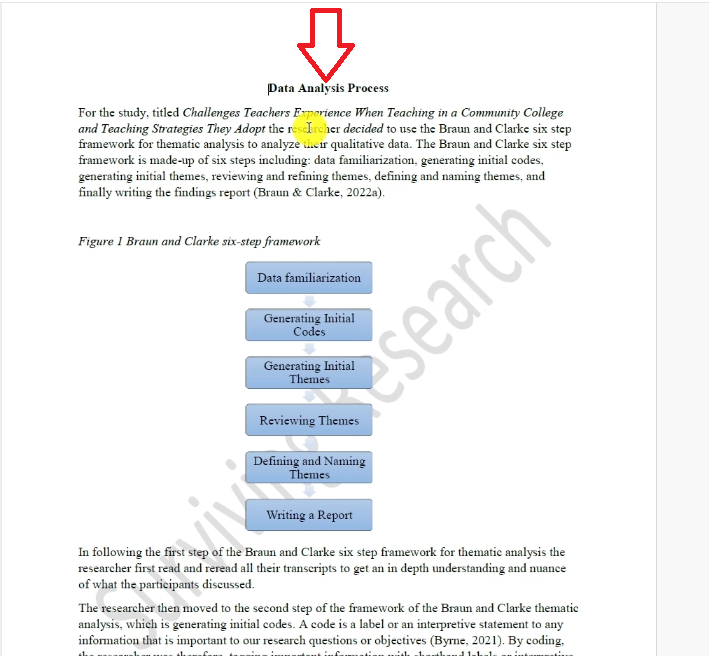
So here we clearly state the steps we took to conduct our thematic analysis.
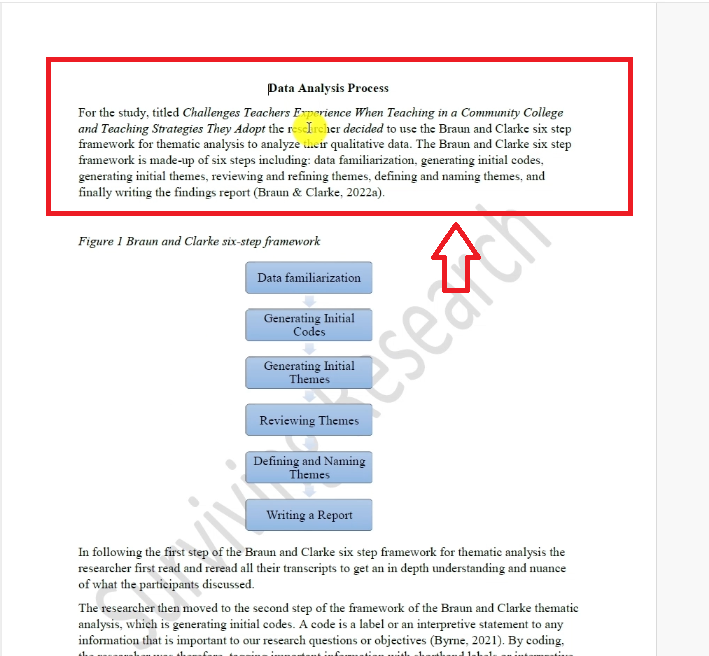
For example, here I am describing how I followed the Braun and Clarke six-steps, including familiarizing the data generating initial codes.
All this are descriptions with the right citations in APA 7 format.
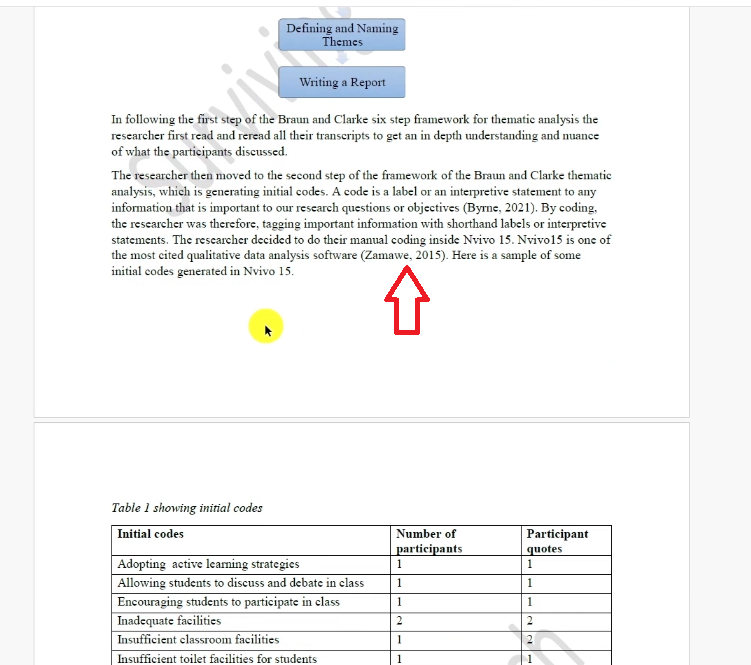
Then I provide a sample of initial codes.
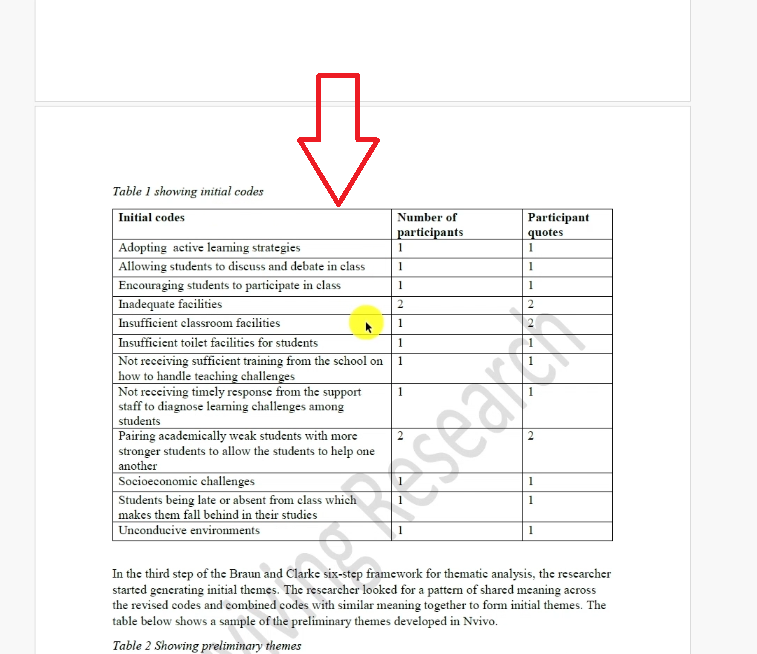
Remember we had an initial codes file, so I just go to that MAXQDA file, and grab some codes.
If you look at MAXQDA , you’ll notice that we have some numbers.
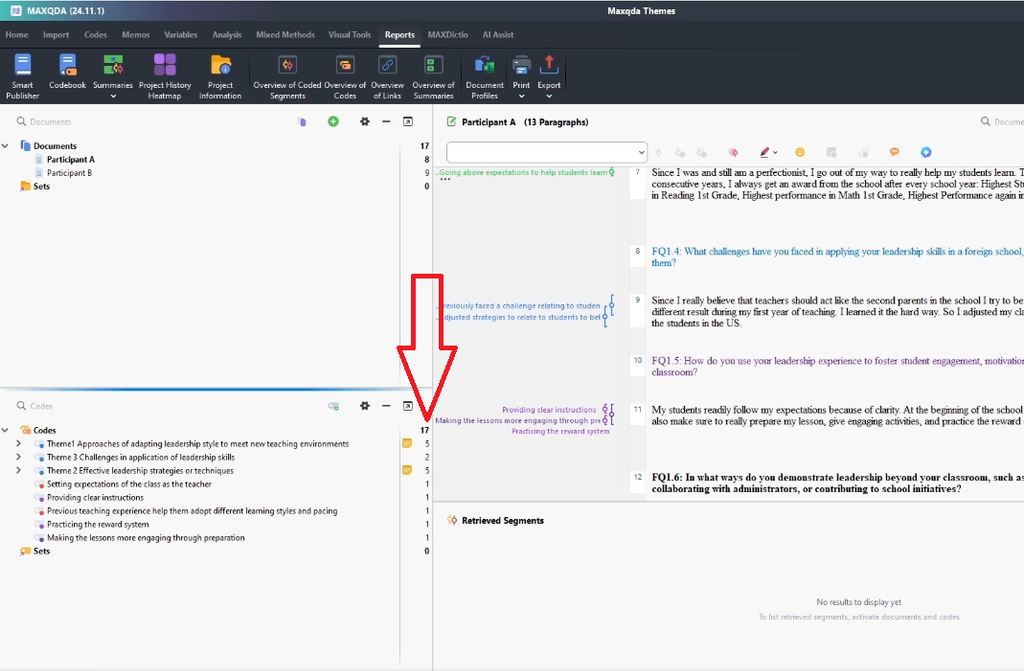
They are called the frequencies.
In MAXQDA the frequencies are the number of quotes that we have in a given section.
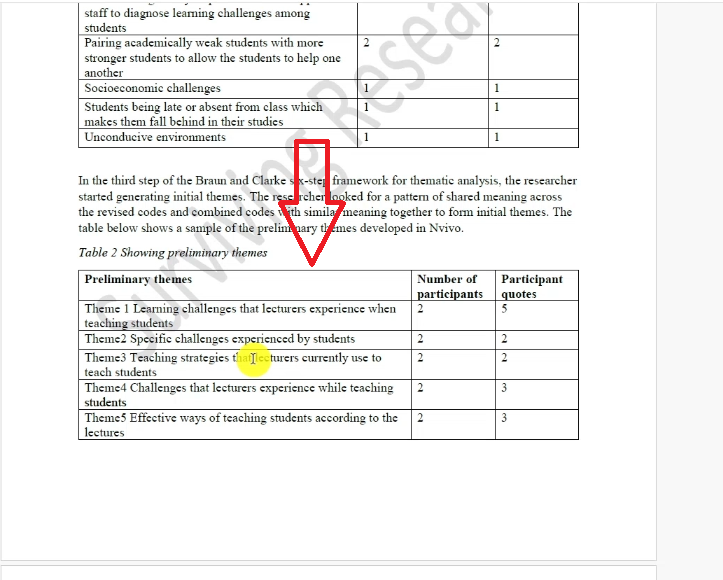
So these tables are drawn using those numbers, then we keep explaining how we got preliminary themes, what are the preliminary themes.
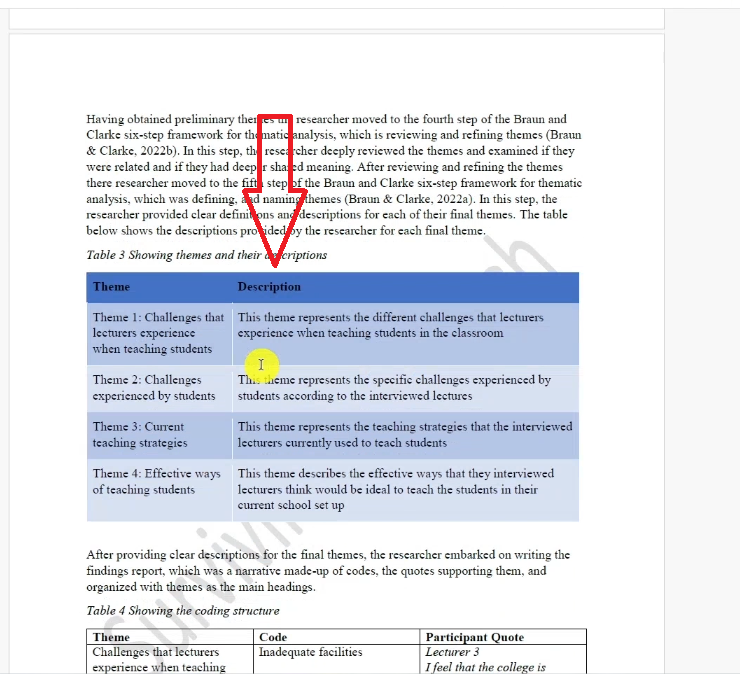
Then we have themes and their description.
That is basically the first part.
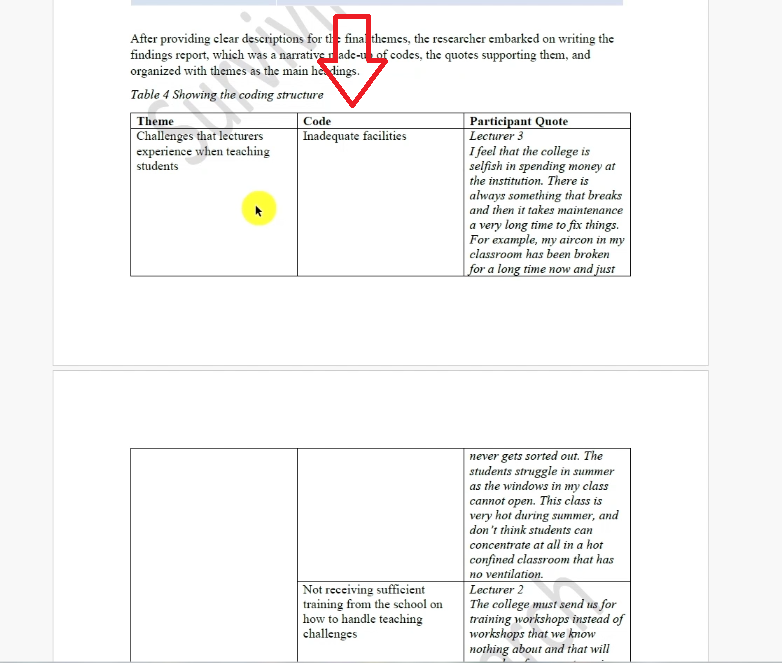
Then I have a table here that I drew creatively where I went ahead to show my coding structure.
It have themes, codes, and quotes.
Retrieving Quotes from MAXQDA
Where do we get the quotes from in MAXQDA?
For example, let’s say we want to get the quote of this code encouraging innovation.
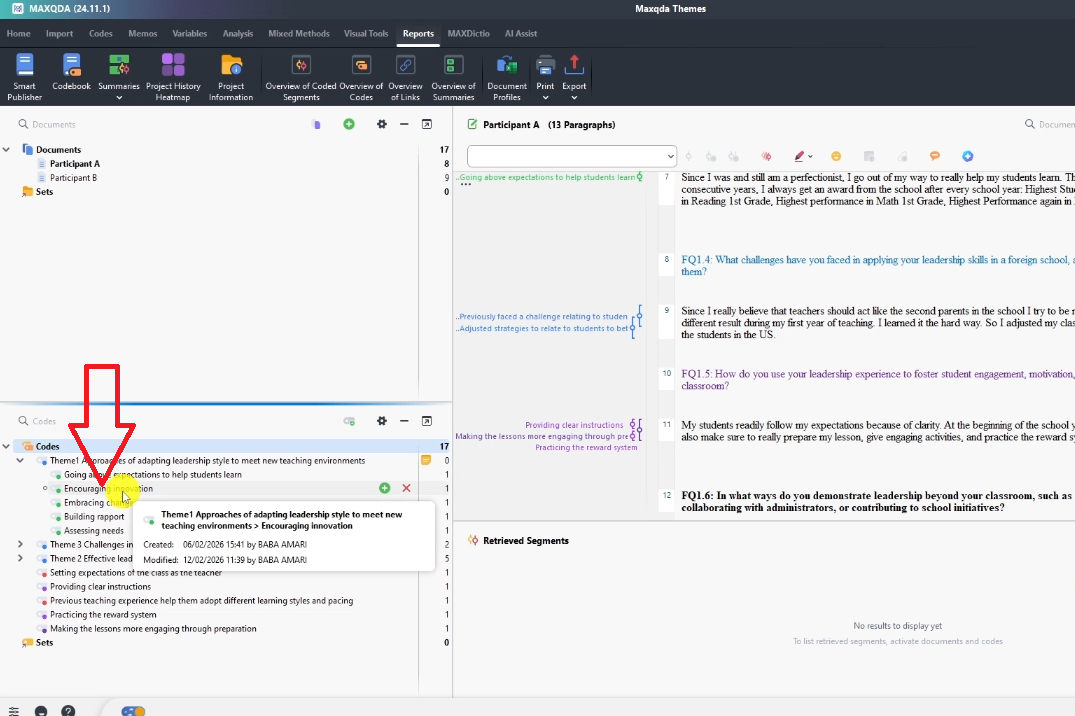
I just double click on that and then click on the transcript.
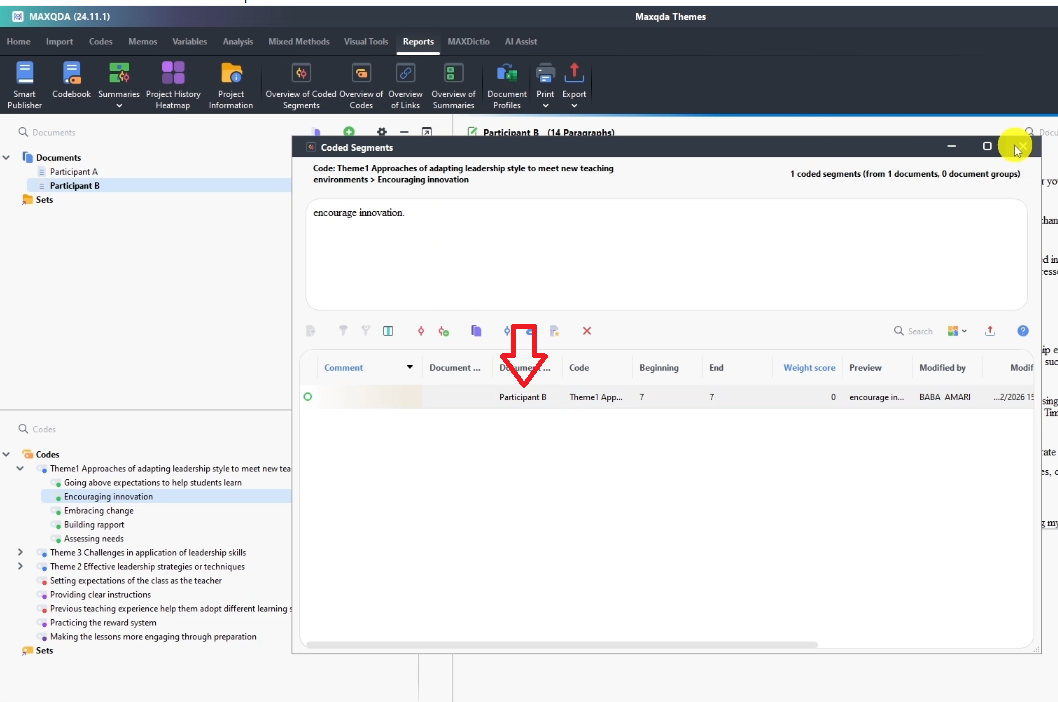
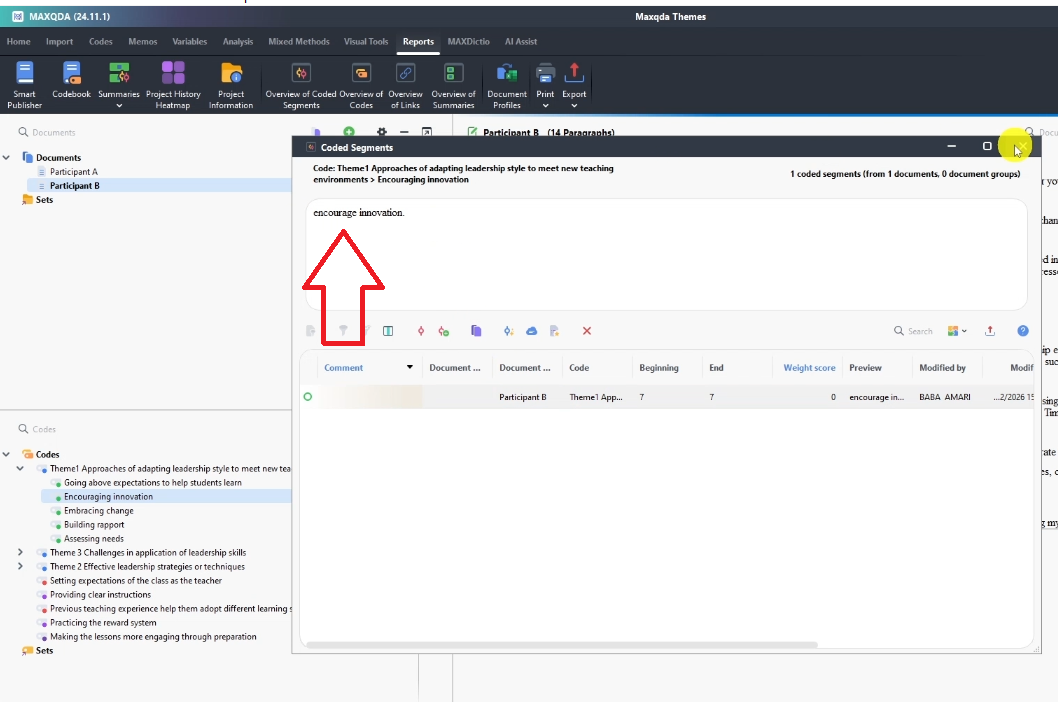
And this is the quote.
Another way we can get the quote is getting retrieved segments.
We can activate everything.
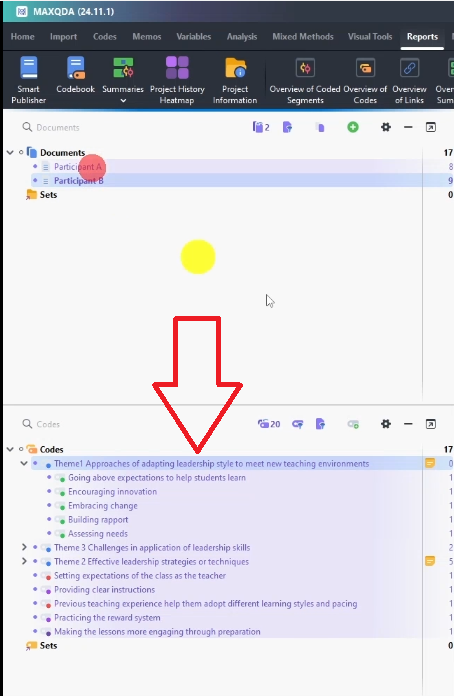
Once we activate everything, we can get all the quotes from the different sections.
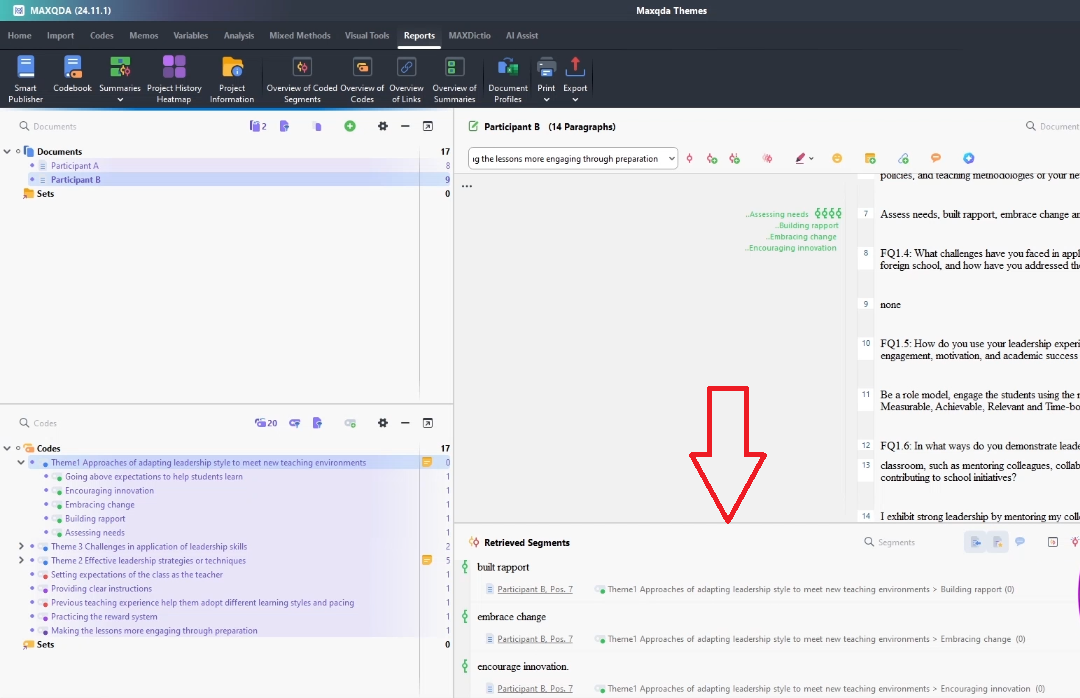
And we can export that in an Excel file.
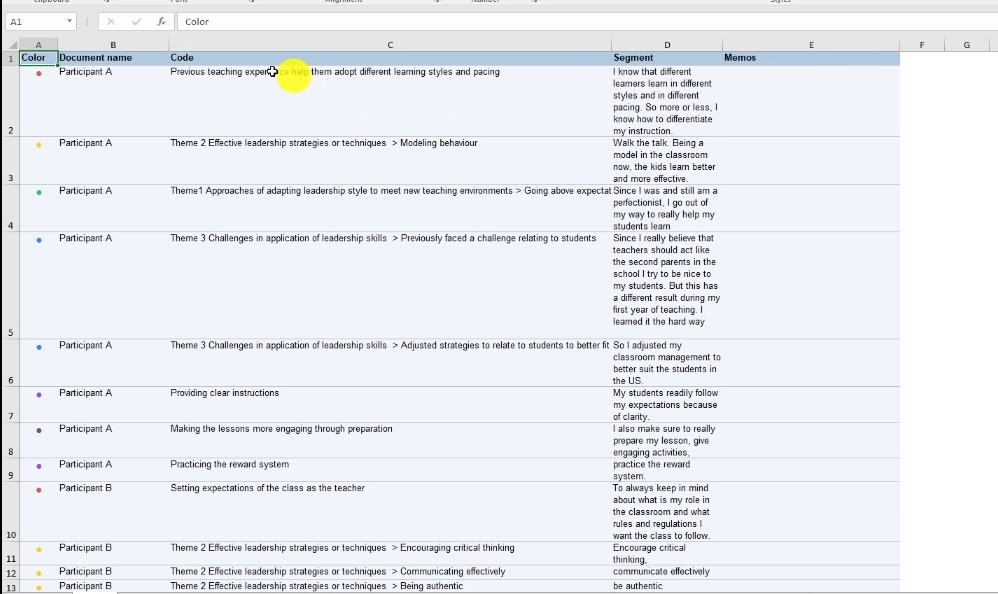
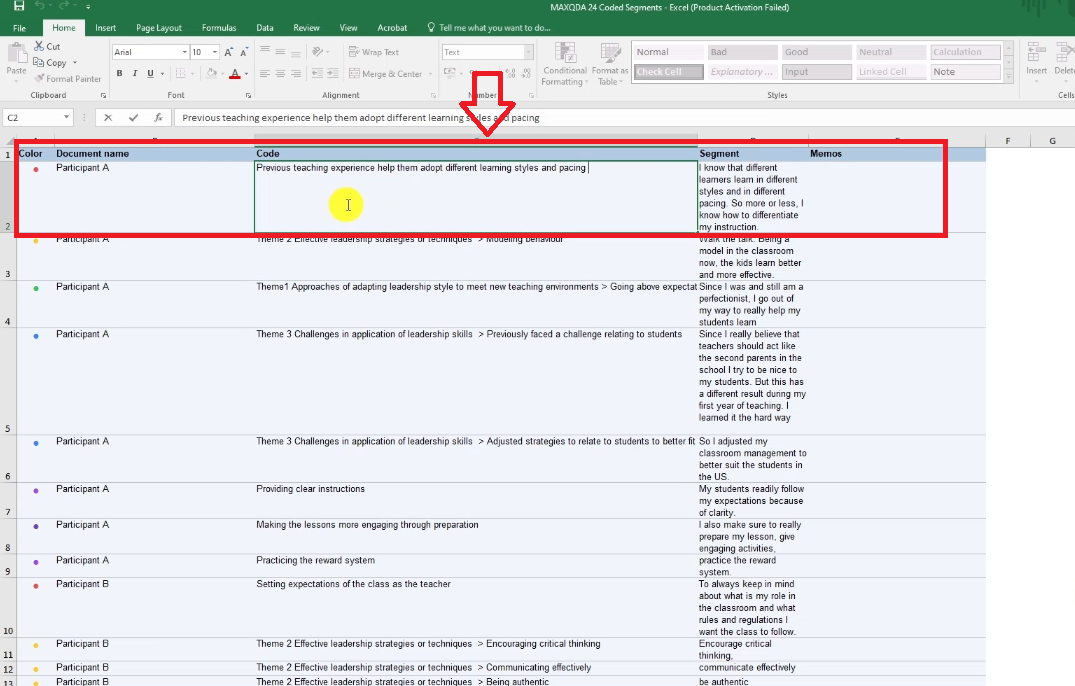
We can export all the quotes at once so that we are able to use them in our report.
You can see, for example, this quote came from a code called Previous teaching Experience, under participant A.
Participant A still provided a code called modeling behavior under the two effective leadership strategies or techniques.
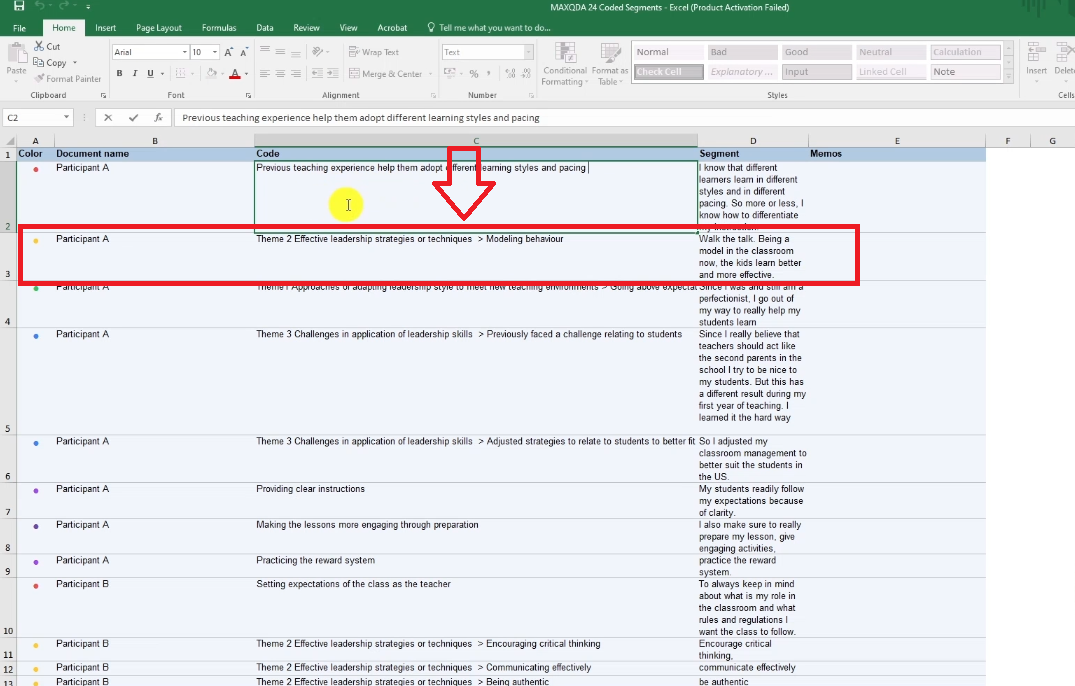
So we can use that in our report.
Now let’s get back to explainings.
Then now we present the results.
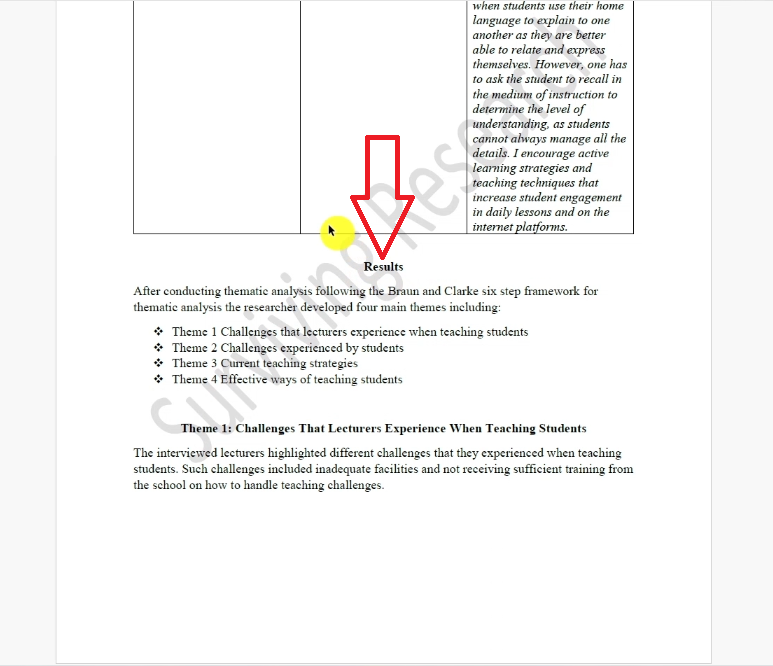
When you are presenting the results, you are basically providing a narrative of your findings.
So you can see the themes are the main headings.
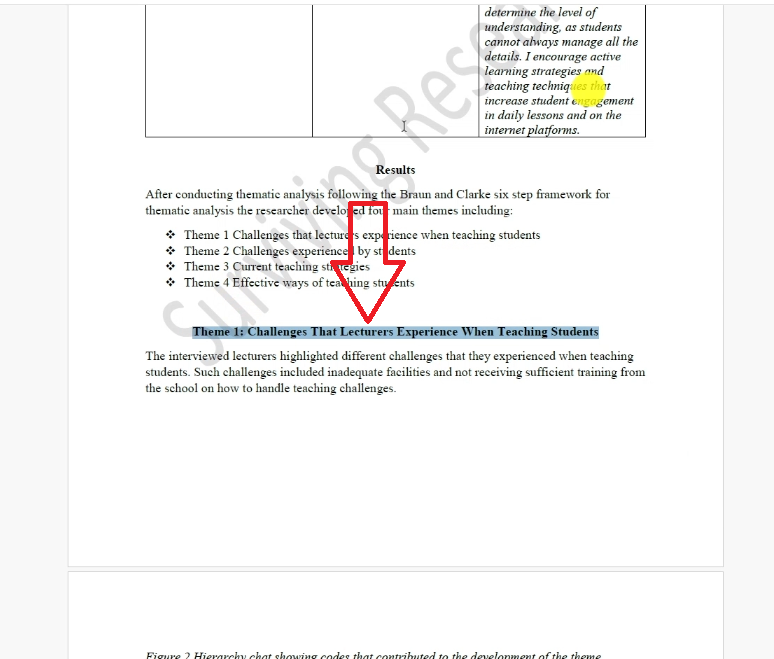
This is the description of the themes.
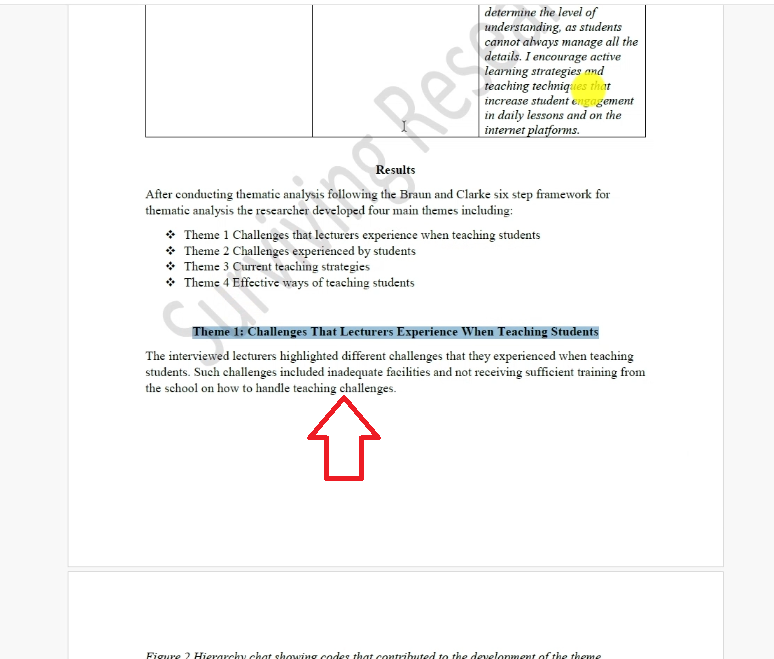
Remember that every theme must have a description.
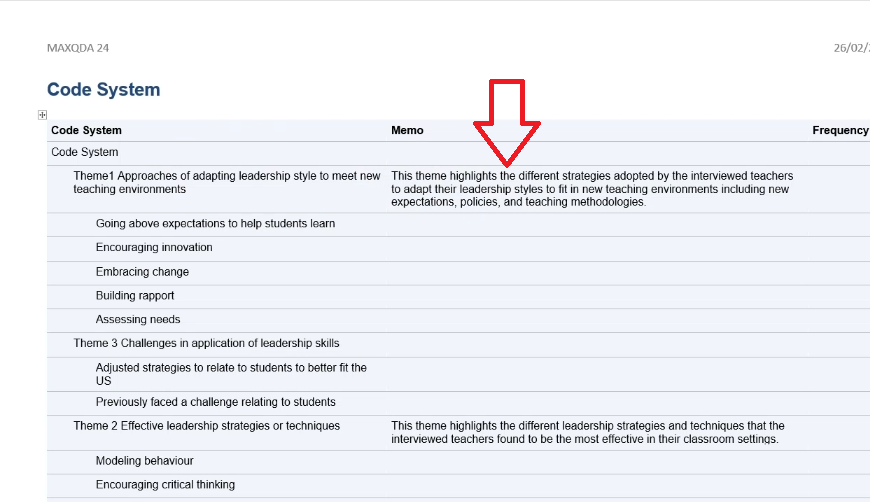
So here we can say that the interviewed participants, highlighted that they utilized different strategies to adapt their leadership styles to fit in new teaching environments including new expectations, policies, and teaching methodologies.
So ideally, this is the narrative.
Then I have another visual here..
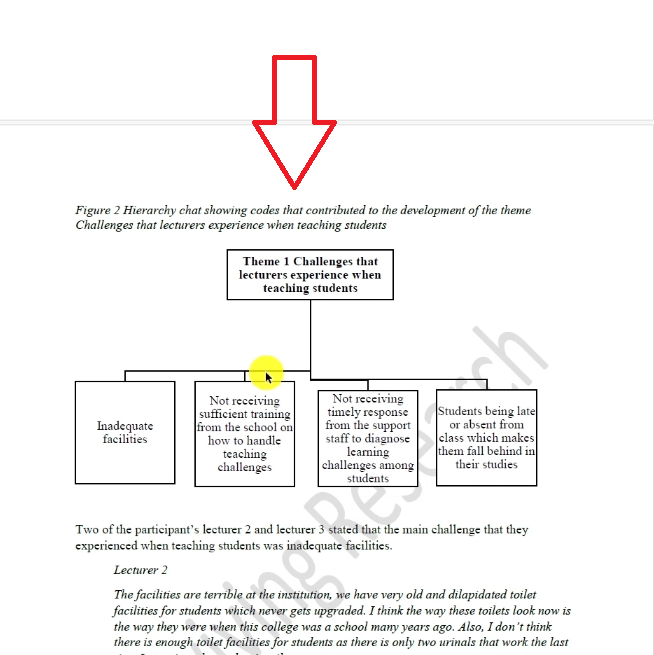
I drew this in Word.
Then I provide a narrative of the codes, then I provide the quotes.
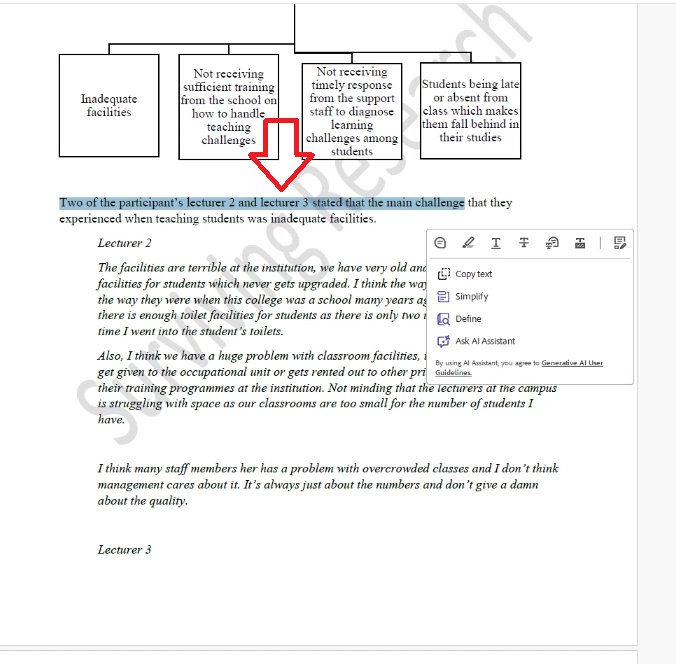
Again, we can get the quotes directly from MAXQDA, or we can get them from the retrieved segment Excel file.
That’s basically how the findings report is.
I have different visuals.
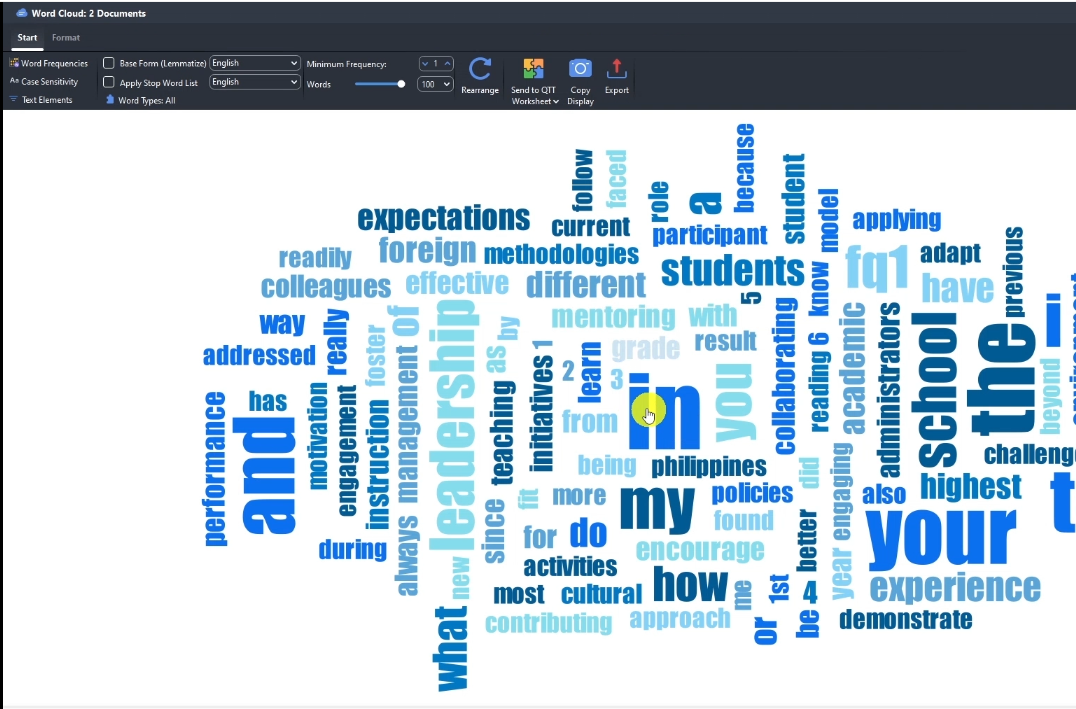
I have a word cloud.
By the way, if you want to make a word cloud in MAXQDA, just come and click on one of your themes.
Creating a Word Cloud
Then I can go to visual tools.
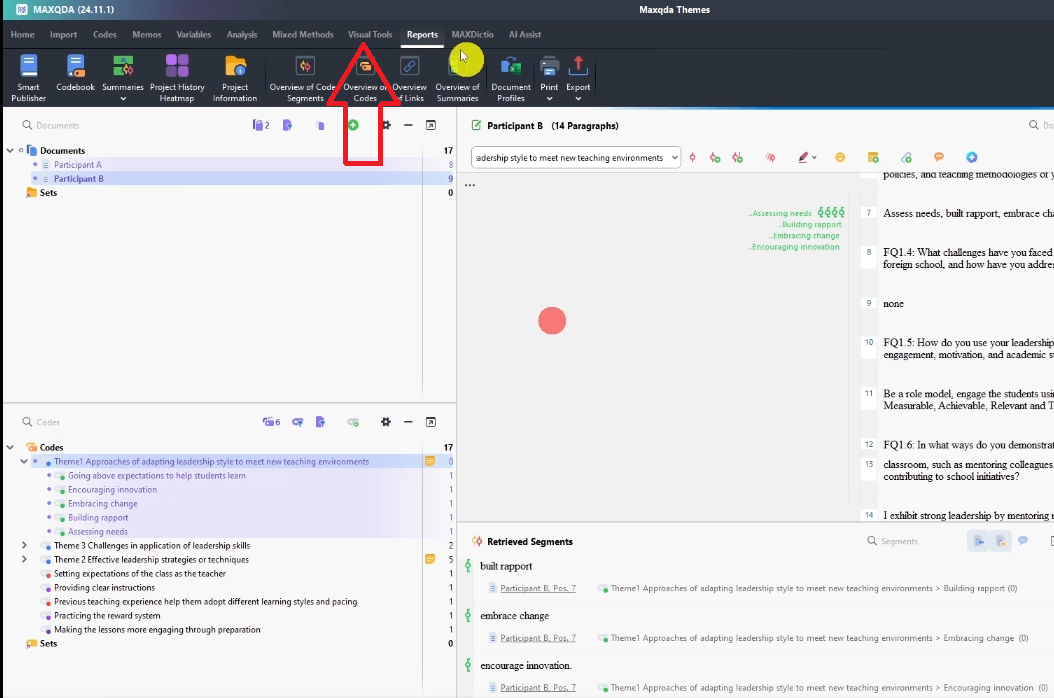
click on word cloud, then in insert activated elements and click okay.
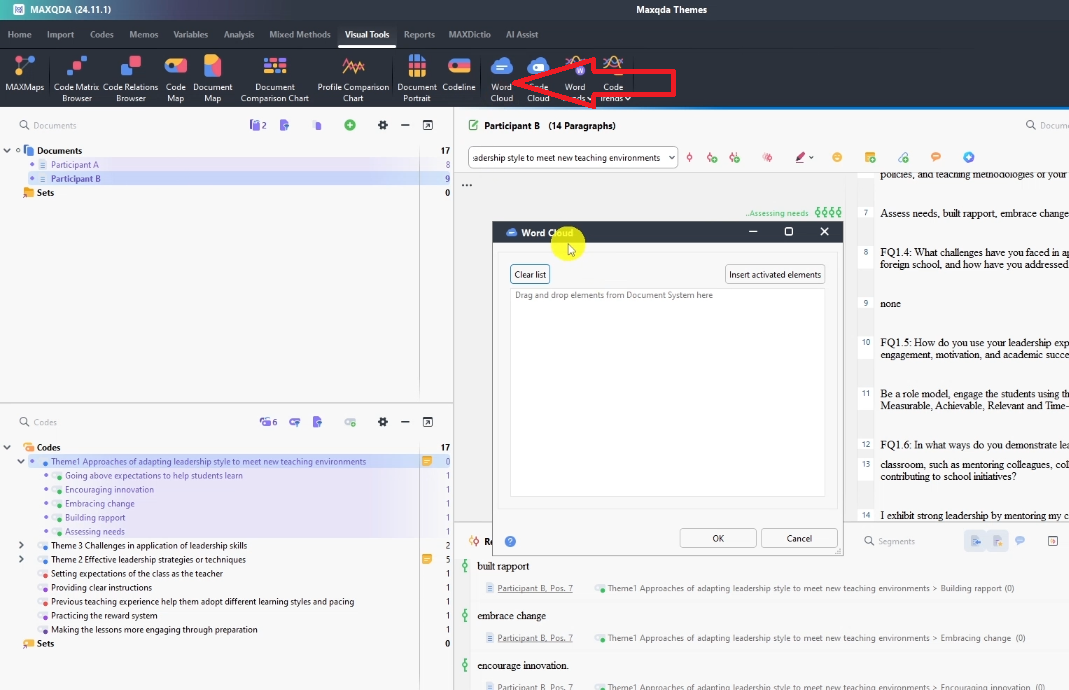
And that’s how you get a word cloud here.
This is the word cloud.
We can right click add to stop word lists.
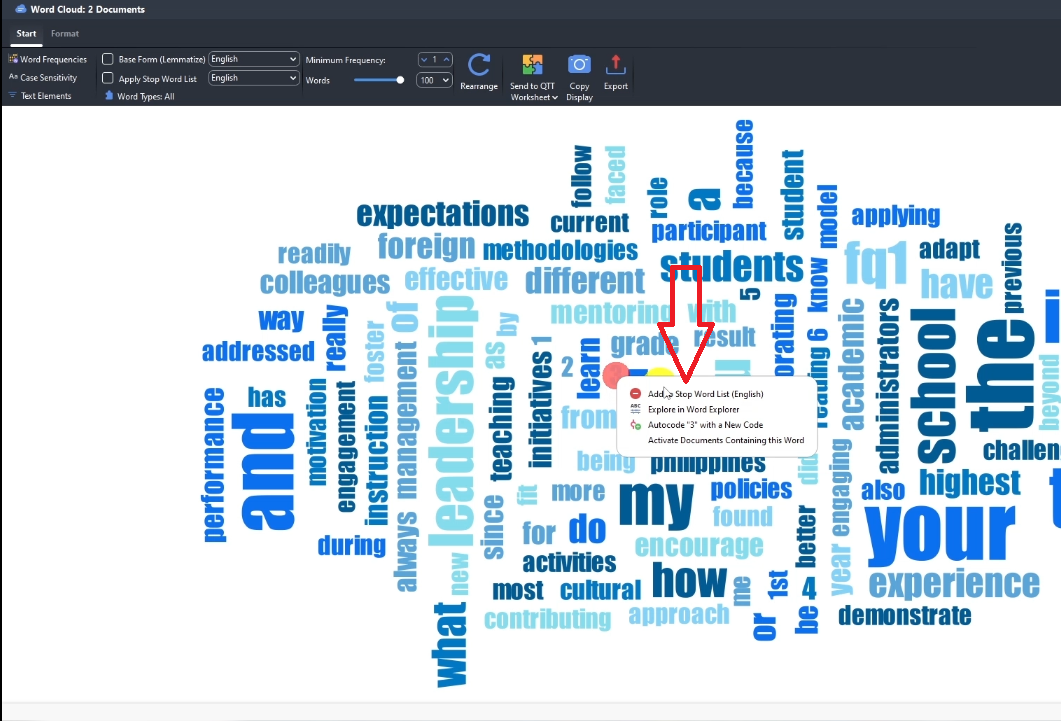
This is how we remove anything we don’t like in our word cloud.
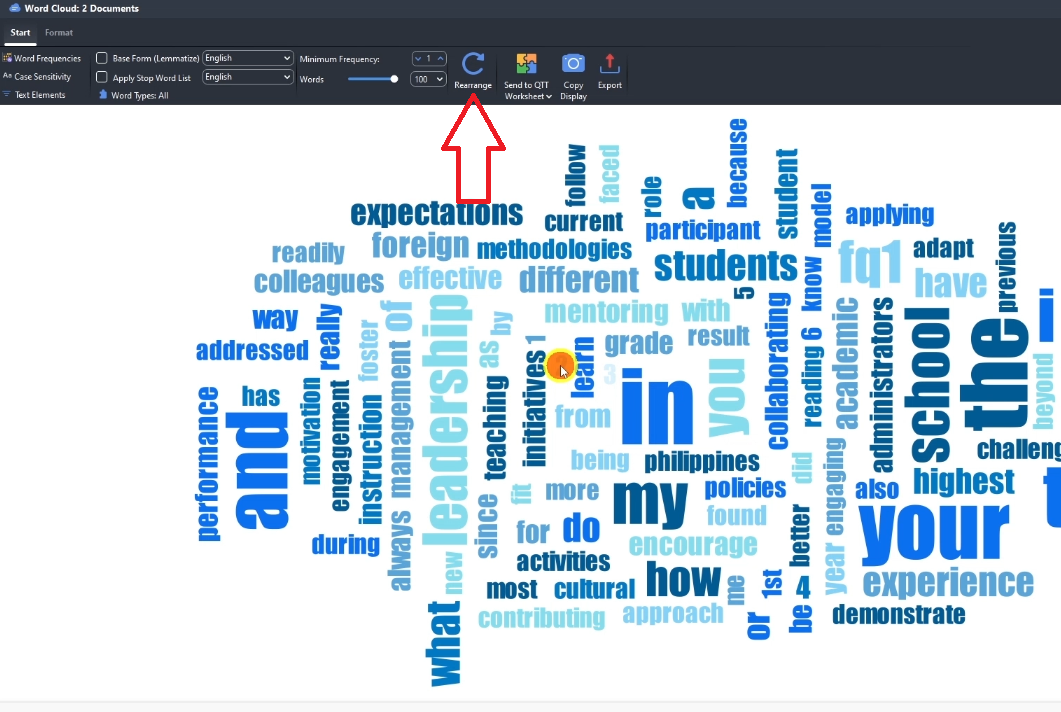
Then we can go to Rearrange and all those letters and numbers that I added to stop words list would just disappear.
Basically that is how we can get different form of visuals and then continue with our narrative.
Summary tips
The tips of reporting findings after conducting thematic analysis in MAXQDA are:
- You have to take your time to describe the data analysis process that you took.
- You have to ensure that you come up with visuals such as tables to show your coding structure, and you have to provide clear descriptions, or narratives to support your themes.
- Then we get the quotes following them.
So basically, these are the main steps that we take to report findings.
You can see that in my report, I also have references.
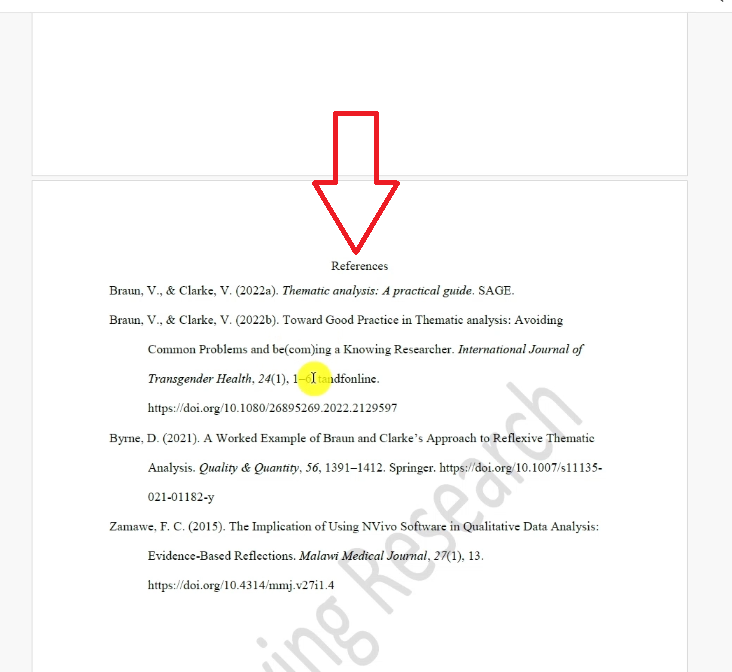
These are for supporting the data analysis process section, which is the first section that I did here.
Inorder to support, we have to cite scholarly sources to support our analysis approach.
So this is how we report findings after conducting thematic analysis in MAXQDA.
![How to Code Qualitative Data in MAXQDA [Step-by-Step Guide]](https://survivingresearch.com/wp-content/uploads/2024/08/Maxqda-Tutorial.webp)
![Is AI Ethical for Qualitative Data Analysis? [Tested]](https://survivingresearch.com/wp-content/uploads/2025/04/Can-I-use-AI-to-do-qualitative-coding-ethically.jpg)
Pingback: Interview Coding in MAXQDA: Step-by-Step Beginner Guide -
Pingback: Reflexive Thematic Analysis in MAXQDA: A Step-by-Step Guide for PhD Students -