

Last Updated on 5 months ago by Grace Nyambura
Inductive vs Deductive Thematic Analysis [Step-by-Step]
| Thematic analysis is a qualitative research method used to identify, analyze, and report patterns — called themes — within a dataset. There are two main approaches: inductive thematic analysis, where themes emerge from the data, and deductive thematic analysis, where themes are defined in advance based on theory or research questions. This guide walks you through both approaches step by step using NVivo 14, with real examples from actual research studies. |
- Inductive vs Deductive Thematic Analysis [Step-by-Step]
- What Is Thematic Analysis?
- Research Philosophy and Thematic Analysis
- When to Use Inductive vs Deductive Thematic Analysis
- Inductive Thematic Analysis: Step-by-Step Example in NVivo
- Deductive Thematic Analysis: Step-by-Step Example in NVivo
- Inductive vs Deductive: Key Differences at a Glance
- Frequently Asked Questions
- Key Takeaways
- Ready to Start Your Thematic Analysis?
What Is Thematic Analysis?
Thematic analysis is one of the most widely used methods for analyzing qualitative data — particularly interview transcripts, focus group discussions, and open-ended survey responses. It involves reading your data carefully, labelling meaningful pieces of information as codes, and then identifying patterns across those codes to produce themes.
The most influential framework for conducting thematic analysis was developed by Braun and Clarke in their 2006 paper, which introduced a clear six-step process that PhD students and researchers worldwide still follow today. This guide applies that framework to both the inductive and deductive approaches.
For a broader introduction to how thematic analysis fits within qualitative research methods, Scribbr’s guide to thematic analysis is an excellent starting point.
Research Philosophy and Thematic Analysis
Before choosing between inductive and deductive thematic analysis, it helps to understand the philosophical position your study sits within. In qualitative research, two philosophies are most relevant: interpretivism and pragmatism. Understanding yours will inform which approach is the better fit — and will matter when your examiner asks you to justify your methodology.
If you want a deeper overview of research philosophy and what it means for your methodology, see my post on the characteristics of qualitative research.

Three research philosophies in qualitative research: positivism, interpretivism, pragmatism
Interpretivism
Interpretivism holds that reality is socially constructed and subjective — different people experiencing the same event can have genuinely different realities. Researchers working within an interpretivist framework seek to understand phenomena through the perspectives of those who experience them, which makes inductive thematic analysis the natural fit. You let the data speak; you do not impose a pre-existing framework onto it.

nterpretivism — reality is subjective and socially constructed, suited to qualitative
Pragmatism
Pragmatism is a more flexible philosophy that acknowledges there are different valid ways of knowing. Pragmatist researchers are guided by what works for their research question — which means they can adopt either inductive or deductive approaches, or even combine them. I personally prefer the pragmatic position because it gives you room to let themes emerge from the data while still using your research questions as a guide for what to code.

Pragmatism research philosophy — uses whatever approach best answers the research question

Pragmatism avoids fixed principles and accepts multiple ways of understanding research
When to Use Inductive vs Deductive Thematic Analysis
The choice between inductive and deductive thematic analysis comes down to your research question and what you already know about your topic.
Use inductive thematic analysis when your research is exploratory. You are asking an open question — “what are the experiences of…?” or “what happens when…?” — and you want the themes to emerge organically from what participants tell you. You have no predetermined framework and are genuinely curious what the data will show.
Use deductive thematic analysis when your research is confirmatory. You are working from an existing theory, a structured interview guide, or prior research and want to assess how well that framework is reflected in your data. The codebook approach is the most common deductive method.
A useful way to distinguish them: inductive analysis is data-driven, deductive analysis is theory-driven.
Inductive Thematic Analysis: Step-by-Step Example in NVivo
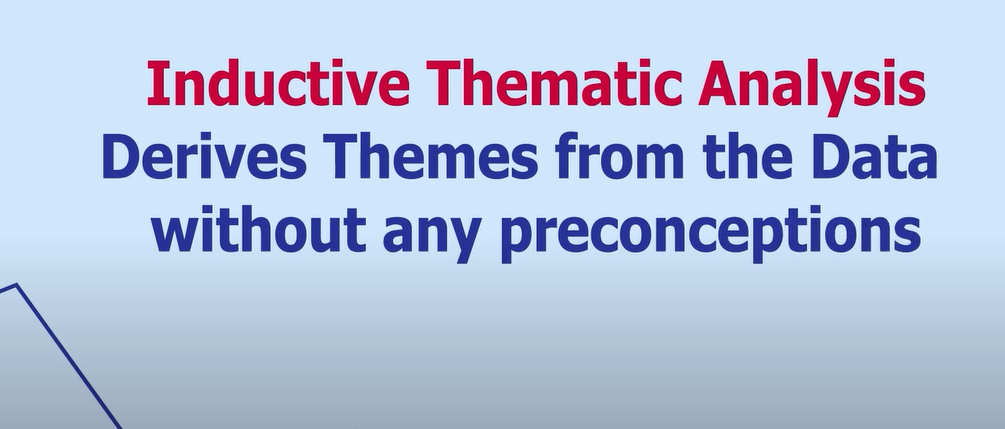
Inductive thematic analysis defined — themes emerge from qualitative data without preconceptions
For this example, I am analyzing transcripts from a study titled “Teachers’ Challenges in Executing Alternatives to Corporal Punishment in Secondary Public Schools.” The research question asks: what are teachers’ experiences of managing discipline without corporal punishment? This is an exploratory question — exactly the right context for an inductive approach.

I use NVivo 15 to manage all my transcripts, codes, and themes. Once you have imported your transcript files into the NVivo Files section, you are ready to begin. If you are new to NVivo, my post on qualitative analysis of interviews in NVivo covers the setup process.

Step 1 — Familiarize Yourself with the Data

Step 1 of Braun and Clarke thematic analysis — familiarizing with interview transcripts
The first step is immersing yourself in the transcripts before coding anything. Open each transcript in NVivo and read it through completely — no skimming, no coding yet. You want to understand the overall shape and tone of the data before you start breaking it into pieces.
If you transcribed the interviews yourself, you have likely already done significant familiarization during that process. For this study, I had two transcripts and read through both before touching the Codes section. I noted early impressions in the NVivo Memos panel but did not start coding at this stage.
I got my transcripts from a website called Figshare.

Figshare website — free repository of qualitative interview transcripts for analysis practice
Step 2 — Generate Initial Codes

Step 2 of inductive thematic analysis — generating initial codes in NVivo 14
Coding is the core analytical act. A code is an interpretive label — a short phrase that captures the meaning or significance of a piece of data. In inductive thematic analysis, codes emerge from the data itself. You are not assigning pre-existing categories; you are discovering what participants are communicating.
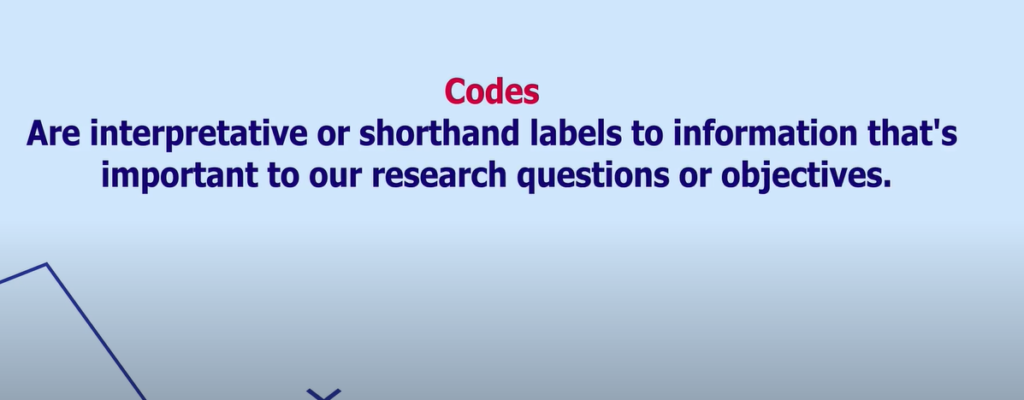
Codes defined — interpretive labels applied to meaningful data in thematic analysis
In NVivo, the process is: open a transcript in the Files section, highlight a meaningful statement, and drag it into the Codes panel. A dialog box appears where you name the code. The coded excerpt is stored inside that code automatically.

Importing interview transcripts into NVivo 14 using the Import button
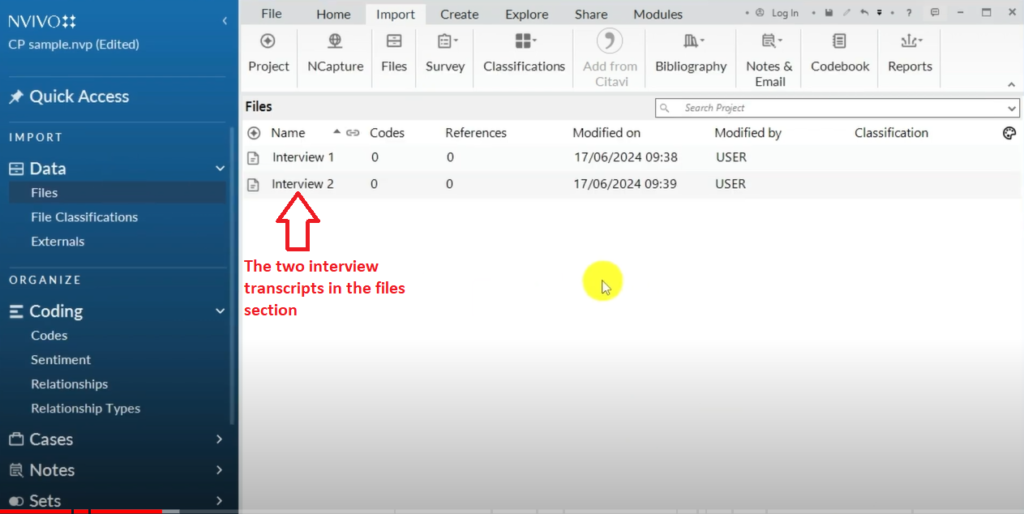
| Two interview transcripts in the NVivo 14 Files section ready for inductive coding |

NVivo 14 Codes section where inductive codes are created during thematic analysis

Transcript excerpt: corporal punishment leads to low self-esteem in students — NVivo 14
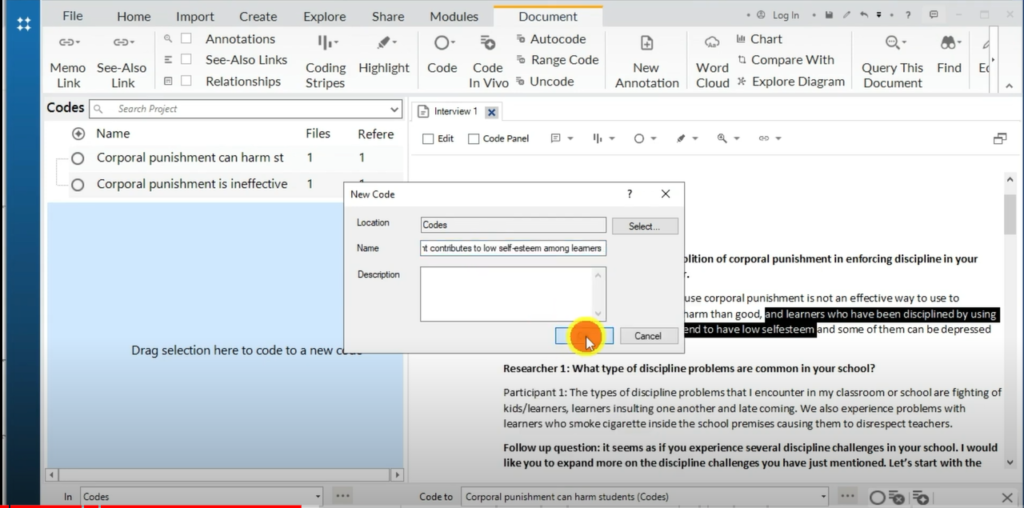
| Creating the code: corporal punishment contributes to low self-esteem — NVivo 14 |
Here are some initial codes I generated from this study’s transcripts:
- Corporal punishment is ineffective in disciplining students
- Corporal punishment can harm students
- Corporal punishment contributes to low self-esteem among learners
- Corporal punishment can lead to depression
- Fighting between students
- Learners insulting one another
- Late coming

All initial codes generated from two interview transcripts in NVivo 14
At this stage, move quickly and code freely. You can always merge, rename, or remove codes later. The goal is to capture as much relevant data as possible before you begin looking for patterns. For a more detailed walkthrough of the NVivo coding mechanics, see my post on qualitative coding in NVivo.
If you would rather have someone else handle the full coding and analysis, my done-for-you NVivo thematic analysis service covers everything from importing your transcripts to delivering a complete findings report.
Step 3 — Generate Initial Themes

Step 3 of Braun and Clarke thematic analysis — generating initial themes from codes in NVivo 14
Once you have coded all your data, look for patterns of shared meaning across the codes. A theme is not just a summary of one code — it is a pattern that spans multiple codes and captures something significant about the research question.
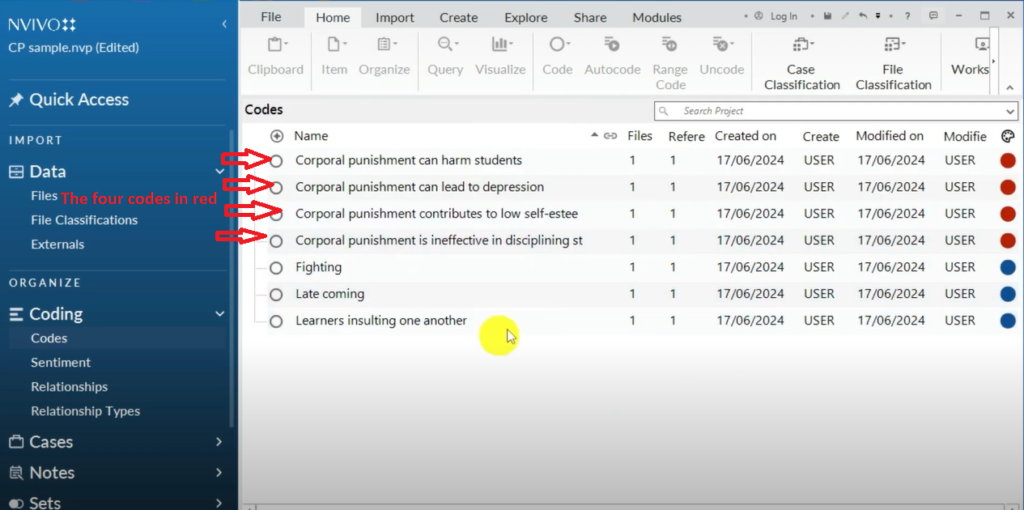
Colour-coded inductive codes in NVivo 14 showing shared pattern of meaning for theme creation
In NVivo, create a new code and name it as a theme. Then drag the relevant codes underneath it. Looking at the codes from this study, I identified two initial themes:
Teacher Support for the Abolition of Corporal Punishment — codes: “corporal punishment is ineffective,” “can harm students,” “contributes to low self-esteem,” “can lead to depression.” All of these share a common meaning: teachers recognizing the negative effects of corporal punishment.
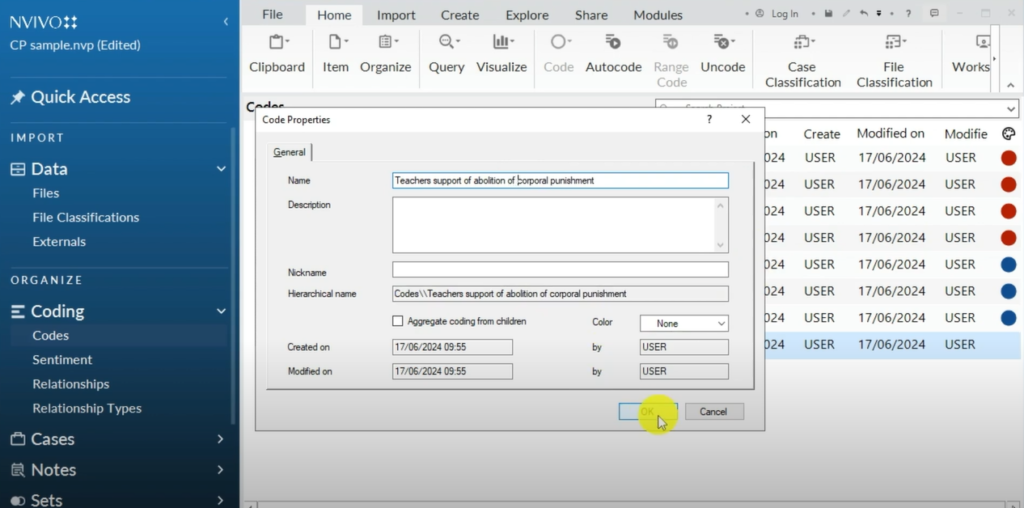
Creating the theme: Teacher Support of Abolition of Corporal Punishment — NVivo 14
Colour-coding is a useful NVivo feature here. Assign the same colour to all codes from the same interview question, which makes it easier to see which codes belong together when generating themes.
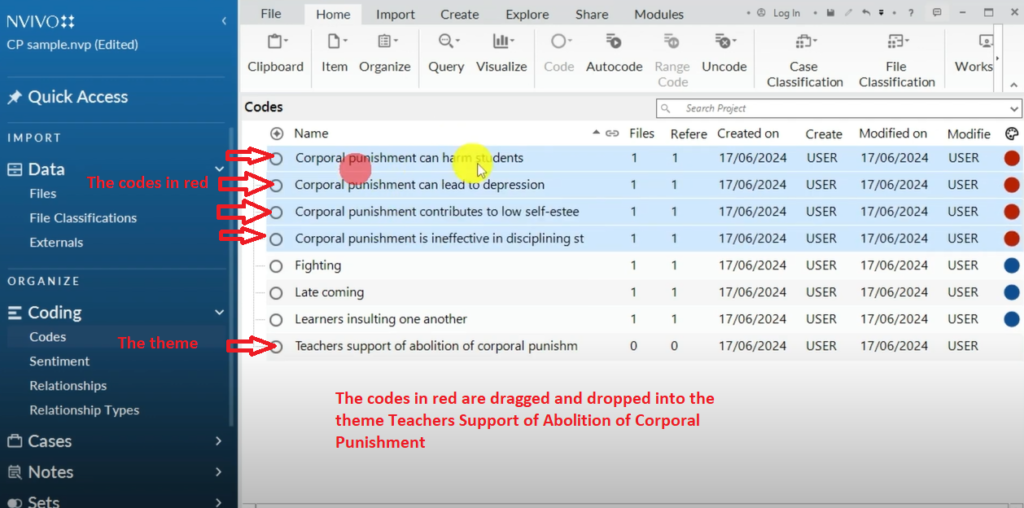
| Red colour-coded codes sharing meaning around corporal punishment — NVivo 14 thematic analysis |
Common Discipline Problems in Schools — codes: “fighting,” “learners insulting one another,” “late coming.” These cluster around the same topic: the types of indiscipline teachers encounter.
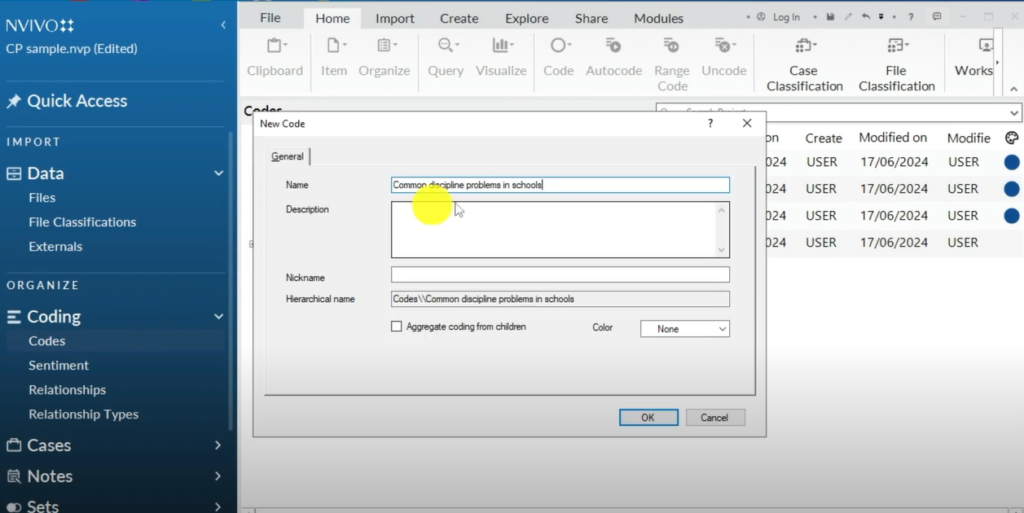
Creating the theme: Common Discipline Problems in Schools — inductive thematic analysis NVivo 14
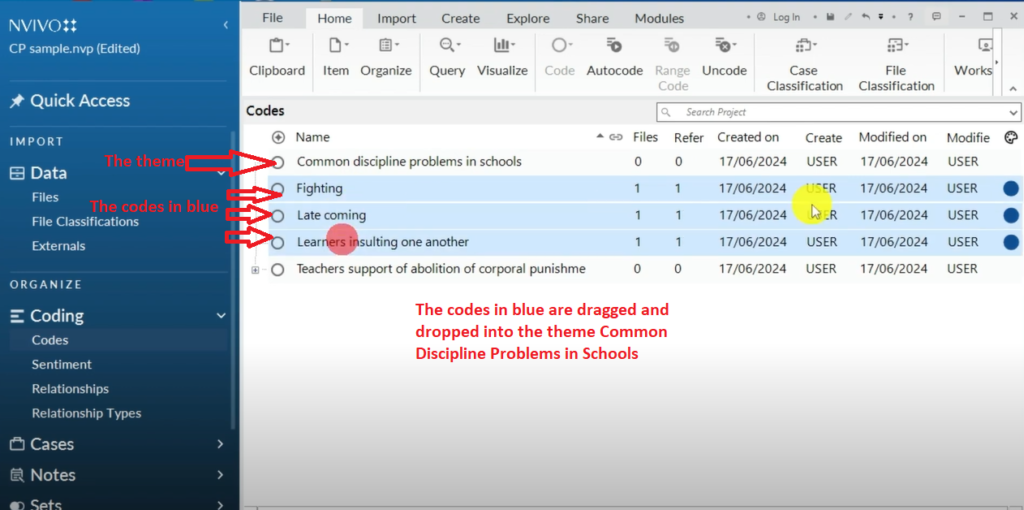
| Blue colour-coded codes dragged into Common Discipline Problems theme in NVivo 14 |
Step 4 — Review and Refine Your Themes
| Step 4 of Braun and Clarke thematic analysis — reviewing and refining themes in NVivo 14 |
Step 4 is where you go back over your themes critically. Ask yourself: do all the codes inside each theme genuinely fit together? Is the theme name accurate? Should any two themes be merged or one split into two?
During this step, you may also discover that some codes can be grouped into sub-themes within a larger theme — creating a hierarchy of theme, sub-theme, and code. In this study, I found that several codes related to how teachers manage discipline could be organized under a theme with two sub-themes: preferred alternatives and challenges. Keep revising until each theme tells a coherent, bounded story.
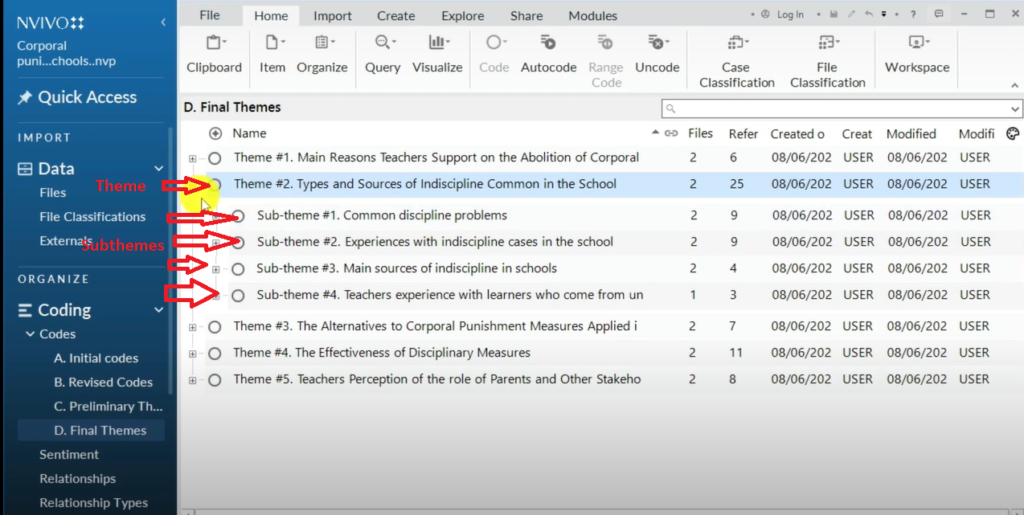
| Themes and subthemes organized in NVivo 14 during Step 4 of inductive thematic analysis |
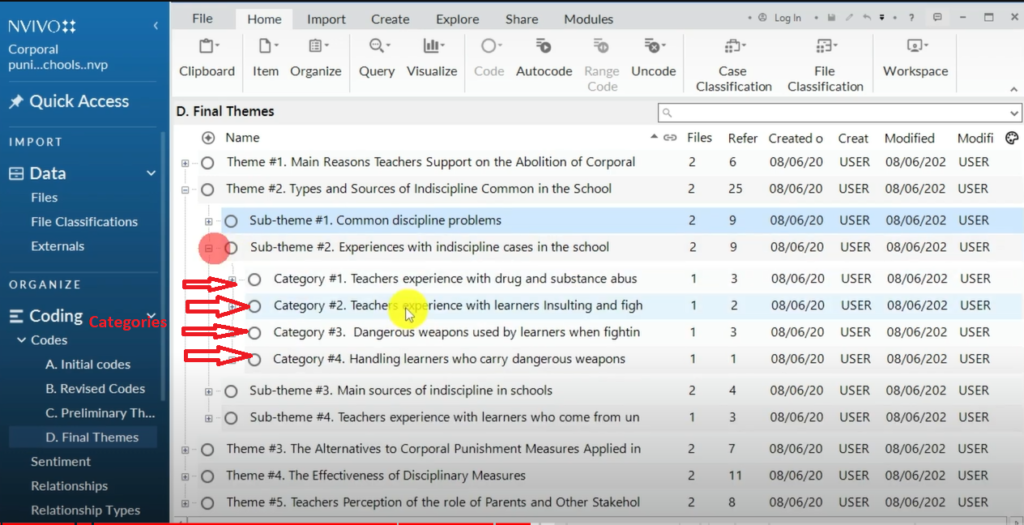
| Categories created during inductive thematic analysis review in NVivo 14 |
Step 5 — Define Your Themes

| Step 5 of Braun and Clarke thematic analysis — defining and naming themes in NVivo 14 |
Step 5 is writing a clear definition for each theme. In NVivo, right-click on a theme, go to Code Properties, and write a short description. This definition guides your writing in Step 6 and demonstrates analytical rigour to your examiner.
For example, I defined “Common Discipline Problems in Schools” as: “This theme captures the types of indiscipline most frequently reported by teachers in secondary schools, including physical aggression between students, verbal misconduct, and punctuality issues.” Every theme should have a definition this precise before you write the report.
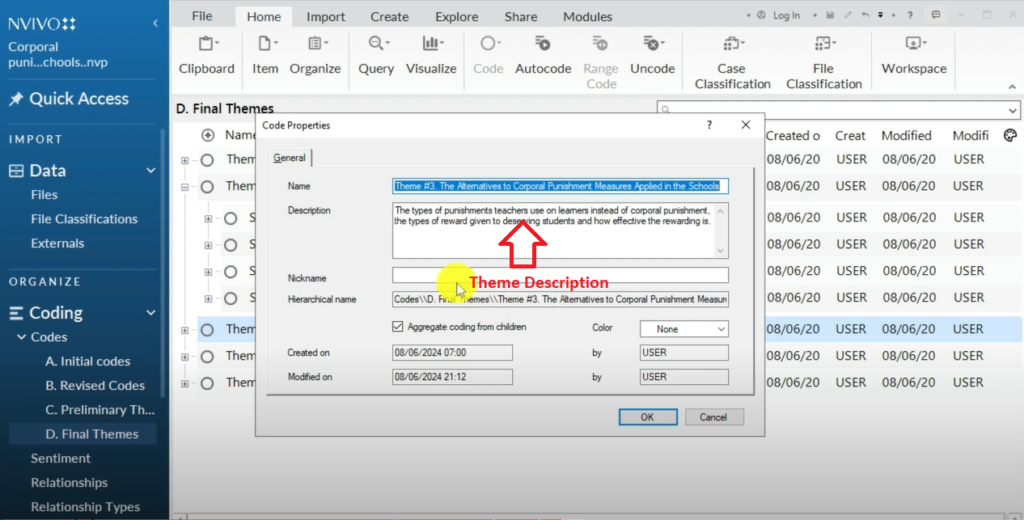
| Theme description written in NVivo 14 Code Properties — Step 5 of thematic analysis |
Step 6 — Write the Findings Report

| Step 6 of Braun and Clarke thematic analysis — writing the qualitative findings report |
The final step is writing your findings chapter — typically Chapter 4 of your thesis or dissertation. The findings report has a clear structure: begin by describing your data analysis process (state that you followed Braun and Clarke’s 2006 six-step framework), then present each theme in turn with a brief description and supporting quotes from participants.
NVivo makes this easier by letting you export your code list and codebook (Share → Export → Export Codebook), which you can include in your appendix. You can also generate visualizations — tables, mind maps, hierarchy charts — directly from NVivo to include in the report body.
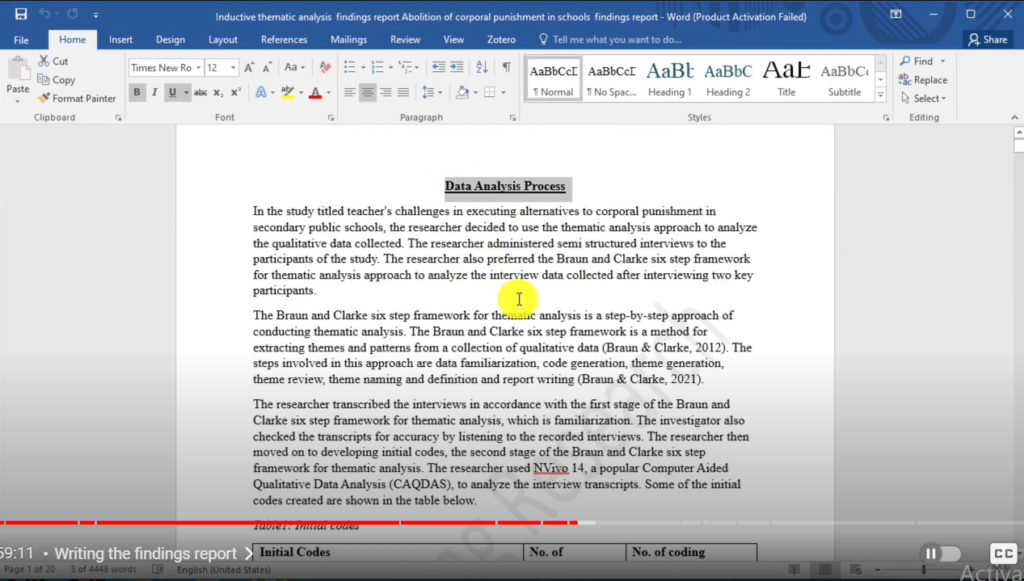
Section of a qualitative findings report produced after inductive thematic analysis in NVivo 14
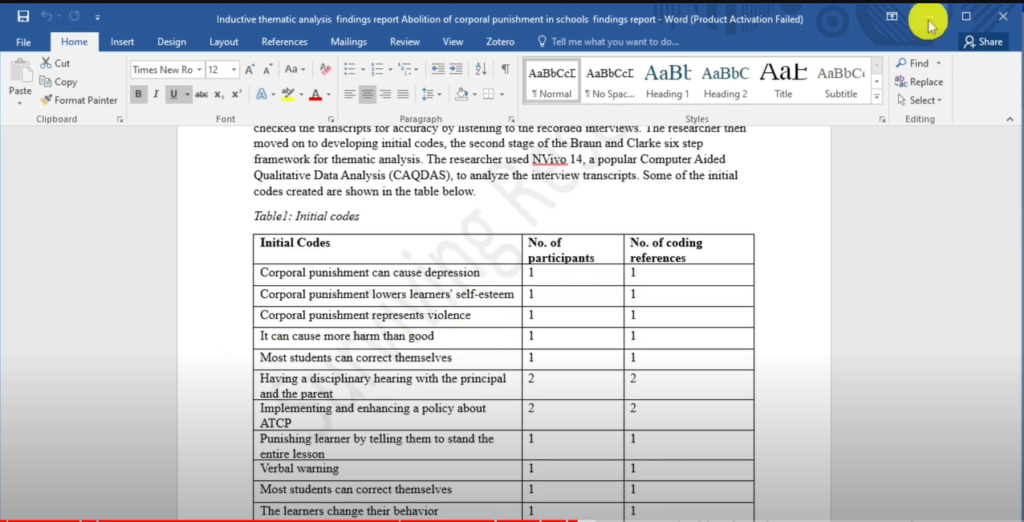
| Sample themes-and-codes table in a thematic analysis findings report exported from NVivo 14 |
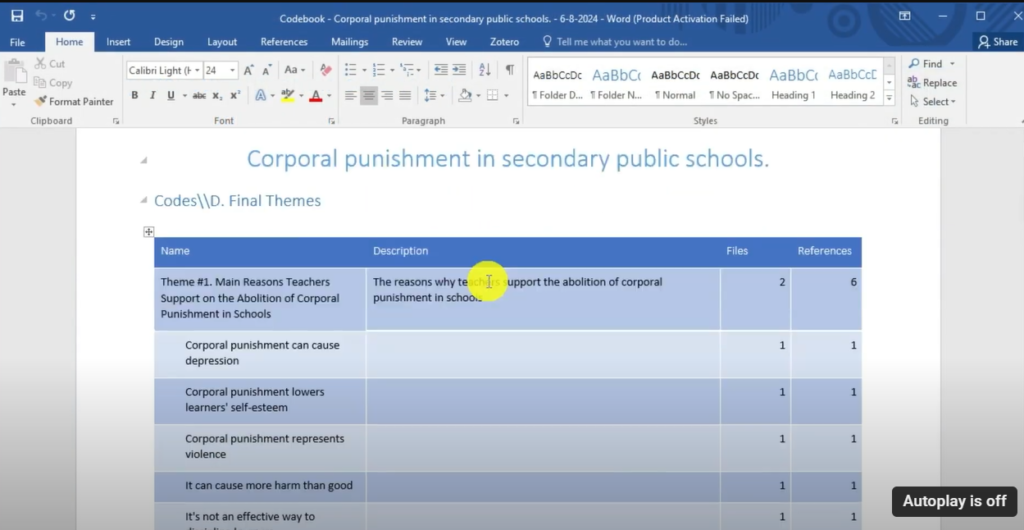
| Codebook exported from NVivo 14 showing inductive themes, codes, and descriptions |
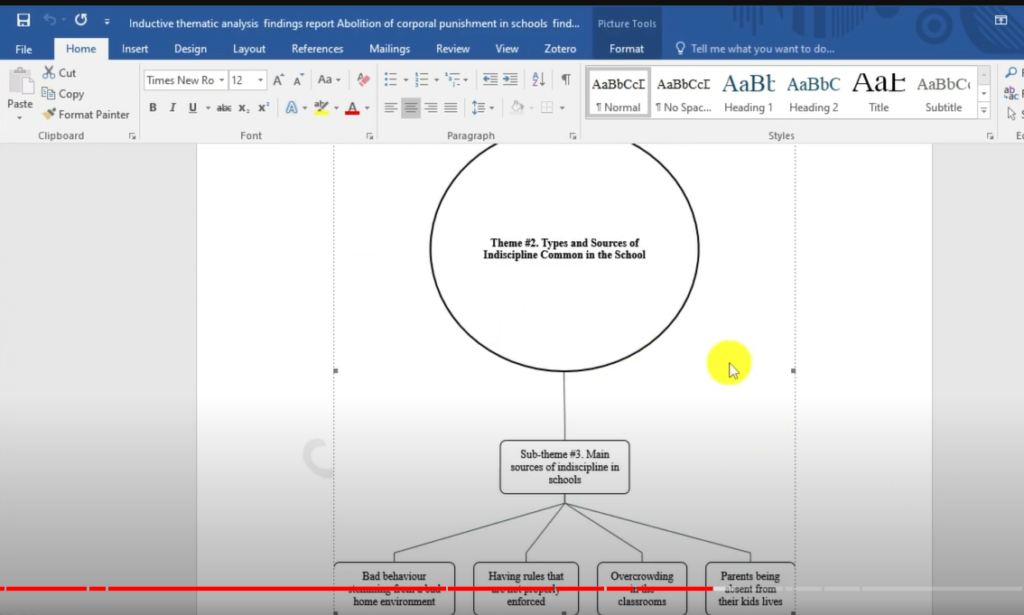
| Mind map visualization of inductive thematic analysis findings in NVivo 14 |
Deductive Thematic Analysis: Step-by-Step Example in NVivo
For the deductive example, I am using a study examining the impact of concurrent verbalization (also called think-aloud protocol) on the writing process. The research was structured around specific interview questions, which makes it a good candidate for a deductive, confirmatory approach.
In deductive thematic analysis, you develop your themes before you touch the data. The themes come from your research questions, existing theory, or prior literature — and you then go into the transcripts to find the codes that fit inside them.
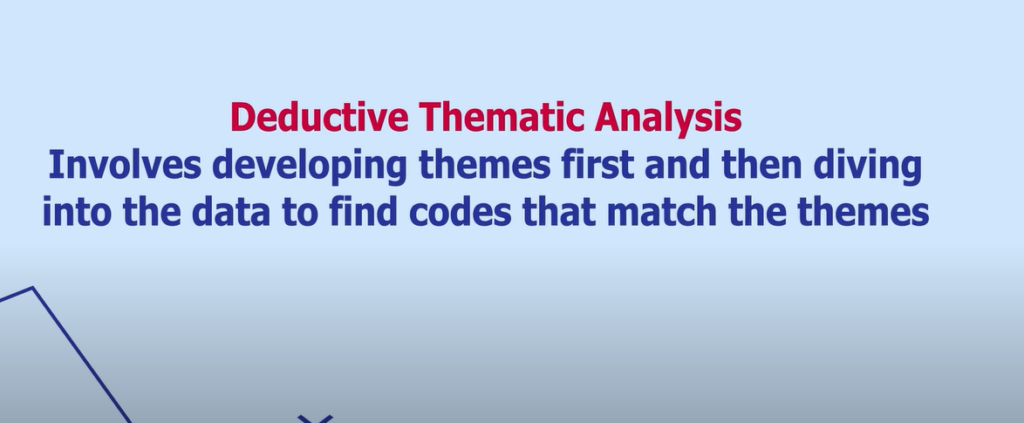
| Deductive thematic analysis defined — predetermined themes applied to qualitative data |
We are going to use the codebook approach to conduct deductive thematic analysis through the following steps:
- Identifying theoretical frameworks or research area.
- Developing coding schemes or codebook, which is made up of themes.
- Developing a clear description of the themes.
- Generating codes and assigning them to themes.
- Reporting the findings
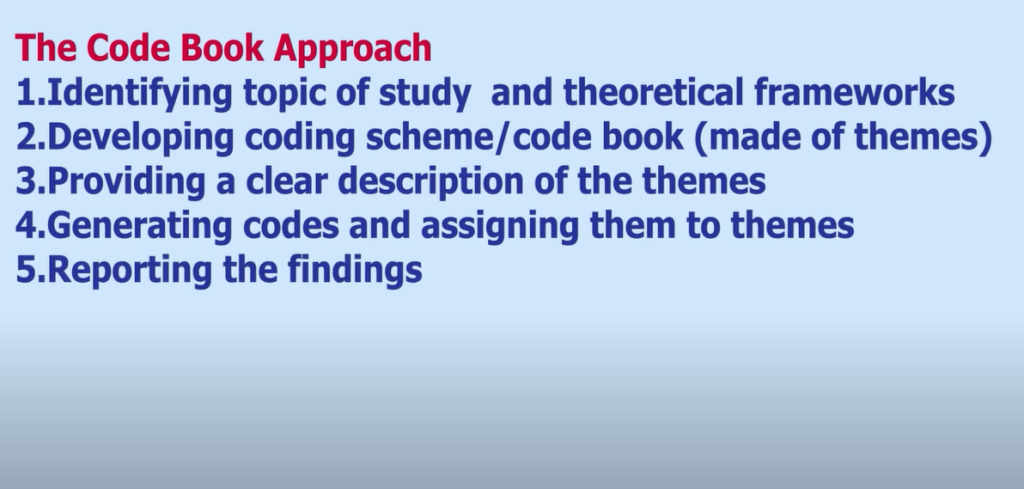
| Codebook approach — example of deductive thematic analysis in qualitative research |
Step 1 — Identify the Topic or Theoretical Framework

Step 1 of codebook approach — identifying the topic or theoretical framework
Start by clarifying what you already know about the phenomenon you are studying. In this case, the researcher is assessing how participants experienced concurrent verbalization — a well-defined, theory-grounded construct. The four research questions asked about: which chapter participants focused on, how the writing went, what challenges they encountered, and any other observations about the process.
These four questions become the basis for the codebook. This is what distinguishes deductive analysis: rather than discovering themes from the data, you define them first from the questions you asked or the theory you are testing.
Step 2 — Develop the Codebook

| Step 2 of deductive thematic analysis — developing the codebook with themes and descriptions |
The codebook is your analytical framework — a list of themes and their definitions, developed before you begin coding. Each theme should have a clear, precise description so that any coder looking at the data can apply it consistently.
For this study, I developed four themes directly from the interview questions:
- Chapters of Focus During Concurrent Verbalization Sessions — captures which chapters participants wrote during the sessions
- Author Experiences Writing a Chapter — captures how participants felt the writing process went
- Challenges Experienced by the Author During the Writing Experience — captures difficulties participants encountered
- Author Experiences During Concurrent Verbalization — captures reflections on the think-aloud process itself
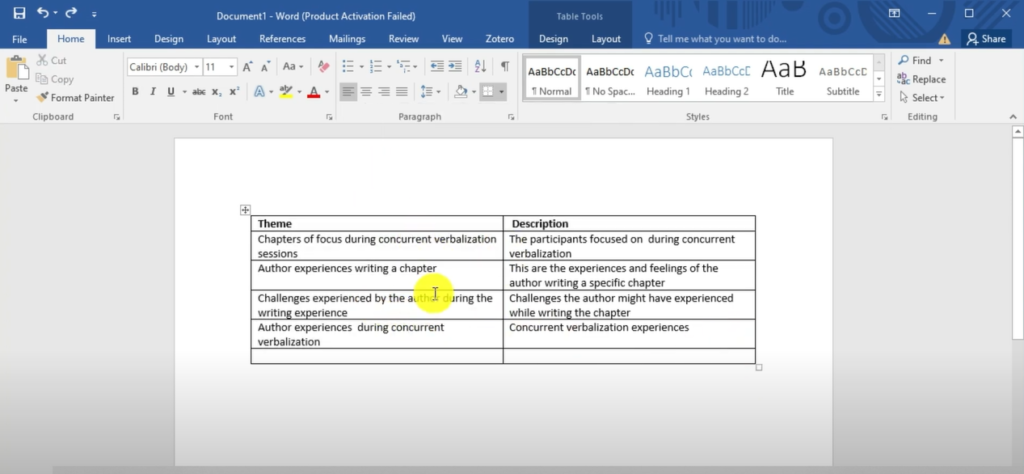
| Complete deductive codebook with four themes and descriptions before data analysis |
Once the codebook is finalized, create these themes in the NVivo Codes section by right-clicking and selecting New Code, then paste the theme name and add the description via Code Properties. At this stage, the Codes section in NVivo is essentially your codebook loaded into the software.
Step 3 — Generate Codes and Assign them to Themes

| Step 3 of codebook approach — generating codes and assigning to themes in NVivo 14 |
With your themes already in NVivo, open your transcript and begin reading. As you identify meaningful statements, drag them into the relevant theme — or right-click, choose Code Selection, navigate to the correct theme, and create a child code within it.
For example, reading the first question response, a participant mentions they focused on the integrity chapter. I create a code “choosing integrity chapter” under Theme 1. Another participant mentions focusing on ethical use of sources — that becomes another code under Theme 1 as a sub-code. A participant’ experience of the writing going well becomes “great experience writing the chapter” under Theme 2.
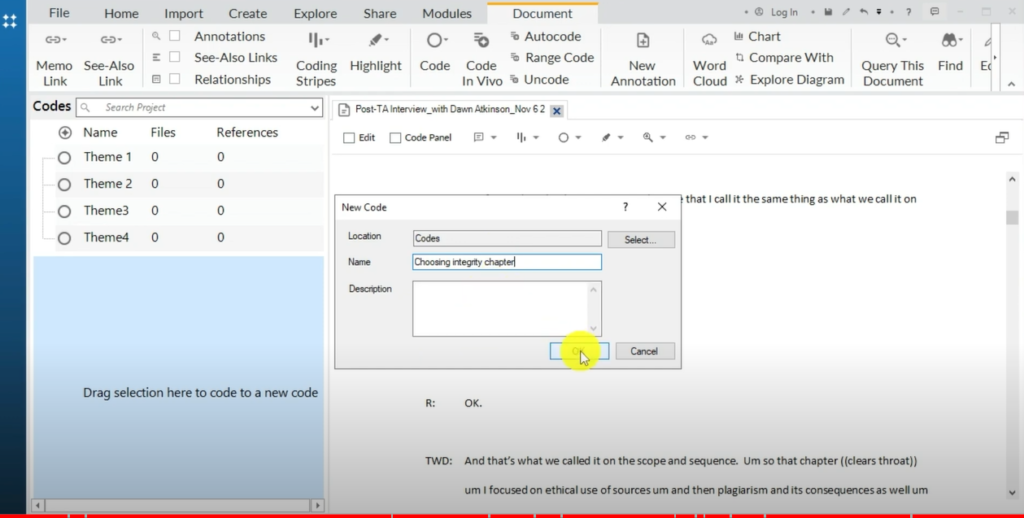
Creating deductive code: choosing integrity chapter under Theme 1 in NVivo 14
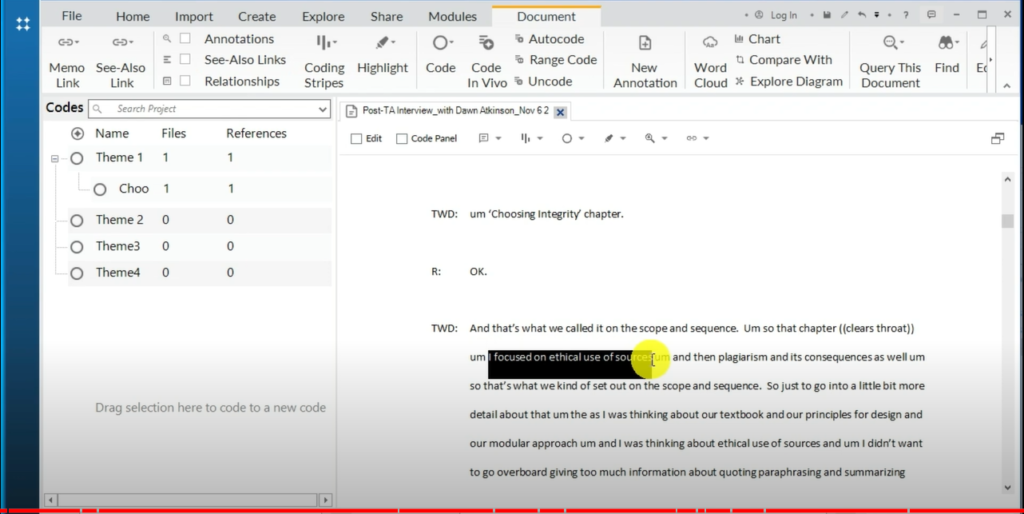
Transcript excerpt about ethical use of sources — deductive coding in NVivo 14
Drag and drop, it’s under issue of focus.
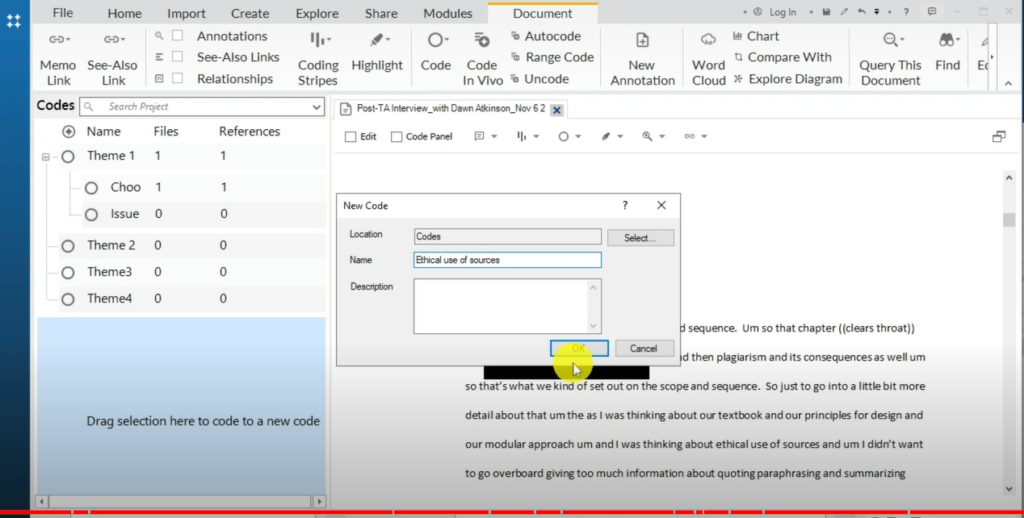
Creating deductive code: ethical use of sources under Theme 1 in NVivo 14
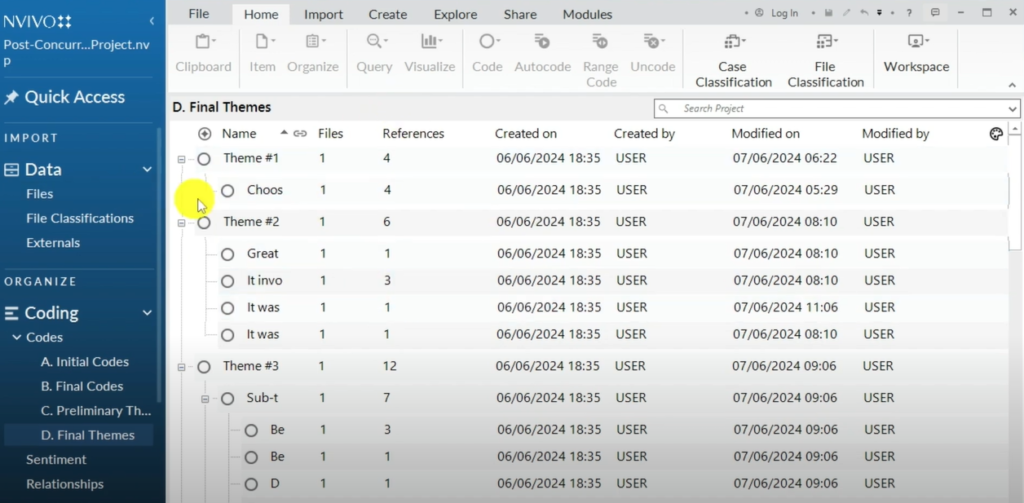
Themes and codes after completing deductive thematic analysis in NVivo 14
The key difference from inductive coding is that you already know where each code belongs before you create it. You are not building the structure — you are populating it.
Step 4 — Report the Findings

Final step of codebook approach — reporting findings after deductive thematic analysis
Reporting deductive findings follows the same structure as inductive findings: describe your data analysis process (state that you used the codebook approach, a form of deductive thematic analysis), then present each theme with its definition, supporting codes, and participant quotes.

| Section of a qualitative findings report from deductive thematic analysis in NVivo 14 |
The main difference in the write-up is that you can explain upfront where each theme came from — your research question or theoretical framework. This demonstrates methodological coherence. Export your code list from NVivo (select all codes, then Export → Export List) and include it as an appendix alongside your codebook.
Inductive vs Deductive: Key Differences at a Glance
| Inductive Thematic Analysis | Deductive Thematic Analysis | |
| Starting point | The data | Theory or prior research |
| Themes come from | Patterns in participant responses | Predetermined coding framework |
| Research type | Exploratory | Confirmatory |
| Example approach | Braun & Clarke reflexive TA | Codebook approach |
| Philosophy | Interpretivism / pragmatism | Pragmatism |
| Best for | Open research questions | Testing specific expectations |
Frequently Asked Questions
Can I combine inductive and deductive thematic analysis?
Yes. A combined approach is sometimes called hybrid thematic analysis. You might start with a deductive framework from theory and then allow new codes to emerge inductively from the data that fall outside your initial themes. This is common in mixed-methods studies and studies where some concepts are well-established but others are unexplored.
Do I have to use NVivo for thematic analysis?
No — you can conduct thematic analysis manually using Word, Excel, or even printed transcripts and highlighters. However, NVivo makes it significantly faster to organize, retrieve, and present coded data, especially for larger datasets. It also makes your analysis auditable, which is important for dissertation examiners.
How many themes should I have?
There is no fixed number. A typical thematic analysis study produces between 3 and 8 themes. Too few suggests your analysis may be too broad; too many suggests you have not done enough merging in Step 4. Let the data (and your research questions) guide you.
Is Braun and Clarke’s framework inductive or deductive?
Braun and Clarke’s reflexive thematic analysis is primarily inductive — the framework does not prescribe what themes you will find. However, it can be applied in a more deductive way if you use your research questions or a theoretical framework to guide the coding. The flexibility is one reason it is so widely used.
Key Takeaways
- Inductive thematic analysis lets themes emerge from the data — it is data-driven, exploratory, and best for open research questions.
- Deductive thematic analysis applies a predetermined framework to the data — it is theory-driven, confirmatory, and best when you already know what themes to expect.
- Both approaches follow Braun and Clarke’s six-step process, but the sequence of theme creation differs: inductive themes come after coding, deductive themes come before.
- NVivo supports both approaches: for inductive work, you build the code structure as you code; for deductive work, you load your codebook into NVivo first, then code to fit it.
- Every theme needs a clear definition before you write the findings report — not just a name.
Ready to Start Your Thematic Analysis?
If you are ready to dig into your data but not sure which approach is right for your study, book a one-on-one consulting session and we can work through your methodology together. I will help you choose the right approach and get your coding started.
If you want the full analysis done for you, my done-for-you NVivo thematic analysis service delivers a complete findings report from your raw transcripts — coded, themed, and written up.
For more on coding specifically, see my guide on qualitative coding in NVivo. And if you are working with MAXQDA instead of NVivo, the same thematic analysis logic applies — take a look at my post on qualitative coding with MAXQDA.
![NVivo Tutorial for Beginners [Step-by-Step Guide]](https://survivingresearch.com/wp-content/uploads/2024/07/Nvivo-for-Beginners.jpg)
Pingback: 9 Best Qualitative Data Analysis Software Tools [Compared] -
Pingback: Thematic Analysis of Interviews in NVivo [Step-by-Step Guide] -
Pingback: Qualitative Analysis with MAXQDA [Complete Tutorial] -
Pingback: 12 Qualitative Coding Mistakes (And How to Fix Them) -