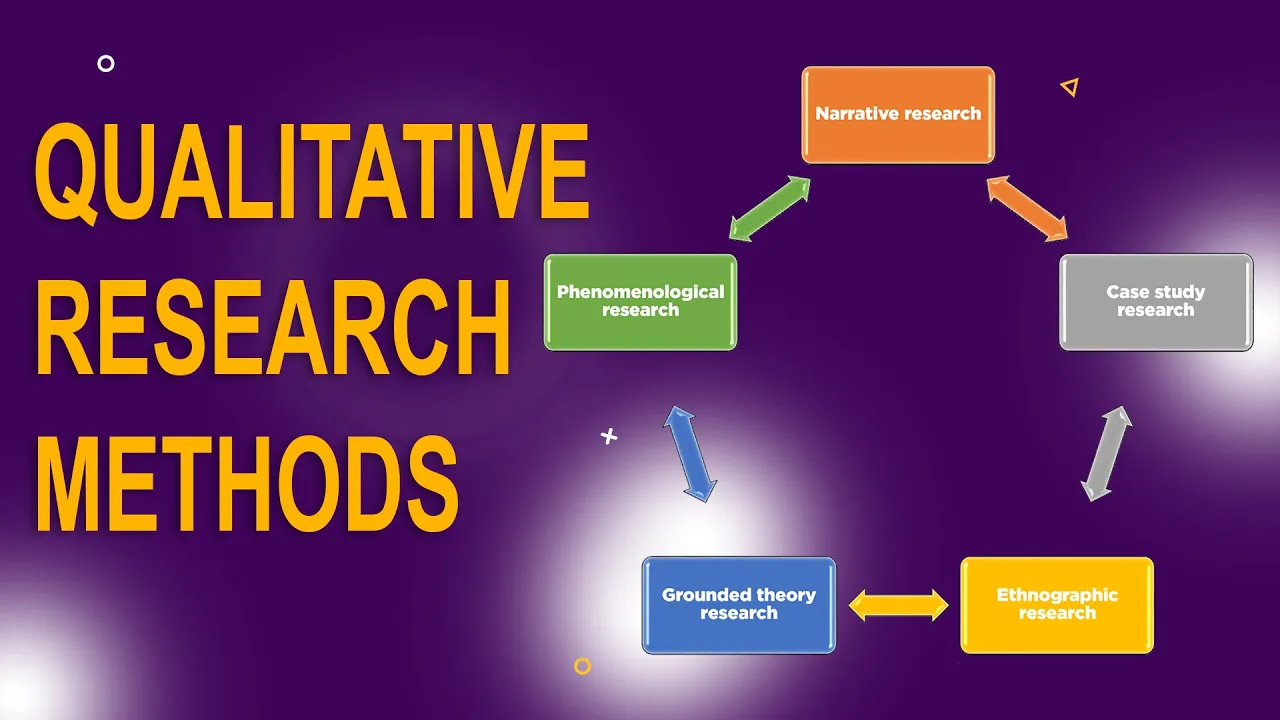


Last Updated on 5 months ago by Grace Nyambura
How to Write the Methodology Chapter for a Qualitative Study
| The methodology chapter for a qualitative study explains and justifies every decision you made about how you conducted your research — from your philosophical assumptions to your data collection tools. The most effective framework to structure this chapter is the Saunders Research Onion, which breaks the methodology into five clear layers that you peel one at a time. |
- How to Write the Methodology Chapter for a Qualitative Study
When you are conducting a qualitative study, you make dozens of decisions — some consciously, some without realising it. These decisions shape everything: how you see reality, how you collect data, and how you make sense of your findings. The methodology chapter is where you surface all of those decisions and explain them to your reader. Get this chapter wrong and your examiners will have endless follow-up questions at your viva. Get it right and you give them a clear, justified account of your entire research process.
Before diving in, if you are still deciding whether qualitative research is the right approach for your study, I recommend reading my post on the characteristics of qualitative research — it covers the core features that distinguish qualitative from quantitative approaches. And if you are comparing both approaches, my post on qualitative vs quantitative data is a good place to start.
What Is the Methodology Chapter in a Qualitative Study?
The methodology chapter — often Chapter 3 in a dissertation — documents your ways of working so that readers can interpret, understand, and evaluate your findings. Think of it as a recipe. Anyone picking up your methodology chapter should be able to follow what you did and understand exactly why you made each choice.
Note that methodology and methods are different things. Methodology is the philosophical reasoning behind your approach. Methods are the specific tools — such as interviews or thematic analysis — that you used. Both belong in this chapter, but they are distinct, and your examiners will notice if you confuse them.
Why the Saunders Research Onion Is the Best Framework to Use
The Saunders Research Onion is a framework developed by Mark Saunders, a respected scholar in the business and management research field. It structures your methodology chapter as a series of layers — like peeling an onion — moving from your broadest philosophical assumptions at the outside all the way to your specific data collection and analysis techniques at the centre.
Using the research onion gives your methodology chapter a clear, logical flow that examiners recognise and trust. Instead of listing methods in a random order, you move through five connected layers, each narrowing your focus from philosophy to practice. The five layers are:
- Research philosophy
- Methodological choices
- Research strategy
- Time horizon
- Techniques and procedures
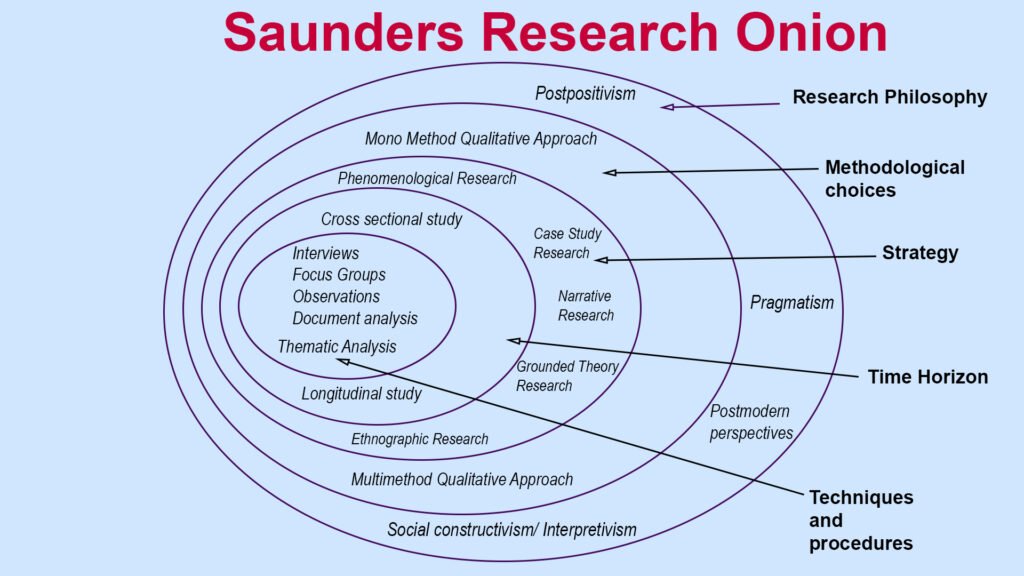
Saunders Research Onion diagram showing five layers used to structure a qualitative study methodology chapter
The 5 Layers of the Saunders Research Onion — Explained
Layer 1 — Research Philosophy
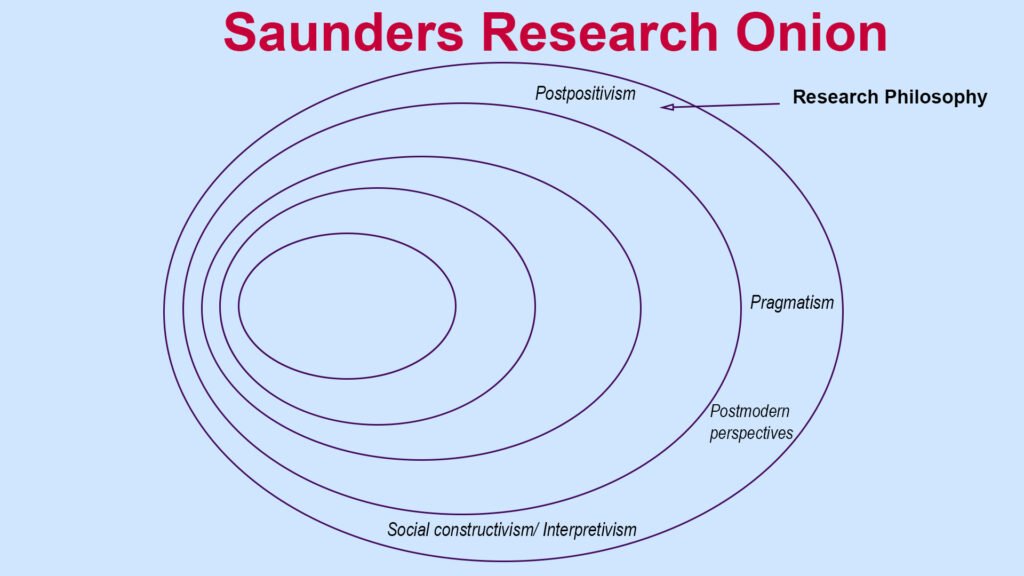
Research philosophy layer of the Saunders Research Onion for writing a qualitative study methodology chapter
Your research philosophy is your foundational worldview — the assumptions you carry about the nature of reality, how knowledge is created, and the role of your values as a researcher. In qualitative research, you will typically adopt one of the following interpretive frameworks:
- Post-positivism
- Social constructivism / Interpretivism
- Pragmatism
- Postmodern perspectives
Most qualitative researchers rely on social constructivism (also called interpretivism). Under this philosophy, your goal is to understand the world as your participants experience it, recognising that reality is multiple and shaped by lived experiences and social interactions.
For a deeper look at how research philosophy shapes your study design, Grad Coach’s guide to research philosophy is a reliable and clear starting point.
Philosophical Beliefs in Social Constructivism
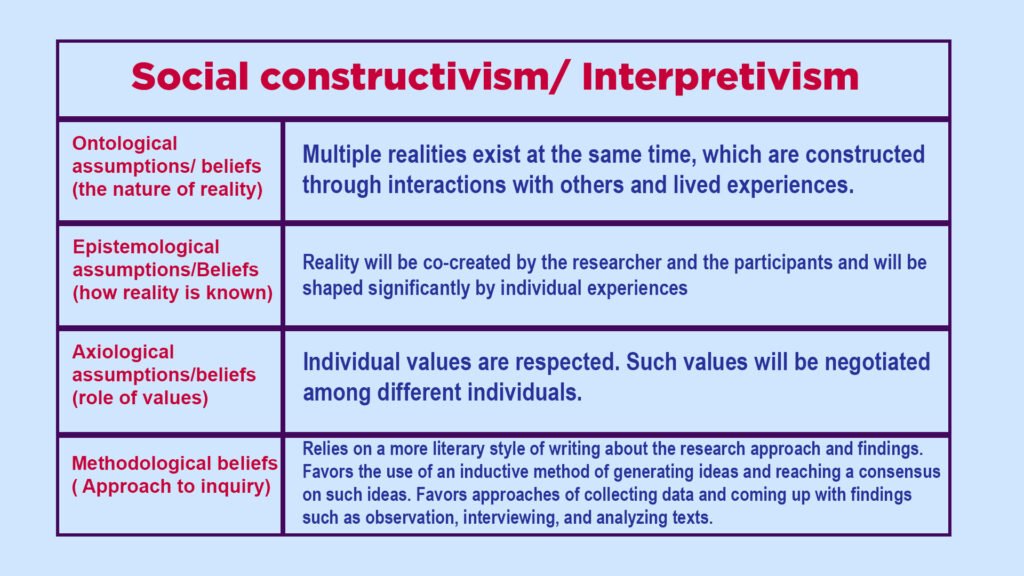
If you adopt social constructivism, here is how your assumptions break down across four dimensions:
- Ontological (nature of reality): Multiple realities exist simultaneously, constructed through interactions and lived experiences.
- Epistemological (how reality is known): Reality is co-created by the researcher and participants and shaped significantly by individual experience.
- Axiological (role of values): Individual values are respected and negotiated. The researcher acknowledges that their own values influence interpretation.
- Methodological (approach to inquiry): Favours inductive, literary, and interpretive approaches — interviewing, observing, and analysing texts.
How to Write About Philosophical Assumptions (With an Example)
Let me show you exactly how to write this section using a worked example. Imagine you are researching the causes of stress among pregnant mothers who are considered a vulnerable group.
Ontological Assumptions:
“In this study, the researcher adopted an ontological stance that reality is multiple and can be experienced in different ways. The experiences of different mothers regarding the causes of stress during pregnancy were therefore considered and reported individually.”
Epistemological Assumptions:
“The researcher sought subjective evidence from participants, establishing a close connection with them in order to understand their experiences. Audio recording was used to capture participant responses, and participant quotes are presented throughout the findings as evidence.”
Axiological Assumptions:
“The researcher acknowledged that biases are present because of the subjective experience of both participants and the researcher. Having worked previously with pregnant women, the researcher recognised that past experiences could influence interpretation of the data.”
If you find this section difficult to articulate without guidance, my qualitative analysis consulting service is designed specifically to help PhD students like you work through these philosophical decisions confidently.
Layer 2 — Methodological Choices
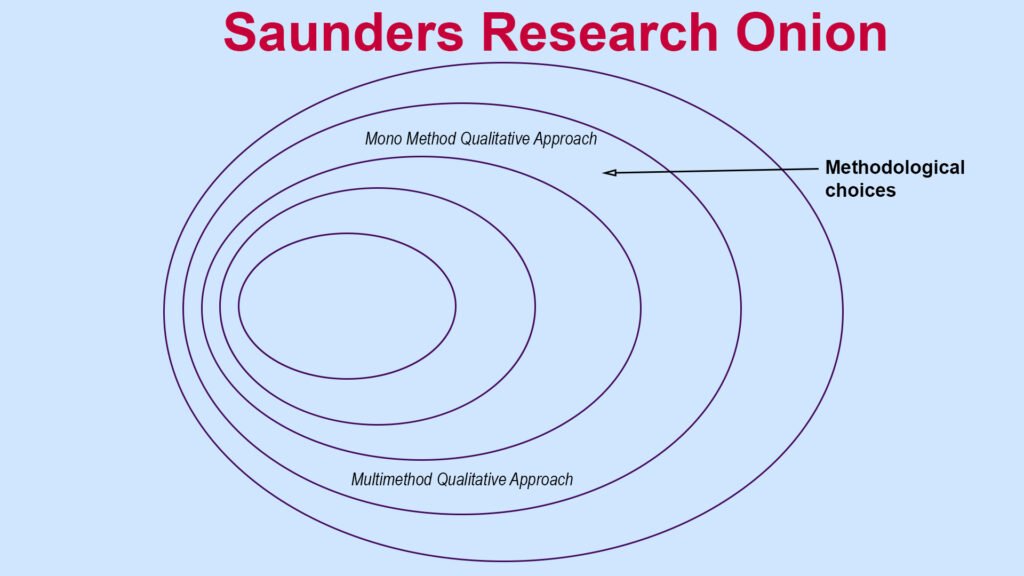
Methodological choices layer of Saunders Research Onion showing mono-method and multi-method qualitative approaches
Once you have established your philosophy, you decide how you will collect your data. In qualitative research, there are two broad methodological choices:
- Mono-method qualitative approach: You use a single data collection method — for example, only interviews, only focus groups, or only observations.
- Multi-method qualitative approach: You use more than one data collection method and triangulate findings across sources — for example, interviews combined with document analysis and observations.
Layer 3 — Research Strategy

Research strategy layer of Saunders Research Onion showing five qualitative approaches including phenomenology and case study
Your research strategy is the design framework that shapes how you gather and interpret data. There are five main qualitative research strategies:
- Phenomenological research — focuses on the lived experience of a specific phenomenon, seeking the universal essence of experience shared across participants. Example: studying the common experience of grief, anger, or undergoing surgery.
- Grounded theory — aims to generate a theory grounded in participant data, moving beyond description to explain why a phenomenon occurs. The theory is literally grounded in the data provided by participants.
- Ethnographic research — involves immersive, extended observation of a cultural group. The researcher studies shared patterns of behaviour, language, values, and beliefs through participant observation and interviewing.
- Case study research — examines a single bounded system in depth. A case can be an individual, an organisation, a project, or a community. Data is collected through multiple sources: interviews, documents, and observations.
- Narrative research — highlights individual experiences as told through stories. The researcher focuses on one or two participants, gathering their narratives and organising them chronologically.
Choose the strategy that best answers your research question and justify that choice explicitly in your chapter.
Layer 4 — Time Horizon
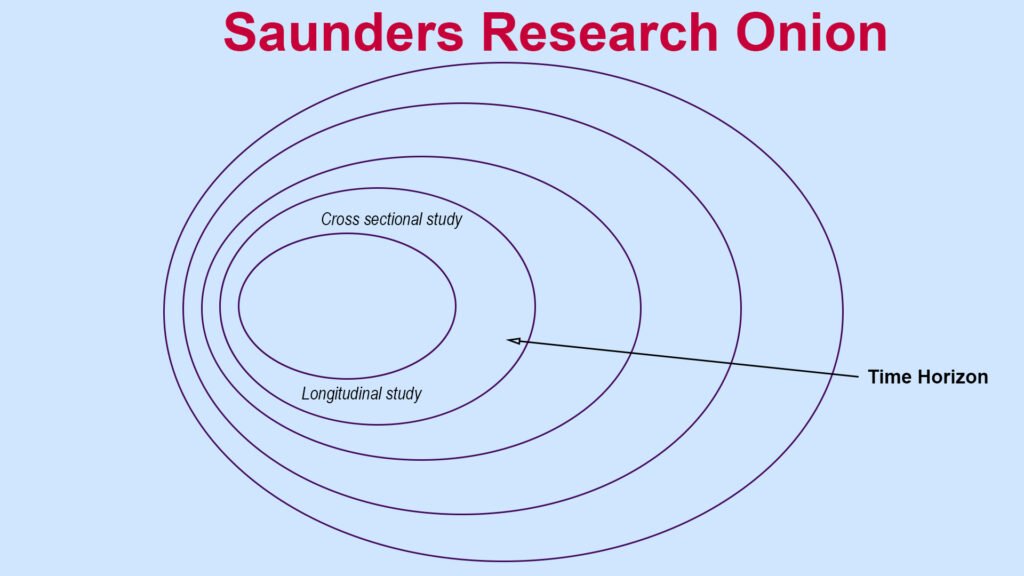
The time horizon describes the period over which you collect your data. In qualitative research, two alternatives exist:
- Cross-sectional study: Data collected within a short, defined period — a few weeks or a month. This is the most common time horizon in qualitative dissertations because of the large volume of data generated.
- Longitudinal study: Data collected over an extended period — years or decades. Less common in student dissertations but appropriate when studying change over time.
State which time horizon you used and link it clearly to your research design and research questions.
Layer 5 — Techniques and Procedures
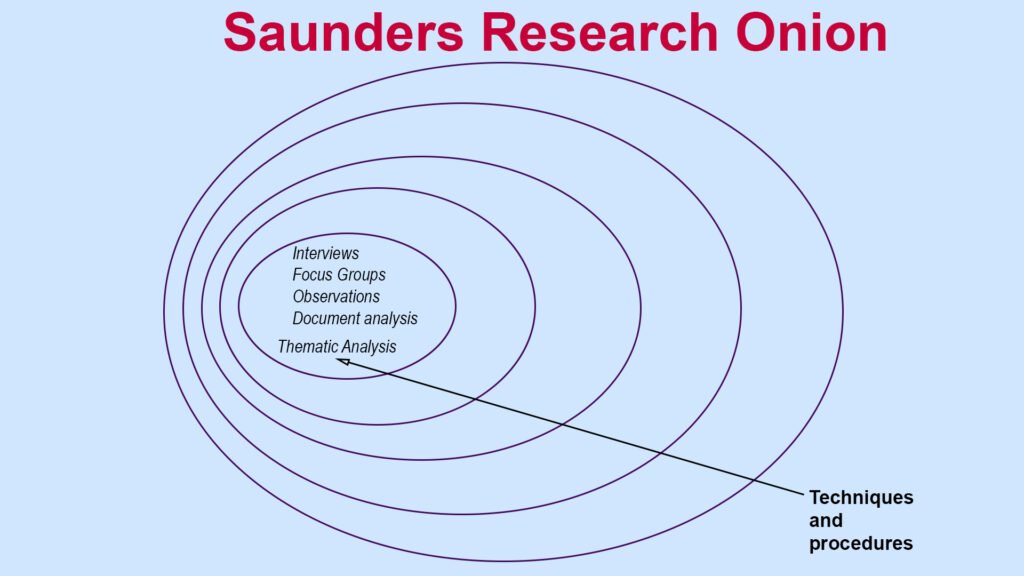
This innermost layer covers the specific tools you used to collect and analyse data — the most concrete and practical layer of the research onion.
Data Collection Methods
There are four main qualitative data collection methods:
- Interviews — a social interaction based on conversation about a given topic, during which knowledge is constructed through the exchange between researcher and participant. Semi-structured interviews are most common in PhD research.
- Focus groups — a group discussion exploring participants’ attitudes, feelings, or experiences toward a topic. Participants interact with each other, generating richer group dynamics than individual interviews.
- Observations — systematic recording of phenomena in field settings using the researcher’s senses and a note-taking instrument. Observations capture behaviour as it naturally occurs, without relying on self-report.
- Document analysis — examination and interpretation of printed or electronic documents to identify key themes, topics, and meanings. Used when existing records are the primary data source.
For step-by-step guidance on preparing for data collection, my post on how to conduct a qualitative research interview covers everything you need before your first session.
Data Analysis
Data analysis is the final and often most challenging component of the methodology chapter. You need to name your approach precisely — vague references to “thematic analysis” are not enough. Explain whose framework you used and how you applied it step by step.
The two most common qualitative data analysis approaches are thematic analysis and content analysis. Under thematic analysis, you can adopt an inductive approach — such as Braun and Clarke’s six-phase reflexive thematic analysis framework — or a deductive approach, such as the codebook method.
If you used qualitative analysis software, state it explicitly and clarify that the analytical decisions remain yours — the software is a tool, not an analyst. For a full walkthrough of applying thematic analysis in NVivo, see my post on inductive thematic analysis using NVivo. For MAXQDA users, I cover thematic analysis in MAXQDA step by step.
Frequently Asked Questions
What is the difference between methodology and methods?
Methodology is the philosophical reasoning behind your research approach — it explains why you made the choices you made. Methods are the specific tools you used, such as semi-structured interviews or thematic analysis. Both belong in Chapter 3, but they answer different questions.
Do I need to justify using qualitative research?
Yes. You must explain why a qualitative approach is appropriate for your research questions — typically because you are exploring meaning, experience, or social phenomena that cannot be measured numerically.
Can I reference the Saunders Research Onion in my methodology chapter?
Yes, and I recommend it. Cite Saunders, Lewis, and Thornhill’s Research Methods for Business Students (the edition your library holds). The research onion is an examiner-recognised framework that gives your chapter a clear, logical structure.
What referencing style should I use?
Use whatever style your institution requires — APA 7th is most common in qualitative research. Key sources to cite include Saunders et al. for the research onion, Braun and Clarke (2006/2022) if you used thematic analysis, and Lincoln and Guba (1985) for trustworthiness criteria.
How do I justify my sample size?
Qualitative research is not about statistical representativeness. Justify your sample size by referencing data saturation — the point at which new interviews stop generating new themes. You can cite Guest et al. (2006) or Fusch and Ness (2015) to support your decision.
Key Takeaways
- The methodology chapter justifies every research decision — it is not a list of what you did, but an explanation of why you did it.
- The Saunders Research Onion gives you a logical five-layer structure: philosophy → methodological choices → strategy → time horizon → techniques and procedures.
- In qualitative research, most researchers adopt social constructivism — the assumption that reality is multiple and shaped by lived experience and social interaction.
- Name your data analysis method precisely. Vague references to ‘thematic analysis’ are insufficient. Name the framework, the phases, and how you moved from codes to themes.
- If you used NVivo or MAXQDA, say so — and clarify that the analytical decisions remained yours.
- Methodology and methods are different. Both belong in Chapter 3, but they answer different questions.
Need Help Writing Your Methodology Chapter?
Writing the methodology chapter is where many PhD students get stuck — especially when it comes to articulating philosophical assumptions or explaining data analysis in enough detail for examiners. If you need support:
- For one-to-one guidance on your methodology, research design, or data analysis, book a consulting session with me and we will work through it together step by step.
- If you would rather hand off the analysis entirely so you can focus on writing, my done-for-you qualitative analysis service covers everything from coding to final output.