

Last Updated on 1 week ago by Bernard Mugo
Picture this: you’re sitting in your defense, and your examiner looks up and says, “Your method doesn’t match your design.” That moment almost always traces back to one small decision you made months earlier.
In this guide, I’ll show you how to design a qualitative study in 13 steps across four phases, from choosing your topic to writing up your findings, plus the one mistake at each step that sends students back to square one.

Quick answer: To design a qualitative study, you (1) define a focused research problem, (2) write open “how” and “what” research questions, (3) choose a research paradigm, (4) pick a qualitative design, (5) review the literature, (6) sample purposefully, (7) secure ethics approval, (8) collect data, (9) transcribe and store it securely, (10) code the data, (11) develop themes, (12) establish trustworthiness, and (13) write up your findings.
My name is Bernard Mugo. Over the past four or so years, I’ve helped more than 400 PhD students master qualitative research, and these are the exact steps I walk them through.

- Why Qualitative Research Design Is a Loop, Not a Straight Line
- Phase 1: Designing Your Qualitative Study (Steps 1–5)
- Phase 2: Getting Into the Field (Steps 6–9)
- Phase 3: Analyzing Your Qualitative Data (Steps 10–11)
- Phase 4: Writing Up Your Qualitative Study (Steps 12–13)
- Frequently Asked Questions
- Key Takeaways
- Get Expert Help With Your Qualitative Data Analysis
Why Qualitative Research Design Is a Loop, Not a Straight Line
The qualitative research process is iterative: you collect some data, analyze it, reflect, and let what you learn shape your next move. Most people picture it as a straight line where you plan, collect, analyze, write up, and you’re done. To be fair, that’s how I pictured it when I started too.
Here’s what nobody tells you. The students who treat it like a straight line are the ones who finish 30 interviews, sit down to analyze, and only then realize their questions were never going to give them what they needed.
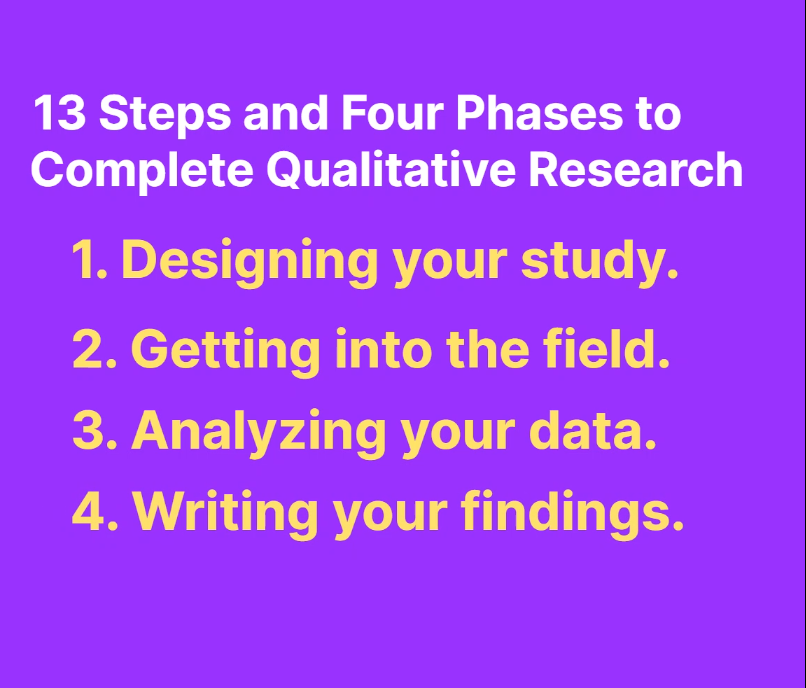
That’s why I’ve broken qualitative research design into 13 steps grouped into four phases:
- Phase 1: Designing your study (Steps 1–5)
- Phase 2: Getting into the field (Steps 6–9)
- Phase 3: Analyzing your data (Steps 10–11)
- Phase 4: Writing your findings (Steps 12–13)
If you’re new to the field, it helps to first understand the core characteristics of qualitative research before you start designing.
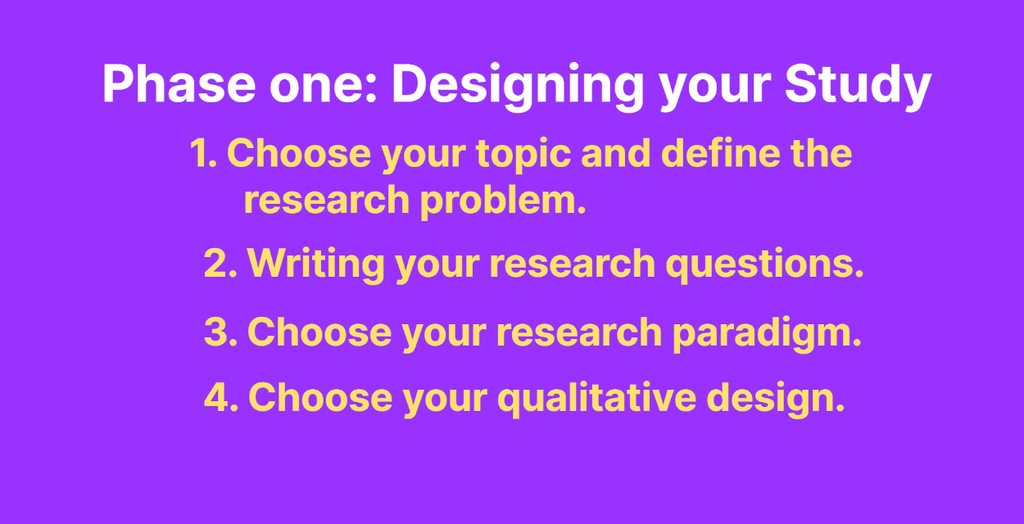
Phase 1: Designing Your Qualitative Study (Steps 1–5)
The first phase of designing a qualitative study is about making five decisions that everything else depends on: your problem, your questions, your paradigm, your design, and your literature.
Step 1: Choose Your Topic and Define the Research Problem
Your research problem is the specific gap in knowledge your study sets out to fill. Everything starts with something you’re curious about, but you have to shape that curiosity into a research problem.
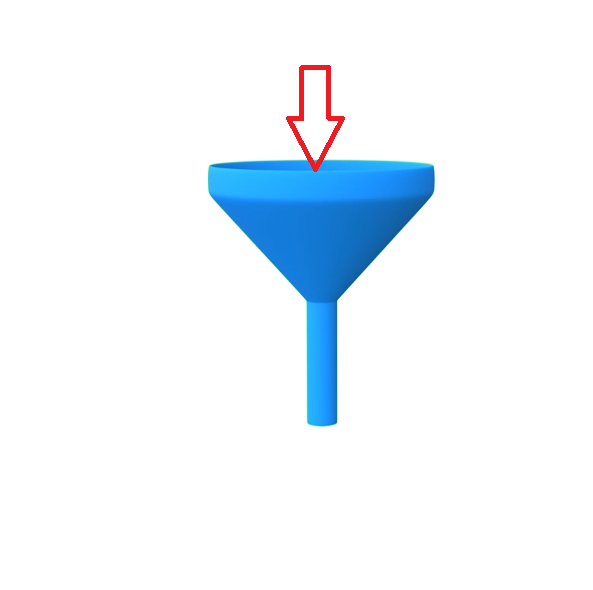
Think of it like a funnel:
- Top of the funnel: the broad context, or what we already know about your topic.
- Middle of the funnel: what we don’t know. This is the research gap your study should focus on.
- Bottom of the funnel: the purpose of your study, which is to fill that gap.
Common mistake: choosing a topic that’s far too broad. “Eating disorders” is not a research topic. “How young women recovering from an eating disorder use social media” is. One is a huge subject area; the other is a narrow focus you can actually study.

Step 2: Write Your Qualitative Research Questions

Qualitative research questions are about meaning: how people experience something and how they make sense of it. Aim for one central question with three to five sub-questions beneath it.

Watch your verbs. Qualitative questions use words like explore, understand, and describe. Words like affect, cause, and prove belong to quantitative research.
So if your question is “Does intervention X increase Y?”, I’m sorry, but that’s a quantitative question.

The good news: in qualitative research, your questions are allowed to evolve as your study progresses.
Step 3: Choose Your Research Paradigm
A research paradigm is simply what you believe about reality and how we come to know about it. When some students hear “research paradigm,” they start to worry, but bear with me, because getting this right saves you headaches later.
For most qualitative studies, the paradigm is interpretivism. In plain terms, interpretivism holds that there is no single truth out there. Different people experience the same phenomenon in different ways, so your job is to build an understanding of that phenomenon together with your participants. Scribbr’s overview of qualitative research is a helpful companion if you want more background on these philosophical foundations.
Common mistake: stating an interpretivist paradigm in your methodology chapter, then claiming objective findings that can be generalized to larger populations.
That’s a contradiction. Interpretivist research is context-specific, and its results aren’t meant to be generalized. Whatever paradigm you choose, everything else in your study must align with it. Grad Coach’s explainer on research philosophy has plain-English examples if you want to compare paradigms.
Step 4: Choose Your Qualitative Research Design
If your paradigm is your worldview, your qualitative research design is the blueprint. There are five main designs:
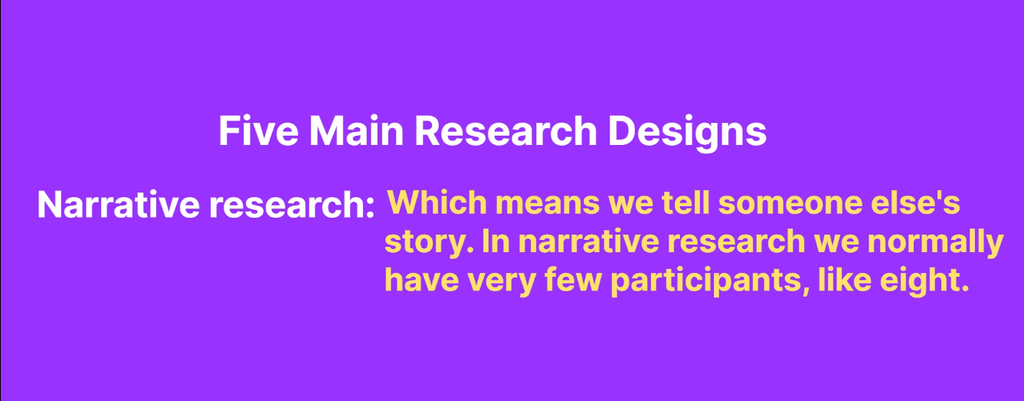
- Narrative research: tells someone’s story. It usually involves very few participants, for example around eight.
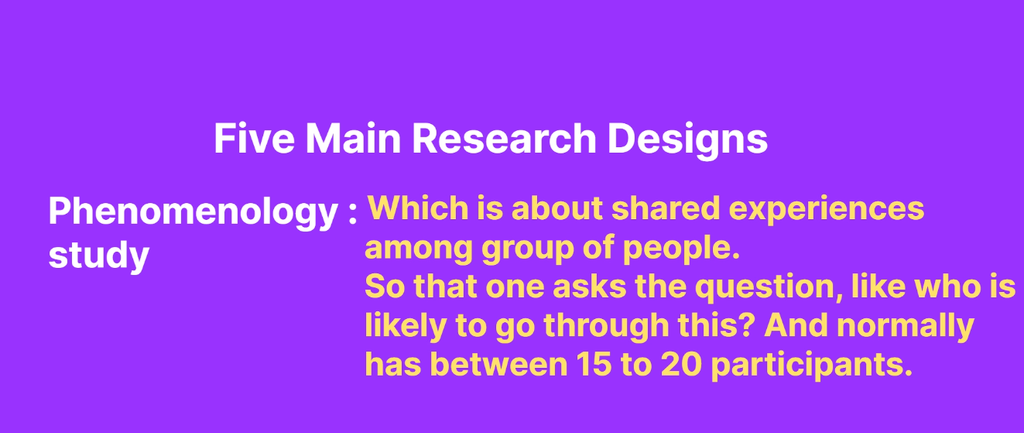
- Phenomenology: explores a shared experience among a group of people, asking what it’s like to go through a particular experience. It typically involves 15 to 20 participants.
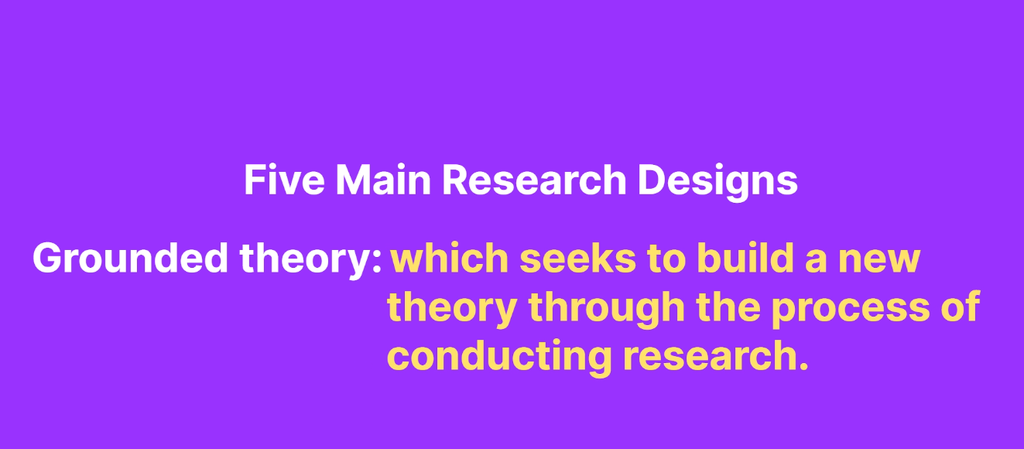
- Grounded theory: builds a new theory through the process of conducting the research.
- Ethnography: requires the researcher to immerse themselves in a group or culture over a long period of time.
- Case study: examines a specific setting, group, or context in depth, such as one school or one organization. This is one of the most common qualitative designs.
For a broader look at how these fit with other options, Scribbr’s guide to research methods offers a useful comparison.
Common mistake: labeling your study incorrectly. A student may call their research a case study because it focuses on one individual, when they’re actually telling that person’s life story. That’s narrative research, not a case study. Your design shapes everything that comes after, so get the label right.

Step 5: Review the Literature
In qualitative research, the literature review isn’t a one-time task; it’s an ongoing conversation. Keep reading as you collect data, and keep returning to the literature to check how your findings relate to what’s already known.

There are two common mistakes here:
- Rigid use of literature: forcing your data to fit your literature review instead of letting it speak.
- Under-preparation: walking into the field without being familiar enough with the literature. Your reading helps you understand what to look for and how to conduct your study effectively.


Phase 2: Getting Into the Field (Steps 6–9)
The second phase of qualitative research design covers who you’ll study, how you’ll protect them, and how you’ll gather and store your data.
Step 6: Sampling and Recruitment
Qualitative research relies on purposeful (purposive) sampling: deliberately choosing people who can give you rich, in-depth answers, rather than trying to represent a whole population statistically. Common strategies include:
- Criterion sampling: recruiting everyone who meets a set criterion, for example nurses with five years of experience working in an ICU.
- Maximum variation sampling: deliberately picking people who are different from one another. If you still see patterns across them, you know your findings are meaningful.
- Snowball sampling: asking participants to refer you to others who would be hard to reach otherwise.

How many participants do you need? The answer is data saturation: the point where new interviews stop giving you new perspectives or information.
There’s no magic number in qualitative research. Once new interviews stop producing new findings, you can stop. I explain how to judge this in my guide on how many interviews you need for qualitative research.
Step 7: Address Research Ethics
Before you contact a single participant, get IRB (ethics) approval from your institution. IRB approval is non-negotiable.
You also need to protect participant confidentiality. Use pseudonyms so you never reveal participants’ real names in your transcripts, analysis, or write-up.

Step 8: Collect Your Data
The main qualitative data collection methods are:
- Interviews: use a semi-structured guide with open questions, let participants do most of the talking, and record what they say. For sample open-ended questions, see my qualitative research questionnaire examples.
- Observations: watching and recording behavior in its natural setting.
- Focus groups: guided discussions with a small group of participants.
- Secondary documents: existing materials such as reports, policies, or records.
Step 9: Transcribe and Store Your Data Securely
Once you’ve collected your data, transcribe it and store it somewhere secure. Transcription is much easier these days with AI tools such as Otter.ai. Just as important, back up your data so you never risk losing it.

Phase 3: Analyzing Your Qualitative Data (Steps 10–11)
The third phase is where you analyze and code your data, and one of the most common approaches is thematic analysis.
Step 10: Code Your Data Using Thematic Analysis
Thematic analysis is a method for identifying patterns of meaning across qualitative data. It can be done in two main ways, or a combination of both:
- Inductive: you approach the data with an open mind and let codes and themes emerge from it.
- Deductive: you start with themes or a framework before analyzing the data.
- Hybrid: you combine inductive and deductive approaches.

The most widely used inductive approach follows Braun and Clarke’s (2006) six-phase framework for thematic analysis. You can do this with software like NVivo, ATLAS.ti, or MAXQDA. I’ve covered this in depth in my tutorial on thematic analysis of interviews in NVivo, and you can see both approaches side by side in these inductive and deductive thematic analysis examples.
Step 11: Develop and Refine Your Themes
Braun and Clarke’s six steps take you from raw data to finished themes:
- Familiarize yourself with the data.
- Generate initial codes.
- Develop themes from the codes.
- Review and refine the themes.
- Write definitions and descriptions for each theme.
- Write the findings report.
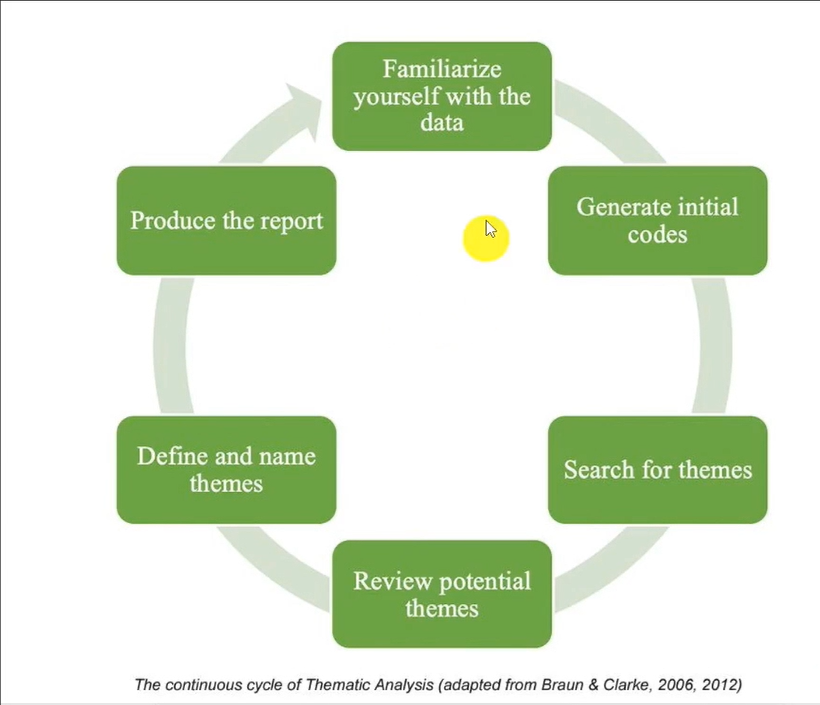
Following these steps completes the analysis phase of your qualitative study.
Phase 4: Writing Up Your Qualitative Study (Steps 12–13)
The final phase of designing a qualitative study is about proving your findings are credible and presenting them clearly.

Step 12: Establish Trustworthiness
Trustworthiness is how qualitative researchers demonstrate that their findings can be trusted. The concept comes from Lincoln and Guba’s (1985) work on naturalistic inquiry, which describes it through criteria such as credibility (your findings reflect participants’ realities), transferability (readers can judge whether findings apply to their own context), and dependability (your process is consistent and traceable). Three practical ways to build it:
- Triangulation: use different forms of data, such as semi-structured interviews, focus groups, and document analysis, to confirm your findings.
- Member checking: after analysis, present your findings to the people you interviewed and confirm your interpretation reflects what they meant.
- Transparency: clearly explain how you analyzed your data and provide evidence.
- Reflexivity: acknowledge how your own background and assumptions may shape your interpretation, especially in interpretivist research.
For more techniques, see my guide to boosting validity in qualitative research.
Step 13: Write Up Your Findings
When you write up your findings after thematic analysis, show the evidence of how you got there. If you followed Braun and Clarke, highlight each step and include evidence from your software, such as NVivo. For example, show a sample of your initial codes and your preliminary themes. That transparency is what convinces examiners your analysis is rigorous.
Frequently Asked Questions
What are the steps in designing a qualitative study?
Designing a qualitative study involves 13 steps across four phases: designing the study (topic, research questions, paradigm, design, literature review), getting into the field (sampling, ethics, data collection, transcription), analyzing the data (coding and theme development), and writing the findings (trustworthiness and write-up).
What are the five main qualitative research designs?
The five main qualitative research designs are narrative research, phenomenology, grounded theory, ethnography, and case study. Each answers a different kind of question, so choose the one that fits your research problem.
How many participants do I need for a qualitative study?
There is no fixed number. Most qualitative researchers sample until data saturation, the point where new interviews stop producing new information. As a rough guide, narrative studies may involve around eight participants, while phenomenological studies often involve 15 to 20.
What research paradigm do most qualitative studies use?
Most qualitative studies use interpretivism, which holds that there is no single truth and that people experience the same phenomenon in different ways. Your methods and claims must stay consistent with that paradigm.
What is the difference between inductive and deductive thematic analysis?
In inductive thematic analysis, themes emerge from the data itself. In deductive thematic analysis, you start with predefined themes or a framework. A hybrid approach combines the two.
Key Takeaways
If you want to design a qualitative study that holds up in your defense, remember these points:
- Qualitative research is a loop, not a straight line: analyze early and let it shape your next steps.
- Narrow your topic until it points at a specific research gap.
- Use qualitative verbs (explore, understand, describe) in your research questions.
- Make sure your paradigm, design, and claims all align.
- Sample purposefully and stop at data saturation.
- Build trustworthiness through triangulation, member checking, and transparency.
Get Expert Help With Your Qualitative Data Analysis
Whether you’re still learning how to design a qualitative study or you’re stuck on your data analysis chapter, don’t stress. I’m here to help.
- Done-for-you qualitative data analysis: I handle the heavy lifting with careful manual coding, theme development, data visualization, a findings report ready for your thesis or dissertation, and a walkthrough video showing exactly how I analyzed your data in NVivo.
- One-on-one NVivo consulting: we hop on a Zoom or Microsoft Teams call, and in just a few hours I’ll help you become confident using NVivo for your own analysis.