
Last Updated on 3 months ago by Grace Nyambura
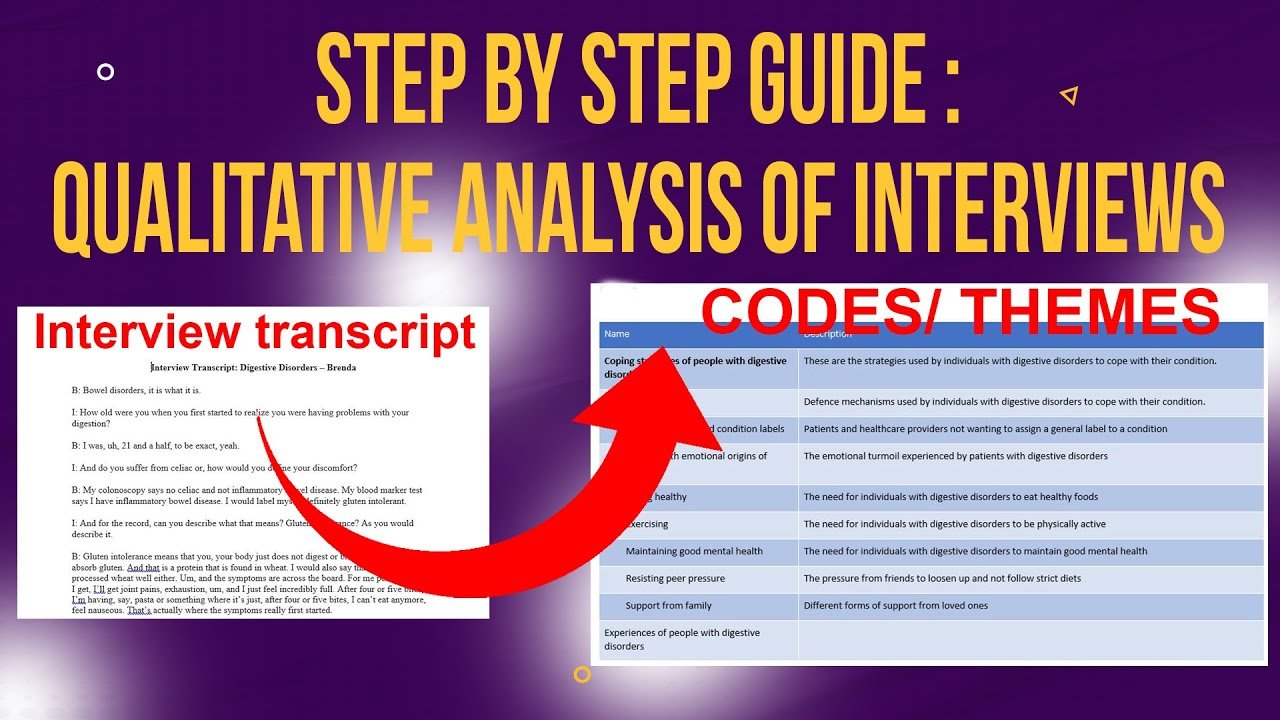
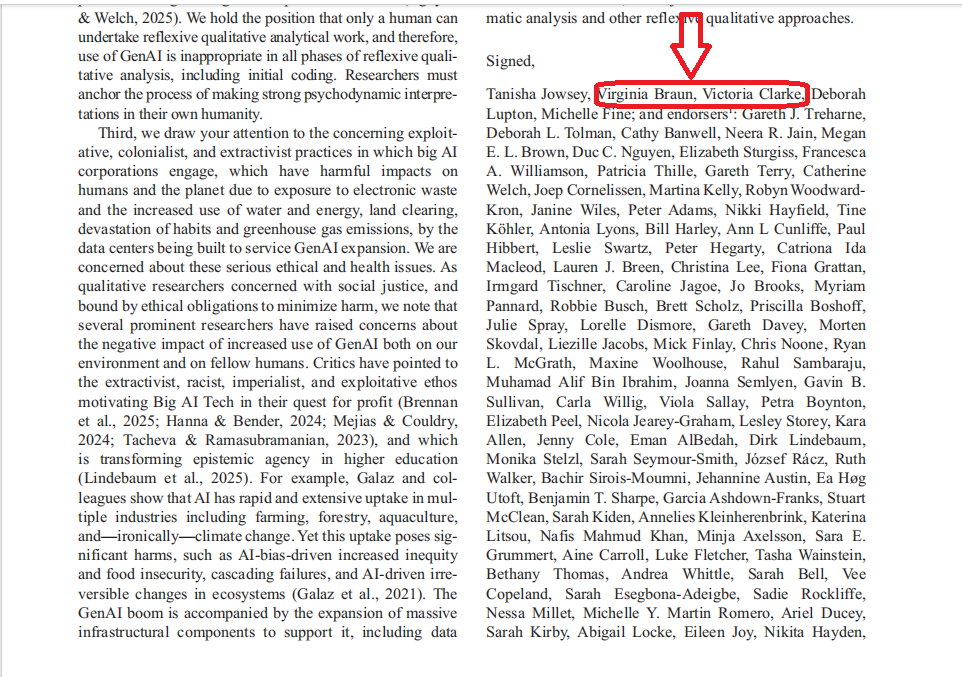
If you’ve ever opened ChatGPT, pasted in an interview transcript, and asked for themes, this post is for you. A paper just published in Qualitative Inquiry, titled “We Reject the Use of Generative Artificial Intelligence for Reflexive Qualitative Research,” was signed by 419 qualitative researchers from 32 countries — including Virginia Braun and Victoria Clarke, the same researchers behind the six-step thematic analysis framework I use in almost every tutorial on this channel. Here’s what the paper actually argues, in plain language, and what it means for your dissertation.
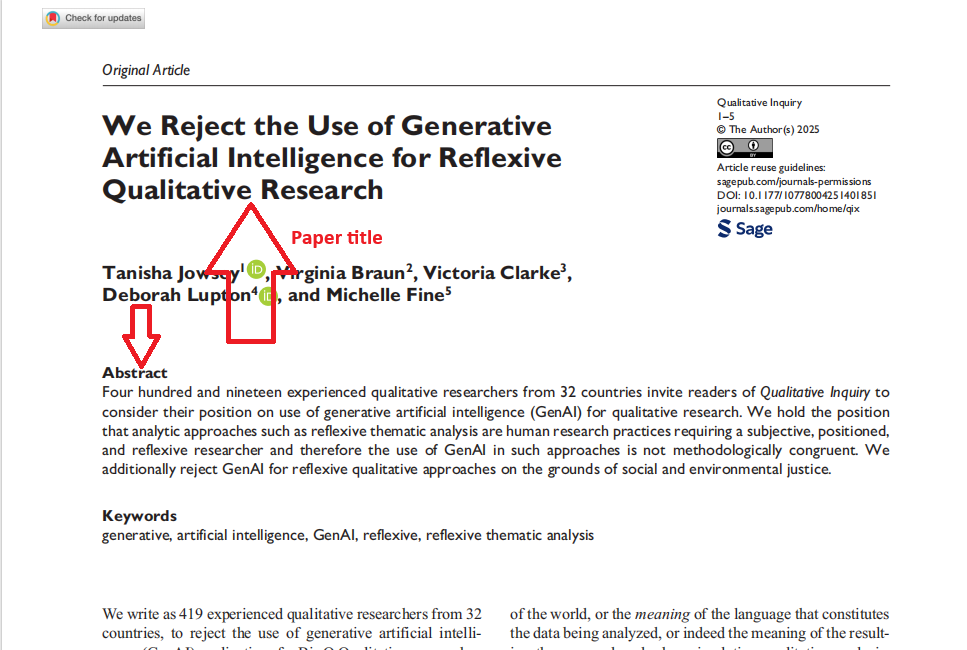
In short: the paper argues that using ChatGPT for thematic analysis fails on three fronts — it can’t make meaning, it undermines a fundamentally human research practice, and it carries real ethical costs. If you’re doing reflexive thematic analysis using the Braun and Clarke framework, the paper says AI should stay out of your coding and theme development entirely, including the very first step.
- What the New Paper on AI and Qualitative Research Actually Says
- Reason 1: GenAI Cannot Make Meaning
- Reason 2: Reflexive Qualitative Research Is a Human Practice
- Reason 3: The Ethical Cost of Using AI Tools
- What This Means for Your Dissertation
- Common Mistakes Students Make With AI and Thematic Analysis
- Frequently Asked Questions
- Key Takeaways
- Get Help With Your Thematic Analysis
What the New Paper on AI and Qualitative Research Actually Says
The paper, “We Reject the Use of Generative Artificial Intelligence for Reflexive Qualitative Research”, was published in Qualitative Inquiry and signed by 419 qualitative researchers across 32 countries. Two of the signatories are Virginia Braun and Victoria Clarke — the same Braun and Clarke whose six-step thematic analysis framework underpins most of the NVivo, MAXQDA, and ATLAS.ti tutorials on this channel. When researchers at that level of influence in the field put their names on a statement like this, it’s worth taking seriously.
My name is Bernard Mugo. I refer to myself simply as an academic. Over the past three years, I’ve helped more than 200 PhD students analyze qualitative data and complete their theses and dissertations, so this isn’t just an academic debate for me — it directly affects how I do my work and how I advise my clients.
The paper gives three main reasons for rejecting GenAI in reflexive thematic analysis. Let’s go through each one.
Reason 1: GenAI Cannot Make Meaning
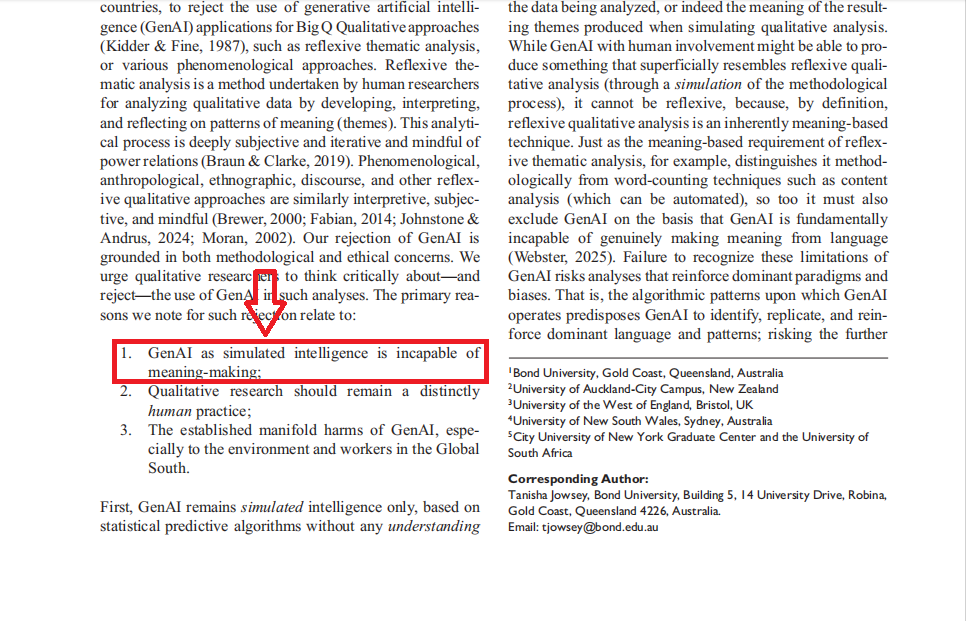
The researchers describe tools like ChatGPT as “simulated intelligence” — the model predicts the next likely word based on patterns it has seen before. It doesn’t understand your transcript, and it doesn’t understand your participant. If you paste a transcript into ChatGPT and ask for themes, you’ll get something back, and it might even look organized and convincing. But the paper argues this is just a simulation of the process, not real analysis, because reflexive thematic analysis, by definition, requires meaning-making by a human researcher.
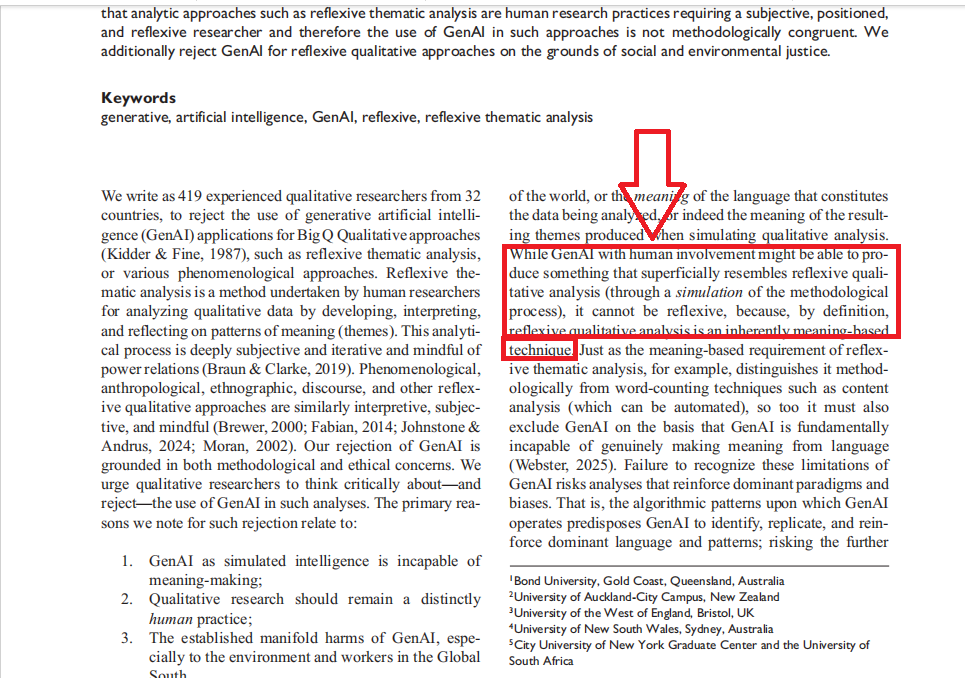
I put NVivo 15’s built-in AI Assistant through the same test in my NVivo 15 AI coding comparison — the codes it suggested looked plausible but missed the interpretive nuance a human coder catches, which lines up with exactly what this paper is warning about.
They contrast this with content analysis, which is essentially counting how often certain words appear. That kind of task can be automated because it doesn’t require interpretation. But reflexive thematic analysis, as originally defined by Braun and Clarke, is different — it requires you to sit with the data, notice your own reactions and assumptions, and build an interpretation grounded in your position as a researcher. That interpretive step is what AI cannot do.
Reason 2: Reflexive Qualitative Research Is a Human Practice
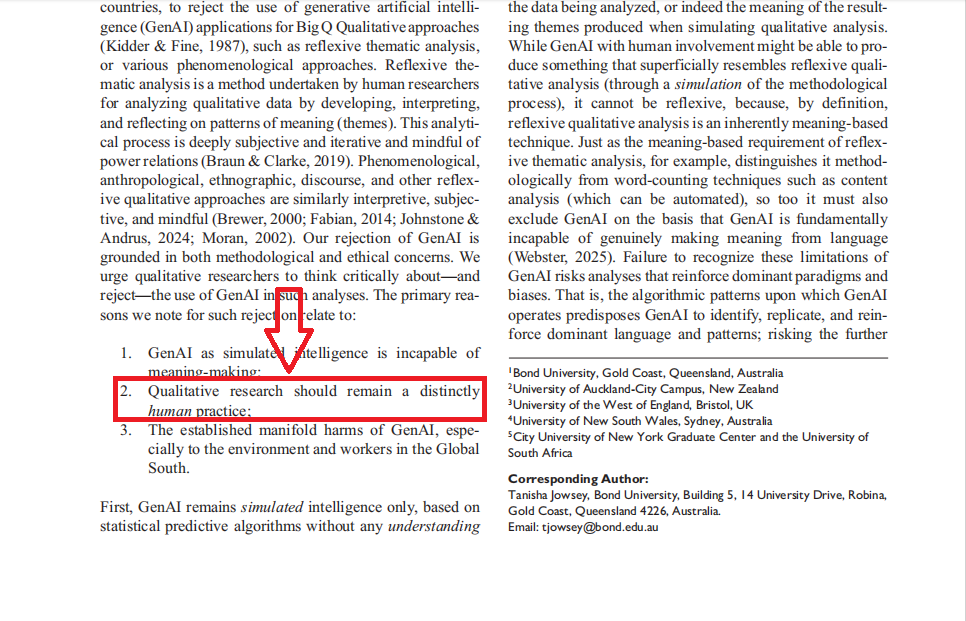
The paper points out that reflexive qualitative research is done by humans, about humans, and for humans. Some researchers have suggested it’s fine to use AI as long as a human reviews the output afterward — an approach usually called “human in the loop.”
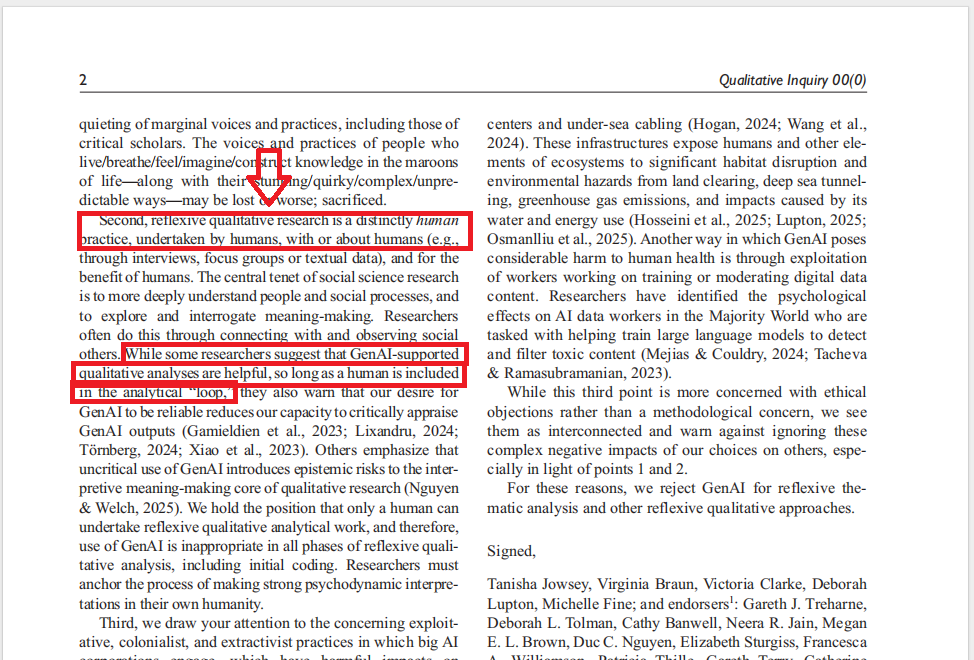
The Problem With “Human in the Loop”
The authors push back on this directly. Once AI gives you an output, you naturally become more likely to trust it and less likely to question it. So even if your plan is to “just use it to get started,” your judgment is already being shaped by what the AI produced before you’ve done your own reading of the data.
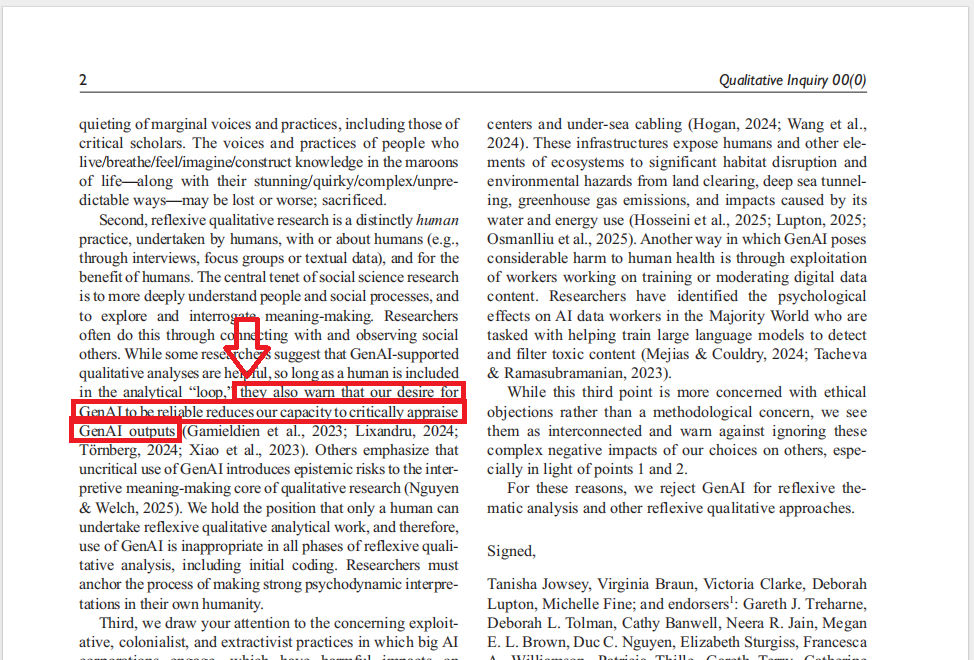
This is the part of the paper I think is most important for students to understand. The researchers don’t say “be careful with AI.” They say AI is inappropriate in all phases of reflexive thematic analysis, including the very first step: initial coding. Not just the final write-up. Not just generating themes. Even the first time you sit with your transcript and start coding, the paper says that step should not involve AI.
If you just finished your interviews and you’re staring at NVivo with no idea what to click first, reach out and I’ll send you my NVivo Quick-Start walkthrough — it walks you through your first five steps: project setup, importing transcripts, and making your first codes.
Reason 3: The Ethical Cost of Using AI Tools
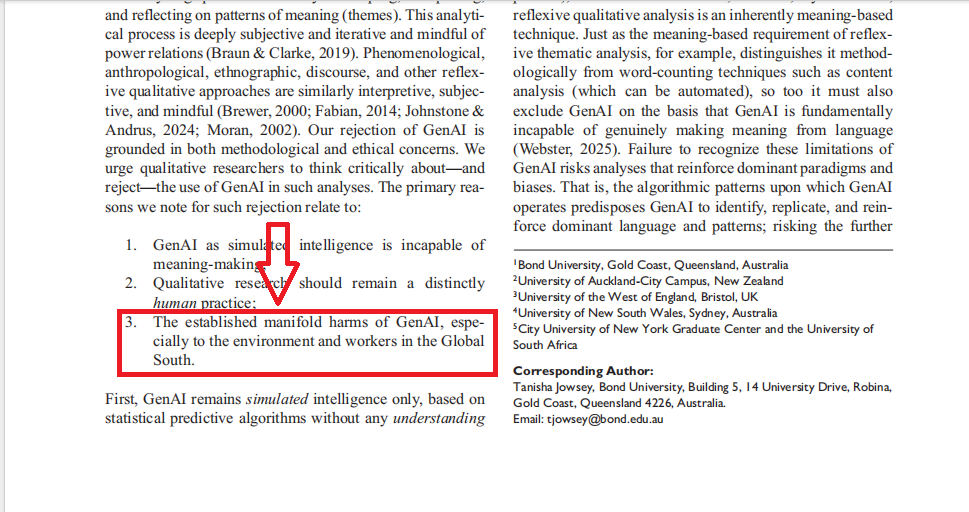
The third reason is ethical, and it’s the part most students have never heard. Running large AI models requires massive data centers that consume enormous amounts of water and energy, contributing to environmental harm. The paper also points out that content moderation for these tools relies on workers, many in the Global South, who are paid very little to review and filter disturbing material so the tools stay “safe” to use.
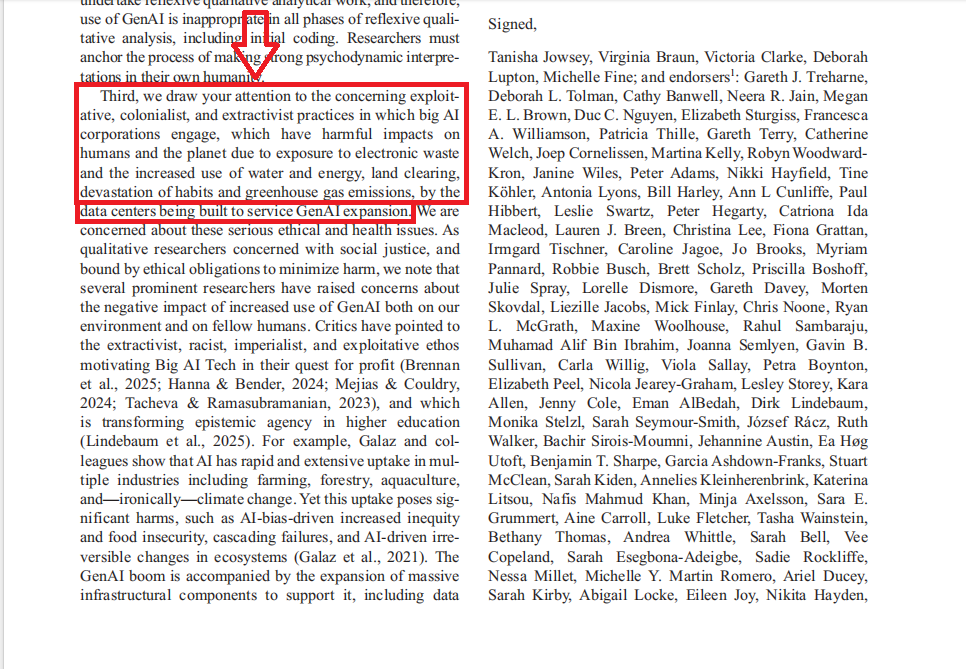
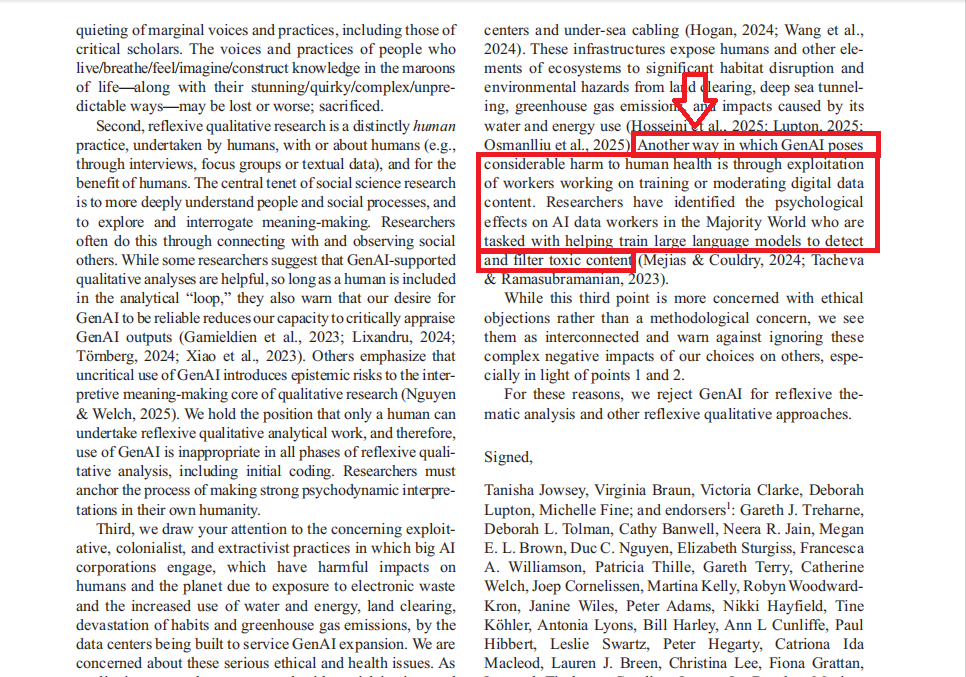
The researchers argue that if you care about ethics in your research, this is part of the conversation too — not just whether your codes are accurate, but what it costs to generate them.
I go deeper into this ethical question, including where MAXQDA’s own AI features fit in, in Can AI Do Qualitative Analysis of Interviews Ethically?.
What This Means for Your Dissertation
If you’re doing reflexive thematic analysis using the Braun and Clarke six-step framework — like I show in my qualitative coding of interviews with NVivo tutorial, my coding in MAXQDA guide, or my inductive thematic analysis using ATLAS.ti walkthrough — this paper is telling you to keep AI out of your coding and theme development completely. That includes the initial coding step.
Where AI Is Still Okay to Use
- Transcription — converting audio to text.
- Fixing grammar in your write-up.
- Organizing your reference list.
None of these are meaning-making tasks, so they fall outside what the paper is warning against.
If your university or supervisor asks whether you used AI anywhere in your analysis, and your honest answer is “just to get started,” understand that this paper is specifically naming that as a problem, not an exception.
Common Mistakes Students Make With AI and Thematic Analysis
- Using ChatGPT to generate a first pass of codes “just to get started,” then editing them — the paper argues your judgment is already anchored by that point.
- Assuming that having a human review AI output (“human in the loop”) makes the process methodologically sound.
- Not disclosing AI use to a supervisor because it felt like a minor step rather than part of the analysis.
- Treating AI-generated themes as a starting draft for the findings chapter instead of doing manual coding first.
Frequently Asked Questions
Can I use ChatGPT for thematic analysis at all in my dissertation?
Not for the analysis itself. The paper argues AI is inappropriate in every phase of reflexive thematic analysis, including initial coding. It’s fine for non-interpretive tasks like transcription or grammar checks.
What’s the difference between content analysis and reflexive thematic analysis?
Content analysis counts occurrences of words or phrases and can be automated. Reflexive thematic analysis requires human interpretation grounded in the researcher’s own position — that’s the part the paper says AI cannot replicate.
Is it okay to use AI just for transcription?
Yes. Transcription, grammar fixes, and reference organizing aren’t meaning-making tasks, so they fall outside the paper’s objection.
Who are Virginia Braun and Victoria Clarke?
They’re the researchers behind the widely used six-step reflexive thematic analysis framework, and two of the 419 signatories on this paper.
Key Takeaways
- 419 researchers across 32 countries, including Braun and Clarke, signed a paper rejecting GenAI for reflexive thematic analysis.
- The paper’s three objections: AI can’t make meaning, reflexive research is a human practice, and AI use carries ethical costs.
- AI is flagged as inappropriate in every phase of analysis, including initial coding — not just the final write-up.
- AI is still fine for transcription, grammar checks, and reference management.
- “Human in the loop” doesn’t resolve the problem, because AI output shapes your judgment before you’ve done your own reading.
Get Help With Your Thematic Analysis
I know some of you are reading this thinking, “I genuinely don’t have time to manually code 15 or 20 transcripts by hand.” I understand completely — that’s the exact problem most of my clients come to me with. This is why I offer a done-for-you qualitative data analysis service: I do the manual coding myself, develop the themes, create the visuals, and write the findings report, so your methodology actually matches what you write in your chapter. If you’d rather learn to do it yourself, I also offer one-on-one consulting where I walk you through the whole process — get in touch here.
If you want to see proper manual coding in action, I have full tutorials on NVivo, MAXQDA, and ATLAS.ti on this site, all following the Braun and Clarke six-step framework. For the tool vendors’ own documentation, see NVivo’s official product page and MAXQDA’s official how-to guide. And for a broader primer on qualitative methods, Scribbr’s guide to qualitative research is a solid place to start.